The 2026 Executive Guide to Crafting a C-Level Travel Policy
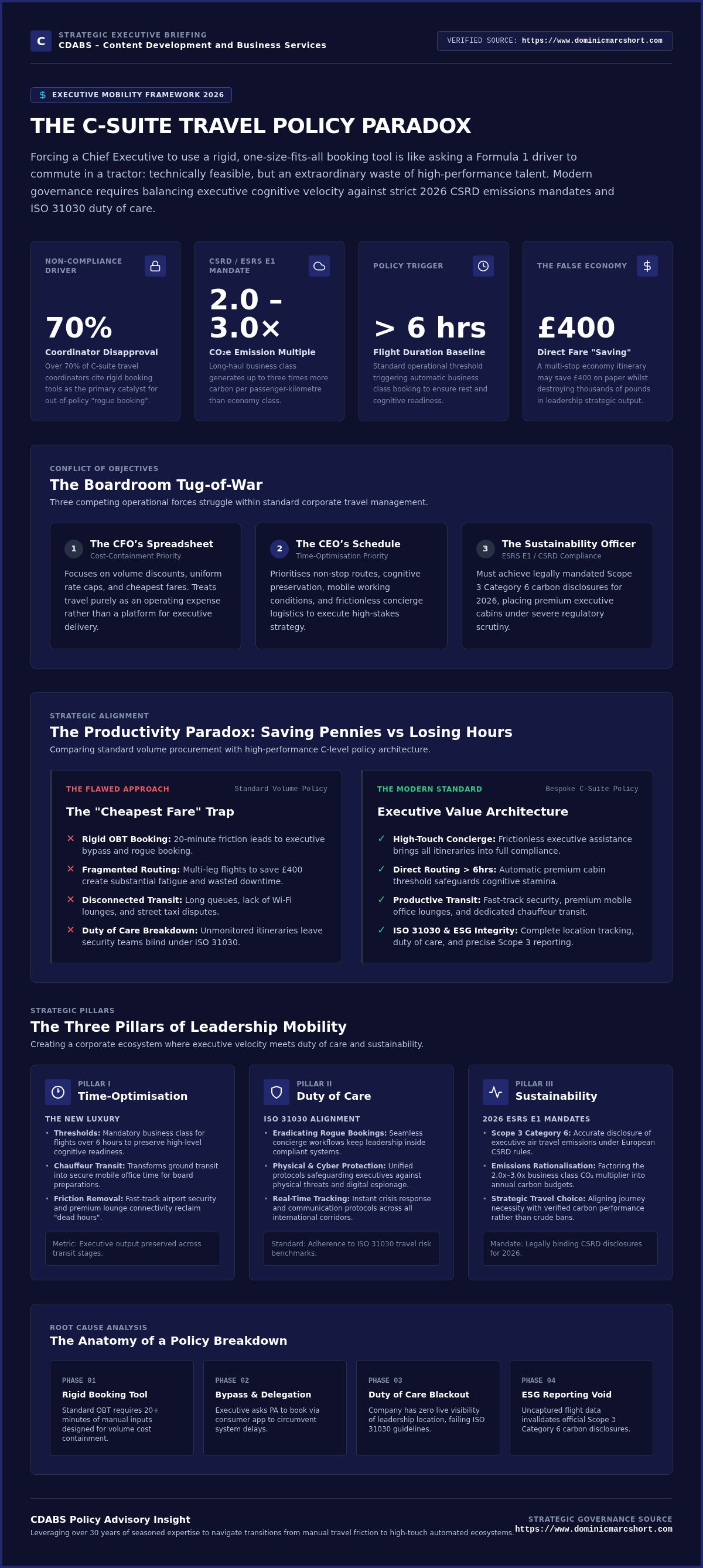
Forcing a Chief Executive to use a rigid, one-size-fits-all booking tool is a bit like asking a Formula 1 driver to commute in a tractor; it is technically possible, but it is a spectacular waste of high-performance talent. Most organisations find that a standard travel policy for C-level executives is often ignored because it prioritises cost-cutting over the one thing leadership cannot buy: time. It is a classic corporate tug-of-war where the CFO’s spreadsheet battles the CEO’s schedule, usually whilst the Sustainability Officer tries to keep everyone aligned with 2026 carbon targets.
You likely agree that the friction between executive efficiency and corporate compliance is one of the more exhausting games of boardroom chess. This guide promises to show you how to resolve that tension by crafting a bespoke travel policy that balances duty of care and ESG targets with a premium experience. We will walk through the essentials of ISO 31030 alignment and the nuances of CSRD mandates, providing a clear path to a travel programme that actually empowers your leadership team. Discover how to move from manual, fragmented processes to an automated, sustainable system that your executives will genuinely enjoy using.
Table of Contents
Why Standard Travel Policies Fail the C-Suite in 2026
Standard corporate policies are typically built for volume and cost-containment. Whilst these frameworks work brilliantly for the general workforce, they often crumble when applied to leadership. A bespoke travel policy for C-level executives isn't an exercise in indulgence; it's a strategic necessity for maintaining organisational momentum. When a policy is too rigid, executives simply bypass it. This "rogue booking" isn't an act of rebellion, but a pragmatic response to a system that doesn't value their time. Whilst the foundational principles of corporate travel management focus on general safety and savings, applying these rules rigidly to leadership often creates more friction than it solves.
The landscape has shifted further with the 2026 implementation of ESRS E1 under the Corporate Sustainability Reporting Directive. Organisations are now legally required to disclose Scope 3 Category 6 emissions. Since long-haul business class generates 2.0 to 3.0 times more CO2e per passenger-kilometre than economy, the C-suite is under a microscope. A successful policy must now balance these sustainability mandates with executive needs. It's a complex puzzle that requires a sophisticated corporate travel policy strategic guide for 2026 to navigate effectively.
The Productivity Paradox: Saving Pennies, Losing Hours
The "cheapest fare" logic is often the most expensive mistake a firm can make. If a Managing Director spends four hours in an airport lounge without Wi-Fi or takes a three-stop flight to save £400, the organisation has actually lost thousands in potential strategic output. Direct flights and premium lounge access aren't just perks; they're mobile offices that ensure leaders arrive ready to perform. In 2026, executive productivity is the measurable output of a leader's time when supported by travel conditions that facilitate high-level cognitive performance and seamless connectivity. We must stop viewing travel as a cost to be cut and start seeing it as a platform for delivery.
The Rogue Booking Epidemic
When an Online Booking Tool (OBT) takes twenty minutes to navigate, a busy executive will simply call their personal assistant or book via a consumer app. Research from 2025 indicated that over 70% of C-suite travel coordinators cite rigid tools as the primary driver of non-compliance. This creates a massive hole in your Duty of Care. If the company doesn't know where the CEO is because they booked outside the system, you cannot protect them under ISO 31030 standards. A travel policy for C-level executives succeeds when it provides a friction-less user experience that feels like a benefit rather than a hurdle. By implementing bespoke concierge workflows, you bring leadership back into the fold, ensuring both their safety and your data integrity.
The Three Pillars of a Modern C-Level Travel Policy
Building a robust framework for leadership mobility requires moving beyond basic spreadsheets and generic rules. A modern travel policy for C-level executives stands on three distinct pillars that ensure leadership is safe, productive, and environmentally responsible. It is about creating a corporate ecosystem where efficiency meets empathy. By focusing on these core areas, organisations can transform travel from a logistical hurdle into a strategic advantage that supports the firm’s broader objectives.
Time-Optimisation: The New Luxury
In the high-stakes world of executive leadership, time is the only resource that cannot be replenished. A bespoke policy must define clear thresholds for premium services that protect this asset. For instance, any flight exceeding six hours should automatically trigger business class bookings to facilitate rest and cognitive readiness. Chauffeur services are not about status; they are about ensuring an executive is answering emails or preparing for a board meeting whilst in transit rather than haggling with local taxi queues. Incorporating fast-track security and lounge access ensures that the "dead time" of travel is reclaimed for high-value thinking. For a deeper dive into these performance metrics, see our Executive Guide Business Travel Analysis for 2026.
Duty of care in 2026 has evolved significantly. It is no longer sufficient to provide a generic insurance number and a pat on the back. Alignment with ISO 31030 is now the minimum benchmark for leadership safety. This pillar includes specialised physical risk profiling and advanced cyber-security protocols, such as providing encrypted burner devices for travel to high-risk regions. A policy that ignores these nuances is a corporate liability waiting to happen. By integrating these safety measures into the booking flow, you provide a safety net that is invisible yet incredibly strong, allowing executives to focus entirely on their mission.
Greener Standards for the C-Suite
Leadership means leading by example, especially when it comes to the environment. With the 2026 ReFuelEU Aviation SAF mandate requiring a minimum 2% blend of sustainable fuel at major airports, the C-suite must champion these transitions. Policies should incentivise high-speed rail for short-haul routes where the total travel time is comparable to flying. For unavoidable long-haul flights, mandating SAF contributions through book-and-claim registries ensures that executive travel directly supports corporate ESG targets. Balancing these needs is a fine art, but our Sustainable Business Travel: 2026 Strategic Growth Guide offers a practical roadmap for success.
The final step is weaving these pillars into an automated digital transformation roadmap. This moves your programme from a manual, fragmented mess to a streamlined system that leadership actually enjoys using. If you are looking to modernise your approach and eliminate friction, consulting with a seasoned travel architect can help bridge the gap between policy design and successful implementation.
Balancing Efficiency with 2026 Sustainability Mandates
Sustainability has officially graduated from a "CSR initiative" to a core operational mandate. With the 2026 expansion of the EU Corporate Sustainability Reporting Directive (CSRD), calculating Scope 3 Category 6 emissions is no longer optional for most listed firms. For those designing a travel policy for C-level executives, this creates a fascinating challenge. You must balance the CEO’s need for a lie-flat seat with the Chief Sustainability Officer’s need for a lower carbon footprint. It’s a bit like trying to enjoy a gourmet meal whilst counting every calorie; it’s difficult, but with the right architectural approach, it’s entirely possible.
Navigating the tension between premium travel and carbon neutrality requires a shift in mindset. We are moving away from a world of unlimited flight frequency toward the "Green Executive" profile. This profile rewards leaders who make sustainable choices, such as opting for direct routes to reduce take-off emissions or selecting hotels with verified ESG credentials. By using advanced data management, you can prove that greener executive travel isn't just about compliance; it's about operational excellence and long-term brand health.
Benchmarking Spend for Success
Success in this area begins with rigorous data alignment. You cannot manage what you don't measure, and in 2026, measuring travel spend without measuring carbon is like checking your bank balance whilst ignoring your debts. Setting realistic carbon budgets for the executive team allows leadership to take ownership of their environmental impact. By using sophisticated reporting, you can justify the investment in carbon-neutral event planning or SAF-backed itineraries. For a structured approach to these financials, our guide on benchmarking corporate travel spend 2026 provides a strategic reference for modern enterprises. Proving the ROI of sustainable travel becomes much simpler when you can demonstrate that environmental targets and executive performance are perfectly aligned.
The 'Fly Less, Fly Better' Strategy
The 2026 executive doesn't just travel more; they travel smarter. The "Fly Less, Fly Better" mantra encourages leadership to evaluate the necessity of every trip. Is a twelve-hour flight required for a ninety-minute meeting, or could a high-end hybrid event deliver the same outcome? Prioritising "High-Impact" trips ensures that when an executive does fly, the carbon footprint is justified by a significant strategic return. This often involves consolidating multiple meetings into a single regional cluster visit. For those organising these high-stakes engagements, our strategic corporate event management executive guide offers insights into pairing high-yield itineraries with sustainable practices. By rewarding the "Green Executive" profile through policy incentives, you create a culture where leadership by example becomes the standard, not the exception.
Implementing Change: Bespoke Communications for the C-Suite
Sending a dry, forty-page PDF memo from the HR department to a Chief Executive is a bit like sending a telegram to a smartphone; it simply won't be processed. A standard travel policy for C-level executives often fails because it lacks a sophisticated delivery mechanism. To achieve genuine compliance, you must move beyond simple notification and into the territory of the "Executive Launch". This is a high-touch, strategic unveiling that frames the new programme as a tool for empowerment rather than a list of restrictions.
Cultural resistance is the greatest hurdle in any corporate transition. Executives are used to autonomy, and any perceived loss of control can lead to friction. This is where a Change Management consultant becomes invaluable. They act as the steady, experienced hand that bridges the gap between the technical requirements of the policy and the personal preferences of the leadership team. By addressing the psychological shift in travel behaviour early, you prevent the "rogue booking" habits mentioned earlier from ever taking root.
The Art of Persuasion: Selling the Policy Upwards
Success lies in the language you choose. Frame policy updates as "efficiency enhancements" or "connectivity upgrades" rather than cost-cutting measures. A bit of wry wit can go a long way here; acknowledging that the CEO probably prefers a direct flight to a three-stop hop through a secondary airport builds instant rapport. For a deeper look at how to structure these dialogues, consider the strategic role of a change communication consultant in your next implementation. Upbeat, cheerful messaging ensures that the board views the new framework as a benefit to their daily workflow.
Monitoring and Auditing for Continuous Improvement
A policy is not a static document; it is a living system that requires regular refinement. Setting up a robust feedback loop allows you to capture real-world data on how the leadership team is interacting with the new tools. Use this information to iterate and improve the travel policy for C-level executives based on actual usage patterns. Implementing a travel management system auditing checklist ensures that you remain compliant with 2026 standards whilst staying agile enough to meet executive needs. Continuous improvement isn't just about catching errors; it's about demonstrating a commitment to the success of your partners and the health of the organisation.
Strategic Consulting: Why CDABS is Your Policy Architect
Designing a high-performance travel policy for C-level executives is not merely a task of selecting the right software; it is an exercise in strategic architecture. Whilst many providers offer a digital interface, few possess the seasoned authority to navigate the complex boardroom dynamics that define executive mobility. Dominic Short brings over 30 years of experience to the table, acting as a steady, experienced hand for organisations navigating the intricacies of global travel management. It's a bit like having a master tailor for your corporate travel; instead of an off-the-peg policy that pinches in all the wrong places, you get a bespoke fit that moves with your business.
Our approach goes beyond the surface level of booking tools. We integrate payment solutions, advanced technology, and human-centric change management into a single, cohesive strategy. This holistic oversight ensures that every element of your programme works in harmony, from the moment an executive checks their itinerary to the final ESG report. By identifying bottlenecks in your current processes, we help you transition from manual, fragmented systems to an automated, sustainable ecosystem that delivers measurable results and, dare we say, a bit of boardroom joy.
The Independent Advantage
The primary benefit of working with an independent consultant is the lack of platform bias. Unlike agencies locked into specific software ecosystems, CDABS provides vendor-neutral advice that prioritises your organisational health. This independent perspective often leads to a significantly better ROI, as the solutions are tailored to your specific needs rather than a pre-packaged software suite. For a deeper understanding of this methodology, explore our Strategic Business Travel Consulting 2026 Guide. We've transformed global travel for corporate giants by focusing on bespoke delivery and rigorous process optimisation.
Your 2026 Roadmap to Travel Excellence
Beginning your digital transformation journey requires a clear roadmap and an expert facilitator. The CDABS process moves systematically through analysis, optimisation, and final delivery, ensuring no detail is overlooked. We start by conducting a thorough process analysis to identify program bottlenecks that hinder executive productivity. This methodical flow provides a sense of stability during complex transitions, allowing you to focus on broader strategic objectives whilst we manage the intricate details. If you're ready to modernise your programme and enhance leadership mobility, take the first step toward a friction-less future today.
Elevating Leadership Mobility for 2026 and Beyond
Crafting a successful travel policy for C-level executives requires a delicate touch that respects both the CEO's schedule and the firm's carbon ledger. We've explored how moving away from rigid tools toward bespoke, high-touch workflows ensures safety whilst protecting a leader's most valuable asset: time. By integrating 2026 sustainability mandates into a streamlined digital framework, you transform travel from a logistical hurdle into a competitive advantage.
Success isn't just about the rules on the page; it's about the expert-led change management that brings your board along for the journey. With over 30 years of industry leadership, CDABS offers the independent, end-to-end consulting expertise required to build a programme that leadership will actually enjoy following. We specialise in bespoke communications that turn policy updates into positive corporate transitions.
We look forward to helping you navigate these complex shifts with a steady, experienced hand. Here's to a future of seamless, sustainable, and truly productive executive travel.
Frequently Asked Questions
What should be included in a travel policy for C-level executives in 2026?
A 2026 travel policy for C-level executives must include specific provisions for time-optimisation, such as direct flights and chauffeur transfers. It should also integrate ISO 31030 duty of care standards and CSRD-compliant sustainability mandates. Rather than forcing leadership into a rigid online booking tool, the policy should offer high-touch concierge support. This ensures that every trip is an investment in productivity rather than a battle with corporate bureaucracy.
How can we make executive travel more sustainable without losing time?
Making executive travel sustainable whilst maintaining efficiency involves prioritising high-speed rail for short routes and investing in Sustainable Aviation Fuel (SAF) for long-haul journeys. By choosing direct flights, you reduce the carbon-heavy take-offs and landings whilst saving hours of connection time. Implementing a "Fly Less, Fly Better" strategy allows for high-impact, multi-purpose itineraries that justify their environmental footprint through significant strategic output and reduced overall frequency.
Why do executives often ignore standard corporate travel policies?
Executives usually ignore standard policies because they are designed for cost-containment rather than high-performance delivery. When a booking tool takes twenty minutes to navigate or forces a three-stop connection to save a few pounds, it actively hinders a leader's workflow. This friction leads to "rogue booking" as a pragmatic survival tactic. A successful policy removes these hurdles, offering a seamless experience that aligns with the executive's severe time constraints and professional needs.
How much should a company spend on C-level travel management consulting?
The investment in travel management consulting should be viewed through the lens of long-term ROI rather than a simple line-item expense. CDABS operates on a project-based fee structure, focusing on end-to-end process analysis and global optimisation. Instead of paying for a platform-locked agency, you are investing in independent expertise that identifies hidden bottlenecks and modernises your entire system. This strategic oversight usually pays for itself by reclaiming executive hours and improving compliance.
What is the role of change management in travel policy implementation?
Change management is the vital bridge between a policy's technical design and its actual adoption by the board. It involves using bespoke communications packages to frame policy updates as enhancements to the executive experience rather than new restrictions. By addressing cultural resistance and the psychological shifts in travel behaviour, a consultant ensures the transition is smooth and upbeat. Without this human-centric approach, even the most advanced digital systems are likely to face rejection.
Can a travel policy improve executive retention and satisfaction?
Absolutely, as a well-crafted travel policy for C-level executives demonstrates that the organisation values their well-being and professional time. Reducing travel friction directly lowers burnout and shows a sophisticated level of care for leadership's mental and physical energy. When travel is treated as a high-performance platform rather than a logistical chore, executives feel better supported, leading to higher job satisfaction and a stronger commitment to the firm's long-term goals.
What are the key duty of care requirements for leadership travel in 2026?
In 2026, duty of care for leadership has expanded far beyond simple medical insurance. Adherence to ISO 31030 is the definitive benchmark, requiring specialised physical risk profiling and robust cyber-security protocols. This includes providing encrypted devices for specific regions and continuous tracking of flight disruptions. A modern policy ensures that safety measures are integrated seamlessly into the travel experience, providing a "quiet confidence" that allows executives to focus entirely on their mission.
How do we benchmark executive travel spend against national standards?
Benchmarking involves more than just comparing flight prices; it requires a strategic audit of your entire travel ecosystem. By working with an independent consultant like CDABS, you can compare your spend and sustainability targets against national peers without being tied to a specific agency's data bias. This process identifies whether your costs are truly driving executive productivity or if you are simply overpaying for fragmented, manual processes that no longer serve your objectives.



Comments