Benchmarking Corporate Travel Spend: A Strategic 2026 Reference for National Enterprises
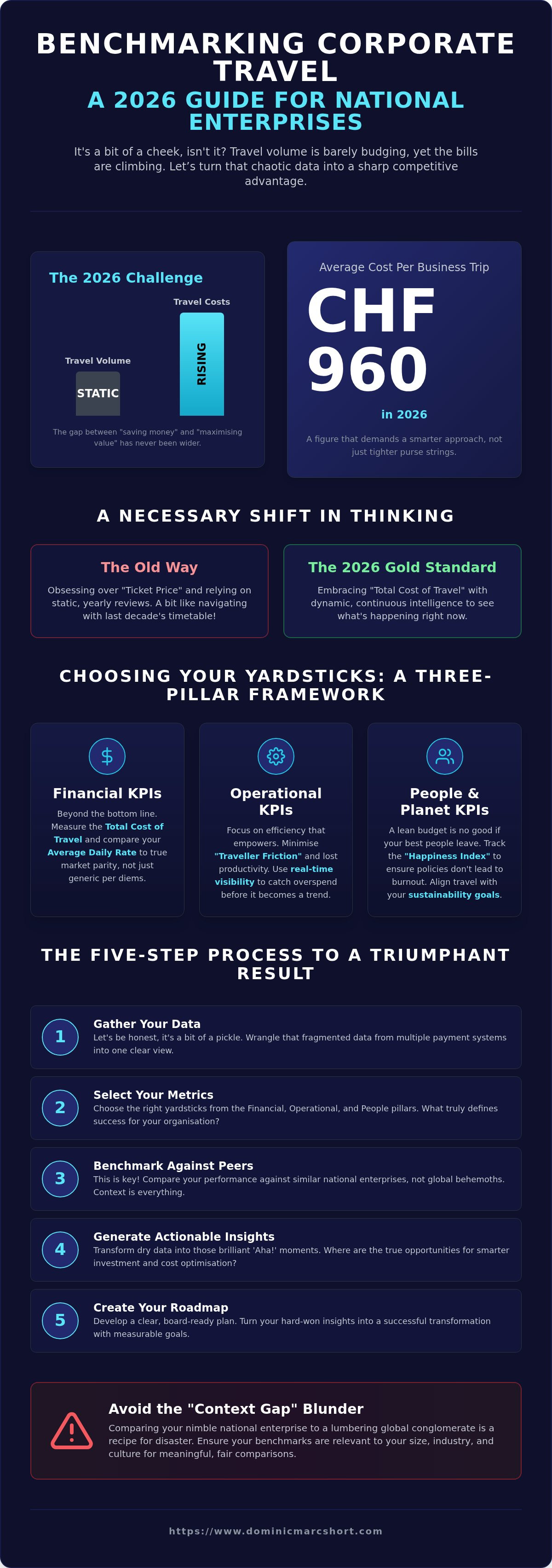
Did you know that the average cost per business trip has leapt to approximately CHF 960 in 2026? It’s a bit of a cheek, really; while travel volume is barely budging, the bills are climbing faster than a local funicular. If you feel like you're throwing money at aeroplanes without a clear view of the return, you aren't alone. Effectively benchmarking corporate travel spend has moved from a "nice-to-have" exercise to a vital survival skill for national enterprises navigating this high-cost environment.
We understand the headache of trying to reconcile fragmented data from multiple payment systems while keeping your frequent travellers smiling. It’s a delicate balancing act to trim costs without losing the "happiness factor" on the road. This article promises to help you transform that chaotic data into a sharp competitive advantage through seasoned benchmarking and strategic optimisation. We will provide a methodical framework for measuring success and actionable insights that will make your next board presentation a total triumph.
Table of Contents
The Strategic Importance of Benchmarking Corporate Travel Spend
For a national enterprise, benchmarking corporate travel spend acts as a pulse check for organisational health rather than just a blunt instrument for cost-cutting. Modern Corporate travel management has evolved far beyond simply haggling over airfares; it’s now a sophisticated exercise in balancing fiscal responsibility with the growth of the business. In 2026, the challenge isn’t just about spending less. It’s about ensuring every Swiss Franc (CHF) allocated to travel is actually working for you. With global expenditure hitting record highs, the gap between "saving money" and "maximising value" has never been wider.
We often see firms fall into the trap of looking purely at the price tag of a ticket. However, a cheaper flight that requires multiple connections and a lengthy layover creates "traveller friction" that can lead to burnout and lost productivity. To truly understand your position, you might find our executive guide to business travel analysis a helpful companion to this section. True efficiency comes from identifying where investment drives revenue without exhausting your most valuable assets: your people.
Why Static Data is a Bit of a Pickle
Relying on a yearly review in a market as fast-moving as ours is a bit like trying to navigate a complex national transport network with a timetable from the previous decade. Outdated benchmarks fail to account for sudden shifts in supplier pricing or national demand. We are seeing a major shift toward continuous intelligence in travel procurement, where data is updated and analysed in real-time. Dynamic benchmarking is the new gold standard for 2026, providing the agility needed to pivot when market conditions change. This approach moves you away from "what happened last year" to "what is happening right now."
Real-time visibility: Catching overspend before it becomes a trend.
Agile procurement: Adjusting accommodation caps based on current market rates.
Proactive policy: Updating guidelines before traveller frustration peaks.
Aligning Benchmarks with Corporate Culture
A one-size-fits-all benchmark is a recipe for a rather grumpy workforce. If your company culture thrives on face-to-face relationship building, forcing everyone into a restrictive, low-cost policy will likely backfire. The trick is to balance executive expectations for a lean budget with the practical needs of the travellers on the ground. This is where independent consulting proves its worth. An external, experienced hand can look at your data objectively, helping you find that delicate sweet spot where financial efficiency meets a happy, productive team. Without this alignment, benchmarking corporate travel spend becomes a hollow exercise that ignores the human element of business.
Choosing Your Metrics: What to Measure in 2026
Selecting the right yardsticks for 2026 is about more than just staring at a spreadsheet until your eyes water. To get the full picture, we must categorise metrics into three distinct buckets: Financial, Operational, and Sustainable. It’s a bit of a juggle, but essential for clarity. One of the biggest shifts we've seen is the move away from obsessing over the "Ticket Price" in favour of the "Total Cost of Travel". While a flight might look like a bargain at CHF 200, once you add in baggage fees, airport transfers, and the time lost to a poorly timed departure, the true cost often balloons. The global average cost per business trip has climbed to roughly CHF 975 in 2026. If you're only looking at the airfare, you're missing a huge chunk of the story. By benchmarking corporate travel spend through this wider lens, you gain a much clearer view of where your investment is actually going.
We also shouldn't overlook the "Happiness Index". In a competitive national labour market, retaining top talent is paramount. If your travel policy is so restrictive that it leaves your team exhausted, you'll pay for it in turnover costs rather than travel expenses. It’s a delicate balance that requires a steady hand to manage effectively.
Financial KPIs: Beyond the Bottom Line
When tracking Financial KPIs, look at your Average Daily Rate (ADR) compared to market parity. While many firms use GSA per diem rates as a foundational starting point, national enterprises need to adjust these for the specific economic realities of our major business hubs. Don't forget the hidden costs of manual expense processing. Every hour your team spends wrestling with receipts is an hour not spent on high-value work. Implementing optimised payment solutions can significantly sharpen your benchmarking accuracy by providing cleaner, structured data from the start.
Sustainable Benchmarking: The 2026 Mandate
Sustainability has officially graduated from a "nice-to-have" to a core business mandate. With 85% of travel managers now required to report on carbon emissions, you need to benchmark CO2 per traveller or department. Comparing your green initiatives against national industry standards isn't just about optics; it’s about future-proofing your programme. For a deeper dive into this, our Sustainable Business Travel Guide offers a comprehensive look at balancing growth with environmental responsibility. If you're feeling a bit overwhelmed by these new requirements, having a chat with an expert can help simplify the transition.
The Benchmarking Process: From Data to Insight
Turning a mountain of raw receipts into a strategic narrative requires more than just a fancy spreadsheet; it demands a methodical, five-step process. In my 30 years of industry experience, I've seen many enterprises struggle because they treat data like a static report rather than a living roadmap. The goal is to move from simply asking "what did we spend?" to understanding "how does this spend drive our national growth?" This transition is vital for any enterprise looking to stay competitive in a high-cost environment where every Swiss Franc (CHF) must be accounted for.
Fragmented data is often the biggest hurdle, especially when information is scattered across various national branches using different payment systems. Centralising this information is the only way to gain a true bird's-eye view of your programme's performance. Without a unified view, you're essentially navigating a complex landscape in a thick fog without a compass.
Step 1 & 2: Data Aggregation and Normalisation
The first step involves pulling data from your ERP, T&E systems, and corporate credit card statements. It’s a bit of a task to ensure you aren't losing your mind in the process, but the results are well worth the effort. Once gathered, you must "clean" the data to ensure you are comparing apples to apples. This means normalising currencies and categorising expenses consistently across all departments. If you find this stage particularly daunting, our Travel Data Management Consulting checklist provides a structured way to audit your current data health before you dive into deeper analysis.
Step 3 to 5: Analysis, Comparison, and Action
Once your data is tidy, the next phase is selecting the right peer group for an accurate external comparison. Comparing a specialised engineering firm to a retail giant is a recipe for confusion. You need to look at organisations of similar size and sector to understand if your rates are truly market-competitive. According to the GBTA and ASTA Business Travel ROI Study, companies with strategic management can significantly outperform their peers in revenue. This highlights why benchmarking corporate travel spend is such a high-stakes exercise.
Finally, identify "policy drift" where your actual spend is wandering off-track from your written guidelines. Perhaps your team is booking last-minute travel more often than necessary, or accommodation choices are creeping above the agreed caps. When you've found these gaps, it's time to act. To secure buy-in, present your benchmarking results to the C-suite as a clear, evidence-based strategy for modernising the business rather than a simple list of budget cuts.
Avoiding Common Benchmarking Pitfalls
While the promise of data-driven decisions is enticing, it's remarkably easy to wander into a bit of a pickle if you aren't careful. The "Context Gap" is a classic example. If you're an agile national enterprise, comparing your travel programme to a global conglomerate is a recipe for disaster. Their massive volume-based discounts and dedicated global desks simply don't translate to your operational reality. You must ensure your peer group is relevant so you aren't chasing ghosts that your budget can't catch.
Another cheeky trap is the over-reliance on "Average" figures. If one executive is flying first class to an international hub while everyone else is taking a regional train to a nearby business center, the average spend per trip will look quite skewed. It’s far more useful to look at the median or identify specific outliers. This prevents a few high-cost trips from masking systemic inefficiencies in the rest of your programme. Without this nuance, benchmarking corporate travel spend can lead to conclusions that are technically accurate but strategically useless.
We also see many firms ignoring "Indirect Costs". Traveller burnout and the time employees spend wrestling with booking systems are real costs that don't always appear on a line item. If a policy is so restrictive that it adds three hours of travel time just to save 50 currency units on a flight, you've actually lost money in terms of productivity. Benchmarking must account for these human factors to be truly strategic. Don't let the quest for a lower ticket price damage your team's morale.
You might hear the objection that deep analysis is "too expensive" or "too time-consuming". However, the cost of inaction is almost always higher. Without a clear view of your performance, you risk continuing with leakages that could easily reach thousands of currency units per month. It’s better to invest in clarity now than to keep paying for the same invisible mistakes month after month.
The Danger of 'Data for Data's Sake'
Having 50 KPIs is often less useful than having five jolly good ones. It’s easy to fall into "Analysis Paralysis" where you spend so much time looking at charts that you never actually make a decision. Keep your project moving forward by maintaining a laser focus on actionable outcomes. Every chart you produce should answer a specific question: "What are we going to change because of this information?" If it doesn't lead to action, it’s just noise.
Misinterpreting the Market
Seasonal shifts in the national travel market can easily skew your benchmarks if you aren't prepared. For instance, hotel rates in popular venues during major national or international events, or in seasonal destinations during peak holiday periods will be vastly different from the rest of the year. A "low price" isn't always a "good value" if it significantly increases employee friction or leads to poor attendance at vital meetings. You can find more on this in our guide on how to reduce business travel costs without sacrificing quality.
Turning Benchmarks into Action with CDABS
Data is a splendid foundation, but without a clear path to implementation, it’s just a collection of interesting numbers. At CDABS, Dominic Marc Short - Independent Consultant draws on over 30 years of industry experience to transform those insights into a practical growth roadmap. We don't just tell you where the leakages are; we help you plug them. Effectively benchmarking corporate travel spend is only the first step in a much larger journey toward operational excellence and fiscal health.
One of the primary benefits of working with an independent consultant is the unbiased perspective we bring to the table. Unlike software vendors who might offer an "optimised" view that conveniently favours their own platform, our loyalty lies solely with your success. We bridge the gap between analysis and action, ensuring that your newly identified benchmarks are woven into the very fabric of your corporate culture. This often involves a strategic change management framework to ensure that every update to your policy is met with enthusiasm rather than resistance. By benchmarking corporate travel spend with an independent eye, you avoid the conflict of interest inherent in many automated tools.
Bespoke Consulting for National Success
We pride ourselves on tailoring travel solutions to the specific needs of national enterprises, SMEs, and NGOs. Each organisation has a unique "human element" that digital tools often overlook. Our approach focuses on managing this transition with empathy and precision. Whether you are looking to streamline business travel processes or overhaul your entire payment structure, we provide the bespoke change management communications packages needed to keep your team informed and engaged.
The CDABS Advantage: Seasoned Authority
Navigating complex travel transitions requires a steady, experienced hand. It’s about more than just numbers; it’s about clear communication and building trust across all levels of the organisation. We provide the comprehensive oversight needed to manage intricate details while never losing sight of your broader strategic objectives. By the time we’ve finished, your travel programme won't just be more cost-effective; it will be more sustainable and easier to manage. Let’s make travel management a joy rather than a chore. After all, a well-run programme is something to be celebrated!
Future-Proofing Your Travel Strategy for 2026 and Beyond
Mastering the art of benchmarking corporate travel spend is no longer just a task for the finance department; it’s a strategic imperative for any national enterprise looking to thrive in 2026. You now have the framework to look beyond simple ticket prices and embrace the "Total Cost of Travel," ensuring your programme remains both sustainable and competitively sharp. By avoiding the context gap and focusing on actionable intelligence, you can transform fragmented data into a clear roadmap for growth.
With 30 years of global travel management expertise, we understand the delicate balance required to optimise programmes for SMEs and NGOs alike. Our independent and unbiased strategic advice ensures your programme is built on trust, not just a vendor's algorithm. It’s time to turn those spreadsheets into a source of joy and organisational health.
We look forward to helping you navigate these transitions with a steady, experienced hand. Let’s make your 2026 travel strategy your most successful one yet!
Frequently Asked Questions
What is the primary goal of benchmarking corporate travel spend?
The primary goal is to ensure organisational health by identifying cost leakages and maximising the value of every Swiss Franc (CHF) spent. It moves the conversation from merely cutting costs to strategically investing in travel that drives growth. By benchmarking corporate travel spend, you gain the clarity needed to see if your rates are truly market-competitive. This process helps you align your travel budget with broader business objectives while maintaining a high standard of service for your team.
How often should a company perform a travel spend benchmark?
Companies should aim for continuous intelligence, though a comprehensive deep dive is essential at least once a year. In a fast-moving national market like Switzerland, prices can fluctuate wildly due to seasonal demand or economic shifts. Waiting twelve months to review your data is a bit of a gamble. Modern travel programmes use dynamic benchmarking to catch overspend in real-time. This allows you to adjust your policy caps and supplier negotiations before small leaks become a flood.
Can an SME benefit from benchmarking as much as a global corporate?
SMEs can often benefit more than global corporates because they have the agility to implement changes almost immediately. While a conglomerate might take months to steer a new policy through various committees, an SME can pivot in weeks. CDABS specialises in tailoring these benchmarks to the specific needs of smaller national enterprises and NGOs. This ensures you aren't chasing irrelevant global targets but are instead focused on what works for your specific operational scale and culture.
What are the most important KPIs for travel benchmarking in 2026?
The most vital KPIs for 2026 include the Total Cost of Travel, CO2 emissions per department, and the "Happiness Index" for employee retention. Looking at the ticket price alone is a bit of a cheek in this high-cost environment. You must also track the hidden costs of manual expense processing and traveller friction. Balancing financial efficiency with sustainability and employee wellbeing is the only way to build a resilient and modern travel programme that truly lasts.
How do I handle fragmented data from multiple payment systems?
Handling fragmented data requires a methodical process of centralisation and normalisation to ensure you are comparing apples to apples. Data often sits in silos across ERP, T&E, and various credit card systems, which can be a bit of a headache to reconcile. We recommend using structured payment solutions to clean this information at the source. This provides the "seasoned authority" needed to turn chaotic raw data into a clear, board-ready narrative for your next strategic review.
Is sustainability a standard metric in travel benchmarking now?
Sustainability has officially become a standard and non-negotiable metric for 2026, with 85% of travel managers now required to report on carbon emissions according to GBTA reports. Benchmarking your environmental impact is no longer just about being "green"; it’s about meeting regulatory requirements and corporate social responsibility goals. You should compare your CO2 per traveller against national industry standards. This ensures your programme is as efficient for the planet as it is for your bottom line.
What is the difference between internal and external benchmarking?
Internal benchmarking compares your current performance against historical data or different departments within your own organisation. External benchmarking involves measuring your benchmarking corporate travel spend against industry peers of a similar size and sector. Both are necessary to get the full picture. Internal reviews help catch policy drift, while external comparisons tell you if your negotiated rates are actually "good" compared to the wider market. It’s about finding the sweet spot between your own history and the market reality.
How do I ensure my travel policy changes are accepted by employees?
Ensuring employee buy-in requires clear, empathetic communication that explains the "why" behind any policy updates. Using bespoke change management communications packages can help bridge the gap between executive decisions and traveller reality. It’s vital to show your team that these changes aren't just about saving money, but also about reducing friction and improving their travel experience. When employees feel heard and understood, they are far more likely to embrace a more sustainable and cost-effective travel culture.



Comments