Communicating Travel Programme Updates to Employees: A Practical Guide
A revised travel policy lands in an employee’s inbox: the booking process changes next week. The message explains the new rule, but not what to do about a trip already in progress. That’s where communicating travel program updates to employees can fall short. The policy may be clear to its authors, yet leave travellers wondering whether they need to act, and by when.
Employees already manage plenty of messages across busy channels, so an update can easily be missed or misunderstood. If teams receive different versions, outdated guidance can linger. Clear communication connects each change to its practical impact: what’s changing, why it matters, when it takes effect and which actions apply to each employee or trip.
This guide explains how to plan timely, consistent travel programme updates that employees can understand and trust. You’ll learn how to tailor messages to different audiences, choose channels that support the change, and create a repeatable process for questions and feedback. The aim is simple: fewer crossed wires, more confident decisions and guidance people can actually use.
Table of Contents
Why clear travel programme updates matter to employees
A travel programme update is any change to the rules or practical arrangements employees rely on when travelling for work. It might affect policy, booking, payment, approval or support. Communicating travel program updates to employees means more than announcing a change: people need to know what’s different, why it’s happening, when it starts and what they should do next.
Without those answers, employees may follow old guidance, ask the same questions through several channels or make inconsistent decisions. A traveller might continue using the previous booking route while an approver expects a new workflow. That creates avoidable friction, not necessarily because the change is complicated, but because its practical meaning hasn’t been made clear.
An announcement shares information. Effective communication helps people understand and act on it. That distinction is central to change management processes, where communication supports people as they move from established practices to new ones. A useful update considers not only what the organisation wants to say, but also what each audience needs to do with the information.
Which travel programme changes need employee communication?
Communicate changes whenever they affect someone’s responsibilities or experience. Examples include policy revisions, booking process changes, new tools and payment workflow updates. Tailor the detail to the audience: travellers need trip-planning instructions, approvers need to know what they must review, and travel bookers or support teams may need guidance on handling requests.
Separate organisation-wide information, such as the reason for a programme change, from role-specific instructions. Employees can then find what matters to them without sifting through a message designed to cover everyone.
What employees need to know first
Lead with the essentials in plain language: what is changing, why it matters, when it takes effect, who is affected and what action is required. State dates clearly and explain the practical difference, rather than relying on internal project terms or policy wording that may mean little to a busy traveller.
For example, if a booking process is changing, explain which group must use the new process and from what date. Then link to the current guidance and give employees a clear route for questions. Keep the opening message focused; detailed instructions can sit in a linked reference for those who need them. A little clarity up front can spare everyone a less cheerful round of follow-up emails.
Build a travel update around the change and the employee action
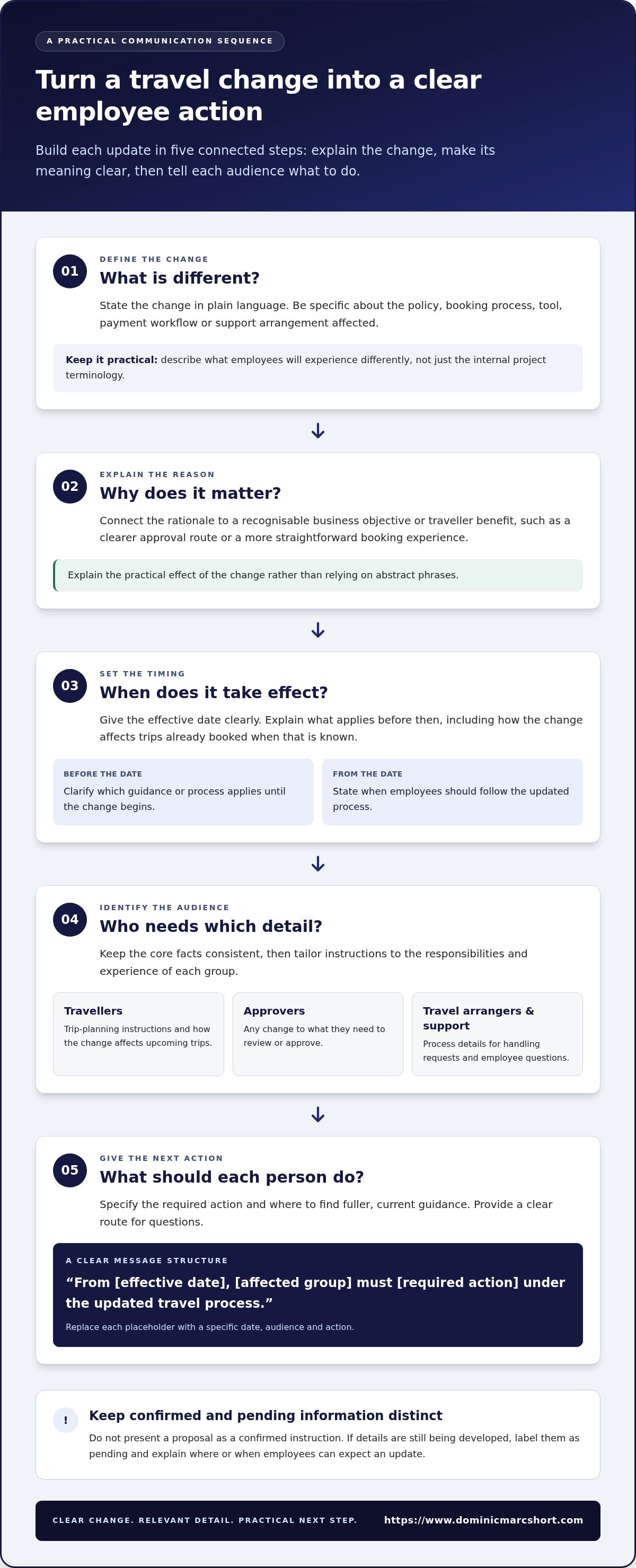
A useful travel update follows a clear sequence: what is changing, why, when it takes effect, who is affected and what each person needs to do next. This structure makes communicating travel program updates to employees more practical and helps readers quickly find the information that matters to them.
Change: State what is different in plain language.
Reason: Explain the business objective or traveller benefit behind it.
Timing: Give the effective date and clarify what applies before then.
Audience: Identify the employee groups affected.
Action: Say precisely what people should do and where to find fuller guidance.
Make the key instruction easy to scan. A summary might read: “From [effective date], [affected group] must [required action] under the updated travel process.” Replace the placeholders with a specific date and action in the published message. If some elements are still being developed, label them as pending and explain when or where employees can expect an update. Don’t present a proposal as a confirmed instruction; it’s an efficient way to create confusion, but not the useful kind.
How to explain the reason for a travel programme change
Connect the rationale to something employees can recognise: a business objective, a clearer approval route or a more straightforward booking experience. Describe the practical effect rather than leaning on abstract phrases such as “transformation” or “operational optimisation”. For example, explain which step in the booking process is changing and how to use the revised process. Fisher College of Business also highlights the value of regularly communicating your policies clearly and consistently.
Anticipate reasonable questions, such as how the change affects a trip already booked. If the answer is still being worked out, say so and explain where confirmed guidance will appear. Honest boundaries build more trust than a confident guess.
How to tailor messages for different employee groups
Keep the core facts consistent, then adapt the instructions. Frequent travellers may need to know how a change affects upcoming trips; occasional travellers may need a brief explanation of where to start. Travel arrangers may need process details, while approvers need to understand any changes to their review responsibilities. Link each audience to the relevant travel policy or process guidance instead of giving everyone a lengthy set of instructions they may not need.
For larger programme changes, clear messaging is one part of a broader transition. Bespoke change management communications support can help organisations align employee-facing messages with the travel programme change.
Choose channels and timing that make travel updates easy to find
Good channel planning is about more than repeating a message in several places. Each channel should have a clear job: alert the right people, explain the change or provide guidance they can return to later. When communicating travel program updates to employees, make one location the authoritative source for current policy and process details, then direct employees there from other communications. This stops an old email or saved document becoming the unofficial rulebook.
Which channel suits each type of travel update?
Match the channel to the information’s urgency, audience and lasting value. A short message can flag a change, while detailed instructions belong somewhere easy to find again. Give each channel a clear role:
Email: Useful for direct announcements and targeted instructions. It reaches named groups, but important details can quickly disappear in a crowded inbox.
Intranet: A suitable home for current policy, process steps and frequently needed reference material. Make the route to the relevant page clear.
Collaboration tools: Helpful for team reminders and discussion. Pin or link to the authoritative guidance so conversational updates don’t become a competing source.
Manager briefings: Valuable when teams need local context or a chance to ask questions. Give managers consistent source material to avoid different interpretations.
For example, announce a booking-process change by email to the affected group, publish full instructions on the intranet, and equip managers to explain team-specific implications. The channels reinforce one another while the guidance stays consistent.
When should employees hear about a change?
Give affected employees enough notice to understand and prepare before the change influences a real decision. The right lead time depends on the impact: a minor process adjustment may need a different communication sequence from a new tool or a change affecting upcoming travel. Plan around the actions employees must take, not simply the date an announcement is scheduled.
A practical sequence is to share advance notice, provide a reminder as the effective date approaches, then offer post-launch guidance as questions or process snags emerge. Time reminders around relevant moments, such as making a booking or submitting an expense, so the instruction arrives when it’s useful rather than becoming digital wallpaper.
Sending identical messages through every channel won’t guarantee understanding. Tailor reminders to the people and actions involved, and keep the policy source current. For a broader view of coordinating communications with implementation, see this strategic change management for corporate travel framework.
Address employee concerns and check whether the update has landed
One announcement rarely shows whether employees have understood a change or can put it into practice. A message may be delivered and opened, yet leave a traveller unsure how to book an upcoming trip. Treat communicating travel program updates to employees as an ongoing exchange: provide a clear way to ask questions, learn from the responses and refine guidance where needed.
State where employees can raise queries and who is responsible for answering them. Depending on the organisation, that could be a shared travel support contact, a dedicated inbox or a manager who can direct questions to the right owner. Make the route visible in the original update and on the main policy or process page. A help route without a named owner is rather like a signpost pointing into the fog.
How to respond to resistance without becoming defensive
Listen first, then respond to the concern directly. An employee questioning a new booking step may have misunderstood the instruction, or encountered genuine friction the change team hasn’t anticipated. These are different problems and need different responses. Clarify the process if information is missing; investigate the workflow if the instruction is understood but difficult to follow.
Explain the operational reasoning respectfully, without dismissing the effect on people’s work. If the answer is not yet known, say so and explain how the question will be followed up. If similar concerns recur, record them and consider whether the process or supporting guidance needs improvement. Feedback is useful evidence, not an obstacle to be talked out of the room.
How to assess whether communication is working
Look beyond message reach. Email delivery or intranet views can show that information was available, but not whether employees understood it or acted correctly. After launch, review questions, repeated booking or payment errors, and requests for clarification. Ask managers and travel support teams which instructions people still find difficult to follow.
Repeated questions may point to missing detail or unclear wording.
Recurring process errors may signal a gap between the stated instruction and the task employees need to complete.
Feedback from managers and support teams can reveal where different groups need more specific guidance.
Use these signals to decide whether to clarify the message, update the reference guidance or review the underlying process. A travel management system audit checklist can also help structure a review of the tools and workflows that support the programme.
Make travel programme communication a repeatable change process
Travel communication works best when it is part of programme implementation from the outset, not a final task added just before launch. Give each stage a clear owner: the subject expert drafts accurate content, the relevant decision-maker approves it, a designated channel owner publishes it, and someone keeps employee-facing guidance current. Clear accountability helps prevent conflicting versions and shows employees where to find the latest instructions.
Include communication tasks in the change plan alongside process design, system preparation and launch activities. Cover audience impact, message development, approvals, publication, manager support and post-launch review. If a booking tool or approval workflow changes, for example, account for both the technical transition and the guidance employees need to use the revised process.
A simple operating rhythm for future updates
A consistent cycle makes communicating travel program updates to employees easier to manage and improve. Start by assessing who and what the change affects, then map audiences and agree the core message. Coordinate approval, publication and manager briefings through one owned plan. After launch, gather questions and feedback, review whether guidance needs updating, and record lessons for the next change. It’s a practical rhythm, not another meeting that could have been an email.
Before publication: Confirm the impact, affected groups, message owner and approver.
At launch: Publish the update, supporting instructions and route for questions in a coordinated way.
After launch: Review employee feedback and recurring issues, then update the guidance or process where needed.
Keep guidance under review after launch. A policy page that no longer matches the actual booking process can undo the value of a carefully planned announcement. Assign responsibility for checking employee-facing information when programme processes change, and retire superseded versions so outdated instructions don’t hang around like unwanted office stationery.
When specialist change communication support can help
Complex travel programme or technology transitions can involve connected changes to policy, tools, roles and ways of working. In these situations, specialist communication support can align the change plan with the messages and guidance employees need at each stage. CDABS provides bespoke change management communications packages, bringing together business travel management experience and practical support for programme change. For further context, explore the change communication consultant for travel technology.
Make every travel update easier to act on
Clear travel programme communication turns a policy or process change into practical guidance employees can use. State what is changing, why it matters, when it takes effect and what each affected group needs to do. Keep detailed instructions in one reliable place, then use relevant channels and reminders to help people find them.
Just as important, treat communication as an ongoing part of the change. Invite questions, learn from recurring issues and update guidance when employee needs or processes shift. That is the difference between communicating travel program updates to employees and simply sending an announcement: the aim is understanding, confidence and action.
Dominic Marc Short - Independent Consultant provides bespoke change management communications packages, informed by Dominic Marc Short's more than 30 years of experience across business travel management, meetings and events, and marketing. This combination helps bring strategic travel changes and employee communications into closer alignment.
With a clear process and thoughtful communication, each update can make the travel programme easier to understand and use. You’re well placed to make the next change a smoother one.
Frequently Asked Questions
How do you communicate travel policy changes to employees?
Explain what is changing, why, when it takes effect and which employees are affected. When communicating travel program updates to employees, give each group a clear action and link to the current policy or process instructions. Choose suitable channels, provide a route for questions and follow up after launch. Check whether employees can apply the new process rather than relying only on evidence that they received the announcement.
When should employees be told about changes to a travel programme?
Tell affected employees early enough to understand the change and prepare for any required action. The right lead-in depends on the impact and the steps people need to take. Make effective dates clear, then schedule reminders around relevant moments, such as booking a trip or submitting expenses. Keep the reference guidance current after the initial announcement so employees can find the latest instructions when they need them.
What should a travel programme update to employees include?
Include a concise description of the change, its reason, effective date, affected employees and required action. Add role-specific instructions where travellers, approvers or travel arrangers need different guidance. Explain where to find the full policy or process details and how to ask a question. Keep the central message consistent across groups, adapting practical instructions without creating conflicting versions.
How can you get employees to read travel programme updates?
Make the subject line and opening sentence specific about the change and its relevance to employees. Keep the message concise, use familiar language and state the action clearly. Put detailed instructions in an easy-to-find reference source, then direct each audience to the relevant section. Follow up on important changes, and review recurring questions to identify wording or guidance that needs improvement.
Which channels are best for communicating corporate travel changes?
Choose channels according to urgency, audience and the amount of detail involved. Email or another direct message can flag a specific action, while an intranet or maintained knowledge source can hold complete policy and process guidance. Manager briefings can provide team context and space for discussion. Identify one source as authoritative and keep it current. Sending a message through several channels doesn’t, by itself, prove employees understood it.
How can you tell whether employees understood a travel programme update?
Look beyond delivery and open rates. Review questions, recurring errors and support requests after the change takes effect, and ask employees, managers or travel support teams which instructions remain unclear. Repeated problems may indicate missing information, confusing wording or friction in the process itself. Use these signals to clarify guidance or address practical issues, then apply the lessons to the next communication cycle.
How often should employees receive travel programme updates?
Communicate when a change affects employees’ decisions, responsibilities or travel processes, rather than following an arbitrary schedule. Give advance notice when people need time to prepare, then provide reminders around relevant actions. Keep reference information current between announcements, too. A planned rhythm helps employees stay informed without turning every minor adjustment into another inbox event; reserve broader announcements for information that genuinely needs wider attention.



Comments