Integrating Sustainability into Travel Policy: A Practical 2026 Guide
What if a more sustainable business trip could also be the more practical one? Integrating sustainability into travel policy isn’t about saying “no” to every journey or making employees wrestle with a spreadsheet before booking. It’s about giving people clear guidance on when travel is worthwhile and how to make considered choices without losing sight of business needs or traveller wellbeing.
Broad sustainability goals can be difficult to apply to individual trips. Employees need fair, workable options, while leaders need consistent information to understand where travel impacts arise and whether policy changes are helping. If the rules leave decisions vague, similar requests can receive different answers, which is hardly a recipe for enthusiastic adoption.
This guide sets out a practical framework for turning goals into trip-level decisions. You’ll learn how to assess whether a journey is necessary, choose lower-impact options where they suit the business, communicate expectations clearly and track progress without creating an administrative monster. Sustainability works best as an operational programme, supported by sound processes, useful data and thoughtful change communications, not simply a well-intentioned paragraph in a policy document.
Table of Contents
Why integrate sustainability into your business travel policy?
A sustainability statement can express an organisation’s intentions, but employees still need to decide whether a meeting warrants a journey, which travel option fits and how to handle exceptions. A sustainable travel policy turns those intentions into guidance employees and approvers can use when planning and reviewing trips. It gives them shared criteria, rather than leaving each person to interpret broad goals on their own.
A travel policy is a practical lever because it shapes the choices made before, during and after a business trip.
That doesn’t mean every journey should be avoided or that one transport option will suit every itinerary. A client meeting, a technical visit and an internal discussion can have very different purposes. Policy should help people account for those differences while keeping business outcomes, environmental impact and traveller wellbeing in view. The aim is considered travel, not travel for its own sake or restrictions that make essential work harder.
Business purpose: Is an in-person meeting necessary to achieve the intended outcome?
Environmental considerations: Could the journey be avoided, combined with another trip or planned using a lower-impact option?
People and operations: Will the choice support the traveller’s wellbeing and the organisation’s practical requirements?
These questions connect environmental aims with wider social and organisational responsibilities. The broader idea of Sustainable tourism considers the effects of travel beyond the journey itself. For business travel, policy can bring that perspective into everyday planning while recognising that decisions must remain appropriate to the work being done.
What does sustainability in a travel policy mean?
In practice, a policy influences both whether a trip happens and how it is arranged. It might ask employees to consider a virtual meeting if that format can meet the business need, or prompt them to compare feasible journey options for an essential visit. The right choice depends on the purpose, timing and operational context. Guidance should make those considerations clear without turning every booking into a philosophical debate at the departure gate.
Why policy wording alone will not change travel behaviour
Broad phrases such as “travel sustainably” sound positive but leave important questions unanswered. If employees and approvers don’t know which priorities take precedence, similar trips may receive different decisions. Clear criteria, named ownership and useful communication help translate policy into consistent practice. They also give employees a way to raise practical concerns and understand the reasoning behind changes.
Policy works as part of a programme, supported by processes and communication, rather than as a document expected to change behaviour by itself. For the wider strategic context, the corporate travel policy guide explores how policy fits into a managed travel programme. The next step is to build decision guidance employees can use and leaders can review against business needs.
How to build sustainability into travel-policy decisions
Make the policy usable at the point of decision. Employees should be able to explain why a trip is needed, consider whether another format could achieve the same outcome and choose a suitable way to travel. Approvers need the same criteria, so a decision doesn’t depend on who happens to review the request. Integrating sustainability into travel policy means designing a repeatable process, not simply adding an environmental preference to a booking form.
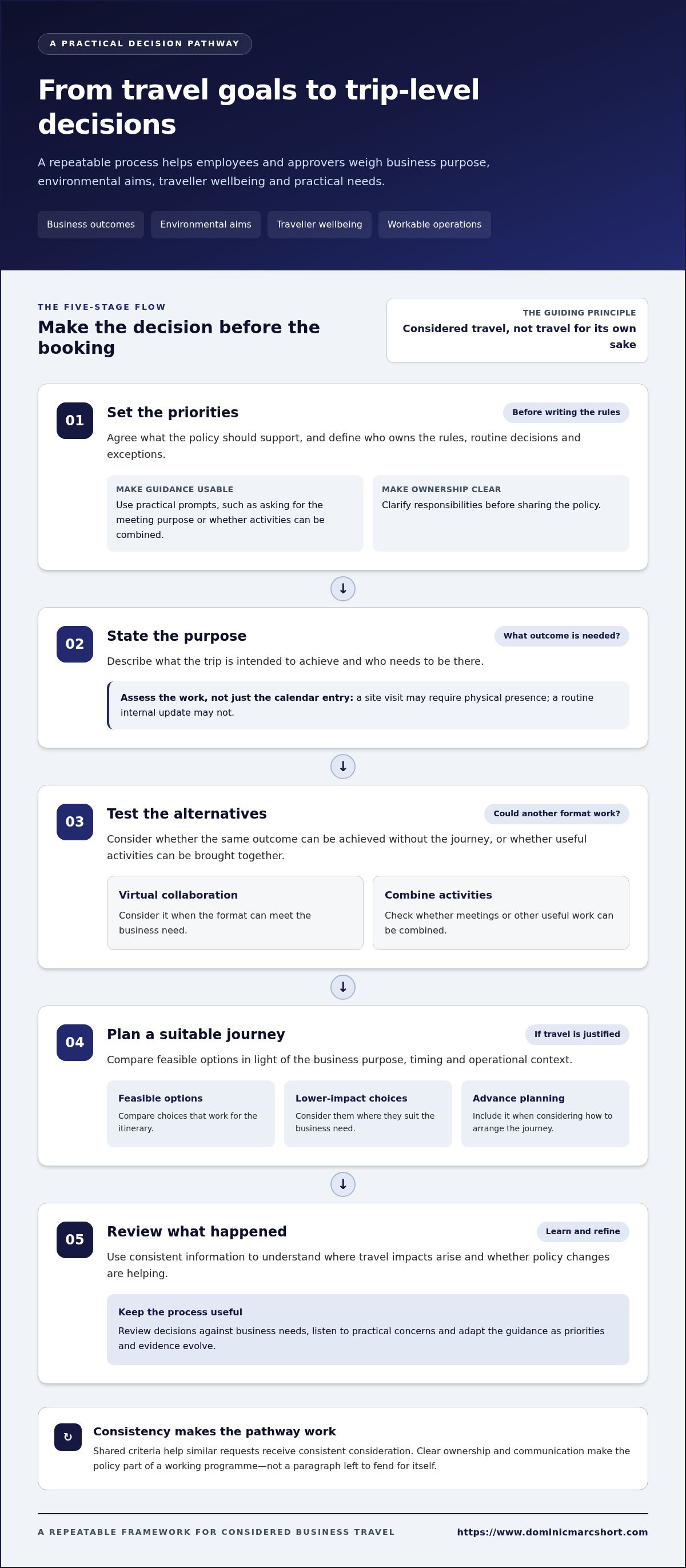
Set the goal, assess the purpose, consider alternatives, choose a suitable journey, then review what happened.
Set priorities before writing travel rules
Start by agreeing what the organisation wants its travel policy to support: business outcomes, environmental aims, traveller wellbeing and workable operations. Then decide who owns the rules, who approves routine requests and who handles exceptions. These responsibilities should be clear before the policy is shared, not discovered during an awkward email chain. Define practical prompts, such as asking for the meeting purpose or whether related activities could be combined, rather than relying on slogans.
Turn trip assessment into a repeatable process
Give travellers a short sequence they can apply consistently. It should help them distinguish essential in-person work from meetings that could be handled virtually, while leaving room for business context. For example, a site visit may require physical presence, whereas a routine internal update may not. The policy should guide that judgement, not pretend every meeting fits neatly into a universal rule.
Establish the objective. Identify the policy priorities and define how they fit with organisational needs.
State the purpose. Describe the outcome the trip is intended to achieve and who needs to be there.
Test alternatives. Consider virtual collaboration or whether the activity can be combined with other useful meetings or work.
Plan the journey. Where travel is justified, compare feasible options and consider advance planning and lower-impact choices.
Review the result. Record the decision and relevant outcome so the organisation can learn and refine its guidance.
Each step can become a simple prompt in a request or approval workflow. A traveller might explain why a visit is time-sensitive, whether colleagues can join the same trip, or why a virtual meeting would not meet the objective. Combining activities can make a journey more purposeful when timing, location and workload make it sensible. Advance planning can also give employees more opportunity to compare suitable options. It should support good decisions, not become a rigid test that ignores changing business needs.
For related guidance on setting policy foundations, the corporate travel policy guide provides useful planning context. Organisations translating these decisions into workable processes may also find business travel management consulting relevant to aligning policy and implementation.
Which sustainability measures balance impact, cost and traveller experience?
There’s no single travel measure that suits every business trip. A virtual meeting may work well for an internal update, while a visit that depends on hands-on work or relationship-building may call for people to be there in person. Effective policy gives employees options and a way to explain their choices, rather than treating sustainability as a blanket ban or a reason to reduce traveller support.
Compare each measure against the trip’s purpose, practical feasibility and effect on the traveller. The table below offers prompts that can be adapted to your organisation’s travel patterns.
Compare policy levers by trip context
Use the measures as distinct levers, not a fixed ranking. For a journey where rail is a practical option, compare the route and timetable with the meeting’s requirements. A tight schedule or limited connections could change the decision. Similarly, combining meetings may reduce separate journeys when timing and purpose align, but it should not become an instruction to stretch every trip. The policy can encourage employees to consider alternatives while asking them to record why another choice makes better business sense.
Protect wellbeing while setting clearer expectations
Involve travellers when reviewing how measures work on real itineraries. Their feedback can reveal where a rule creates avoidable pressure, such as a journey that adds disproportionate time or a format that doesn’t meet an accessibility need. Apply the same principles consistently, but allow a clear route for exceptions based on business purpose, safety, accessibility or practical constraints. Sustainability should improve travel decisions, not turn support into a prize for choosing the “right” option. That balance is central to integrating sustainability into travel policy in a way employees can use and trust.
How to implement, communicate and measure a sustainable travel policy
A policy becomes effective through the process around it. Assign ownership, build guidance into relevant travel workflows, explain the changes, listen to employees and review the evidence. This sequence makes integrating sustainability into travel policy a managed programme rather than a document launch followed by crossed fingers.
Make policy changes understandable and usable
Begin by naming an owner who can coordinate policy decisions and involve the people responsible for travel approvals, booking processes and employee communications. Build the steps employees will encounter into the process, such as a prompt to record trip purpose or consider an alternative. Then explain why the policy is changing and what action is expected. Keep examples practical, and give managers guidance so similar requests are handled consistently.
Communication should make the policy feel workable, not like a puzzle with a hidden correct answer. Explain how to raise an exception and where to share feedback. If employees aren’t following a new process, first investigate whether the instruction is clear, accessible and feasible. A confusing booking prompt can look like resistance from a distance; closer inspection may reveal that it simply needs rewriting.
Measure progress and set a review rhythm
Establish a baseline using organisational data before setting goals. Choose indicators that reflect what the policy is intended to change and that the organisation can collect consistently. Depending on available records, useful measures may include trip volumes, journey types, use of policy options, approval exceptions and available travel-impact estimates. Avoid presenting estimates as exact results: document how they were produced and what they leave out.
For each measure, record its source, definition, coverage and assumptions. If one report covers booked trips while another includes additional travel, comparisons may tell a misleading story. Keep the scope and definitions stable over time, or clearly explain any change, so leaders can distinguish genuine shifts from differences in reporting. A travel data management audit checklist can help frame questions about data quality and consistency.
Set a regular review point that brings together policy owners, travel stakeholders and employee feedback. Look for patterns: Are people using the intended process? Do exceptions point to a genuine operational need, or a rule that needs clarification? Compare results with the baseline, then adjust guidance where evidence or business priorities have changed. The aim is useful learning, not a dashboard full of numbers nobody knows how to interpret.
Clear ownership, process analysis and change communications connect policy wording to everyday practice. Business travel consulting can help organisations shape implementation around their operational needs.
How to make sustainable travel policy work over the long term
A policy should evolve as the organisation’s priorities, travel patterns and available evidence change. Set a review point, then use it to examine what is working, where employees encounter friction and whether business needs have shifted. The aim isn’t to rewrite the rules for every new challenge. It’s to keep them relevant, fair and practical, rather than allowing a once-useful policy to gather dust in a shared folder.
Build ownership into everyday travel management
Long-term progress needs clear roles. Travel teams can manage policy processes, finance can help assess spending patterns, sustainability colleagues can advise on environmental objectives, and business leaders can judge operational priorities. Employees also offer valuable insight into how guidance works in practice. Define who proposes changes, approves them and communicates decisions, so accountability is clear without making every straightforward trip a committee meeting.
Where the organisation’s systems allow, connect policy rules with booking and approval workflows. A relevant prompt at the point of request can make expectations easier to follow than a reminder buried in a handbook. Keep the employee journey simple, and make clear how questions or exceptions are handled. Integrating sustainability into travel policy is more likely to become routine when responsibility sits within existing travel management, rather than in a separate process nobody quite owns.
Use specialist support to move from policy to practice
Independent business travel consulting can help organisations analyse current processes, identify improvement opportunities and align policy with operational requirements. Depending on the organisation’s needs, this work may connect with global travel management solutions or digital transformation. Change communications can then explain what is changing, why it matters and how employees should apply the updated guidance. The purpose is to support implementation, not to promise a particular result.
Dominic Marc Short - Independent Consultant provides business travel management consulting across process analysis and optimisation, global travel management solutions, digital transformation and change-management communications. This joined-up view helps connect policy, systems and employee understanding as the programme develops.
Use this practical checklist to keep the foundations in view:
Ownership: Named stakeholders understand their roles in decisions, approvals and exceptions.
Usable rules: Employees can apply the guidance to real trip requests and explain their choices.
Communication: Updates clarify what has changed and where to get help with the process.
Data: Measures use documented definitions, sources and coverage.
Scheduled review: Stakeholders revisit the policy using employee feedback, business priorities and available evidence.
With these foundations in place, policy improvement becomes part of managing travel well. Review what the evidence and employee experience are telling you, adjust where needed, and keep the process proportionate to the organisation. Steady progress is more useful than a grand launch followed by silence.
Make your next policy decision count
The most useful next step may be smaller than a complete policy redesign. Choose one recurring travel decision that feels unclear, such as whether a meeting needs to be in person or how employees should compare viable journey options. Check whether your guidance gives travellers and approvers enough clarity to act confidently. A focused improvement can reveal where your wider approach needs attention without turning policy change into a mammoth exercise.
Integrating sustainability into travel policy is ongoing work: business needs evolve, and good guidance should evolve with them. Keep the conversation open with the people who plan, approve and take trips. Their experience can help refine the policy so it supports meaningful business travel and remains practical to use.
With clear decisions and a willingness to learn, your organisation can make steady progress, one better-informed journey at a time.
Frequently Asked Questions
Is carbon offsetting enough to make business travel sustainable?
No. Carbon offsetting alone doesn’t change why a trip is taken or which travel option is selected, so it can’t replace decisions about travel demand and journey planning. First assess whether a proposed visit is necessary and whether a suitable alternative exists. If you then consider offsetting, treat it as a separate measure: define its purpose, review the evidence behind the approach and avoid presenting it as proof that a trip has no impact.
Can a sustainable travel policy apply to small businesses?
Yes. Integrating sustainability into travel policy can be proportionate to a small organisation’s scale. A concise policy might ask staff to record the purpose of travel, consider whether a call can achieve the objective and note the chosen transport option. One named owner can maintain the guidance and gather questions. As travel patterns change, the business can update its rules without building a large-company approval structure.
What should a travel policy say about exceptions?
State who may approve an exception, what information the request should include and where the decision is recorded. For example, an employee might explain that a connection would make attendance impractical or that an accessibility requirement affects the available route. Apply the same principles to comparable requests, while allowing judgement for genuine differences. Reviewing exception records can also show whether a rule needs clarification or a recurring process issue needs attention.
How can a company encourage employees to follow a sustainable travel policy?
Make the guidance visible where employees first plan or request a trip, not only in a policy library. Explain the reason for each key rule and show a brief example, such as what to include when proposing an in-person meeting. Managers should use the same approach when approving requests. After rollout, invite questions through a clear channel and use recurring feedback to improve unclear instructions before assuming people are unwilling to comply.
Should business travel always be replaced with virtual meetings?
No. Virtual meetings can suit routine updates or discussions where participants can contribute effectively online, but they may not meet objectives that rely on physical inspection, practical collaboration or relationship-building. Ask what the meeting must accomplish and which people need to take part before choosing the format. A policy should make virtual collaboration a genuine option, not an automatic substitute that creates extra work or weakens the outcome.
How often should an organisation review its sustainable travel policy?
Choose a review rhythm that reflects how often your travel programme and priorities change, then bring the review forward if a major operational shift or repeated employee concern arises. For example, a new approval workflow may make an existing instruction confusing. Check whether staff understand the rule, whether managers apply it consistently and whether the evidence still supports it. The interval matters less than acting when the policy no longer fits.
What if lower-impact travel options are not practical for a particular trip?
Give travellers a straightforward way to record why an alternative doesn’t fit, such as a timetable that conflicts with a required meeting or an accessibility need. The request should follow the normal approval route, with a proportionate explanation rather than a lengthy justification. Track these cases to spot patterns, such as a route or process that repeatedly limits choice. That evidence can inform future guidance without penalising employees for constraints beyond their control.



Comments