Reducing Carbon Footprint from Business Travel: How to Measure and Lower Emissions
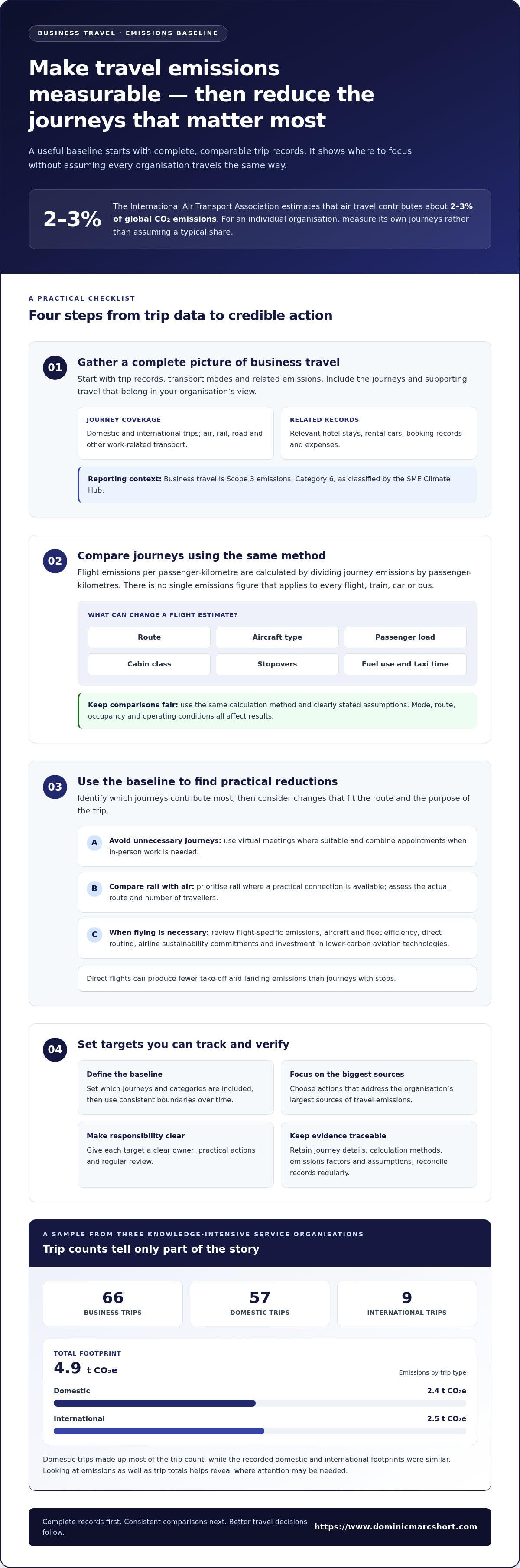
A flight’s carbon footprint is shaped by more than distance. Reducing the carbon footprint from business travel starts with a baseline: flight estimates account for route, aircraft, passenger load, cabin class, stopovers and operating factors such as fuel use and taxi time. The International Air Transport Association estimates that air travel contributes about 2-3% of global CO₂ emissions, so understanding what drives each trip’s impact is a useful first step.
It’s easy to assume that fewer flights are the whole answer. In practice, a clear travel policy helps teams decide when a virtual meeting will work, when rail is feasible, and how to make essential journeys count by combining appointments. This guide explains how flight emissions are estimated, what to include when measuring business travel in Switzerland, and how lower-carbon transport, airline and hotel choices can reduce the footprint. It also explains how to assess offsets sensibly, after considering opportunities to reduce emissions. The aim is a practical approach that supports business needs without letting the spreadsheet take over the trip.
Table of Contents
1. Travel emissions baselines and reduction opportunities
The International Air Transport Association estimates that air travel contributes about 2-3% of global CO₂ emissions. For a Swiss organisation, a baseline shows which journeys contribute most and where reducing the carbon footprint from business travel can begin. Gather trip records, transport modes and related emissions, then review the results consistently. A perfect spreadsheet can wait; complete, comparable records come first.
Flight emissions per passenger-kilometre are calculated by dividing journey emissions by passenger-kilometres. There is no single figure for every flight, train, car or bus: mode, route, occupancy and operating conditions all affect the result. Flight estimates may also account for aircraft type, cabin class, stopovers, fuel use and taxi time. Compare like with like by using the same method and clearly stated assumptions.
Business travel is part of Scope 3 emissions. The SME Climate Hub classifies it as Scope 3, Category 6. Its share of a company’s carbon footprint varies with travel activity and other value-chain emissions, so measure the organisation’s own journeys instead of assuming a typical proportion. Include domestic and international trips, plus relevant hotel stays, rental cars and other work-related transport.
A May 2013 sample from three knowledge-intensive service organisations recorded 66 business trips: 57 domestic and 9 international. The total footprint was 4.9 t CO₂e, split between 2.4 t CO₂e for domestic trips and 2.5 t CO₂e for international trips. Trip counts alone can therefore hide meaningful differences in impact.
Swiss businesses can reduce travel emissions by combining appointments, using virtual meetings where suitable and comparing rail with air on feasible routes. When flying is necessary, review flight-specific emissions, aircraft and fleet efficiency, direct routing, airline sustainability commitments and investment in lower-carbon aviation technologies. Direct flights can produce fewer take-off and landing emissions than journeys with stops.
To set a target, define which journeys the company will measure, establish a consistent baseline and choose actions that address its largest sources of emissions. Track progress using the same boundaries and categories over time. Reducing the carbon footprint from business travel is easier to manage when each target has a clear owner, practical actions and regular review.
For reporting and verification in Switzerland, retain booking and expense records, journey details, calculation methods, emissions factors and assumptions. Reconcile the records regularly so reported totals can be traced to actual travel activity and reviewed consistently.
There is no typical proportion: business travel’s share of a company’s emissions depends on its travel activity and other value-chain emissions.
2. Choosing trains over flights for shorter distances
When a practical rail connection is available, compare train travel with flying before approving a booking. Rail generally generates fewer emissions than air travel, although the best option depends on the route and number of travellers. For national teams, start with the actual door-to-door itinerary: include access to the station or airport, transfers, waiting time and the meeting location. A short flight may look quick on a booking screen, but the full journey gives a more useful comparison.
Use a consistent comparison for every trip. Record the origin, destination, number of travellers and transport modes, then compare available rail and air journeys using the same emissions method. For example, a team travelling between regional offices can compare rail and air by considering the whole itinerary, not just time in transit. A train may also let colleagues work en route, making travel time part of the working day rather than a separate activity.
Video meetings can avoid travel emissions altogether when the purpose is a routine update, presentation or progress review. The cost comparison between rail, air and video depends on the route, booking conditions, number of travellers and meeting requirements. Compare total trip costs, including transfers and time away, with the resources needed to hold the meeting virtually.
Build these choices into a sustainable travel policy. State when virtual meetings are appropriate, when rail should replace air, and how exceptions are approved. For longer journeys, decide based on the route and number of travellers rather than applying a blanket rule. Public transport, walking and cycling may also suit local appointments; shared transport can work when colleagues are travelling to the same location.
A sustainable travel management approach should support practical comparisons across transport modes and make emissions visible during planning or booking. Look for a process that brings itinerary options, emissions information and policy rules together. The goal is to make lower-carbon choices straightforward for employees, not to turn every booking into a lengthy committee meeting.
Prioritise rail where feasible, but consider more than sustainability alone. Compare journey duration, connections, meeting schedules and the number of people travelling. Flying can produce fewer emissions than driving in some circumstances, so assess the actual alternatives rather than assuming one mode always wins. A direct flight can also avoid the additional take-offs and landings associated with stops.
For organisations refining these decisions, a structured travel programme review by Dominic Marc Short - Independent Consultant can help connect policy, booking processes and business needs. The result should be a clear commitment employees can follow, with enough flexibility for the route to matter.
3. Sustainable travel suppliers and booking technology
A corporate travel policy turns environmental priorities into everyday booking decisions. Define when virtual meetings are suitable, when rail should replace air travel, and which flight choices need approval. Include requirements for direct routes, emissions reporting and supplier selection. Clear rules help employees make consistent choices and support reducing the carbon footprint from business travel. Think of the policy as a helpful sat-nav, not a maze of exceptions.
Connect the policy to the booking process. Travel management technology can collect journey details and support automated emissions tracking when integrated with booking tools or corporate travel apps. Capture origin, destination, transport mode and cabin class consistently. Compare reports with booking and expense records so missing trips or inconsistent categories don’t quietly distort the picture. A tidy data trail saves everyone from playing detective later.
Airlines: Compare flight-specific emissions information, fleet efficiency, sustainability commitments and investment in lower-carbon aviation technologies.
Rental vehicles: Include electric or hybrid options in booking decisions, making the vehicle choice visible before confirmation.
Hotels: Consider eco-certified accommodation that prioritises energy and water efficiency.
For accommodation, assess environmental practices alongside location and business needs. A hotel close to a meeting can reduce the need for local transport. Include energy and water efficiency in preferred-hotel decisions, and make the criteria visible in booking tools. This helps travellers find a suitable stay without starting a separate research project each time.
Sustainable aviation fuel (SAF) can reduce lifecycle greenhouse-gas emissions compared with fossil kerosene. When comparing airlines, consider SAF information alongside route, fleet efficiency and wider sustainability commitments. Record the basis for supplier decisions in the travel programme so preferred-airline choices follow defined criteria rather than a vague green label.
For Swiss teams travelling to different destinations, present policy-compliant options and relevant emissions information together at booking. Record exceptions with a reason, such as a route without a workable alternative or a meeting schedule requiring a particular arrival time. Reviewing exceptions can reveal recurring patterns and opportunities to reduce avoidable travel.
Assign responsibility for maintaining the policy, booking-system settings and reporting categories. If supplier sustainability information or booking-tool data fields change, review how this affects comparisons. Consistent definitions make reports more useful over time and help organisations measure progress in reducing the carbon footprint from business travel. Good technology should make sound decisions easier, not add administration for its own sake.
4. Carbon offsetting and evaluating offset programs
Offsets can address emissions that remain after a company has reduced avoidable travel. They should not become permission to keep flying when a lower-emission journey or virtual meeting would work. The University of Reading advises prioritising emissions reduction first, then considering offsets for unavoidable emissions. This keeps the focus on changing journeys, not simply paying to balance the footprint.
A carbon credit represents one metric tonne of carbon dioxide equivalent. Credits support projects intended to reduce or remove greenhouse-gas emissions, but the unit alone doesn’t explain how a project works. Before selecting a programme, establish which business travel emissions it covers, how the amount is calculated and which project receives the funding. Keep calculation and purchase records alongside travel reports.
Offset projects can include solar, wind, biomass, cookstoves and reforestation. These approaches differ, so compare the project type with the programme’s stated aims and supporting evidence. A wind project, for example, supports renewable energy, while reforestation focuses on trees. Neither description alone is enough to assess a programme’s quality or relevance.
Scope: Check which emissions and journeys the programme is intended to address.
Project: Identify the activity funded, its location and the claimed climate benefit.
Evidence: Review the programme’s documentation and how it accounts for credits.
Recognition: Consider Gold Standard-certified projects when evaluating offset options, as advised by the University of Reading.
For each journey, first record the emissions estimate and identify practical ways to reduce it. A company might combine appointments, choose rail where feasible or use video for a meeting that does not need to be in person. Then calculate residual emissions using the same method as for the travel baseline. Consistency makes offset decisions easier to explain and compare across reporting periods.
Develop an internal offsetting principle that separates emissions-reduction actions from offset purchases. Assign responsibility for reviewing project information, retaining purchase evidence and matching credits to reported residual emissions. Avoid presenting an offset as making a flight emission-free. It supports a project intended to mitigate emissions, while the flight itself still produced emissions.
A considered programme therefore has two parts: a documented reduction plan and a transparent approach to unavoidable emissions. Review them together as travel patterns change. If flying falls but offset purchases rise, examine whether the organisation has reduced emissions effectively or simply shifted its response. Offsets work best as a measured final step, not the headline act.
5. Carbon footprint of business travel in knowledge-intensive services
In consulting, finance and other knowledge-intensive services, travel can support client relationships, project delivery and collaboration. Those activities also create greenhouse-gas emissions through flights, hotel stays, rental cars and other work-related journeys. Treating travel as part of operations helps teams examine how work is organised, not just how employees get from one meeting to the next.
Business travel sits within Scope 3 emissions, alongside other indirect impacts across a company’s value chain. Scope 3 can account for up to 50% of a company’s indirect emissions, so a travel programme deserves attention within a wider climate plan. For a professional-services firm, separate client visits, internal meetings, conferences and project travel in reporting. That breakdown shows which activities drive emissions and where changes may fit.
Travel patterns can reveal opportunities specific to knowledge work. If several consultants visit the same client region, schedule appointments together or use a regional hub. A team might combine a workshop and client review on one visit instead of making separate journeys. For routine progress meetings, teleconferencing can maintain regular contact without adding another trip to the calendar.
Meeting format matters too. A first-class flight has emissions attributed to it 2.5 times higher than an economy-class flight. Where a flight is essential, class choices therefore affect the reported footprint per person. Apply clear travel rules, and assess the business purpose, route and traveller numbers before approving a journey. The climate benefit comes from choices reflected in actual bookings, not policy wording alone.
Client delivery: Group appointments by location and align travel with project milestones.
Internal collaboration: Use video meetings for suitable updates, then reserve in-person sessions for work that benefits from being together.
Events: Consider regional meetings or local partnerships to limit long-distance journeys.
Reporting: Track flights, accommodation and ground transport separately to identify operational hotspots.
These steps need to support service quality as well as climate goals. A client workshop may require people in the room, while a routine briefing may not. Record the purpose of trips and review repeat journeys, meeting locations and attendance patterns. This gives managers evidence to refine travel practices without treating every face-to-face meeting as either essential or avoidable.
The clear takeaway for knowledge-intensive organisations is to redesign recurring travel before focusing on one-off exceptions. Connect project planning, meeting formats and travel decisions, then monitor emissions alongside delivery needs. This makes climate action part of how the business works, rather than a separate exercise after bookings are complete.
Dominic Marc Short - Independent Consultant: Business Travel Management Consulting
Dominic Marc Short - Independent Consultant offers Business Travel Management Consulting for organisations ready to turn emissions insights into practical changes to their travel programmes. This is a useful next step when trip data is fragmented, travel policies are difficult to apply, or lower-emission choices need to fit operational needs.
The work can include analysing travel processes and identifying opportunities to optimise them, alongside global travel management solutions and digital transformation. For organisations introducing new booking practices, change management communications packages can help explain the reasons for updated procedures and support their adoption. The focus is a coherent programme, from understanding current travel activity to embedding decisions employees can follow.
To discuss your organisation’s business travel management needs, contact Dominic Marc Short - Independent Consultant.
Make your next travel decision count
The next step is to make climate considerations part of how your organisation plans work, serves clients and brings people together. Assign a clear owner for travel decisions, then build environmental priorities into planning conversations rather than leaving them until a booking is underway. That way, reducing the carbon footprint from business travel becomes an operational practice, not a separate sustainability exercise.
When the challenge is aligning travel processes with wider organisational change, Dominic Marc Short, Independent Consultant, offers Business Travel Management Consulting and Global Transformation Management. For organisations reviewing how in-person gatherings fit their objectives, Meeting and Conference Organization can support purposeful event planning. The focus is on connecting travel choices with how your teams need to work, while keeping next steps clear and manageable.
Progress starts with a considered decision, then grows through practical choices your people can carry forward. A more thoughtful business travel programme is within reach.
Frequently Asked Questions
How are flight emissions calculated?
Flight emissions are estimated from journey activity and an emissions factor, then expressed as carbon dioxide equivalent (CO₂e). The estimate can account for distance, route, aircraft, cabin class, passenger load, stopovers, fuel use and operating conditions. For a practical comparison, record each passenger’s itinerary and cabin class, apply one consistent calculation method and retain its assumptions. Different calculators may produce different estimates because their inputs and methods vary.
What does a business carbon footprint mean?
A business carbon footprint is the greenhouse-gas emissions associated with an organisation’s activities and value chain. It includes direct emissions from sources the company owns or controls, emissions from purchased energy, and other indirect emissions. For example, fuel used by company vehicles differs from purchased electricity, while employee business travel is an indirect value-chain source. Separating these categories helps teams identify which operations create emissions and assign responsibility for addressing them.
How to calculate business travel emissions using the GHG Protocol?
Start by collecting travel activity data, such as passenger journeys, transport modes, distances and flight cabin classes. Apply consistent emissions factors to the recorded activity, convert results to CO₂e and retain the factors, assumptions and source records. The SME Climate Hub classifies business travel as Scope 3, Category 6. Keep business travel distinct from commuting and other value-chain categories, then reconcile calculations against booking and expense records.
How much do flight emissions increase when non-CO₂ climate effects are included?
There is no single multiplier that applies to every flight. Non-CO₂ effects, including contrails and emissions at altitude, vary with flight and atmospheric conditions and route. If a company includes these effects, it should record the calculation method and apply it consistently across its reporting. This makes comparisons more meaningful than adding an unexplained uplift to some journeys but not others.
When is rail travel a lower-carbon alternative to flying in Switzerland and Europe?
Rail is a lower-carbon option when a suitable rail journey can replace a flight for the same business purpose. Compare the full itinerary, including station access, connections, arrival time and number of travellers. A route’s convenience and emissions advantage can vary, so assess each trip rather than applying a universal distance threshold. In Switzerland and across Europe, include public transport connections at both ends of the journey.
What are effective policies for reducing business flights and encouraging virtual meetings?
Effective policies define which meeting types can be held virtually, when rail should be considered, and how employees request exceptions. For example, routine project updates may suit video calls, while workshops requiring in-person collaboration may justify travel. Give staff a clear approval route and make virtual options easy to arrange. Review repeat trips and meeting patterns regularly, then adjust guidance when the same journey recurs without a clear business need.
How do business travel carbon budgets and approval rules work?
A carbon budget sets an emissions allowance for business travel across a defined part of the organisation, such as a team or reporting period. Managers track bookings against that allowance and use approval rules for journeys that exceed it or lack a lower-emission alternative. Set the budget using recorded travel activity, define who approves exceptions, and compare actual emissions against the same boundary. This turns a target into a decision-making tool.
What are the risks of relying on carbon offsets instead of reducing business travel?
Relying on offsets can leave avoidable journeys unchanged and make progress appear stronger than the underlying travel data supports. Offsets are not a substitute for reducing emissions, though they can help mitigate unavoidable emissions. A company should therefore report travel reductions separately from offset purchases. It should also document which projects receive funding and how credits relate to residual emissions, rather than describing an offset purchase as removing a flight’s impact.

Comments