Corporate Travel Expense Audit Best Practices: A Practical 2026 Guide
What if a travel expense audit could strengthen control without making every claim feel like a courtroom drama? The strongest corporate travel expense audit best practices focus on whether the process works, not simply whether each receipt passes inspection.
Inconsistent decisions, manual reviews and incomplete records can frustrate employees and reviewers alike. For organisations managing travel across teams and borders, clear rules and consistent handling matter as much as spotting unusual claims. A fair audit helps employees understand what’s expected and gives finance and travel teams a clearer view of exceptions and recurring policy gaps.
This guide sets out a practical, repeatable approach: define ownership, document evidence, prioritise reviews by risk and handle exceptions consistently. It also shows how to make controls proportionate, so routine claims don’t receive the same scrutiny as genuine outliers. The aim is a more useful audit process that improves visibility and compliance while keeping unnecessary admin, and the occasional receipt-related detective story, to a minimum.
Table of Contents
What corporate travel expense audits should achieve
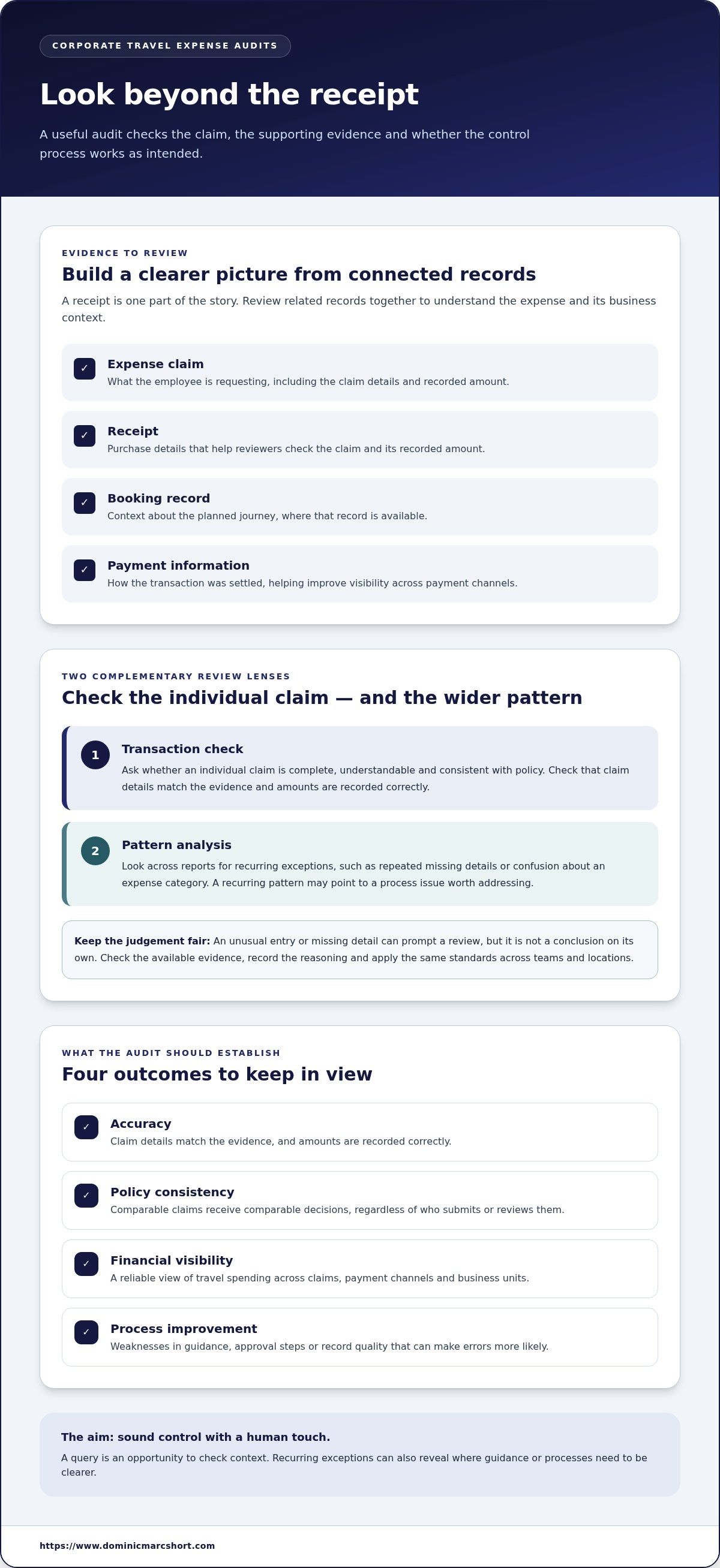
A corporate travel expense audit is a documented review of travel claims, supporting evidence and alignment with organisational policy, with clear outcomes for each control. It should establish whether records are accurate, decisions are consistent, spending is visible and processes are working as intended. In short, an audit tests the control system as well as the claim.
That distinction matters. A claim that needs clarification is an exception for review, not proof of misconduct. Missing context may reflect an unclear rule, a delayed receipt or an unusual but legitimate journey. Fair handling means checking the available evidence, recording the reasoning and applying the same standards across teams and locations.
Effective corporate travel expense audit best practices support four connected objectives:
Accuracy: Check that claim details match the evidence and amounts have been recorded correctly.
Policy consistency: Confirm that comparable claims receive comparable decisions, regardless of who submits or reviews them.
Financial visibility: Build a reliable view of travel spending across claims, payment channels and business units.
Process improvement: Identify weaknesses in guidance, approval steps or record quality that make errors more likely.
What should a travel expense audit examine?
Review complementary records rather than treating a receipt as the whole story. A claim explains what the employee is requesting; receipts provide purchase details; booking records can clarify the planned journey; and payment data can show how a transaction was settled. Together, these sources help reviewers assess whether an expense fits the business purpose and organisational rules. The wider Expense management process also connects policy, procedures and the handling of travel-related spending.
There are two useful levels of review. A transaction check asks whether an individual claim is complete, understandable and consistent with policy. Pattern analysis looks across reports for recurring exceptions, such as the same type of missing detail or repeated confusion about an expense category. One unusual entry may need a simple explanation; a recurring pattern may point to a process issue worth addressing.
How do audits support a stronger travel programme?
Reliable reviews create a more consistent link between written policy and day-to-day decisions. Employees can follow expectations more confidently when guidance is clear and reviewers apply it consistently. Finance and travel teams gain a more useful picture of where spending occurs and which types of claims require attention.
Recurring exceptions can be valuable signals, not just items to resolve. If employees across teams interpret a rule differently, the policy may need clearer wording. If supporting records are routinely incomplete, the submission process may need improvement. Connecting audit findings to a practical corporate travel policy review helps turn individual queries into better guidance and smoother processes. The aim is sound control with a human touch, not a paperwork obstacle course.
Build a travel expense audit framework around policy, evidence and risk
A reliable framework turns policy into checks that reviewers can apply consistently, with evidence and decisions recorded clearly. Start with rules employees can find and understand, then define what each rule means in practice. If a policy says that a particular expense needs approval, for example, the audit control should specify what record demonstrates approval and who reviews it.
Set risk thresholds internally, based on your organisation’s travel patterns, policy priorities and capacity to review claims. Avoid importing generic benchmarks that may not suit your programme. A threshold should guide attention, not automatically label a claim as incorrect. Record why a claim was selected, what evidence was examined and how the reviewer reached a decision.
Turn travel policy into reviewable controls
Translate policy wording into observable questions: Was the required approval recorded? Is the expense category clear? Is the supporting documentation available? Where a rule allows judgement, provide examples and a route for resolving questions. If different teams interpret a rule differently, clarify it before treating the variation as employee non-compliance. Assign a policy owner to approve clarifications and communicate them consistently.
Select evidence and prioritise review effort
Match available evidence to the control being tested. An expense claim may be compared with its receipt, booking record and payment information, where available. Missing support, unusual patterns and repeated exceptions can prompt a review, but none is a conclusion on its own. Use your own risk indicators and document the rationale for escalation. Where system settings or workflows form part of the control, travel management system auditing can help assess how those controls operate.
A practical control map:
For each control, also state where the decision is recorded and which organisation-approved retention approach applies. This creates a traceable audit trail without assuming that every claim needs the same level of scrutiny. These corporate travel expense audit best practices make the framework usable across teams while leaving room to tailor controls to the organisation’s processes.
Where policy, evidence and payment processes need to work together, independent business travel management perspective can help connect audit findings with wider process improvements.
Choose audit checks that catch issues without creating unnecessary friction
Not every claim needs the same depth of review. Applying an identical, detailed check to every transaction can use up reviewer time without helping teams distinguish routine claims from those needing closer attention. A proportionate model combines baseline checks with targeted reviews and periodic analysis of broader patterns. The aim is not less control, but to direct attention where it can answer a useful question.
Three review types serve different purposes. Routine checks establish that core information is present and consistent. Targeted exception reviews examine claims with a specific reason for follow-up. Pattern analysis looks across reports for recurring issues that may need a policy or process response.
When should a claim receive additional scrutiny?
Use a defined signal to explain why a claim needs a closer look. That might be missing support, details that do not align across records, or a similar exception recurring in reports. Check the facts and seek relevant context before reaching a conclusion. A discrepancy may have a straightforward explanation, and a repeated issue may indicate a confusing process rather than individual wrongdoing.
How can controls remain fair to employees?
Fairness comes from applying documented rules consistently and explaining decisions in plain language. Tell employees what information is missing or unclear, identify the evidence behind a decision and provide a clear way to correct an error or add context. Keep the process calm and specific; nobody enjoys being asked to solve a mystery with half the clues missing.
Reviewers should distinguish between an inadvertent mistake, an ambiguous policy and deliberate non-compliance through evidence-led follow-up, not assumption. Record the reason for escalation and the outcome, so comparable cases can be handled consistently. If an employee’s explanation resolves the question, close the exception accordingly. If it does not, follow the organisation’s established process and keep the rationale documented.
These corporate travel expense audit best practices make review intensity easier to explain: routine claims receive proportionate checks, while defined signals prompt a closer look. Employees are treated as participants in a clear control process, not as suspects by default. That balance helps protect confidence in the audit while preserving meaningful oversight.
Run a corporate travel expense audit from intake to follow-up
A clear workflow makes an audit easier to manage and its decisions easier to explain. Give each stage an owner, record the outcome and make sure exceptions don’t disappear into an inbox once a question has been answered. The sequence below gives employees, managers, finance reviewers and policy owners a shared route from submission to improvement.
Define the scope. The finance reviewer and policy owner agree which claims, period, business units or control areas are in scope, and what questions the review should answer. Keep the scope focused enough to guide the work.
Assemble the records. The employee submits the claim and relevant supporting material. The line manager confirms business context or approval where required, while finance gathers available booking and payment records for comparison.
Review against the agreed controls. The finance reviewer checks the records within scope and notes any discrepancy or missing detail. Apply the documented criteria consistently, and distinguish verified facts from assumptions.
Resolve exceptions. Give the employee a clear opportunity to explain a difference or provide further information. The line manager can clarify the business context; finance records whether the question is resolved or needs escalation.
Report the outcome. Summarise what was reviewed, the findings, any unresolved questions and the actions agreed. The policy owner considers whether an issue points to unclear guidance or a broader control weakness.
Follow up. Assign each action to a role, set an internally agreed completion point and record its status. Finance tracks individual corrections, while the policy owner monitors changes to guidance or process.
Document findings so decisions are traceable
Use one consistent record for the reason a claim was reviewed, the evidence considered, the decision and its rationale, the action owner and completion status. Separate confirmed errors from unresolved questions and matters awaiting more evidence. That distinction keeps a pending query from looking like a settled finding. Handle and share records in line with your organisation’s data governance requirements, limiting access to what the review needs.
Close the loop after the review
An audit isn’t finished when the reviewer reaches a decision. Check that corrections and process actions are completed, then examine recurring findings for opportunities to improve policy wording, employee guidance, payment visibility or workflow design. For example, repeated delays in obtaining the same supporting detail may point to a submission step that needs clarification.
Where findings reveal avoidable hand-offs or duplicated work, connect the audit response to broader business travel process improvements. A well-designed workflow should make the right action clear without adding a new form for every small question. These corporate travel expense audit best practices turn review records into accountable follow-up, rather than a tidy report that nobody opens again.
Use audit findings to improve corporate travel expense management
An audit becomes more valuable when its findings lead to practical changes. Group observations by the problem they reveal, rather than treating every exception as a one-off. This helps distinguish a claim-level correction from an improvement that could make the travel programme clearer and easier to manage.
Policy clarity: Identify rules that employees or reviewers interpret differently, then clarify the wording and explain the change.
Process design: Look for repeated hand-offs, duplicated steps or points where information is often missed.
Payment visibility: Check whether available payment information gives reviewers a coherent view of travel transactions.
Data quality: Note missing, inconsistent or difficult-to-reconcile records and identify where they enter the process.
Employee guidance: Spot recurring questions that suggest instructions, examples or communications need improvement.
Prioritise possible actions by business relevance, recurrence and feasibility. A recurring issue that affects a core control may deserve attention before an isolated inconvenience; a useful change should also be practical to implement and maintain. Record why an action takes priority, who owns it and what outcome will show it has been completed. Avoid promising savings based on audit findings alone. The goal is to make decisions better informed, not to turn every observation into a forecast.
Measure whether the audit process is becoming more useful
Choose internal measures that reveal whether reviews are being completed, repeat exceptions are changing, resolution is progressing and policy clarification is still needed. Define each measure consistently, including what counts as an exception and when resolution time begins and ends. Compare like with like across reporting periods, and interpret changes alongside shifts in audit scope or travel activity. Your own trend is more useful than an unrelated benchmark.
Connect expense controls to wider travel management
Expense evidence is shaped by the wider travel process. Booking steps affect what journey information is available; payment design influences how transactions can be reconciled; and employee communications help determine whether claims arrive with the right context. If payment records create recurring gaps, consider how corporate travel payment optimisation could support clearer visibility and review.
For organisations, an independent review can connect audit observations with process analysis and optimisation, payment solutions and digital transformation. Dominic Marc Short - Independent Consultant provides business travel management consulting that considers how individual control findings relate to the wider programme. With more than 30 years of business travel management experience, Dominic Marc Short - Independent Consultant can help organisations assess issues that cross team or process boundaries.
Make your next audit a useful turning point
Your next step needn’t be a wholesale redesign. Choose one recurring point of friction, such as unclear guidance or information that is difficult to reconcile, and agree who will address it and how you’ll assess progress. A focused improvement gives employees and reviewers something practical to work with, while helping leaders see whether the change is making the process clearer.
Use corporate travel expense audit best practices as a foundation for steady refinement, not a reason to add controls for their own sake. As your travel programme evolves, revisit whether each review still serves a clear purpose and whether employees understand what is expected of them. Good governance can be rigorous and fair; it doesn’t need to feel like a surprise inspection at the airport.
With a clear next step and shared ownership, your audit can support a travel programme that works better for the organisation and the people travelling on its behalf.
Frequently Asked Questions
How often should a company audit corporate travel expenses?
Set audit frequency according to spend patterns, internal capacity, risk signals and changes to travel policy. A company with new approval rules, for example, may benefit from a targeted review to see whether they’re being applied as intended. Document a regular cadence, then add focused reviews when circumstances warrant them. Consistent records help the organisation judge whether its approach remains proportionate. These corporate travel expense audit best practices should fit the programme, not an arbitrary universal timetable.
What documents should be included in a travel expense audit?
Use the records relevant to the claim and the control being tested. These may include an expense report, receipts or other supporting evidence, approval records, applicable policy guidance, booking information and payment records where available. For example, a review of an approval control needs evidence of the decision, while checking a transaction may require supporting purchase details. The precise set depends on the organisation’s process; collecting every available document can add effort without answering the audit question.
Does an expense audit mean an employee is suspected of fraud?
No. An audit can assess accuracy, consistency and policy alignment, and a flagged exception alone doesn’t establish misconduct. If a claim appears incomplete, the reviewer should seek context and check relevant records before deciding what happened. A mistake, an unclear instruction and an unresolved discrepancy call for different responses. Explaining that routine reviews test the process, rather than presume wrongdoing, can help employees understand why information is requested and maintain trust.
What should a business do when a travel expense receipt is missing?
Follow the organisation’s documented process for missing evidence. Record why the receipt isn’t available, then consider relevant information such as the claim details, approval record or other supporting material permitted by internal guidance. Don’t assume one response applies to every claim, or infer a tax or legal treatment from the absence of a receipt. A consistent decision record helps reviewers handle similar cases fairly and can reveal whether employees need clearer instructions.
Can small businesses audit travel expenses without dedicated audit software?
Yes. A small organisation can use the records and tools it already has, provided it sets out who submits and reviews claims, what evidence is considered, how decisions are recorded and who follows up. A shared register can help track open queries and completed actions. Manual checks may become harder to coordinate as claim volumes grow, so review whether the approach remains workable before missing information turns into a paperwork treasure hunt.
What is the difference between an expense audit and a travel management system audit?
An expense audit examines claims and their supporting evidence, usually to assess individual transactions or patterns. A travel management system audit focuses on the technology behind the process, including its configuration, data and controls. They have different scopes, but findings can inform one another: a recurring data gap in claims may lead to questions about how information moves through the system. A system-level review is useful when the focus shifts from a claim to the controls supporting the workflow.



Comments