Blended Travel Policy: Rules for Business and Leisure Trips
A work trip can include leisure without changing its primary purpose. A blended travel policy for business and leisure sets out which dates and costs are work-related, which are personal, and how the organisation manages traveller location and destination risks.
That distinction matters: a meeting itinerary and a holiday may share a suitcase, but they should not be blurred in company bookings, expenses or risk arrangements. Clear rules help employees understand what the organisation covers and what they are responsible for during personal time.
This article explains what blended travel means, how to separate business days from leisure days, and what a policy can say about approvals, expenses, traveller tracking and destination risks. You will get a practical framework for handling extensions without making the policy feel like another piece of holiday reading.
Table of Contents
How Should Companies Set Policies For Blended Trips?
A blended-trip policy should define approvals, expense allocation and responsibilities before employees book. For Swiss organisations, separate records help distinguish work-related costs from personal spending without treating a foreign tax example as a Swiss rule.
Comparing Blended and Business-Only Trip Costs
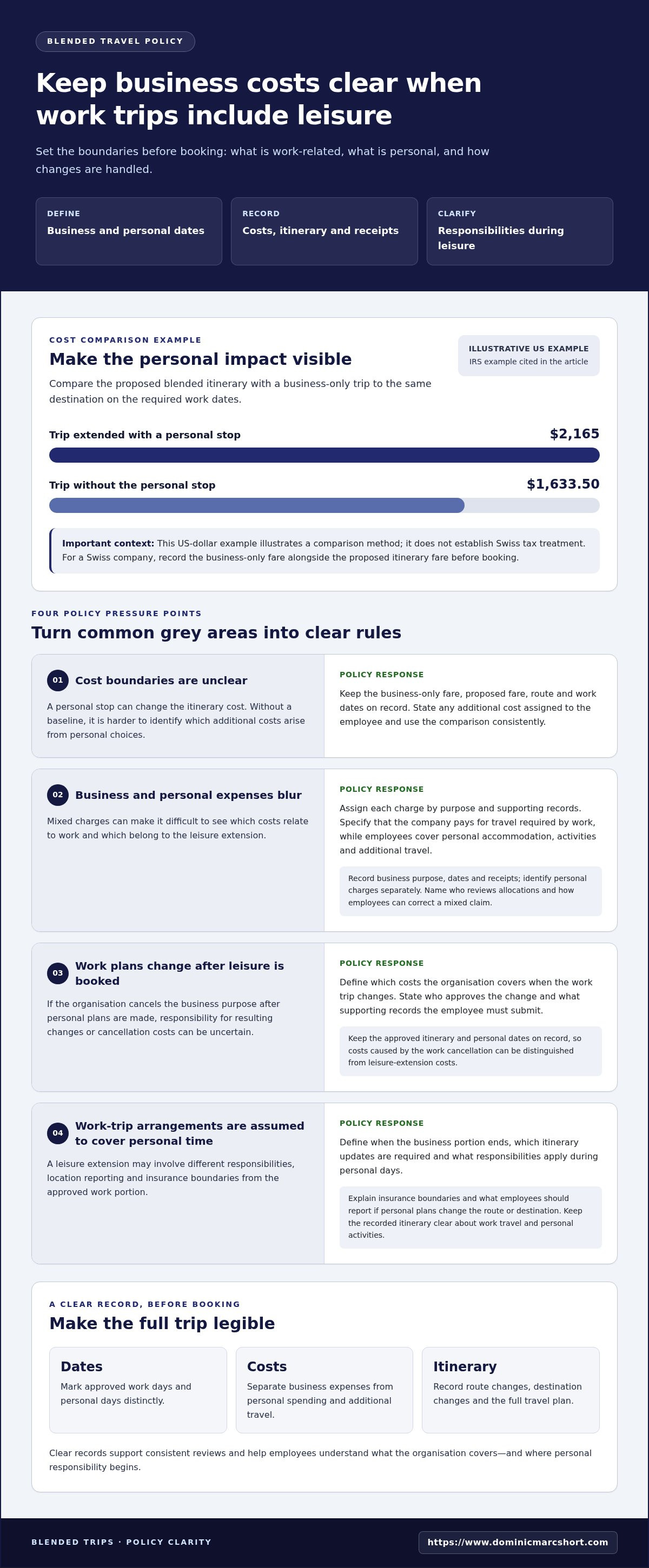
A cost comparison measures a proposed blended itinerary against a business-only trip to the same destination on the required work dates. This shows which costs arise from work and which result from personal choices. According to the Internal Revenue Service, an example trip extended by a personal stop cost $2,165, while the trip without the stop would have cost $1,633.50. This US-dollar example illustrates a comparison method; it does not establish Swiss tax treatment.
For a Swiss company, record the business-only fare alongside the fare for the proposed itinerary before booking. Document the route, work dates and any additional cost assigned to the employee. This comparison gives finance teams a consistent basis for reviewing changes and making transparent decisions across global teams.
Separating and Allocating Trip Expenses
Expense allocation assigns each charge to business or personal time based on its purpose and supporting records. A policy can specify that the company pays for travel required by work, while employees cover personal accommodation, activities and additional travel. Keep receipts and business dates clearly recorded, and separate personal purchases from company expenses.
For Swiss expense reporting, record the business purpose, dates and receipts for each claimed cost, then identify personal charges separately. These records help the organisation apply its expense process consistently, but do not by themselves determine tax treatment. State who reviews allocations and how employees can correct a claim that includes both work and personal costs.
Cancellations and Personal Commitments
Cancellation rules explain what happens when a work trip changes after an employee has made personal arrangements. If the organisation cancels the business purpose after personal plans are booked, the policy should define which resulting change or cancellation costs it covers. It should also state who approves the change and which supporting records the employee must submit.
For example, an employee adds personal days after an approved meeting, then the meeting is cancelled. The policy can distinguish costs caused by cancelling the work itinerary from those belonging to the leisure extension. Recording the approved itinerary and personal dates helps managers apply the rule consistently and prevents uncertainty from surfacing in the expense report.
Duty of Care During Personal Extensions
Duty-of-care boundaries explain which company arrangements apply during work dates and what changes during personal time. Define when the business portion ends, which itinerary updates employees must provide, and what responsibilities apply during the leisure extension. Clear terms help employees understand the distinction before travel begins.
Address insurance boundaries alongside location reporting. Employees should know what information to provide if personal plans change the route or destination, and which company arrangements apply to the approved work portion. A recorded itinerary helps the organisation maintain visibility of work travel without presenting personal activities as company-directed business.
What Is Blended Travel (Or Bleisure Travel)?
Bleisure combines an approved business trip with personal holiday time before or after work commitments. A clear definition helps employees and managers distinguish a leisure trip from business travel, without asking one itinerary to serve both purposes.
Defining Blended and Bleisure Travel
A bleisure trip is a business journey extended with personal vacation days immediately before or after workdays, while its primary purpose remains business. For example, an employee attending corporate meetings domestically might add personal days after the final meeting. The distinction matters because booking, expense and risk arrangements can differ across those dates.
Use consistent terms in the policy: “business days” cover approved work activity, while “personal days” cover the employee’s leisure extension. Specify how a destination change or remote working affects the classification. This prevents a personal stop from becoming an unrecorded work location.
Bleisure Market Size and Growth
Global bleisure growth describes the expansion of travel that combines work commitments with leisure time. The market is projected to grow at a compound annual growth rate of 12.69% from 2025 to 2034. This context helps organisations assess why clear rules matter as employee expectations and booking patterns evolve.
SAP Concur’s 2025 Global Business Traveler Report says the share of trips classified as bleisure rose from 23% in 2019 to 41% in 2025. IATA’s 2025 Global Passenger Survey reports that 73% of business travellers expect one booking to handle both work and leisure segments. That expectation makes policy design relevant to booking systems, not just expense forms.
Start implementation by making bleisure a formal part of the corporate travel policy. Define who can request an extension, which details need approval, and how exceptions are recorded. A request should capture work dates, personal dates, destination changes and the full itinerary. Managers can then assess the proposed trip before employees make personal commitments.
Automation can support these rules by routing requests for approval and capturing business and personal dates in the booking workflow. A system can also prompt employees to identify personal segments and keep relevant itinerary details together. The policy remains the decision-making framework; automation helps apply it consistently across teams and national operations.
For example, an employee proposing a remote leisure stop can submit the revised itinerary through the same approval process as a direct extension. The workflow records the change and gives the appropriate manager a clear view before booking. Consistent records also help organisations review participation, savings and retention considerations without confusing leisure activity with work.
Organisations translating these principles into practical travel rules may find Dominic Marc Short - Independent Consultant a useful next step.
Duty of care, traveller tracking, and destination risks
A blended itinerary can take an employee between company-directed work and personal travel. A policy should explain how destination risks, traveller visibility and insurance boundaries differ across each part of the trip.
Destination Risks and Duty of Care
Destination risk management considers where an employee will be and what support applies during each part of the journey. This matters because a work meeting and a personal excursion may involve different locations, activities and responsibilities.
International SOS’s Risk Outlook 2025 reports that 71% of organisations cannot definitively state whether travel risk coverage extends into employee-funded leisure days. A policy can address this gap by explaining which arrangements apply during business dates and what changes during personal time.
For example, an employee attends a conference in one destination, then travels elsewhere for personal reasons. The itinerary should show both locations and identify when the work programme ends. The organisation can then assess destination risks relevant to the business portion and explain the boundaries that apply during the leisure portion.
ISO 31030 is relevant to shared responsibilities between organisations and travellers in travel risk management. Use it as a reference point when defining responsibilities, communicating risk information and setting employee expectations. The policy should also explain how employees report changes affecting their destination or itinerary.
Approval Workflows and Duty-of-Care Boundaries
An approval workflow records the itinerary, dates and destinations before a blended trip is booked. This gives the organisation a clear view of the work portion and any employee-funded extension, supporting consistent decisions about risk and responsibility.
Require employees to submit the full itinerary, including leisure destinations and dates, through the organisation’s managed booking or registration process. If a personal change affects the route, employees should update the recorded details. Unmanaged bookings can make it harder to locate travellers when destination risks remain present.
For visibility, companies can require employees to disclose their location during workdays. They can also establish full-trip registration, continuous risk monitoring, consistent cybersecurity protocols and clear communication about insurance boundaries. These measures maintain useful records without treating personal travel as company-directed work.
Set out the boundaries plainly: identify when the business portion begins and ends, which locations require updates, and how personal changes are reported. Explain the employee’s responsibilities during leisure time, including what to do if plans change. A well-structured business travel risk management policy can bring these processes together for a hybrid itinerary.
What Defines Business Travel?
For blended trips, classify each activity by its business purpose, not simply by its place in the itinerary. Corporate rules should connect that distinction to spending controls, flexibility and duty of care.
Corporate Policies and Spending Controls
A corporate travel policy defines which trip costs employees may charge to the organisation and how they report them. This matters because an itinerary can include both approved work and personal purchases. Set out eligible expenses, required receipts, approval responsibilities and the process for correcting an expense report. For example, record a client meeting’s travel costs separately from a personal dinner after the meeting.
Corporate-card controls can reinforce those boundaries. State that employees may use the card only for approved business expenses, then require personal charges to be identified and repaid under the organisation’s process. A clear report should show the date, business purpose and receipt for each claim. This gives finance teams a consistent record instead of asking them to solve a holiday puzzle at month-end.
Companion travel also needs a defined rule. In one survey, 24% of business travellers planned to bring friends on trips. A policy can require employees to pay companion costs personally and keep them off corporate bookings or cards, unless a separate business purpose has been approved.
Flexibility in Corporate Travel Policies
Policy flexibility lets employees adapt travel arrangements while retaining clear approval and spending boundaries. This matters because a rigid rule may not suit every route, meeting schedule or blended itinerary. Establish which changes employees can make independently and which require manager approval, such as changing the destination or adding personal nights.
For instance, an employee attending a Geneva conference may request an extra personal night. The policy can permit the extension while requiring the employee to separate its costs and preserve the approved work itinerary. This supports practical planning without transferring personal expenses to the company or obscuring corporate travel records.
Flexibility should not remove duty-of-care requirements for the work portion. Specify how an employee reports itinerary changes and how updated work arrangements are recorded. A straightforward approval path helps managers assess requests before booking, while employees retain room to plan their leisure time.
Use of Corporate Hotel Rates
A corporate hotel rate is a negotiated accommodation rate intended for eligible company travel. Its use matters on blended trips because the arrangement may apply to work nights but not automatically to personal nights. Whether employees can use a negotiated rate for personal nights depends on the hotel’s agreement.
Write the rule in practical terms: identify business nights, show personal nights separately, and explain how each is booked and paid. For example, an employee could reserve the meeting-night stay through the corporate programme, then arrange and pay for an additional leisure night separately. This keeps the expense report clear and avoids assuming that one corporate booking covers every night.
When reviewing a hotel invoice, employees should identify the dates and charges connected with work. Finance teams can then match those entries to the approved itinerary and apply the organisation’s expense rules consistently across blended trips.
Business travellers’ leisure extensions
Leisure extensions are becoming a regular part of corporate travel planning, not an unusual detour. The GBTA 2025 Business Travel Index Outlook reports that 68% of corporate travellers extend at least one trip annually, with an average extension of 2.3 nights. For Swiss organisations, the practical question is how to make that flexibility work without losing sight of the business itinerary.
That pattern matters to employees and employers alike. In a cited survey, 76% of business travellers had added leisure time to a work trip, while 89% wanted to extend their next trip. A conference in Lausanne, for example, might finish on Friday, giving an employee the option to stay for personal time. The business purpose remains the conference; the extension is a separate leisure portion.
Policies can turn that common practice into a consistent process. Require employees to submit the business dates, leisure dates and full itinerary before booking. Approval should cover the proposed trip as a whole, so a manager can see the route and timing together. Set out which changes need fresh approval, such as adding a destination or shifting a workday into personal time.
Extension limits are another useful boundary. One policy model caps domestic extensions at 3-7 nights and permits up to 10 nights internationally for trips crossing 6 or more time zones. These are policy design options, not a universal rule. A company can choose limits that reflect its travel programme, trip purpose and ability to maintain visibility.
Keep the business trip and leisure portion distinct in practice. The work itinerary should show the meetings, conference or other approved activity. Record personal dates and destinations separately, and communicate any changes through the agreed process. This makes the itinerary easier to understand if work arrangements or a traveller’s plans change.
Personal interests can also shape whether employees accept a trip. Nearly 40% of business travellers used downtime on blended trips to pursue personal hobbies in 2024. That does not make leisure time a work activity; it shows why clear boundaries can make an extension easier to plan without confusing the two purposes.
The key takeaway: treat an extension as a planned part of the itinerary, with its own dates, approvals and responsibilities. A conference may bring an employee to a destination, but the policy should make clear where work ends and personal time begins.
Dominic Marc Short - Independent Consultant: Business Travel Management Consulting
Dominic Marc Short - Independent Consultant can help organisations turn blended-trip principles into a coherent business travel programme. Travel consulting supports companies reviewing travel processes, policy design and operational arrangements, including how blended itineraries fit existing controls.
Consider this support when different teams apply inconsistent approval rules, booking processes or expense boundaries, or when a policy needs to work across global operations. Global Transformation Management can support wider changes to travel systems and processes, while Change Management Communications Packages help communicate new arrangements to employees. For organisations planning conferences alongside business travel, Meeting and Conference Organization is also relevant.
A well-designed policy should make work and personal responsibilities easier to understand, not turn every itinerary into a puzzle. To discuss your organisation’s travel management needs, contact Dominic Marc Short - Independent Consultant or visit the company website.
Make Your Travel Policy Ready for What Comes Next
A blended travel policy for business and leisure works best as an operating framework, not a document filed away after approval. As booking tools, employee expectations and business priorities evolve, review whether the policy still fits how your organisation makes decisions. Consider how managers approve itinerary changes, how finance teams record expenses, and how employees understand their responsibilities during work and personal time.
For Swiss organisations with teams travelling across borders, consistency matters. A policy should give employees a dependable process while allowing managers to respond to genuine business needs. Use feedback from travellers and policy owners to identify confusing steps, then refine the guidance and supporting workflows. Clearer processes can make the next blended trip easier to plan, manage and explain.
Give your travel programme a thoughtful next step, making room for work trips that run smoothly from departure to return.
Frequently Asked Questions
How Can Companies Support Flexibility Without Losing Control?
Companies can allow personal extensions while keeping approval and booking changes within a defined process. For example, an employee could request a weekend stay after a conference, with the revised itinerary submitted before booking. Managers can assess whether work dates remain unchanged and whether the extension affects the route or company costs. A consistent process gives employees room to plan while preserving a clear record for finance and travel teams.
How Should Transportation Be Handled For Blended Trips?
Separate the transport required for work from any additional travel chosen for leisure. Compare the proposed route with a business-only itinerary to the same destination on the necessary work dates. If a personal detour changes the fare, the policy can explain how to allocate the difference. Record business and personal legs clearly, including ground transport, since airport transfers and local journeys can otherwise be difficult to classify.
What is a blended business and leisure travel policy?
A blended travel policy for business and leisure sets the organisation’s rules for combining approved work travel with personal time. It explains how an employee requests an extension, which costs relate to work, and how itinerary changes are recorded. For example, a policy could distinguish a client visit from a personal stay afterwards. This gives employees and managers a shared framework for handling one journey with two purposes.
What should a bleisure travel policy cover?
A bleisure policy should cover approval, itinerary visibility, expense allocation and responsibility during personal days. It should also explain how employees report changes to destinations or travel dates. For instance, if a traveller adds a personal stop after a work event, the policy should clarify how the stop is recorded and which arrangements apply. Clear wording helps employees understand the boundaries before their plans become difficult to change.
Who pays for flights, hotels, meals, and other expenses on a blended trip?
The company generally covers expenses required for approved business activities, while employees pay personal costs arising from their leisure extension. A policy can limit the company’s flight contribution to the business-only fare and assign any added fare difference to the employee. It can also distinguish hotel nights needed for work from personal nights, and apply meal reimbursement only to designated business days.
How should companies allocate costs between business and personal travel?
Allocate each expense according to its purpose, timing and connection to approved work. Compare the blended itinerary with a business-only equivalent, then identify additional costs arising from personal choices. For example, an employee may submit a business hotel night separately from a personal night, even if both appear on one invoice. Keep receipts and itinerary records together so finance can explain the allocation when reviewing an expense report.
Who is liable for accidents or emergencies during the personal portion of a work trip?
Responsibility depends on the circumstances and arrangements for the trip, so a policy should not imply that business coverage automatically extends to personal days. It should define the business portion, explain insurance boundaries and state the employee’s responsibilities during leisure time. For example, the traveller should know which itinerary changes to report and what company arrangements apply before leaving the approved work route.
How should employees request approval and document blended travel expenses?
Employees should submit the complete itinerary for approval before booking, including work dates, personal dates, destinations and proposed route changes. Once approved, they should keep business and personal bookings or charges distinguishable where practical. For an expense report, retain receipts and identify the purpose and date of each charge. If plans change, update the itinerary through the organisation’s approval process so records remain aligned with the trip.



Comments