Travel Programme Stakeholder Management: 2026 Guide
What if the biggest obstacle to a better travel programme isn’t the policy, but uncertainty over who gets to shape it? Finance may focus on spend, HR on employee experience, procurement on supplier value, and travellers on whether the process works in practice. Without clear ownership, decisions can stall while meetings multiply. Effective travel program stakeholder management turns those different perspectives into shared priorities and practical action.
It’s understandable if stakeholder engagement feels like a calendar full of conversations but little visible progress. A programme needs input from the right people at the right points, clear decision rights and a way to see what has changed. Otherwise, even the keenest committee can become very good at booking its next meeting.
This guide explains how to identify the people and functions that should be involved, clarify ownership, and establish communication routines and measures of progress. It also explores how useful data and tailored change communications can turn decisions into improvements that support business goals and preserve a positive traveller experience. The aim is simple: build alignment that moves the programme forward, not just around the table.
Table of Contents
What Travel Programme Stakeholder Management Means, and Why It Matters
A corporate travel programme is a connected set of decisions, not simply a policy document or booking process. It brings together policy, booking, payment, risk, data, technology and the traveller experience. A change to one part can affect several others. For example, a new approval step may strengthen finance controls while adding work for travellers and travel arrangers.
Travel programme stakeholder management is the deliberate coordination of the people who shape or are affected by travel decisions, so their input leads to clear ownership and considered action. General programme communication shares information. Stakeholder engagement seeks relevant input, clarifies how it will inform a decision and follows through afterwards. That doesn’t mean inviting everyone to every meeting. It means involving the right people at the right point, rather than giving the whole organisation a permanent calendar invitation.
For a useful foundation in the wider principles, stakeholder management covers stakeholder analysis and the process of understanding and coordinating interests. In a travel programme, the practical task is to connect that thinking to real decisions and responsibilities.
Who counts as a stakeholder in a corporate travel programme?
The answer depends on the process or change being considered. Internal stakeholders may include travel management, finance, procurement, HR, risk, IT and business leadership. Each brings a different perspective. Finance may focus on payment and reporting, HR on employee experience, and IT on the systems involved.
Travellers and travel arrangers count too. They experience the policy and processes in everyday use, so their perspective can reveal where a seemingly tidy procedure creates friction. Suppliers or other external partners may also need to contribute when a decision affects their part of the programme. Not every decision needs every voice; involvement should follow the issue.
What does effective stakeholder management improve?
Clear ownership makes it easier to see who decides, who advises and who needs to be kept informed. It can also reduce duplicated requests, such as separate teams asking for the same information without knowing another function has already gathered it.
Purposeful cross-functional input helps balance competing needs. A proposed change can be considered against cost, traveller experience, risk and operational requirements, rather than optimised for one team alone. Organisations can assess progress using relevant measures, such as whether responsibilities are understood, decisions are completed as agreed and feedback identifies process issues to address.
Organisations reviewing how travel decisions fit into wider programme design can use strategic business travel consulting alongside broader process analysis and optimisation. A sound starting point is to make each decision and its owner visible, then invite the people whose knowledge can improve the result.
How to Map Travel Programme Stakeholders, Interests and Responsibilities
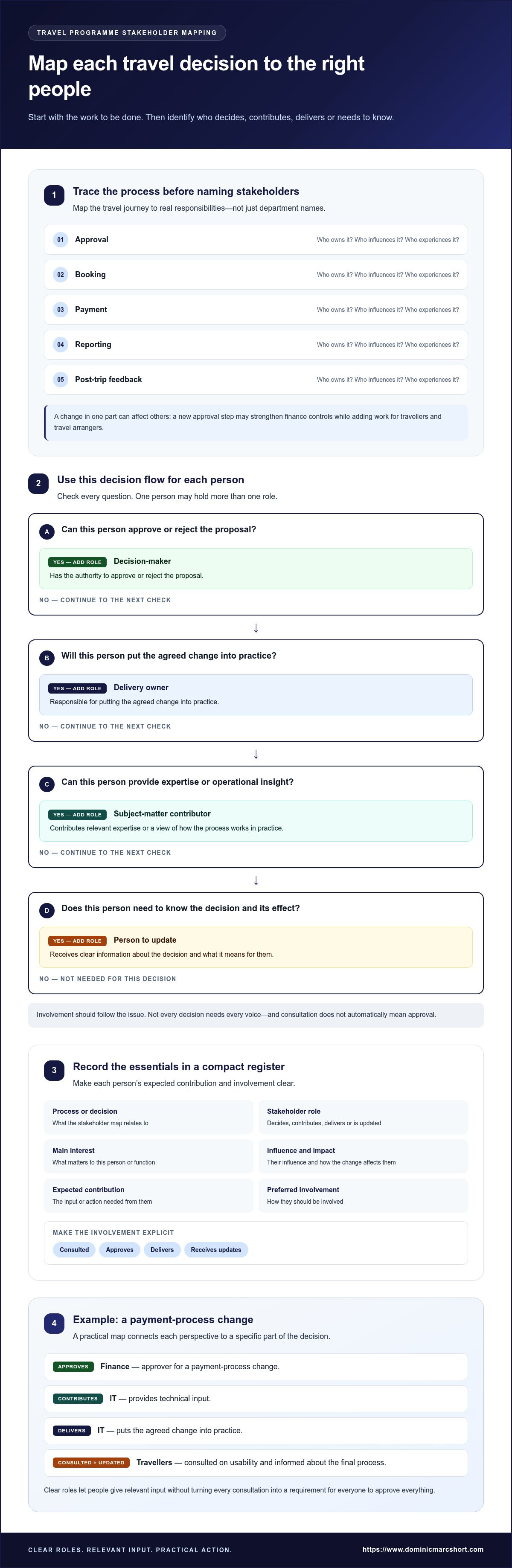
A useful stakeholder map starts with the work and decisions, not a list of department names. Trace the travel journey from approval and booking through payment, reporting and post-trip feedback. At each stage, ask who owns the process, who can influence its design and who experiences the outcome. This keeps the map connected to real responsibilities rather than turning it into an impressive-looking directory that nobody uses.
How to identify the right stakeholder groups
For each process, identify the functions responsible for policy, budgets, systems, traveller support and organisational risk. Then consider whose work or experience would change if the policy, process or technology changed. For example, an approval redesign may involve the policy owner and finance, while travel arrangers and travellers can explain how the proposed steps would work day to day. Bring in external partners only when their input is relevant to the specific decision.
Next, distinguish four types of involvement:
Decision-makers have authority to approve or reject a proposal.
Subject-matter contributors provide expertise or operational insight.
Delivery owners put the agreed change into practice.
People to update need clear information about the decision and its effect.
One person may hold more than one role, but naming the roles prevents a common muddle: contributors being asked to approve a decision they don’t own, or delivery teams hearing about a change after the planning is finished.
How to record interests, influence and ownership
Keep the register compact. Record the process or decision, stakeholder role, main interest, influence, impact, expected contribution and preferred involvement. Add whether the person is consulted, approves, delivers or receives updates. A simple example might show finance as an approver for a payment-process change, IT as a technical contributor and delivery owner, and travellers as a group to consult on usability and inform about the final process.
Be explicit about how input will be used. Consultation invites insight; it doesn’t automatically give every contributor approval rights. This distinction helps people contribute candidly without leaving the final decision owner unclear. A structured stakeholder engagement plan can also help turn stakeholder identification and needs into an organised approach.
Review the map when programme scope, business needs or responsibilities change. For broader context on how stakeholder alignment fits into programme analysis and improvement, read this strategic business travel consulting guide. If you’re shaping a framework for your organisation, explore business travel management consulting as a considered next step.
How to Set Decision Rights, Governance and Travel Programme Measures
Good governance doesn’t require consensus on every operational decision. It requires people to know who is accountable, whose expertise should inform the choice and who needs to hear the outcome. Without that distinction, routine adjustments can become lengthy negotiations, while genuinely strategic questions lack a clear route to resolution. A practical travel program stakeholder management framework makes decision rights visible and proportionate to the issue.
How should travel programme decisions be assigned?
Separate strategic decisions, such as setting policy direction or agreeing programme priorities, from operational decisions, such as refining an approval process. Assign one accountable owner to each decision. Record contributors and any required approvals separately, so consultation is meaningful without creating accidental vetoes.
Use a simple decision table as a starting point, then tailor roles to your organisation’s structure:
These are role examples, not a fixed organisational chart. For trade-offs between cost, service, risk and traveller needs, define an escalation route in advance. The decision owner can first seek input from relevant specialists, then escalate unresolved issues to the appropriate sponsor or governance group. That keeps discussion constructive and helps prevent a small process question from becoming a company-wide summit.
Which data and measures help stakeholders act?
Choose a small set of measures linked to agreed programme objectives. For each one, state what it means, who owns it, how often it is reviewed and what action it may prompt. Useful categories include:
Adoption: whether travellers use the intended process, owned by the relevant programme or process lead.
Compliance: how activity aligns with agreed policy, reviewed by the policy owner with relevant contributors.
Service: feedback or service issues that can inform improvements, owned by the designated service lead.
Process performance: delays, rework or other friction points, reviewed by the process owner.
Share only the information each stakeholder needs to fulfil a responsibility or make a decision. Establish a baseline from your organisation’s data before setting targets, and avoid borrowed benchmarks that may not reflect your programme. A measure is useful when it prompts a clear next step, not simply because it looks tidy in a dashboard.
How to Build a Travel Programme Stakeholder Management Plan
A workable plan turns stakeholder mapping into coordinated delivery. For travel program stakeholder management, keep the document practical: it should help people understand the change, their part in it and how the organisation will respond when implementation reveals a snag. Think of it as a route map, not a paperwork expedition.
Build the plan in five repeatable steps, with a clear output at each stage:
Define the change. Record its purpose, scope, intended outcomes and what will be different. Output: a concise change brief.
Map stakeholders. Identify affected groups, their interests and the involvement each needs. Output: a stakeholder map.
Agree ownership. Confirm decision rights, delivery responsibilities and how unresolved issues will be escalated. Output: an ownership record and decision log.
Plan engagement. Set audiences, messages, channels, timing, owners and the action expected from each group. Output: a communication schedule.
Review outcomes. Check adoption, gather feedback and agree when the change or engagement approach should be adjusted. Output: a review point with actions recorded.
This sequence makes the travel programme change management framework part of the programme’s practical delivery, rather than a separate exercise.
What should a stakeholder management plan include?
Bring the essentials together in one accessible working document: project purpose and scope, stakeholder roles, decision rights, engagement approach, risks, feedback routes and review points. Record decisions and actions as they happen, including who owns each follow-up. Keep the level of detail proportionate to the change. A minor process adjustment needs clarity, not a binder with its own shelf.
How to communicate programme changes and collect feedback
Tailor each message to what its audience needs to know, decide or do. A leader may need the rationale and expected organisational impact; a travel arranger may need the new workflow; an employee may need to know what changes when arranging or taking a trip. Explain why the change is happening, what it means in practice, when it takes effect and where questions or issues can be raised.
Keep feedback open after launch. Give people a clear route to flag confusion, delays or unintended friction, then assign someone to review and respond. Track adoption alongside these comments: low uptake may signal a communication gap, a process problem or a need for further explanation. Use the evidence to make proportionate adjustments, rather than treating every concern as a reason to rewrite the policy.
For more detail on employee-facing messages, see the travel programme update communication guide.
How to Sustain Stakeholder Alignment as the Travel Programme Evolves
Stakeholder alignment needs attention beyond launch. Business priorities shift, processes are refined and responsibilities can move between teams. A role that was central to a technology change may be less involved once the system is established, while a new operational issue may bring different colleagues into the picture. Review the stakeholder map and decision records at meaningful change points, not simply because another month has passed.
How to review engagement without creating meeting overload
Use scheduled decision points, milestone reviews and concise written updates. Before arranging a meeting, define the decision or issue it must resolve; if there isn’t one, a short update may do the job more cheerfully and with fewer calendar negotiations. Check whether each stakeholder remains relevant to current decisions, and adjust their involvement as responsibilities change.
After each review, record the decision, actions, owners and expected follow-up. This makes progress visible and gives people a clear route to raise unresolved issues. It also prevents the familiar cycle of revisiting the same topic because nobody can quite remember what was agreed.
Use feedback and data to guide sensible adjustments
Bring programme information together with recurring feedback from travellers, arrangers and the teams delivering the process. For example, repeated reports of confusion alongside evidence of incomplete adoption may point to a communication or usability issue. Neither signal automatically means the policy has failed. Look for patterns, establish where friction occurs and identify who can act on it.
Assign an owner to each improvement and set a review point to assess what changed. Close the loop with the people who raised the issue, even if the decision is to retain the current approach and explain why. This turns feedback into a source of insight rather than a suggestion box with excellent stationery.
When specialist support can help
When changes affect several processes or functions, specialist support can connect stakeholder alignment with end-to-end travel-process analysis and optimisation. Dominic Marc Short - Independent Consultant provides business travel management consulting, global travel solutions and digital transformation support. With more than 30 years of experience in business travel management and related fields, Dominic Marc Short - Independent Consultant can help organisations examine how programme components fit together.
Tailored change communications can also help employees understand what has changed, why it matters and how to follow the updated process. For a broader view of planning and delivering corporate travel change, see this travel programme change management framework. Consistent review, clear ownership and useful communication keep travel program stakeholder management connected to the programme’s real needs.
Turn Stakeholder Alignment into Lasting Progress
A travel programme is stronger when people understand their responsibilities, decisions have clear owners and feedback leads to considered action. Start with the processes and decisions that matter, involve stakeholders according to their role, and review whether the arrangements still fit as organisational needs evolve. That’s the practical value of travel program stakeholder management: better coordination without adding meetings simply for the pleasure of attending them.
Where programme processes need closer examination, business travel consulting can connect stakeholder alignment with end-to-end analysis, optimisation and digital transformation. CDABS provides this consulting, drawing on more than 30 years of experience in business travel management and related fields. Bespoke change communications can also help employees understand programme updates and what they mean in practice.
With clear ownership and a willingness to learn from experience, your travel programme can keep moving forward while staying aligned with the people it serves.
Explore CDABS business travel management consulting to connect your programme’s stakeholder priorities with practical process analysis and change support.
Frequently Asked Questions
What is stakeholder management in a travel programme?
Stakeholder management in a travel programme is the structured process of identifying people who shape or experience programme decisions and involving them appropriately. In practice, it clarifies ownership across policy, processes, systems, payments, risk and traveller communication. Effective travel program stakeholder management doesn’t mean consulting everyone on everything. It means connecting relevant input to a clear decision, recording follow-up actions and communicating the outcome to the people affected.
Who are the key stakeholders in a corporate travel programme?
Key stakeholders depend on the programme’s scope and the decisions being considered. They may include travel management, finance, procurement, HR, IT, risk and business leadership, as well as travellers and travel arrangers who use the processes. Suppliers or other external partners may contribute to specific decisions. Map people against the processes they influence or experience, rather than relying on a generic list that may include groups with no role in the work.
How do you create a stakeholder management plan for a travel programme?
Start by defining the objective or change, then map affected groups and record their interests and responsibilities. Assign a decision owner, identify contributors and approvals, and set communication and feedback routines. Include a small number of relevant measures and review points. Keep the plan practical: it should help people understand what they need to do and how decisions will be made, not become an administrative document that requires more care than the programme itself.
How often should travel programme stakeholders meet?
There’s no universal meeting schedule that suits every travel programme. Set engagement around decisions, milestones and changes, and use concise written updates when discussion isn’t needed. Before each meeting, define its purpose, the decision or action required and who owns the follow-up. If there’s no clear reason to gather, a short update may be more useful. Review the rhythm as the project evolves so meetings remain purposeful rather than simply recurring.
How can travel managers handle conflicting stakeholder priorities?
Make the trade-offs clear and assess proposals against agreed programme objectives. Confirm who has decision authority, whose expertise is needed and how unresolved issues will be escalated. A process change, for example, may affect cost, service and traveller experience differently. Record the rationale, communicate what was decided and explain why. Then review the effects using relevant programme information and feedback, so stakeholders can see how the decision is working in practice.
Which measures should a travel programme share with stakeholders?
Share measures that help a named stakeholder make or assess a decision. Depending on programme objectives, these could cover adoption, policy compliance, process performance, traveller feedback or programme costs. Define each measure, its data source, owner and intended use before circulating it. Establish baselines and targets using the organisation’s own data. A dashboard should make it easier to recognise when action is needed, not reward readers with a colourful puzzle.
How do you keep employees informed about travel programme changes?
Explain what is changing, why it matters and what employees need to do differently. Tailor the message to the audience, choose channels employees can access and provide a clear route for questions or feedback. Coordinate communication with implementation so guidance is available when the change takes effect. Afterwards, review recurring questions and comments. They can reveal unclear instructions or process friction and help the programme team decide whether further explanation or an adjustment is needed.



Comments