Sustainable Business Travel: 2026 Strategic Growth Guide
What if your corporate travel policy was actually something your employees bragged about at dinner parties rather than a source of office-wide grumbling? We all recognise the mounting pressure to hit those 2026 CSRD targets, but trying to untangle Scope 3 emissions while keeping your road warriors happy can feel like trying to fold a fitted sheet in a gale. You need sustainable business travel solutions that provide a clear, pragmatic roadmap without the usual greenwashing fluff that leaves everyone feeling a bit cynical.
It's entirely possible to build a programme that satisfies both the auditors and the human beings who actually use it. This guide promises to show you how to transform your travel approach into a sustainable powerhouse that boosts efficiency and attracts ethically minded top talent. We'll walk through a strategic framework for modernising your policy, improving your ESG reporting, and using bespoke change management communications to ensure your team is genuinely excited about the journey ahead.
Table of Contents
What Are Sustainable Business Travel Solutions in 2026?
In 2026, the definition of sustainability has matured significantly. It's no longer about simply ticking a box or throwing a few pounds at a carbon-offsetting scheme that promises to plant a sapling in a forest you'll never visit. Real sustainable business travel solutions are now viewed through the lens of process optimisation. This means moving beyond the "fly-and-forget" mentality and adopting a model where every journey is evaluated against its actual business value. We call this "Purposeful Travel". If a trip doesn't earn its carbon keep by delivering tangible results, it probably shouldn't be happening in the first place.
This shift isn't just about being "green" for the sake of it. With the EU Corporate Sustainability Reporting Directive (CSRD) in full swing as of January 2026, reporting Scope 3 emissions is a legal requirement for many. Listed small and medium-sized enterprises (SMEs) are now required to comply with these regulations. Sustainability has moved from the marketing department to the boardroom, making it a core operational priority.
The Triple Bottom Line of Corporate Travel
A robust programme balances three critical areas. First, the environmental impact involves reducing waste and emissions across the entire travel lifecycle. Second, the social aspect ensures traveller wellbeing and aligns with the principles of sustainable travel by supporting local economies. Finally, the economic pillar identifies cost savings. By prioritising smarter routing and multi-purpose trips, companies can reduce their footprint and their expenses simultaneously. Developing sustainable business travel solutions requires a steady, experienced hand to navigate these complexities without losing sight of the bottom line.
Why Your Company Cannot Afford to Wait
The "Talent Magnet" effect is very real in 2026. Gen Z and Millennial professionals are increasingly vetting potential employers based on their ethical alignment. If your travel policy looks like it was written in 1995, you'll likely struggle to recruit the best minds. Beyond recruitment, investors are demanding transparent ESG data. You can find more on how to align these needs in our strategic business travel consulting 2026 guide. It's about building a programme that people are proud to be part of.
Greenwashing is defined as the practice of making unsubstantiated or misleading claims about the environmental benefits of a company policy, which in 2026 carries a massive reputational and legal risk.
The Core Pillars of a Sustainable Travel Programme
A common misconception in the corporate world is that a shiny new booking tool will magically solve your carbon footprint woes. While technology is a brilliant enabler, it's merely the engine. Your travel policy is the steering wheel. Building effective sustainable business travel solutions requires a foundation of clear, actionable rules rather than just a subscription to a fancy platform. We often encourage clients to adopt the 'Avoid, Shift, Improve' framework to ensure every trip is truly necessary:
Avoid: Evaluate if a virtual meeting could achieve the same outcome before booking.
Shift: Prioritise rail or lower-emission transport for essential national trips.
Improve: Utilise sustainable aviation fuel (SAF) or carbon-efficient accommodation for unavoidable travel.
Data management serves as the bedrock of this entire structure. Without accurate, granular data, any sustainability claim is little more than a well-intentioned guess. By establishing a robust data baseline, you can implement 'Green Choice' defaults within your booking platforms. These subtle nudges guide employees toward lower-emission hotels or transport options by making them the easiest, most attractive choice. It's about making the right thing to do the easiest thing to do. It might even make the journey more enjoyable.
Policy Overhaul: From Permissive to Purposeful
The transition from a permissive travel culture to a purposeful one is where the real magic happens. This involves integrating sustainability into travel policy at a fundamental level. For instance, you might mandate rail travel for all national journeys where a door-to-door train trip takes less than four hours. It's a pragmatic shift that balances efficiency with ethics. To see how this fits into a broader strategy, our corporate travel policy strategic guide for 2026 provides a deeper dive into modernising your rulebook.
Digital Transformation as a Sustainability Catalyst
Digital tools are the secret sauce that makes these sustainable business travel solutions stick. In 2026, AI-driven systems can predict high-carbon choices before they're even booked, offering alternatives in real-time. This level of transparency at the point of sale empowers travellers to make better decisions on the fly. If you're looking to modernise your tech stack, our digital transformation for business travel: the 2026 strategic roadmap outlines the necessary steps. For those who feel a bit overwhelmed by the technical jargon, seeking an independent travel management consultant can help clarify the path forward without the vendor bias.
Policy vs. Practice: Integrating Sustainability into Your Travel DNA
The most common anxiety we hear from leadership teams is a variation of: "This all sounds brilliant on paper, but our employees are going to hate it." It's a valid concern. If a new policy feels like a series of joyless restrictions handed down from on high, your road warriors will likely find creative ways to bypass the system. However, the secret to successful sustainable business travel solutions isn't about policing your team; it's about changing the culture through expert change management. When people understand the 'why' behind the 'what', resistance usually melts away into genuine engagement.
We often see companies get bogged down in what we call the 'Carbon-Heavy Biscuit' trap. This is when an organisation spends three months debating the ethics of single-use plastic in the office pantry while ignoring the fact that half their sales team is flying short-haul when a train would be faster. It's vital to focus on the big wins first. By gamifying the process, you can turn sustainability into a friendly competition. Rewarding the department that achieves the highest carbon reduction per pound spent creates a sense of collective achievement that a dry memo simply can't match.
The Role of Change Management Communications
One-size-fits-all emails are where good intentions go to die. To truly embed sustainability, you need bespoke communication packages that speak directly to different stakeholders. A C-suite executive needs to hear about ESG reporting and risk mitigation, while a frequent traveller needs to know how these changes might actually improve their travel experience or wellbeing. Our strategic change management for corporate travel: a 2026 framework explores how to tailor these messages to ensure everyone feels like a partner in the transition rather than a passenger.
Creating a Culture of Accountability
Accountability is the bridge between a policy document and real-world results. This requires a shift in mindset from a traditional 'Duty of Care' to a broader 'Duty of Sustainability'. It's not just about keeping travellers safe; it's about keeping the planet safe too. Transparency in reporting is the only way to avoid internal scepticism. When employees can see the actual impact of their choices, they're far more likely to stay committed to the programme. Implementing these sustainable business travel solutions effectively means ensuring every department has skin in the game, with clear targets and visible rewards for those who lead the way.
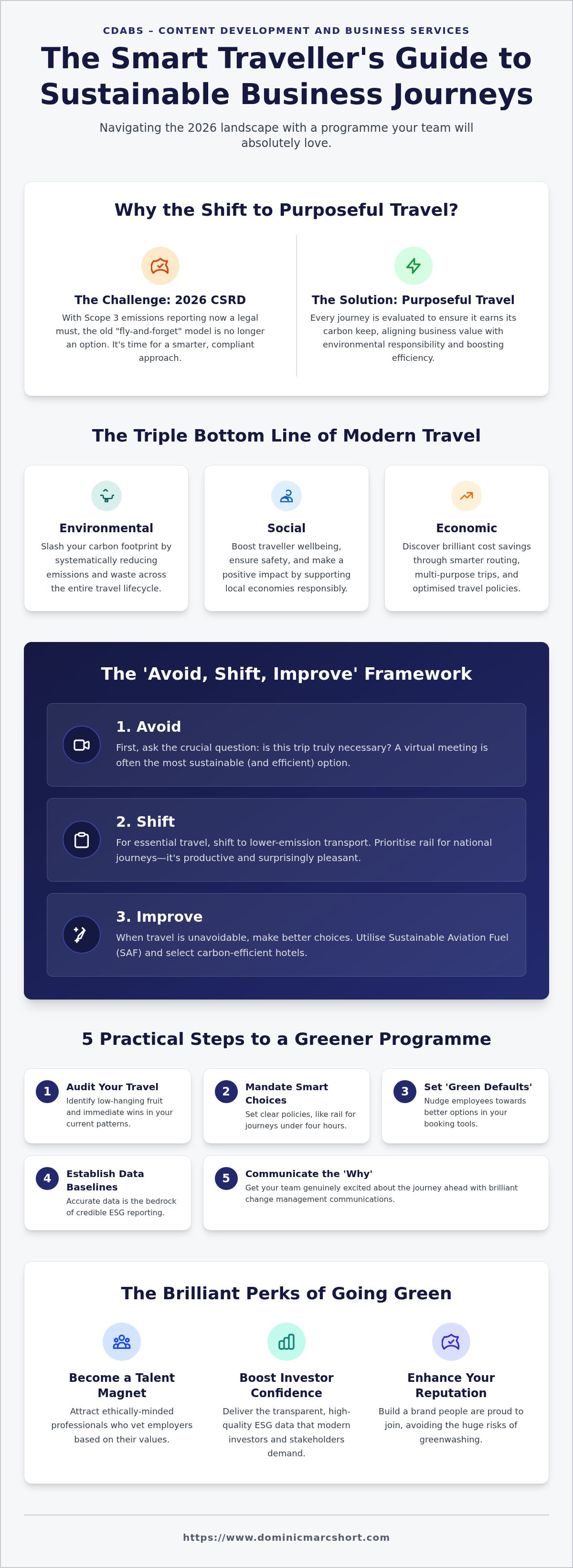
5 Practical Steps to a Greener Travel Programme
Building a programme that actually delivers results requires more than just good intentions; it needs a structured, sequential plan. Transitioning to sustainable business travel solutions is a project lifecycle that begins with a cold, hard look at the numbers. By following a methodical process, you can strip away the complexity and focus on the actions that yield the highest impact for both the planet and your budget. Start small. Think big. Move fast.
Auditing for Success
You can't manage what you haven't measured. A deep-dive analysis is the only way to uncover hidden inefficiencies and identify 'Ghost Travel', those habitual trips that could have easily been a ten-minute video call. This initial audit provides the carbon baseline you need to set realistic, auditable goals. For a detailed breakdown of how to approach this, our executive guide business travel analysis for 2026 offers a strategic framework for identifying these specific areas of waste.
Selecting the Right Partners
Updating your preferred supplier list is about looking beyond the green badge on a website. You need partners who are genuinely invested in the future, whether that's through significant Sustainable Aviation Fuel (SAF) contributions or hotels with verified circular economy practices. Negotiating 'Green Rates' for sustainable business travel solutions shouldn't mean paying a massive premium; it's about leveraging your volume to support those who prioritise the planet. It's a win-win that keeps your finance director smiling while your carbon reporting stays on track.
Step 1: Audit your current spend and data to establish a clear carbon baseline.
Step 2: Harvest 'Low-Hanging Fruit' by prioritising rail for any national trip where the journey is under four hours.
Step 3: Refresh your supplier list to favour partners with auditable sustainability credentials and SAF programmes.
Step 4: Roll out a bespoke communication plan that makes the team feel like heroes, not culprits.
Step 5: Measure your progress regularly, adjust the sails where necessary, and celebrate the milestones together.
Navigating the Future: How CDABS Transforms Travel into a Force for Good
In a market often crowded by travel management companies pushing their own proprietary booking tools, CDABS stands apart as an independent, steady hand. Our approach is rooted in the belief that sustainable business travel solutions should be built around your specific organisational goals rather than a vendor's sales targets. With over 30 years of industry experience, Dominic Short provides the seasoned authority needed to navigate these complex transitions with quiet confidence. We don't just offer a software subscription; we provide a strategic partnership that views sustainability as a powerful competitive advantage for 2026 and beyond.
Choosing an end-to-end consulting model over a simple agency tool allows for a much deeper level of process optimisation. While an app might flag a high-carbon flight, it won't help you restructure your entire travel culture or align your ESG reporting with the latest CSRD mandates. By treating travel as a strategic asset rather than a mere cost centre, we help you build a programme that is both ethically aligned and operationally elite. It's about ensuring your business is ready for the future, not just reacting to it.
Bespoke Consulting for SMEs and NGOs
Smaller organisations and non-governmental bodies often find themselves struggling with travel playbooks designed for global giants. These "one-size-fits-all" strategies usually result in unnecessary friction and wasted budget. Our SME travel management strategic guide for 2026 explores why bespoke, project-based consulting is the most effective way to achieve focused results. We specialise in creating lean, high-impact sustainable business travel solutions that respect the unique resource constraints and mission-driven nature of SMEs and NGOs.
Turning Strategy into Action
Our work spans the entire project lifecycle, moving from the inspiration of a keynote speech to the hands-on reality of process optimisation. We typically begin with a high-level audit to identify immediate opportunities for carbon and cost reduction. This methodical flow ensures that no detail is overlooked while keeping the broader strategic objectives in clear sight. It's a thorough process, but we believe it's the only way to build lasting stability in your travel programme.
Ultimately, the goal is to make business travel "happy" again. When journeys are purposeful, well-organised, and ethically sound, the dread of the "road warrior" lifestyle begins to fade. By making smarter, more intentional choices, you're not just hitting environmental targets; you're creating a better experience for your people. If you're ready to transform your travel programme into a force for good, we're here to facilitate that change with a calm and controlled perspective.
Building Your Sustainable Travel Legacy for 2026
The transition toward 2026 compliance shouldn't feel like a slog through dense regulations and disgruntled road warriors. By reframing sustainable business travel solutions as a process optimisation task, you can build a programme that satisfies both the auditors and your team. We've seen that the real magic happens when you combine data-driven audits with bespoke change management to create a culture that genuinely values purposeful travel.
With 30 years of industry leadership, CDABS provides the independent, unbiased expertise required to navigate these digital and ethical shifts. Our bespoke change management packages are designed to turn policy updates into office-wide wins. It's about moving beyond the "greenwashing" trap and delivering a travel programme that acts as a genuine talent magnet and a source of organisational pride.
You now have the roadmap to transform your corporate travel into a powerhouse of efficiency and ethics. It's time to make your travel programme something worth bragging about at the next board meeting.
Frequently Asked Questions
What is the most effective way to start reducing business travel carbon footprints?
The most effective starting point is a comprehensive audit of your current travel data to establish a carbon baseline. This allows you to identify "Ghost Travel", those habitual trips that don't earn their carbon keep and could easily be replaced by a video call. By focusing on high-impact areas first, such as shifting short-haul flights to rail, you can see immediate results without a total programme overhaul. It's about being pragmatic rather than perfect.
How can I integrate sustainability into our existing travel policy without a total rewrite?
You can integrate sustainability by introducing "Green Choice" defaults within your existing booking platforms. Instead of rewriting the entire rulebook, use subtle nudges that guide employees toward lower-emission hotels or transport options by making them the easiest selection. This approach respects existing workflows while gradually shifting the culture toward more purposeful travel. It's a bit like hiding vegetables in a child's dinner; they get the benefit without the fuss.
Are sustainable business travel solutions more expensive than traditional ones?
Implementing sustainable business travel solutions doesn't have to break the bank. In fact, many green initiatives, such as reducing the overall volume of trips and prioritising rail over air, lead to significant cost savings. While sustainable aviation fuel (SAF) or eco-certified hotels might carry a premium, these costs are often offset by the increased efficiency and reduced waste identified during a strategic audit. It's about spending smarter, not just spending more.
What are the best 'green' alternatives for short-haul national business trips?
Rail travel is the primary alternative for short-haul national trips where the door-to-door journey takes less than four hours. It's often more productive for the traveller, as trains offer a stable environment for working compared to the friction of airport security and boarding. For trips that are absolutely essential, opting for electric vehicle rentals or car-sharing schemes can further reduce the footprint of your national travel programme. It's a win for the planet and the traveller's sanity.
How do I communicate travel policy changes to employees to ensure they actually follow them?
Effective communication requires a bespoke approach that speaks to the "why" behind the changes. Rather than sending a dry, office-wide email, use tailored change management packages that highlight the benefits for different stakeholders. For example, show road warriors how rail travel reduces stress, while explaining the ESG benefits to the board. When people feel like partners in the transition rather than victims of a new rule, compliance becomes much more natural and cheerful.
Can an independent consultant really help more than a large travel management company?
An independent consultant offers an unbiased perspective that large travel management companies often lack. Large agencies are frequently tied to their own proprietary tools and vendor commissions, whereas an independent specialist focuses solely on your organisational health. With over 30 years of experience, we provide the steady hand needed for end-to-end analysis and process optimisation. We're not trying to sell you a subscription; we're here to make your travel programme actually work.
What role does digital transformation play in achieving a carbon-neutral travel programme?
Digital transformation acts as the engine for sustainable business travel solutions by providing real-time data and transparent reporting. Modern systems can predict high-carbon choices at the point of sale and suggest greener alternatives instantly. This level of technical integration ensures that your sustainability claims are backed by auditable data rather than guesswork. It transforms your travel programme from a manual headache into a streamlined, digital powerhouse that's ready for the reporting requirements of 2026.
How do I measure the ROI of my sustainable travel initiatives?
Measuring ROI involves looking at both financial savings and broader strategic gains. Beyond the immediate reduction in travel spend from fewer flights, consider the value of improved ESG reporting for stakeholders and the "Talent Magnet" effect on recruitment. Attracting top talent who value ethical alignment provides a long-term return that far outweighs the cost of consulting. It's a comprehensive view of success that positions your company as a forward-thinking leader in your industry.



Comments