Optimising Corporate Travel Payments: A 2026 Strategic Guide
The most expensive part of your business travel isn't the business class seat; it's the manual labour required to account for it. As global business travel spending is forecast to reach CHF 1.48 trillion in 2026, the challenge of optimizing corporate travel payments has shifted from a back-office administrative task to a high-stakes strategic priority. If your finance team is still reconciling credit card statements by hand or your travellers are frustrated by out-of-pocket expenses, you're likely losing the granular data needed to negotiate effectively with suppliers. Dominic Marc Short - Independent Consultant provides the steady, professional hand required to navigate this transition with quiet confidence.
We understand that modernising legacy systems feels daunting, particularly when managing Swiss VAT compliance and cross-border visibility. This guide promises to show you how to transform your payment ecosystem from a manual burden into a strategic asset that keeps both your finance team and your travellers smiling. We'll explore the methodical transition to virtual cards, the practical application of AI in expense coding, and how to harness rich data to gain the upper hand in your next procurement negotiation.
Table of Contents
The Hidden Costs of Fragmented Travel Payment Systems
True travel payment optimisation is far more than selecting a card with a competitive interest rate or a sleek mobile app. It's the seamless alignment of booking, payment, and expense data into a single, coherent stream. When these elements are fragmented, your organisation suffers from "data leakage." This occurs when transaction details aren't captured at the point of purchase, forcing your team to piece together the story of a trip weeks after it ended. This lack of transparency doesn't just create admin; it actively weakens your procurement leverage. Without consolidated spend data, you're entering supplier negotiations with a blindfold on, unable to prove the true volume of your business with specific hotel chains or airlines.
For many Swiss organisations, the complexity of Corporate travel management is compounded by strict VAT requirements and the need for cross-border visibility. Fragmented systems make it nearly impossible to reclaim Swiss VAT accurately on smaller expenses, essentially leaving money on the table. Beyond the balance sheet, there's a human cost. High-friction payment processes are a primary driver of employee frustration. When your most frequent flyers are forced to act as the company bank, you aren't just managing travel; you're managing a retention risk.
Reconciliation: Why Your Finance Team Is Not Laughing (Yet)
Manual reconciliation is a productivity killer that costs Swiss businesses thousands of CHF in lost labour every year. In 2026, the administrative burden of matching physical receipts to credit card statements is no longer just an annoyance; it's a strategic failure. Traditional physical cards often fail to provide the granular level 3 data required for modern, automated accounting. By optimizing corporate travel payments, you shift the focus from merely paying for travel to managing travel financial data strategically. This transition allows your finance team to move away from the "chasing receipts" cycle and toward high-value analysis that supports organisational health.
Frictionless Travel as a Genuine Corporate Benefit
In a competitive talent market, the "traveller experience" is a legitimate differentiator. Frictionless payment is the elimination of out-of-pocket expenses for travellers. When employees don't have to worry about personal credit limits or the tedious process of manual reimbursement, they're more likely to book within policy. This natural drive toward compliance is far more effective than any rigid travel mandate. Optimizing corporate travel payments ensures that the payment method is embedded directly into the booking flow, creating a "set and forget" experience for the traveller. You can find more detail on how this integrates with broader business goals in our guide on optimizing corporate travel payments for Swiss enterprises.
The 2026 Travel Payment Landscape: Tools and Technologies
The financial infrastructure supporting business travel has moved beyond the physical card in a wallet. In 2026, the ecosystem relies on a sophisticated mix of lodge, corporate, and virtual cards, each serving a distinct purpose within the procurement lifecycle. As global business travel spending reaches a record CHF 1.48 trillion this year, the focus has shifted toward API-first integrations. This allows payment data to flow directly into your broader digital transformation for business travel, ensuring that every franc spent is visible in real-time. Mobile wallets have also matured, becoming the primary vehicle for on-trip incidental spend, such as local transport and meals, while keeping receipts digitally captured from the start.
With Visa increasing Level 2 interchange rates by 0.75% in early 2026, the efficiency gains from these digital tools are no longer optional. Organisations must adopt a multi-layered approach to ensure they aren't losing margin to outdated processes. The goal is to create a closed-loop system where the payment method itself acts as the primary data source, reducing the reliance on traveller-submitted expense reports.
Virtual Cards: Security and Control in 2026
Virtual Credit Cards (VCCs) have become the gold standard for optimizing corporate travel payments due to their inherent security. Unlike a physical card that can be lost or skimmed, a VCC is a single-use number generated for a specific transaction. You can pre-define exact limits and restrict usage to specific merchant category codes, such as hotels or airlines. This level of control prevents overspending before it happens. Many organisations initially fear that VCCs are difficult for travellers, but with modern mobile integration, they're as simple to use as any digital wallet. They provide a seamless way to handle hotel guarantees without the employee ever needing to present a physical corporate card at check-in.
Lodge Cards: Centralising Your High-Volume Spend
For high-volume air and rail procurement, lodge cards remain the workhorse of the industry. These are centralised accounts "lodged" with your Travel Management Company (TMC), allowing for the bulk of travel costs to be billed to a single source. The primary advantage is the depth of data; by optimizing corporate travel payments through a lodge card, you achieve near 100% reconciliation. The system automatically matches transaction data with TMC booking reports, removing the manual burden from your finance team. Integrating these accounts into global travel management solutions in Switzerland ensures that complex VAT requirements are met without manual intervention.
If you're unsure which combination of these tools fits your specific organisational structure, a steady, experienced hand can help you navigate the transition and select the right technology mix for your needs.
Centralised vs. Decentralised Payment Models
Selecting the right payment architecture is a fundamental step in optimizing corporate travel payments. This decision isn't merely technical; it's a reflection of your organisational culture and operational needs. A centralised model places the control of Lodge and Virtual cards within a specific department, whereas a decentralised model empowers individual travellers with their own corporate cards. Finding the balance between these two extremes is often where the greatest efficiency lies for global organisations operating across Switzerland. Your choice dictates how data is captured, who carries the administrative weight, and how effectively you can manage Swiss VAT reclamation.
The Strategic Case for Centralised Payment
A centralised model is built on the pillars of total control and automated reconciliation. By managing Lodge and Virtual cards through a central finance or travel department, you ensure that every major transaction is captured at the source. This is particularly effective for ngo travel program optimization and for SMEs with predictable, high-volume travel patterns. The primary advantage is the significant reduction in fraud risk and the elimination of the "receipt chase." However, this model can create friction for on-trip ancillary purchases, such as a last-minute taxi or a client meal, if a digital solution for incidentals isn't in place. For many Swiss organisations, the centralised approach provides the steady, controlled perspective required to manage complex budgets with precision.
Empowering the Individual: When Decentralisation Works
Decentralisation prioritises the agility of the traveller. Issuing individual corporate cards to frequent flyers provides the flexibility needed for meals, transport, and unforeseen emergencies without a corporate bottleneck. This model is often preferred by organisations with a high-trust culture or those whose employees spend significant time in the field. The traditional challenge here is "leakage," where personal spend commingles with business expenses, making reconciliation a nightmare. In 2026, this is mitigated by using real-time data feeds. These feeds allow finance teams to monitor policy compliance as transactions occur, rather than waiting for an expense report at the end of the month. Optimizing corporate travel payments in a decentralised environment requires robust digital oversight to ensure that flexibility doesn't come at the cost of data integrity.
Most sophisticated organisations eventually move toward a hybrid approach. They use centralised Lodge cards for air and rail, Virtual cards for hotel bookings, and individual cards for on-trip spend. This layered strategy provides the granular data needed for procurement while maintaining the human element that keeps your travellers satisfied and productive.
Strategic Steps to Optimise Your Payment Flow
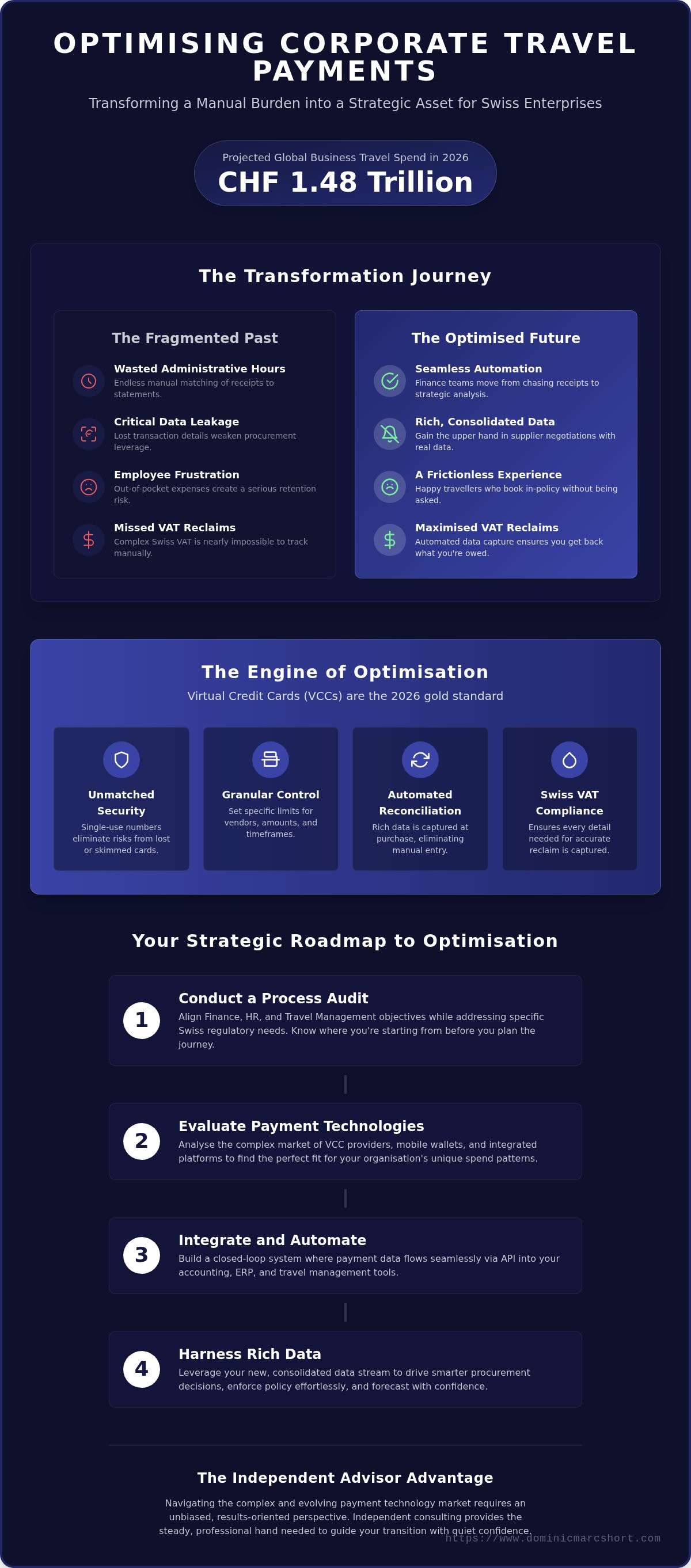
Moving from a fragmented system to a streamlined one requires more than a simple software update. Optimizing corporate travel payments is a cross-functional endeavour that demands total alignment between Finance, HR, and Procurement. While Finance focuses on real-time visibility and Swiss VAT compliance, Procurement needs the granular data provided by modern payment vehicles to secure better supplier deals. HR, meanwhile, views payment optimisation as a way to reduce employee burnout by removing the burden of personal expense management. When these departments work together, the payment ecosystem shifts from a cost centre to a strategic business driver.
Selecting technology partners also requires a broader perspective that often extends beyond your traditional banking relationship. Many modern fintech providers offer superior API integrations that fit more naturally into a digital travel ecosystem. The priority is to find a partner capable of managing the intricate details of the Swiss market while providing a calm, controlled perspective on global spend transitions.
The Audit: Mapping the Payment Journey
Before introducing new tools, you must understand exactly where your current data breaks down. Map every touchpoint from the moment a traveller books a flight to the final reconciliation of the expense. Identify manual silos where teams are still matching receipts to bank statements by hand. Benchmark your current reconciliation time against the 2026 industry standard, where automated systems now handle the vast majority of transaction matching. You must audit your invisible administrative costs before selecting vendors to ensure you aren't just digitising a broken process.
Implementation and Change Management
Communication is the most critical phase of any payment technology rollout. Even the most sophisticated tools will fail if your travellers find them cumbersome or confusing. High adoption rates are only achieved through proactive messaging that highlights the benefits to the individual, such as the total elimination of out-of-pocket spending. Utilising change management for corporate travel is essential to reduce internal resistance and ensure a smooth, happy transition for the entire organisation.
Training should be viewed as an ongoing facilitator rather than a one-time event. Interactive masterclasses and clear, accessible documentation help employees feel supported as they adapt to new digital wallets or virtual card protocols. By treating implementation as a collaborative project, you foster a culture of policy compliance and operational excellence that lasts long after the initial launch.
The Independent Advisor Advantage: Navigating the 2026 Market
In the complex 2026 financial landscape, the primary risk to your organisation isn't a lack of tools; it's biased advice. Many payment providers act as both vendor and advisor, naturally steering clients toward their own proprietary banking products. This is where the expertise of Dominic Marc Short - Independent Consultant becomes essential for optimizing corporate travel payments. By partnering with an external specialist, you gain an unbiased perspective that bridges the gap between corporate finance and travel operations. With over 30 years of industry experience, this authoritative oversight identifies subtle red flags in vendor contracts, such as hidden transaction fees or restrictive data access, ensuring your strategy rests on the solid foundation of travel management for global corporates.
Bridging Strategy and Hands-On Facilitation
Dominic Marc Short - Independent Consultant functions as both a strategic architect and a hands-on facilitator for complex transitions. This goes beyond delivering a high-level report; it involves staying engaged throughout the implementation phase to ensure the creative and experiential aspects of the work are fully realised. This bespoke approach is particularly vital for Swiss-based organisations with global footprints that must balance strict local VAT regulations with international visibility. By focusing on the long-term operational health of your travel programme, we move beyond simple cost-cutting toward a state of operational excellence. Payment systems should support both growth and traveller wellbeing. We provide a calm, controlled perspective on transitions that might otherwise feel overwhelming to internal teams.
Next Steps: From Analysis to Execution
The journey toward a modernised payment ecosystem begins with a methodical discovery session. During this phase, we conduct an end-to-end analysis of your current travel management processes to identify exactly where data silos exist. The typical project lifecycle moves systematically from this initial audit to stakeholder alignment and final delivery. This thorough process ensures that optimizing corporate travel payments delivers the rich, granular data your procurement team needs to negotiate effectively with global suppliers. We provide the steady hand required to navigate these changes without disrupting your daily operations. This structured path ensures that every technical integration serves a broader strategic objective.
Transforming Your Travel Payment Strategy for 2026 and Beyond
The transition from manual reconciliation to a streamlined, digital-first ecosystem is no longer a luxury for Swiss organisations. By aligning your booking and expense data through tools like virtual cards and centralised lodge accounts, you remove the administrative friction that stalls productivity. We've explored how a methodical process audit and dedicated change management ensure that your travellers remain compliant and satisfied throughout this evolution. These steps move your finance team away from the receipt chase and toward high-value strategic analysis.
Optimizing corporate travel payments requires a calm, experienced hand to navigate the complexities of the 2026 market. CDABS provides this through 30 years of cross-industry expertise and a strictly independent advisory model with no ties to specific banks or card issuers. This ensures your technology selection is based purely on operational excellence and your organisation's long-term health. Our proven methodology for digital transformation helps you bridge the gap between finance and travel operations with confidence.
We look forward to helping you turn your travel payments into a genuine strategic asset that supports your global growth and operational stability.
Frequently Asked Questions
What is the most secure method for corporate travel payments in 2026?
Virtual credit cards (VCCs) are the most secure method for corporate travel payments in 2026. Because they're single-use and generated for specific transactions, they eliminate the risk of card skimming or loss. You can set precise spending limits and restrict usage to specific merchant categories. This level of control ensures that funds are only used for intended business purposes, providing a calm, secure environment for both finance teams and travellers.
How do virtual credit cards differ from traditional corporate cards?
Virtual credit cards differ from traditional cards by being digital, single-use identifiers rather than physical plastic. While a traditional corporate card is assigned to an individual for multiple trips, a VCC is generated for a specific booking. This allows for automated reconciliation as the transaction data matches the booking data perfectly. optimizing corporate travel payments through VCCs also reduces the risk of personal spend commingling, which is a common challenge with decentralised physical card models.
Can centralised payment models work for small to medium enterprises (SMEs)?
Centralised payment models are exceptionally effective for Swiss SMEs and NGOs. These organisations often have lean finance teams that cannot afford to waste hours on manual expense matching. By using lodge cards for airfare and virtual cards for hotels, an SME can centralise the bulk of its travel spend. This approach provides 100% visibility into the travel budget while significantly reducing the administrative burden on employees who might otherwise pay out-of-pocket in CHF.
How does optimising travel payments impact our corporate carbon reporting?
Optimising travel payments provides the granular Level 3 data necessary for accurate corporate carbon reporting. Modern payment vehicles capture specific details about carrier, class of service, and distance travelled. When this data flows through an integrated system, it feeds directly into your sustainability dashboards. This allows your procurement team to see the environmental impact of every franc spent, making it easier to meet Swiss regulatory requirements for ESG disclosures and carbon footprint reduction targets.
What are the main barriers to adopting an automated reconciliation process?
The primary barriers to adopting automated reconciliation are legacy technology silos and a lack of stakeholder alignment. Many organisations are hesitant to move away from traditional banking relationships, even when those systems fail to provide real-time visibility. Additionally, the "invisible" labour costs of manual matching are often overlooked during budget planning. Overcoming these hurdles requires a steady hand to facilitate change management and demonstrate the long-term operational health gained through optimizing corporate travel payments.
How do I choose between a lodge card and a virtual card system?
Choosing between these systems depends on your specific procurement patterns. Lodge cards are ideal for high-volume, centralised spend on air and rail where you want a single monthly statement for the entire organisation. Virtual cards are better suited for hotel bookings and guarantees, where single-use security is paramount. Most sophisticated Swiss enterprises find that a hybrid model, using lodge cards for transport and virtual cards for accommodation, provides the perfect balance of control and data richness.
What role does a travel management consultant play in payment optimisation?
A travel management consultant acts as an independent strategic architect who bridges the gap between finance and operations. Dominic Marc Short - Independent Consultant uses 30 years of experience to conduct end-to-end process audits and identify red flags in vendor contracts. We provide an unbiased perspective that card issuers cannot offer. Our role is to ensure that your payment technology is seamlessly integrated into your broader digital transformation, leading to long-term operational excellence and improved traveller satisfaction.
How can we ensure high traveller adoption when changing payment methods?
High adoption is achieved by focusing on the "frictionless traveller" experience. You must communicate the benefits clearly, specifically the total elimination of out-of-pocket spending and the end of manual expense reports. Using bespoke communications packages and interactive masterclasses helps reduce internal resistance. When employees see that the new payment methods make their lives easier and their trips smoother, they're far more likely to embrace the change with a cheery, positive attitude.



Comments