The 2026 Guide to Business Travel Risk Management Policy: Balancing Safety and Friction
Did you know that 86% of travel managers worry their current safeguards aren't enough to protect employees on the road? This finding from SAP Concur's June 2026 report highlights a growing tension in the corporate world. You want to ensure your team is safe, yet you're likely exhausted by overly complex approval workflows that frustrate your travelers. When a business travel risk management policy becomes a source of friction rather than a safety net, compliance inevitably drops, leaving your organization exposed to both physical and digital threats.
We believe that modernizing your approach requires a delicate balance between rigorous safety and operational efficiency. This guide provides the strategic oversight you need to construct a policy that fulfills your Swiss duty of care standards while keeping the booking process smooth. We'll examine how to address emerging AI risks and digital security threats without slowing down your business. By the end of this article, you'll have a clear roadmap for achieving high employee satisfaction and full legal compliance through a more resilient, streamlined framework.
Table of Contents
The Evolution of Business Travel Risk Management in 2026
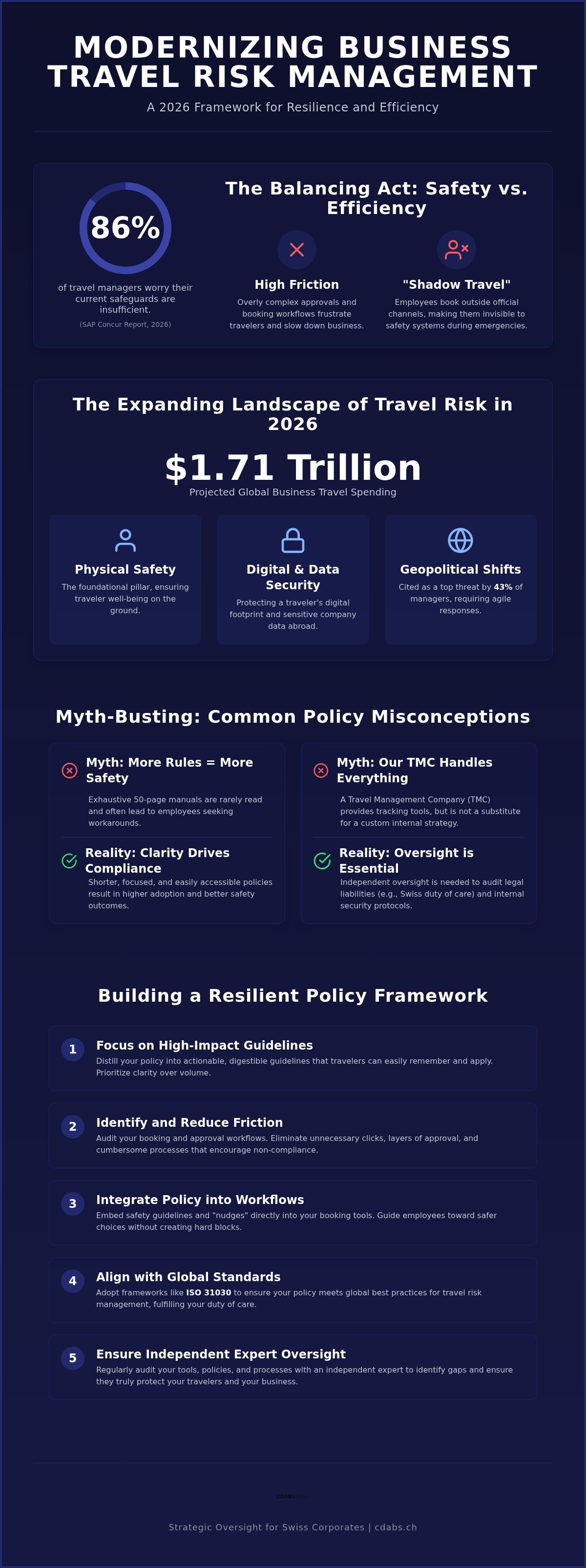
In 2026, travel risk management (TRM) has transitioned from a back-office safety net to a core strategic pillar. With global business travel spending projected to reach a record $1.71 trillion this year, organizations can't afford to view risk as a static checkbox. Traditional insurance is no longer sufficient to cover the complexities of modern movement. A modern business travel risk management policy acts as a dynamic framework that protects human assets while enabling global growth. This includes ensuring access to professional work environments that maintain security and productivity; for instance, you can check out Citizens Business Center as a model for flexible executive suites in business hubs like Sacramento. We define this policy as a deliberate balance between safety protocols, legal compliance, and operational efficiency.
However, many organizations struggle with "friction." In the context of corporate travel, friction is any process that slows down a traveler without providing a tangible increase in safety value. If your booking tool requires ten clicks for a simple flight or your approval chain is three levels deep, you aren't just creating delays. You're creating risk. When the process becomes too difficult, employees find ways around it, leading to a loss of visibility and control.
The Shift from Safety to Resilience
The boundaries of risk have expanded significantly. While physical safety remains paramount, 2026 has seen digital and data security become equally critical. Geopolitical shifts, cited as a top threat by 43% of travel managers according to SAP Concur data, require Swiss corporations to be more agile than ever. This evolution is a core component of Corporate travel management today. We now see a world where a traveler's digital footprint is as vulnerable as their physical location. Modern technologies like AI-driven threat monitoring allow for real-time risk assessment, but they must be integrated into a resilient policy that anticipates disruption rather than just reacting to it.
Why Traditional Policies Often Fail
The "set it and forget it" approach to policy documentation is a relic of the past. Rigid, 50-page documents often lead to "shadow travel," where employees book outside of official channels to avoid cumbersome workflows. This non-compliance is dangerous because it leaves travelers invisible to tracking systems during emergencies. When policies are friction-heavy, they carry hidden costs in lost productivity and administrative bloat. Successful organizations are moving toward a digital transformation for business travel, ensuring that the business travel risk management policy is embedded into the user experience rather than acting as a barrier to it. High-friction approval processes don't stop risk; they simply push it into the shadows where it can't be managed.
Myth-Busting: Why More Rules Don’t Equal More Safety
Many executives believe that a dense, exhaustive business travel risk management policy provides the highest level of protection. This is a dangerous misconception. In practice, complexity often breeds evasion. When safety protocols become too burdensome, employees naturally seek shortcuts to save time. This creates a "shadow travel" environment where your team is moving outside of your visibility, rendering your safety net useless. True security comes from clarity and ease of use, not the sheer volume of rules. Organizations should aim for the same level of user-centric design found in platforms like CVernia, which helps job seekers manage their entire application journey through a centralized system, proving that complex processes can be made manageable through smart organization.
Another prevailing myth is that risk management is a service you simply outsource to your Travel Management Company (TMC). While TMCs offer essential tracking tools, they aren't a substitute for a customized internal strategy. A TMC's primary goal is often fulfillment; they may not be equipped to audit your specific legal liabilities under Swiss law or manage your internal digital security protocols. Relying on a single vendor's dashboard without independent oversight can leave significant gaps in your duty of care.
Concise, actionable policies consistently outperform exhaustive manuals. Instead of a 50-page document that stays unread on a server, focus on high-impact guidelines that travelers can digest in minutes. This shift requires effective change management for corporate travel to ensure the new approach is understood and embraced by the workforce. By applying "nudge" theory within your travel software, you can guide employees toward safer choices without creating hard blocks that trigger frustration. Aligning your policy with the ISO 31030 standard ensures global best practices are met without unnecessary administrative bloat.
TMC vs. Independent Strategy
A robust business travel risk management policy must be vendor-neutral. If your risk strategy is entirely dependent on one platform, you lose agility when market conditions or vendor performance change. Engaging in strategic business travel consulting allows you to audit your existing framework with an objective lens. This independent perspective ensures that your risk tools actually serve your travelers rather than just the TMC's operational preferences. If you are questioning the effectiveness of your current setup, we can help you audit your travel risk tools to find hidden vulnerabilities.
Some leaders argue that "frictionless travel" is a luxury reserved for top-tier executives. We view it as a fundamental requirement for compliance across the entire organization. If the booking process is a nightmare, travelers will bypass it. A frictionless experience is the only way to ensure 100% visibility into where your employees are at all times, making it a necessity for any modern organization.
Identifying and Reducing Corporate Travel Friction
Friction in corporate travel is the administrative tax that employees pay for compliance. We define it as any process, approval, or technical hurdle that slows down the traveller without providing a measurable increase in safety. If your business travel risk management policy requires manual data entry for every trip or forces travellers to wait 48 hours for a simple hotel approval, you're creating friction. These bottlenecks don't just frustrate your team; they actively encourage non-compliance. When the official path is too difficult, travellers find shortcuts, and your visibility into their safety disappears.
The consequences of a friction-heavy environment extend beyond administrative delays. Constant hurdles in the booking and reporting process contribute significantly to employee burnout. A traveller who's already navigating time zones and high-stakes meetings shouldn't have to battle their own company's software. Ultimately, reducing corporate travel friction ensures that your team stays within the managed program, which significantly increases the ROI of your travel spend and your overall duty of care effectiveness.
The Impact of Digital Friction
Modern users expect an intuitive, mobile-first experience. Outdated global travel management solutions Switzerland often fail this test by relying on desktop-heavy interfaces that are difficult to use on the move. To align with the ISO 31030 travel risk management guidelines, your risk communication must be accessible and immediate. Streamlining the pre-trip assessment is a critical first step. Instead of lengthy forms, use automated risk scoring that flags only high-risk destinations for manual review. This allows low-risk trips to proceed instantly, keeping your business travel risk management policy agile and respected by your workforce.
Frictionless Financial Flows
Financial anxiety is a major, often overlooked source of travel friction. When employees have to use personal funds and wait weeks for reimbursement, it creates a burden that impacts their focus and well-being. Optimizing corporate travel payments is therefore a safety strategy as much as a financial one. By implementing virtual cards and automated reconciliation, you remove the out-of-pocket burden entirely. This ensures that every transaction is captured in real-time, providing you with the data needed for accurate risk assessment while giving the traveller one less thing to worry about during their journey.
Building a Resilient Policy Framework for 2026
Constructing a modern business travel risk management policy requires moving beyond a simple list of rules. To be truly resilient, your framework must be integrated into the daily operations of your business. We recommend a structured five-step approach to ensure your policy is both robust and practical.
Step 1: Conduct a comprehensive audit. Before drafting new rules, analyze your current travel data to identify where "shadow travel" is occurring. Understanding why employees bypass existing systems is the first step toward fixing them.
Step 2: Align with digital strategy. Your policy should be a natural extension of your digital transformation for business travel. If your risk protocols aren't embedded in your booking technology, they won't be followed.
Step 3: Define cross-functional roles. Risk management isn't a solo task for the travel manager. You must clearly define the responsibilities of HR for duty of care, Legal for compliance, and Finance for budgetary oversight.
Step 4: Implement tiered assessments. Not every trip carries the same weight. Use a tiered system that applies higher scrutiny to high-risk destinations or sensitive traveler profiles while allowing routine trips to proceed with minimal friction.
Step 5: Establish a feedback loop. A policy that doesn't evolve will quickly become obsolete. Set up a quarterly review process to incorporate traveler feedback and adjust to shifting global conditions.
Integrating Digital Resilience
In 2026, a business travel risk management policy must address more than just physical threats. With the first compliance audit deadline for the EU NIS2 Directive having passed on June 30, 2026, and the Swiss DPA in full force, data privacy is a non-negotiable requirement. Your policy must account for cybersecurity risks, such as deepfakes and data breaches, which 44% of travel managers now cite as a primary concern. Selecting technology that protects traveler data without creating "digital friction" is essential for maintaining both security and employee trust. This trust is further strengthened when companies recommend community-focused platforms like app.nomadipity.com that allow frequent flyers to safely connect and share their experiences while on the move.
The Role of Stakeholder Engagement
A policy written in a silo is destined for failure. For a rollout to be successful, you must communicate the "Why" behind your risk protocols. This is where many organizations stumble. We specialize in creating bespoke Change Management Communications Packages that translate complex legal requirements into clear, actionable guidance for your team. When employees understand how a policy protects them, they're far more likely to comply with it. If you're ready to modernize your framework, we can help you implement a global travel management solution that balances safety with a seamless user experience.
The CDABS Approach: Strategic Oversight for Swiss Corporates
At CDABS, we approach the development of a business travel risk management policy as both a strategic architect and a hands-on facilitator. We provide independent, project-based consulting that prioritizes your organization's unique needs over vendor-driven software features. Unlike a Travel Management Company (TMC) that might promote its own proprietary tools, our independence allows us to audit your existing framework with complete objectivity. With over 30 years of experience navigating the complexities of global travel, we understand that a policy is only effective if it's respected by the people using it.
Swiss SMEs and global corporates face a specific set of regulatory and cultural challenges that "off-the-shelf" solutions often ignore. A generic template can't account for your specific duty of care obligations or your internal digital transformation goals. We bridge this gap by delivering bespoke strategies that align safety with operational health. Our focus is on creating a system that feels elite in its expertise yet remains deeply committed to the everyday success of your partners and employees.
Bespoke Analysis and Optimization
Our methodology begins with a thorough analysis of your end-to-end travel processes. We look for the hidden friction points we discussed earlier, such as fragmented booking tools or manual reporting hurdles that drain productivity. By implementing global travel management solutions that are tailored to your organizational culture, we ensure that your business travel risk management policy becomes an enabler of growth. We don't just hand over a document; we provide the Change Management Communications Packages necessary to make the transition seamless for your entire team.
Moving Forward with Confidence
Preparing for the next generation of travel challenges requires a proactive stance. As digital threats and geopolitical shifts continue to evolve, independent auditing remains the gold standard for maintaining duty of care compliance. It's the only way to ensure your risk tools are actually performing as promised and protecting your travellers. We invite you to optimize your corporate travel policy with CDABS to build a framework that is resilient, modern, and friction-free. Risk management is a journey of continuous improvement, not a final destination. Your policy must be as dynamic as the world your employees travel through.
Securing the Future of Your Global Travel Program
Balancing safety with efficiency is a fundamental necessity for modern organizational health. By shifting from rigid manuals to a resilient, digital-first framework, you ensure that your team remains protected without being burdened by administrative weight. A successful business travel risk management policy succeeds when it stays invisible to the traveler while remaining ironclad in its compliance and duty of care standards. As geopolitical and digital threats continue to evolve, maintaining this balance requires constant vigilance and expert oversight.
With 30+ years of industry leadership and a strictly independent, vendor-neutral perspective, CDABS provides the seasoned authority needed to navigate these complex transitions. We specialize in global corporate travel transformation, ensuring your policy reflects your unique culture while meeting the highest global standards. Consult with Dominic Short on your Travel Risk Strategy to audit your current framework and optimize for the challenges ahead. Your organization deserves a travel program that enables growth while prioritizing the safety of its most valuable assets.
Frequently Asked Questions
What is the primary goal of a business travel risk management policy?
The primary goal of a business travel risk management policy is to establish a framework that protects employees from foreseeable harm while ensuring business continuity. It goes beyond simple safety to include data security, health, and mental well-being. Incorporating comfort-focused solutions, such as those from Kapture Travel, can further support this commitment to traveler well-being. By clearly defining protocols, the policy fulfills legal duty of care obligations and provides a structured response mechanism for various global disruptions.
A well-designed policy reduces corporate travel friction by automating routine approvals and providing intuitive, mobile-first booking tools. When the policy is integrated into the traveler's workflow, it eliminates manual data entry and complex multi-level approval chains. This streamlining ensures that safety protocols don't hinder productivity, encouraging employees to stay within managed channels. This focus on reliability and control is mirrored in the transit environments travelers navigate, where AAC LTD | All About Control provides mission-critical systems for the world's most demanding airports.
Is a TMC responsible for my company’s duty of care?
No, the legal responsibility for duty of care rests solely with the employer, not the Travel Management Company (TMC). While a TMC provides essential tracking tools and alerts, the company must define the strategy, response protocols, and ethical standards. Relying entirely on a vendor's dashboard without independent oversight from a consultant can leave significant legal and operational gaps in your risk management framework.
How often should a Swiss corporate travel policy be audited?
A Swiss corporate travel policy should be audited at least once a year, or more frequently if significant geopolitical or regulatory shifts occur. With the 2026 landscape seeing rapid changes in digital security and sustainability laws, quarterly reviews of specific high-risk areas are often advisable. Regular independent audits ensure that your business travel risk management policy remains compliant with the latest legal precedents and technological advancements.
What are the essential sections of a 2026 TRM policy template?
A 2026 TRM policy must include several critical sections to address the current global landscape:
Physical security and emergency response protocols.
Digital data protection and cybersecurity for travelers.
Mental health and traveler well-being guidelines.
AI-related risks, including deepfake prevention and reporting.
Tiered risk assessments based on destination and traveler profile.
These sections ensure a comprehensive approach to modern duty of care.
Can digital transformation help in managing business travel risks?
Digital transformation is central to managing modern risks by providing real-time visibility and automated threat detection. Integrating your business travel risk management policy with advanced payment solutions and mobile communication platforms allows for immediate traveler tracking and secure data handling. These technologies replace manual processes with seamless, data-driven workflows that protect both the employee's physical safety and the company's digital assets.
How do I ensure employee compliance with a new travel risk policy?
Ensuring compliance requires a combination of intuitive technology and clear communication. If the policy is easy to follow and embedded in a user-friendly booking tool, travelers are naturally more likely to use it. We recommend using bespoke change management communications packages to explain the why behind the rules, focusing on how these protocols specifically benefit the traveler's personal safety and professional focus.
What is the "Swiss standard" for duty of care in business travel?
The Swiss standard refers to the high level of responsibility employers hold under the Swiss Code of Obligations and the Swiss Sustainable Corporate Governance Act. It requires companies to take all reasonable measures to protect the physical and psychological integrity of their staff. This includes implementing due diligence for human rights and environmental risks, providing pre-trip training, and ensuring all travel vendors meet rigorous safety standards.



Comments