Managing Per Diems and Travel Allowances: The 2026 Strategic Reference Guide
What if the true secret to stress-free business travel isn't an airport lounge pass, but banishing the dread of crumpled paper receipts altogether? For finance directors and frequent flyers alike, managing per diems and travel allowances has traditionally felt like an exercise in mutual frustration. Between deciphering confusing statutory tax boundaries, soothing team members bewildered by restrictive daily caps, and watching productive hours evaporate into manual month-end reconciliations, the status quo serves nobody.
You already know that your travelling colleagues perform at their best when they aren't hoarding faded coffee dockets or worrying about personal out-of-pocket costs. In this 2026 strategic guide, you will discover how to design, automate, and govern compliant corporate travel allowances while eliminating receipt fatigue and operational friction. We examine how contemporary policy frameworks, digital card structures, and automated reconciliations can transform subsistence governance into an efficient, cheerful, and fully audit-ready system.
Table of Contents
Per Diems and Daily Travel Allowances in Business Travel
A per diem represents a fixed daily monetary sum provided to employees to cover necessary living costs incurred during business travel. Put simply, per diems function as predictable daily subsistence payments that replace the tedious chore of micro-managing individual receipts with a transparent, equitable stipend. Modern enterprises increasingly adopt this method because nobody relishes spending their evenings taping greasy sandwich dockets to scrap paper. By introducing structured daily stipends, organisations eliminate petty cash bottlenecks and empower their personnel to concentrate entirely on their commercial objectives.
For finance leaders, successfully managing per diems and travel allowances establishes immediate budgetary certainty. Traditional expense reimbursement models leave trip costs open-ended until claims trickle in weeks later. Conversely, a pre-set per diem allowance defines exact subsistence liabilities before a colleague even packs their suitcase. When companies align these allowances with genuine local living costs, travelling team members stay well-fed, comfortable, and motivated throughout their assignments.
The Core Components: Meals, Incidentals, and Accommodation
A comprehensive allowance policy divides daily expenditures into clear operational buckets, ensuring complete clarity for both traveller and auditor:
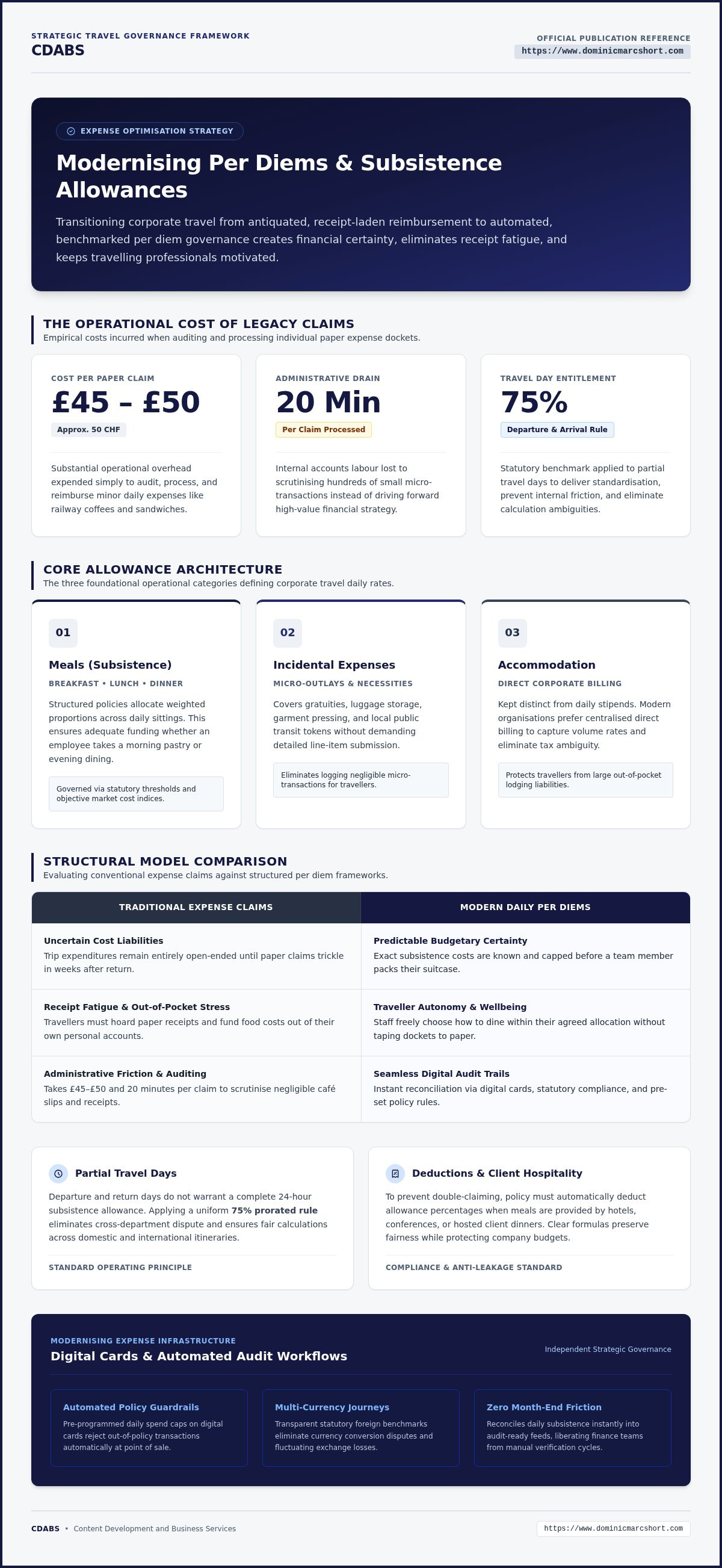
Meals (Subsistence): The primary pillar covers breakfast, lunch, and dinner. Structured policies allocate weighted percentages to each sitting, guaranteeing adequate funding whether an employee requires a quick morning pastry or an evening sit-down meal.
Incidental Expenses: Small outlays quickly mount up. Incidentals account for gratuities, urgent garment pressing, luggage storage, and local public transit tokens, removing the need to log negligible micro-transactions.
Accommodation: While overnight lodging occasionally forms part of an all-inclusive daily rate, contemporary enterprises prefer direct corporate billing for hotel rooms. Separating lodging limits tax ambiguity and ensures corporate hotel programmes deliver volume discounts.
Per Diems versus Actual Expense Reimbursement: The Practical Divide
The operational gap between traditional receipt reconciliation and daily allowances is substantial. Auditing actual expenses demands that accounts teams scrutinise hundreds of individual transactions, from a 4 CHF station espresso to late-night room service fees. Research across global corporate programmes reveals that processing a single paper expense claim costs roughly £45 to £50 (approximately 50 CHF) and devours 20 minutes of administrative labour. That is an expensive way to verify a midday croissant.
Organisations looking to modernise their approach often review how their overarching corporate travel policy balances operational control with traveller autonomy. Shifting to predictable daily allocations respects an employee's personal judgment without risking budget creep. Travellers decide how to dine within their agreed allocation, whilst the business secures absolute financial discipline. Mastering the nuances of managing per diems and travel allowances ultimately builds an environment of professional trust, keeping staff cheerful and balance sheets completely predictable.
Designing a Robust Travel Allowance Policy: Rules, Rates, and Deductions
Designing a sustainable framework requires more than picking arbitrary figures out of thin air. Instead, finance teams ground their programmes in statutory benchmarks and objective market indices. Consulting established authorities, like looking at IRS travel expense guidelines for cross-border parameters or Swiss federal tax scales domestically, ensures your allowances remain realistic and legally sound. When managing per diems and travel allowances across varied jurisdictions, companies must anchor their parameters inside structured corporate travel policy strategic guides to govern daily spend equitably. Partial travel days also demand absolute clarity: applying a consistent 75% prorated entitlement on departure and arrival days prevents disputes and keeps calculations completely uniform.
Handling Meal Reductions and Hosted Client Dinners
Nothing irritates an auditor quite like funding a lavish lunch that the company already bought. When a hotel room includes breakfast, or a conference host provides midday dining, the daily subsistence rate must adjust downward proportionally. A simple, polite rule applies: if a meal didn't cost the traveller anything out of pocket, it cannot be claimed as an allowance outlay. Standard policies deduct 20% for complimentary breakfasts and 40% for fully catered lunches or dinners. This prevents accidental double-dipping while preserving personal dignity.
Tiered Allowance Frameworks Based on Destination and Cost of Living
A single flat allowance creates immediate imbalance. Buying lunch in a high-density financial capital drains funds far quicker than dining near an out-of-town manufacturing depot. Well-designed programmes deploy multi-tiered tables tailored to market realities:
Tier 1 (High-Cost Capital Metros): Elevated thresholds reflecting premium restaurant pricing and steep transportation costs.
Tier 2 (Secondary Cities and Regional Hubs): Balanced baseline allowances suited to standard national price levels.
Tier 3 (Rural and Low-Density Sites): Lower daily allowances aligned with modest local economies.
Regular annual reviews prevent these tiers from eroding against local inflation. If you want an objective review of your spend tiers, collaborating with an experienced business travel management advisor helps strike the perfect balance between frugality and employee satisfaction.
Tax Compliance and Statutory Non-Taxable Thresholds
Tax revenue authorities maintain rigid rules distinguishing genuine business subsistence from hidden employee salary perks. If an organisation pays daily allowances above approved statutory scale rates without collecting itemised receipts to prove actual costs, the surplus transforms into taxable income. That triggers unexpected payroll taxes and social security contributions. Ensuring your system records precise trip dates, commercial justifications, and locations protects the enterprise during routine audits, turning managing per diems and travel allowances into an orderly, compliant routine.
Overcoming Common Pitfalls in Managing Per Diems
Even the most elegantly drafted subsistence schemes encounter turbulence when theory meets human reality. The sharpest clashes between accounts teams and mobile professionals rarely stem from greed. Instead, they arise from ambiguity. A cynical misconception lingers in some boardrooms that lump-sum allowances give staff free licence to cut corners, skipping proper meals to pocket spare change. In truth, modern professionals simply desire clarity, dignity, and fair reimbursement without being interrogated over a five-franc sandwich.
When leadership communicates expense controls with heavy-handed suspicion, staff morale plummets rapidly. Employees begin viewing business trips as stressful chores rather than rewarding commercial opportunities. Bridging this cultural divide requires open dialogue and operational empathy, which is why progressive firms focus on simplifying expense reporting to build mutual trust. Getting the human dynamics right is half the battle when managing per diems and travel allowances across dynamic commercial teams.
The Problem of Currency Fluctuations and Cross-Border Trips
Foreign exchange swings introduce immediate friction during multi-day cross-border journeys. If an enterprise disburses a fixed allowance in Swiss Francs while the traveller spends in Euros, Japanese Yen, or Pounds, conversion margins eat away at daily subsistence. Leaving employees to shoulder unexpected foreign transaction fees or unfavourable card conversion spreads breeds resentment. Sound policy dictates calculating international allocations in destination currency benchmarks, or introducing a modest 5% currency buffer to absorb interbank volatility and local exchange fees.
Managing Out-of-Pocket Hardships and Delayed Reimbursements
Expecting employees, particularly junior colleagues, to finance business trip subsistence out of their personal bank accounts is an outdated, counterproductive habit. Forcing staff to wait weeks for post-trip expense claims creates genuine personal cashflow stress:
Personal Credit Strain: Staff should never feel obliged to float corporate expenditures on private credit cards.
Administrative Delay: Protracted reimbursement cycles drain goodwill and distract personnel from high-value tasks.
Pre-Trip Disbursements: Issuing upfront per diem disbursements or digital advances preserves financial peace of mind.
Approaching travel disbursements with proactive care transforms the entire journey. When organisations eliminate out-of-pocket friction, mobile personnel feel respected, protected, and fully supported. Ultimately, modernising and managing per diems and travel allowances with genuine commercial empathy ensures travelling colleagues return home cheerful, refreshed, and ready to deliver exceptional results.
Modernising Travel Allowances: Automation, Digital Cards, and Audit Trails
Gone are the days when travel managers handed out thick envelopes of physical banknotes before departure. The corporate world has embraced frictionless financial technology, transforming how enterprises disburse daily stipends. Industry data reveals that over 78% of enterprise organisations now deploy virtual payment cards with automated policy guardrails. Moving to digital infrastructure slashes expense processing time by up to 75%, rescuing finance departments from dozens of hours of monthly manual reconciliation. Modern organisations connect these payment workflows directly to strategic programmes for reducing business travel costs without restricting traveller comfort.
Step 1 & 2: System Integration and Pre-Trip Automated Calculation
Modernisation begins by connecting travel booking engines directly to expense modules. Once an itinerary receives management sign-off, algorithms instantly calculate the exact per diem entitlement based on journey duration, destination tier, and itinerary-specific meal inclusions. Travellers know their precise allocation before stepping out of the office. Establishing these parameters pre-trip eliminates post-travel confusion entirely, ensuring transparent alignment between mobile staff and finance controllers.
Step 3 & 4: Virtual Card Loading and Policy-Enforced Merchant Controls
Automated platforms provision dynamic virtual cards directly to an employee's smartphone wallet (such as Apple Pay or Google Wallet) on the day of departure. Rather than exposing the company to unrestricted liability, these cards feature intelligent policy guardrails:
Merchant Category Code (MCC) Controls: Funds can be restricted to dining, local transit, and convenience grocers, preventing non-compliant expenditure.
Automated Balance Depletion: Daily allowances load and refresh in sync with the itinerary, protecting company working capital.
Autonomous Discretion: Staff retain complete liberty over where they dine without intrusive micro-management.
Step 5: Automated Audit Trails and Real-Time Financial Visibility
Digital payment feeds push card transactions directly into general ledger accounting systems, removing manual data entry. Because expenses match pre-calculated statutory allowances automatically, unautomated programme leakage, which historically ranges between 8% and 12%, virtually disappears. Finance directors gain live expenditure dashboards, whilst statutory auditors receive spotless, time-stamped digital records. Streamlining these payment channels turns managing per diems and travel allowances into a rapid, automated, and genuinely painless operation.
Elevating Your Travel Management Strategy: How CDABS Delivers Seamless Governance
Bridging the divide between rigorous financial control and genuine traveller satisfaction requires experienced perspective. Off-the-shelf software packages often promise effortless compliance, yet real-world rollouts frequently stumble because tools cannot fix fractured workflows on their own. This is where independent business travel management consulting serves as the vital link. Drawing on over 30 years of enterprise business travel management expertise, Dominic Marc Short - Independent Consultant helps organisations design balanced expense frameworks. Free from software vendor bias or travel agency sales quotas, Dominic Marc Short - Independent Consultant tailors operational structures that eliminate administrative friction whilst keeping balance sheets disciplined and travellers cheerful.
Independent Process Audits and Policy Optimisation
Modernising your approach begins with an objective assessment of your existing ecosystem. An independent audit identifies where policies lag behind modern mobility:
Bottleneck Identification: Pinpoint exactly where expense approvals stall and resolve manual pain points in accounts payable.
Policy Rationalisation: Translate dense, legalistic allowance rules into transparent, welcoming guidelines staff actually read.
Sustainability Alignment: Harmonise daily subsistence with corporate environmental commitments, encouraging low-emission local transport choices.
Independent consulting uncovers hidden spend leaks across corporate programmes, ensuring your organisation establishes sustainable frameworks without overpaying on external systems.
Transforming Policy Through Empathetic Change Management
A beautifully calibrated travel allowance policy achieves little if employees regard it with scepticism. Winning hearts and minds requires empathetic change communication that positions new workflows as an upgrade to employee wellbeing rather than an administrative crackdown. By conducting focused briefing sessions for line managers and accounts teams, businesses establish seamless approval routines that respect personal dignity while protecting corporate funds.
Moving away from tedious receipt hunting toward automated daily allocations represents a profound operational improvement for any enterprise. When handled with seasoned expertise, managing per dis and travel allowances transforms from a contentious administrative headache into an engine of operational excellence. Take the decisive step toward an audit-ready, harmonious travel programme by discovering bespoke guidance with Dominic Marc Short - Independent Consultant business travel management consulting today.
Transforming Corporate Subsistence into Lasting Operational Harmony
Rethinking corporate travel allowances is far more than an exercise in financial housekeeping. It's about establishing trust, safeguarding employee wellbeing, and reclaiming countless productive hours lost to administrative drudgery. Modernising and managing per diems and travel allowances through intuitive digital card infrastructure, dynamic destination tiers, and transparent deduction rules ensures your organisation remains fully tax-compliant while keeping mobile colleagues cheerful and motivated.
Achieving this balance doesn't require guesswork or rigid software lock-in. Backed by over 30 years of corporate travel leadership experience across Europe and international markets, CDABS delivers comprehensive independent expertise in payment solutions, process optimisation, and travel change management.
Say goodbye to the shoebox of crumpled receipts and build a progressive subsistence framework your entire business can celebrate.
Frequently Asked Questions
How does a daily per diem allowance differ from actual expense reimbursement?
A daily per diem provides a predetermined, lump-sum payment to cover daily subsistence and incidentals without requiring line-by-line receipt verification. Actual reimbursement requires travellers to collect, scan, and submit itemised dockets for every coffee, sandwich, or taxi ride. Shifting to fixed stipends establishes upfront budget certainty for finance teams whilst giving travelling employees greater personal autonomy and eliminating hours of tedious post-trip paperwork.
Are corporate per diems and travel allowances considered taxable income for employees?
Corporate travel stipends remain entirely tax-free as long as they do not exceed approved statutory benchmark scale rates set by national tax authorities. When managing per diems and travel allowances, any unverified disbursement paid above these statutory caps transforms into a taxable benefit in kind. That excess sum becomes subject to standard payroll income tax and statutory social security deductions on the employee's payslip.
What happens if an employee spends less than their allocated daily per diem?
Under a true per diem model, the employee retains any unspent funds from their daily allowance. This structure encourages sensible personal budgeting on the road without penalising travellers for choosing modest dining options. The organisation avoids the administrative expense of auditing microscopic claims, creating a mutually beneficial arrangement where financial discipline is rewarded and payroll reconciliation remains delightfully simple.
Can an organisation reduce per diems if meals are provided during a conference or flight?
Yes, and statutory guidelines expect companies to deduct portions of the daily rate whenever complimentary meals are provided. If a hotel includes breakfast, or a conference organiser provides lunch, the employee did not incur out-of-pocket costs. Robust policies routinely reduce the daily subsistence stipend by 20% for breakfast and 40% for lunch or dinner, preventing duplicate corporate spending while ensuring fair treatment.
How should companies adjust travel allowances for cities with higher costs of living?
Organisations should deploy tiered rate frameworks anchored in objective government benchmarks or reliable international cost-of-living indices rather than relying on a single flat figure. High-density metropolitan hubs with expensive restaurant markets sit in top tiers, whereas secondary destinations and rural locations receive lower allocations. Reviewing these benchmark tiers annually ensures your allowances remain fair, realistic, and reflective of local inflation.
Is it better to distribute per diems via corporate cards or direct payroll reimbursement?
Distributing daily allowances through pre-loaded digital corporate cards or virtual mobile wallets is considerably better than traditional payroll reimbursement. Virtual cards eliminate the unfair practice of forcing junior staff to fund corporate subsistence from their personal bank accounts. They also permit automated merchant spending controls, streamline foreign currency handling, and deliver immediate transaction data straight into company accounting software.
What records must finance teams retain to satisfy tax authorities regarding per diems?
Tax authorities require clear proof that genuine commercial travel took place, even when individual meal receipts are not mandated. Finance teams must retain comprehensive trip documentation, including approved travel requests, transport boarding passes, accommodation folios, and detailed meeting agendas. Successfully managing per diems and travel allowances depends on preserving these clean digital audit trails to satisfy national revenue auditors effortlessly.



Comments