Simplifying Expense Reporting: Strategic 2026 Guide
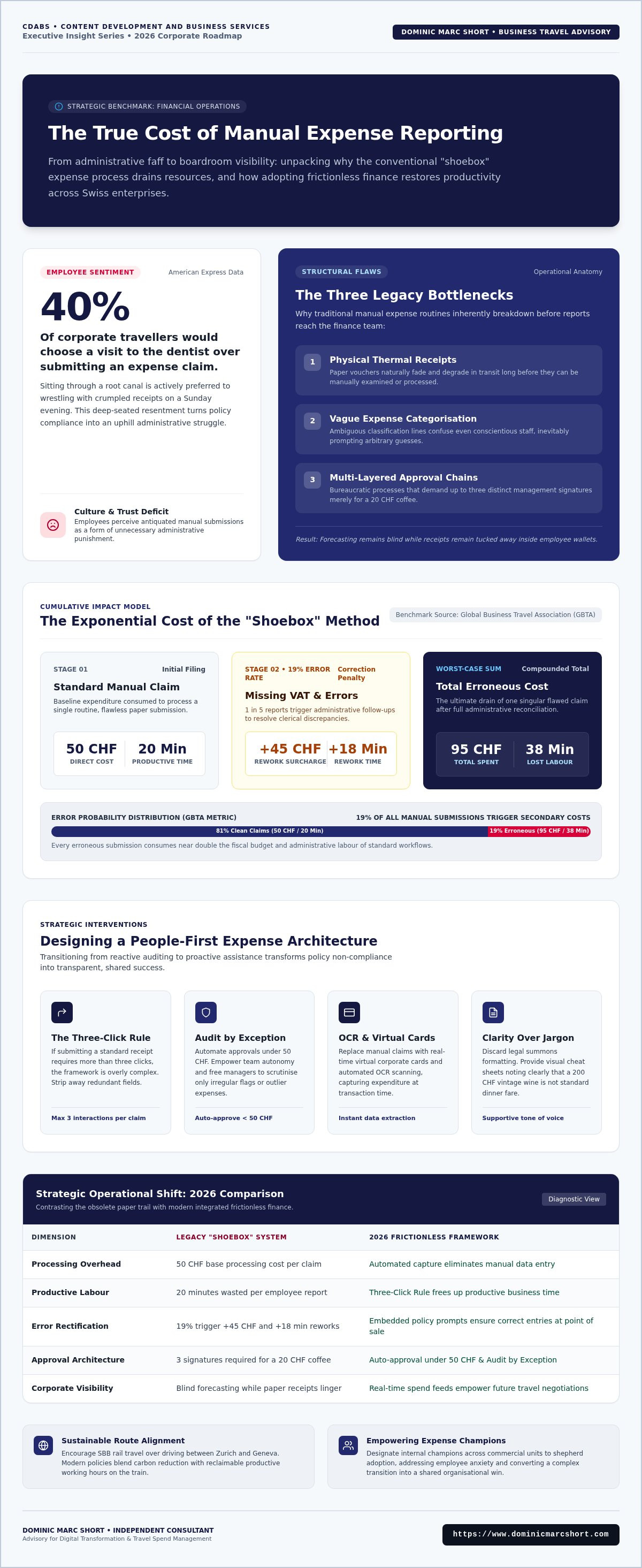
Would you rather sit through a root canal or spend your Sunday evening wrestling with a pile of crumpled receipts? According to American Express, 40% of corporate travellers would actually choose the dentist over the dreaded expense claim. It is a telling statistic that reflects the deep-seated resentment many staff feel toward legacy financial processes. If your team is currently stuck in "receipt purgatory," you will know that simplifying expense reporting for employees is about much more than just tidying up the books. It is about restoring trust and reclaiming the 20 minutes of productive time typically lost on every single manual report.
At Dominic Marc Short - Independent Consultant, we understand that the "shoebox of receipts" is a nightmare for everyone involved, from the professional travelling on business to the finance lead overseeing the overall budget. You deserve a frictionless culture where spend is visible in real time and reimbursements do not cause unnecessary cashflow anxiety. This 2026 guide promises to transform your tedious administrative hurdles into a seamless, even cheerful, workflow. We will preview the latest digital transformation strategies, including how smart corporate cards and automated OCR technology can secure your financial data while keeping your most talented people focused on their actual work.
Table of Contents
Identifying the Friction: Why Traditional Expense Reporting Fails
Expense friction is the tangible gap between a rigid corporate policy and the lived experience of your team on the road. When we focus on simplifying expense reporting for employees, we're dismantling the barriers that turn a routine business trip into a mountain of paperwork. Most legacy systems suffer from three primary bottlenecks: the reliance on physical thermal receipts that fade before they’re scanned, vague expense categories that confuse even the most diligent staff, and multi-layered approval chains that require three signatures for a 20 CHF coffee. The 2026 standard demands a move away from reactive auditing, where you chase ghosts in the machine, toward proactive assistance. By integrating modern expense management systems, you provide a safety net that catches errors before they reach the finance department.
The High Cost of the "Shoebox" Method
Processing a single manual claim costs an organisation approximately 50 CHF and consumes 20 minutes of an employee's time. Data from the Global Business Travel Association suggests that 19% of these manual reports contain errors or missing VAT details. Each mistake triggers a ripple effect, draining an additional 45 CHF and 18 minutes of administrative effort to rectify. This isn't just about lost minutes; it’s about the visibility gap. When receipts are tucked away in wallets, your financial forecasting remains blind to current spend. Relying on outdated manual rules is a recipe for modern inefficiency that no Swiss SME can afford to ignore during their digital transformation journey.
Employee Resentment and Policy Non-Compliance
It's hard to maintain a happy workforce when 40% of travellers would rather visit the dentist than file an expense report. Employees often view these tasks as a form of administrative punishment, which leads to a breakdown in policy compliance. When a process is overly complex, staff may resort to "creative" claiming or simply ignore the rules to save time. The psychological weight of a difficult system shouldn't be underestimated; simplifying expense reporting for employees is a direct investment in your company culture. Frictionless Finance is the ultimate 2026 goal for SMEs, where the reporting process is so intuitive it requires almost no conscious effort from the team.
Designing a People-First Expense Policy
A policy document shouldn't feel like a legal summons. In 2026, the most effective organisations are shifting their tone from "don't do this" to "here is how we support your journey." This shift is fundamental to simplifying expense reporting for employees because it removes the anxiety of making a minor administrative slip-up. We recommend adopting the "Three-Click Rule": if an employee needs more than three clicks to submit a standard receipt, your process is too complex. By stripping away redundant data fields and simplifying categories, you reduce the mental load on your team. Modern policies also integrate sustainability naturally. For instance, encouraging the use of the SBB network for trips between Zurich and Geneva rather than driving can be framed as a way to reclaim productive time while meeting environmental goals.
Clarity Over Complexity
Legalistic jargon has no place in a modern expense handbook. Replace dense paragraphs with plain English and visual "cheat sheets" that clarify exactly what can be claimed for meals or mileage. A touch of humour can also go a long way; a light-hearted reminder that a 200 CHF bottle of wine isn't a "standard dinner expense" is more memorable than a dry directive. By automating the expense report process, you can embed these rules directly into the software, providing real-time guidance as the employee enters data. This proactive approach ensures compliance without the need for constant policing or follow-up emails.
Automating Approvals and Trust
Trust is a far more efficient currency than oversight. Setting sensible thresholds for auto-approval, such as for any expense under 50 CHF, empowers your team and drastically reduces the administrative burden on managers. This allows your finance team to move toward "Audit by Exception," where they only review reports that flag unusual patterns or exceed specific limits. It's a strategy we explore deeply in our SME Travel Management Strategic Guide for 2026. When you prioritise simplifying expense reporting for employees, you stop treating every receipt like a potential crime scene and start building a culture of mutual respect. If you're looking to refine your own internal guidelines to better suit a hybrid workforce, consulting with a seasoned expert can help bridge the gap between corporate policy and employee reality.
Selecting the Right Payment and Reporting Technology
Choosing the right tool is a lot like selecting a Swiss Army knife; you want the one with the blades you’ll actually use, not the one that’s so heavy it pulls your trousers down. Simplifying expense reporting for employees depends on technology that serves the user, not the other way around. Independent consulting is essential during this selection phase to ensure you aren't lured into vendor lock-in by shiny but useless "feature bloat." You need a solution that prioritises mobile-first design and high-speed OCR scanning, allowing your team to snap a photo and forget about it before the coffee has even cooled. The goal is a system that fits your specific culture, providing the necessary oversight without becoming an administrative anchor.
Corporate Cards vs. Personal Reimbursement
The traditional model of asking employees to fund business trips from their own pockets is increasingly seen as a relic of the past. It places an unfair burden on personal cash flow, especially for younger staff who might find a 1,200 CHF flight booking quite a stretch. Moving to a direct pay model via corporate cards isn't just a perk; it’s a strategic shift toward efficiency. Virtual cards eliminate the need for physical receipt hunting by automatically matching digital transactions to the correct expense line item in real-time. This approach turns a month-end headache into a background process that barely requires a second thought.
Seamless Integration with Existing Systems
Your chosen expense tool shouldn't be a lonely island in your tech stack. It must "talk" fluently to your existing accounting software, whether you’re running SAP, Xero, or a bespoke ERP system. For 2026 financial planning, having a real-time data flow is non-negotiable. It allows you to see exactly where the budget is going while it's actually being spent, rather than waiting for a monthly surprise. This level of connectivity is a cornerstone of Optimising Corporate Travel Payments. When systems are integrated, the data remains clean, the finance team stays sane, and your employees can get back to the jobs they were actually hired to do.
Change Management: Ensuring Employee Adoption
Implementing new technology is only half the battle. If your team perceives the change as just another administrative burden, adoption will stall before the first receipt is scanned. Simplifying expense reporting for employees requires a strategic shift in perspective, moving from a mandate to a collaboration. We must recognise that "new" often feels like "more work" to a busy professional who already has a full inbox. To overcome this, your approach should be as much about human psychology as it is about financial software.
Identify "Expense Champions": Recruit influential users within different departments to act as internal advocates. These champions provide peer-to-peer support, making the transition feel less like a top-down decree from the finance department.
Launch with a "Why" Campaign: Focus your messaging on the personal time employees will save. Remind them that the 20 minutes spent on every manual claim is time they could spend on meaningful work or getting home earlier.
Bite-Sized Training: Ditch the 50-page manuals. Provide upbeat, two-minute video tutorials that focus on specific tasks, like snapping a receipt or categorising a dinner expense.
Gamify the Transition: Encourage early and accurate reporting by turning it into a friendly competition. A small reward, such as a 20 CHF coffee voucher for the first team to reach full adoption, can work wonders for morale.
Communicating the "What’s In It For Me?"
Messaging must be laser-focused on the benefits for the end-user. Highlight the speed of reimbursements and the total elimination of paper-shuffling as the primary wins. When employees see that their expenses are approved in hours rather than weeks, resistance tends to evaporate. Using bespoke change management communications packages ensures that the transition feels supported rather than forced. This is a core part of our Strategic Change Management for Corporate Travel framework. It's about crafting a narrative that respects the employee's time and intelligence.
Feedback Loops and Continuous Optimisation
Even the best systems have teething problems. Set up a dedicated "venting" channel or a simple digital feedback box where employees can report tech frustrations. This data is gold for your finance team, allowing them to iterate on the process based on real-user experiences rather than theoretical workflows. Listening is a strategic consulting pillar that transforms a rigid process into a living, breathing system. By acknowledging and fixing minor friction points, you demonstrate a commitment to simplifying expense reporting for employees that goes beyond mere software implementation.
The Strategic Advantage of Simplified Expenses
The benefits of simplifying expense reporting for employees extend far beyond the balance sheet. While the finance team enjoys cleaner books, the wider organisation gains a significant boost in employer branding. In a competitive Swiss market, top-tier talent expects modern, efficient tools that respect their time. If your administrative processes feel like they belong in the 1990s, your employees will notice. By removing the friction from daily tasks, you send a clear message: we value your contribution more than we value chasing 5 CHF receipts. Ultimately, a happy employee is a compliant employee. When the system is intuitive and even a little bit cheerful, people use it correctly, which secures your financial data more effectively than any rigid audit ever could.
Data-Driven Decision Making
Clean expense data is the fuel for strategic growth. When your reporting is simplified, the data quality improves because employees aren't guessing at categories or skipping details to save time. This visibility allows you to identify "leakage," those small, recurring unauthorised spends that add up to thousands of CHF annually. You can then use these insights to negotiate better rates with preferred hotels or transport providers. Understanding the true cost of travel is a major component of The Real ROI of Business Travel Consulting. Instead of reacting to past spend, you begin to shape future policy based on actual human behaviour and corporate needs.
Your Next Steps to Frictionless Reporting
If you're unsure where to start, begin with a simple "Stress Test" of your current process. Ask a handful of employees to record how long it takes them to file a report from start to finish. If the average is over 15 minutes, it’s time to rethink. Bringing in an independent expert to audit your systems ensures you get an unbiased perspective on which technology actually fits your unique culture. A Transformation Advisor can help you navigate the 2026 landscape without the bias of a specific software vendor. If you're ready to turn your expense reporting from a headache into a highlight, contact Dominic for a cheerful consultation today. Let's make your financial processes as precise and reliable as a Swiss watch, but much more fun to use.
Embracing the Future of Frictionless Finance
Transforming your expense process is about more than just installing new software; it's a commitment to a modern, respectful workplace. By implementing the Three-Click Rule and moving toward a direct pay model, you've seen how simplifying expense reporting for employees can save your organisation thousands of CHF in lost productivity. You're no longer just chasing crumpled receipts; you're building a data-driven culture that empowers your team and secures your financial future. It's a strategic shift that turns a historic headache into a genuine competitive advantage.
With over 30 years of business travel expertise, we provide the independent and unbiased strategic advice needed to navigate these complex digital shifts. As specialists in digital transformation and payment solutions, we help you bridge the gap between rigid corporate policy and the lived experience of your staff. It's time to stop enduring administrative punishment and start enjoying the strategic insights that a clean, automated system provides. Your team will certainly thank you for it.
Frequently Asked Questions
How can I encourage employees to submit expenses on time?
You can encourage timely submissions by moving away from punitive deadlines and focusing on immediate rewards, such as faster reimbursement cycles. When you prioritise simplifying expense reporting for employees, the task becomes less of a chore. We often suggest implementing mobile-first solutions where staff can snap receipts at the point of sale. Reducing the time gap between spending and reporting naturally increases compliance without the need for constant, demoralising follow-up emails from the finance team.
What are the best ways to simplify mileage tracking for national teams?
The most effective way to simplify mileage is through automated GPS tracking within your expense app. This eliminates the need for manual logs and the guesswork that often leads to errors. For Swiss organisations, ensuring your system automatically calculates the correct rates based on current national standards is vital. It saves your team from calculating distances manually and provides the finance department with an audit-ready digital trail that is far more accurate than traditional spreadsheets.
Is it better to use corporate cards or reimburse employees for expenses?
Using corporate cards is almost always the superior choice for modern businesses. It removes the unfair burden of asking staff to act as short-term banks for the company, which is particularly important for high-cost items like flights or conferences. Direct pay models provide real-time visibility into company spend, allowing for better budget control. This approach also simplifies the reconciliation process, as digital transaction feeds can be matched automatically to receipts within your reporting software.
How does automated expense reporting reduce the risk of fraud?
Automation reduces fraud by embedding policy rules directly into the payment and reporting process. Modern systems can instantly flag duplicate receipts, identify out-of-policy spend at the point of entry, and cross-reference card transactions with submitted claims. This systemic oversight is much more reliable than manual spot-checks. It creates a transparent environment where errors are caught early, protecting the company's financial integrity while reducing the need for intrusive, high-friction auditing of every single 10 CHF lunch.
What features should I look for in expense management software in 2026?
In 2026, you should prioritise high-speed OCR for receipt scanning, seamless ERP integration, and a mobile-first user interface. The software must be capable of simplifying expense reporting for employees by automating data entry. Look for platforms that offer virtual card issuance and real-time VAT categorisation. It's also important to ensure the tool is scalable and can handle the specific multi-currency and tax requirements of the Swiss market without becoming overly complex or bloated.
How do I handle per diems and travel allowances in a simplified system?
You can manage per diems effectively by pre-loading statutory Swiss meal and incidental rates into your reporting tool. This allows employees to select their destination and duration, with the system automatically calculating the correct allowance. Using flat-rate per diems for smaller expenses reduces the need for petty receipt tracking. It treats your staff like trusted adults and significantly lowers the administrative burden for both the traveller and the finance team during the reconciliation phase.
Can simplifying expense reporting really improve employee retention?
Yes, a frictionless expense process is a tangible indicator of a company's culture and its respect for an employee's time. Reducing administrative faff shows that you value your team's professional contribution over bureaucratic policing. When staff don't have to spend their Sunday evenings wrestling with receipts or worrying about delayed reimbursements, their overall job satisfaction increases. It's a subtle but powerful way to improve employer branding and retain your most productive talent in a competitive market.
How do we manage VAT reclaim on international business travel effectively?
Effective VAT reclaim requires precise digital archiving and clear categorisation at the point of spend. Modern expense systems automatically isolate VAT amounts and store legible, audit-ready images that satisfy Swiss regulatory standards. For international travel, it's often wise to work with a consultant who understands the specific 2026 reclaim trends and cross-border complexities. This ensures you aren't leaving money on the table while maintaining full compliance with both national and international tax authorities.



Comments