Corporate Travel Program Audit: The Strategic 2026 Review Framework
A rigorous corporate travel review doesn't have to mean inflicting dreary austerity measures on your weary road warriors. Conducted with precision, an independent corporate travel program audit breathes fresh energy into your organisation whilst systematically eliminating costly operational leakage. It isn't an exercise in saying no to every journey; it's about finding a far cleverer yes.
If you've spent late evenings untangling opaque management fees, chasing rogue bookings outside preferred channels, or listening to colleagues grumble about clunky expense tools, you aren't alone. It's thoroughly frustrating when fragmented data strips away your leverage during crucial airline negotiations, leaving finance leaders and travelling staff equally exasperated.
Fortunately, you can modernise booking workflows, clarify complex supplier agreements, and secure concrete cost savings without dampening team morale. This strategic 2026 framework demonstrates how an objective operational assessment uncovers hidden costs, streamlines expense reporting, and delivers seamless corporate travel payment solutions that keep everyone smiling.
Table of Contents
What Is a Corporate Travel Program Audit and Why Run One Now?
A corporate travel program audit is an objective, systematic evaluation of an organisation's travel policy, commercial contracts, digital tools, and employee booking behaviours to ensure financial efficiency, operational safety, and traveller satisfaction. Far from an administrative tick-box exercise, it provides an unvarnished health check of how effectively your travel spend supports strategic business goals.
Resting on legacy arrangements quietly drains corporate budgets. Outdated assumptions lead to creeping leakage, leaving finance directors bewildered by escalating costs while travelling colleagues battle antiquated software. As business travel expands in commercial importance, maintaining stagnant setups risks unnecessary financial waste and dampens staff enthusiasm. A comprehensive review bridges the gap between commercial discipline and traveller well-being, aligning daily operations with modern sustainability targets and clear duty of care frameworks like ISO 31030.
The True Cost of Complacency in Business Travel
Complacency carries a heavy price tag. When preferred tools feel cumbersome, employees simply book off-channel. These rogue bookings create dangerous blind spots, making it near impossible to locate personnel quickly during unexpected travel disruptions.
Beyond safety, operational friction eats away at your margins:
Hidden supplier fees: Creeping ancillary charges, payment processing fees, and opaque mark-ups quietly erode hard-won corporate discounts.
Administrative exhaustion: Wrestling with outdated expense interfaces wastes precious working hours and drives your best talent towards needless burnout.
Contractual drift: Corporate rate agreements often underperform when booking compliance slips below expected volume thresholds.
Routine Agency Reports Versus Independent Program Audits
Relying solely on your Travel Management Company (TMC) for diagnostic insights is rather like letting a student mark their own homework. Agency quarterly reviews are naturally curated to highlight operational successes whilst tactfully glossing over structural flaws, booking friction, or opaque supplier kickbacks. They rarely tell you that their own booking portal is driving your employees up the wall.
An impartial corporate travel program audit cuts cleanly through vendor sales puffery. Working with an independent advisor who accepts zero supplier commissions delivers the unvarnished truth about commercial terms, system efficiency, and hidden charges. Integrating these findings into specialised business travel management consulting ensures your policies reflect modern reality. Moreover, pairing forensic contract insights with strategic change management for corporate travel creates genuine organisational resilience, turning cumbersome travel rules into streamlined, cost-effective workflows your team will genuinely appreciate.
The Five Core Pillars of a Modern Corporate Travel Audit
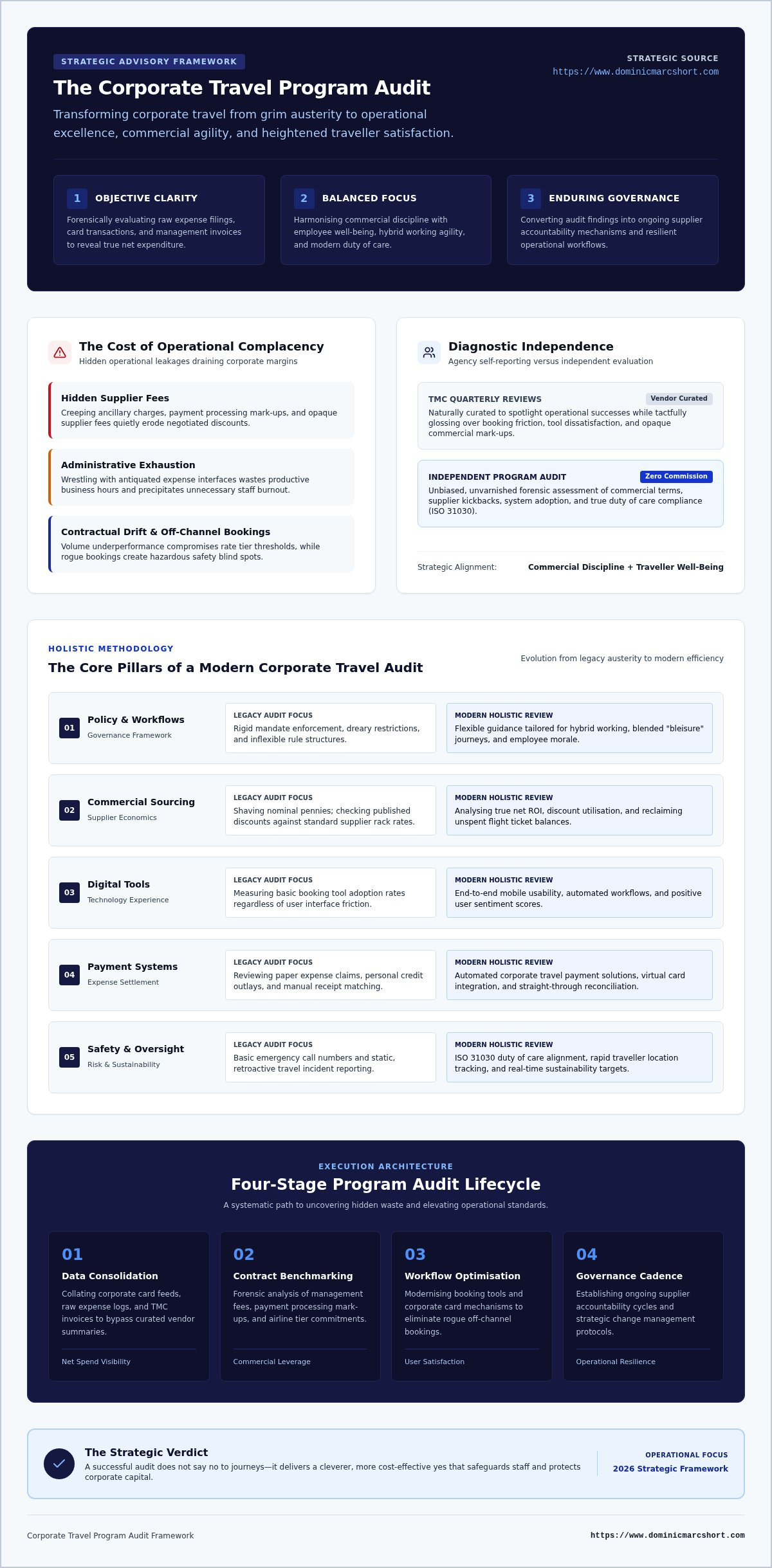
Traditional audits used to be rather grim exercises focused strictly on shaving pennies off airfares. Today, a forward-looking corporate travel program audit assesses the entire travel ecosystem, harmonising fiscal prudence with traveller happiness and operational agility.
Policy Modernisation and Spend Visibility
Static rulebooks quickly fall out of step with real-world prices. Auditing your policy means evaluating hotel rate caps against post-inflation rates and checking whether decentralised teams are quietly bypassing preferred suppliers. Crafting modern corporate travel policies ensures rules reflect commercial realities whilst making sustainable choices, like prioritising rail over short-haul flights, effortless for your staff.
Technology Integration and Payment Systems
Clunky technology ruins great policies. When your booking platform fails to communicate with central finance systems, expense queues grind to a halt. A modern review evaluates how automated data flows reduce friction, examining whether virtual card deployment can eliminate personal card usage entirely. Discover how simplifying expense reporting for employees frees finance teams from manual reconciliation headaches.
TMC Performance and Service Level Agreements
Agency service agreements deserve careful scrutiny. Your audit should measure real offline response times, after-hours ticketing accuracy, and whether fee structures conceal undisclosed technology margins. For companies seeking an impartial second opinion on vendor performance, partnering with independent business travel consultants brings absolute clarity to complex commercial arrangements, ensuring your service contracts deliver genuine value.
Conducting Your Travel Program Audit: A Step-by-Step Strategic Checklist
Executing an effective corporate travel program audit requires a disciplined, methodical roadmap rather than ad hoc reviews. By breaking the process into sequential phases, finance and procurement teams gain complete oversight without disrupting ongoing business activity.
Data Aggregation: Collect raw transaction records across agency billings, corporate cards, and central expense platforms.
Sentiment Capturing: Survey frequent travellers and executive assistants to identify practical friction points.
Supplier Rate Benchmarking: Contrast existing negotiated discounts against prevailing national market conditions.
Workflow Mapping: Chart the journey from pre-trip approval to reimbursement, pinpointing manual bottlenecks.
Remediation Roadmapping: Prioritise operational gaps into practical quick wins and longer-term contractual enhancements.
Cross-Functional Collaboration Across Finance and HR
A successful review brings procurement, finance, and human resources round the same table. While finance seeks commercial control, human resources protects employee engagement and talent retention. Engaging frequent travellers early gives them a voice, turning potential internal critics into enthusiastic allies. This joined-up perspective ensures operational fairness, particularly when managing per diems and travel allowances transparently across distributed regional teams.
Forensic Data Cleansing and Expense Reconciliation
Numbers tell clear stories once you clear out the noise. Merging disparate card feeds with agency booking logs reveals hidden leaks, such as duplicated transaction charges or dormant supplier ticket credits waiting to expire. Tracking repeated compliance exceptions clarifies why employees bypass official tools; usually, it points to clunky software rather than deliberate rebellion.
Benchmarking and Gap Analysis
Assessing airline and accommodation contracts against current national enterprise averages exposes whether volume commitments truly yield genuine value. Pair these financial comparisons with internal technology metrics, such as online adoption rates, to understand the complete picture. Combining forensic numbers with traveller sentiment yields a balanced diagnostic roadmap. This equips your leadership team to eliminate commercial wastage with confidence whilst keeping staff supported on the road.
Addressing Common Misconceptions: Audits Are Not Merely Cost-Cutting Missions
Mention the word "audit" in most corporate corridors, and employees instantly brace for austerity. Frequent travellers envision downgrade edicts, budget motels situated miles from meeting venues, and punitive reimbursement restrictions. That dreary stereotype could not be further from the truth. When structured intelligently, a modern corporate travel program audit is an enabling exercise designed to enhance traveller satisfaction whilst trimming fiscal fat.
Slashing travel budgets blindly is a false economy. True efficiency springs from eliminating administrative waste, reclaiming unspent tickets, and removing process friction. When an enterprise replaces clunky interfaces with consumer-grade mobile tools, policy compliance happens naturally. Staff don't book rogue flights out of spite; they do it because corporate channels feel needlessly difficult. Fixing the workflow protects your bottom line without compromising comfort.
The Balance Between Financial Discipline and Employee Morale
Forcing colleagues into three-stop red-eye flights to save fifty pounds destroys executive productivity. Arriving exhausted to an essential client presentation undermines the very purpose of the journey. Inflexible approval matrices also cause delays, leading to higher last-minute fares when tickets finally receive sign-off.
Auditing your setup identifies these self-inflicted bottlenecks:
Approval bottlenecks: Multi-tiered sign-offs that cause fare quotes to expire before purchase.
Productivity drains: Travel arrangements that ignore rest requirements and basic well-being.
Hidden burnout: Demanding itineraries that drive talent turnover among senior commercial teams.
A strategic review repositions travel as an investment in commercial growth rather than a pure overhead.
Winning Hearts and Minds Through Transparent Communication
Internal communication makes or breaks any operational change. If employees suspect leadership is quietly curtailing basic comforts, resistance builds instantly. Sharing audit findings openly demonstrates that the initiative aims to remove cumbersome expense forms and provide better supplier support.
Engaging department heads early helps them understand how policy refinements benefit their teams directly. Applying structured change management for corporate travel ensures that process updates feel like a collective operational victory rather than a top-down mandate.
Turning Audit Insights into High-Performing Travel Transformation
A corporate travel program audit should never culminate in a hefty diagnostic report that gathers dust on an executive bookshelf. Real value emerges when those forensic observations turn into a living, agile operational roadmap. Transforming raw review data into sustained commercial performance requires deliberate governance cadences, modernised technology stacks, and clear accountability across procurement and business operations.
Periodic governance reviews safeguard your progress. Rather than waiting for annual contract renewals, successful organisations review adoption metrics, unspent credit tallies, and booking behaviours quarterly. Embedding straight-through expense reconciliation and modern virtual cards transforms daily workflows from an administrative chore into a completely painless process. When tools work intuitively, compliance follows naturally.
Executing the Optimization Roadmap
Armed with unvarnished audit data, corporate leaders approach supplier discussions with unprecedented clarity. Forensic spend profiles reveal exactly where volume commitments were met, eliminating speculative guesswork from airline and hotel negotiations. Reconfiguring online booking algorithms ensures compliant options surface first, gently guiding colleagues toward preferred partners without excessive mandate policing. Embracing the full capability of digital transformation for business travel unites mobile booking, corporate cards, and duty of care tracking into one seamless operational engine.
Partnering with an Independent Strategic Specialist
Executing systemic operational changes internally can be tricky, particularly when internal stakeholders hold competing priorities or suppliers push back on contractual transparency. This is where engaging an impartial advisor makes all the difference. An independent consultant functions without supplier commissions or booking-volume kickbacks, focusing solely on driving genuine net return on investment for your enterprise.
CDABS, led by Dominic Short, brings over 30 years of seasoned business travel management leadership to your corner. By providing independent business travel management consulting and global transformation oversight, CDABS cuts through vendor sales puffery to deliver clear, actionable strategies tailored to your enterprise. Ready to revitalise your operational setup and eliminate expensive leakage? Book an exploratory conversation with CDABS today to unlock the full potential of your corporate travel program.
Elevate Your Business Travel Operations for 2026 and Beyond
A well-executed corporate travel program audit does far more than rein in rogue spending; it realigns your commercial arrangements with modern operational reality. By replacing clunky booking hurdles with streamlined payment technology and transparent supplier agreements, you eliminate costly financial leakage whilst giving your travelling colleagues an experience they will genuinely cheer for.
Achieving this balance calls for an objective, seasoned perspective free from supplier commissions and hidden booking quotas. Backed by over 30 years of international corporate travel management expertise, CDABS guides organisations through thorough process analysis, digital payment integration, and lasting change management. Having an impartial partner ensures your commercial interests always come first.
Taking control of your travel expenditure is an invigorating step towards long-term resilience, ensuring your road warriors stay productive, safe, and smiling on every single journey.
Frequently Asked Questions
How often should a company conduct a corporate travel program audit?
Most organisations should conduct a formal corporate travel program audit every two to three years, or whenever major operational shifts occur. These shifts might include corporate restructuring, rapid headcount growth, or introducing new hybrid working models. In addition, carrying out lighter, quarterly health checks on data trends ensures that supplier compliance remains steady and unspent ticket balances don't quietly accumulate between major reviews.
What key data sources are required to run an effective travel audit?
An effective audit demands a unified view across multiple internal and external channels. You will want raw transaction files from your Travel Management Company, corporate credit card billing statements, and internal expense reimbursement filings. Layering in HR personnel directories and direct feedback surveys from travelling employees completes the diagnostic puzzle. Comparing these records highlights off-channel leakage and reveals discrepancies that isolated reports routinely overlook.
How does an independent travel audit differ from an agency review?
Travel agency account reviews are inherently designed to demonstrate supplier value and protect commercial partnerships, often glossing over subtle service friction or opaque margins. Conversely, an independent review operates with zero supplier bias and accepts no booking commissions. Independent consultants evaluate your technology stack, fee schedules, and policy structures objectively, ensuring recommendations focus purely on your bottom-line profitability and employee well-being rather than agency targets.
Can a corporate travel program audit help reduce employee turnover?
Yes, absolutely. Friction-filled travel policies and clunky booking portals consistently frustrate travelling employees, accelerating road-warrior fatigue and commercial talent churn. By identifying awkward flight connections, restrictive meal allowances, and tedious expense processes, an audit helps modernise policy to support traveller well-being. When staff feel properly supported and trusted during business trips, job satisfaction rises, helping retain valuable team members who might otherwise seek friendlier working pastures.
What are the common signs of invisible cost leakage in travel programs?
Invisible leakage often disguises itself as routine business expense. Common indicators include a growing volume of out-of-policy bookings reimbursed through personal credit cards, unclaimed airline ticket credits drifting past expiry, and creeping supplier booking fees. Another telltale sign is widespread rate cap override requests, which usually signal that your negotiated hotel tariffs no longer align with current market conditions across your typical destinations.
How does an audit evaluate duty of care and traveller risk management?
Modern audits evaluate whether your safety protocols meet established international standards like ISO 31030. The assessment examines how quickly your organisation can locate and communicate with mobile staff during disruptions, particularly when decentralised bookings occur. It also reviews emergency response workflows, pre-trip destination risk briefings, and the balance between robust traveller tracking and respecting individual privacy rights across various regional assignments.
What role do corporate payment solutions play in travel program optimisation?
Modern corporate payment solutions act as the financial backbone of an efficient travel programme. Deploying virtual cards and automated central billing eliminates the tedious chore of manual expense reconciliation, preventing out-of-pocket stress for travelling staff. During an audit, reviewing payment infrastructure uncovers hidden merchant fees, improves invoice accuracy, and ensures rich transaction data flows directly into your central accounting systems without human intervention.



Comments