The Corporate Travel RFP Process: 5 Myths That Can Derail Your Search
By Dominic Marc Short · 13 October 2026 · 15 min read

What if the proposal that looks strongest on paper is the wrong fit for your travellers? The corporate travel RFP process can produce plenty of polished responses, but unclear goals may leave you comparing proposals that solve entirely different problems.
A thorough brief and a tidy scoring sheet are useful, but they cannot fix conflicting priorities on their own. When stakeholders value different things, or the RFP becomes a paperwork marathon, even the most organised spreadsheet can lose sight of what matters: how travel works across your organisation and how it feels for the people taking the trips.
This article separates five common RFP myths from practical guidance, so you can build a decision process around your organisation’s real needs. You’ll find ways to define requirements that account for operational priorities and traveller experience, compare responses using consistent criteria, and give the move from selection to implementation clear ownership. The aim isn’t a thicker document. It’s a better-informed decision, with fewer surprises and less paperwork for paperwork’s sake.
Table of Contents
- What the Corporate Travel RFP Process Is, and What It Should Decide
- Three Corporate Travel RFP Myths That Make the Process Harder
- How to Compare Corporate Travel RFP Responses Fairly
- A Practical Sequence for Running a Corporate Travel RFP
- After Selection: Turn the RFP Decision into a Working Travel Programme
What the Corporate Travel RFP Process Is, and What It Should Decide
A corporate travel RFP is a structured request that invites potential travel management partners to respond to the same set of requirements. It creates a basis for comparison; it does not make the decision for you. The corporate travel RFP process connects your organisation’s needs to clear evaluation criteria, then uses the evidence in the responses to support a reasoned selection.
That distinction matters. An RFP is not simply procurement paperwork to complete, file and forget, nor does issuing one automatically commit you to replacing an existing provider. It is a way to examine whether current arrangements and possible alternatives support the organisation’s direction. The review might confirm that the existing model remains suitable, identify worthwhile changes, or show that a different approach deserves consideration.
Business travel management brings together policies, booking arrangements, payments, technology and traveller needs. A well-framed RFP considers these connected elements rather than treating the search as a request for a list of prices. For a broader overview of the discipline, see Corporate travel management. The RFP should focus that wider context on a practical question: what must the travel programme enable, and how will you judge whether a proposal can support it?
When a Corporate Travel RFP Can Help
A formal review can be useful when the organisation’s needs have changed, day-to-day processes create recurring friction, or current arrangements leave important requirements unmet. For example, expansion into new markets may change the mix of journeys, while a new payment approach or digital tool may prompt a review of how travel processes fit together. These are signals to examine the programme, not automatic instructions to launch a tender.
Start with the business direction and the experience travellers need, then define the programme objectives that follow. Is the priority clearer oversight, simpler processes, more useful reporting, or better alignment between policy and how employees travel? Different organisations will answer differently. Keep the review proportionate to the decision at hand. There is no need to run a formal RFP at fixed intervals simply because the calendar has turned.
What the RFP Process Should Deliver
At its best, the process produces three practical outputs: requirements stakeholders recognise as relevant, responses that can be compared consistently, and a documented decision with a clear rationale. The record should show which needs were prioritised, what trade-offs were considered and why the selected option fits the organisation’s objectives.
Trade-offs are part of a sound decision, not evidence that the process has failed. One proposal may align more closely with established workflows; another may offer a stronger basis for future change. There may be no universally best provider, only a best-fit choice against the criteria that matter to your organisation. Make those criteria explicit, and differences between proposals become easier to discuss constructively.
Selection is also a starting point, not the finish line. The chosen approach still needs ownership, implementation and review. Clear decisions made during the RFP can guide that next phase, helping the organisation turn a proposal into a working travel programme rather than celebrating a signed agreement and hoping the rest sorts itself out.
Three Corporate Travel RFP Myths That Make the Process Harder
A structured RFP can bring useful discipline to a search, but a few common assumptions can turn it into a contest of paperwork or headline prices. The corporate travel RFP process works best when it tests what matters to your organisation, without pretending that one document can settle every decision or deliver change by itself.
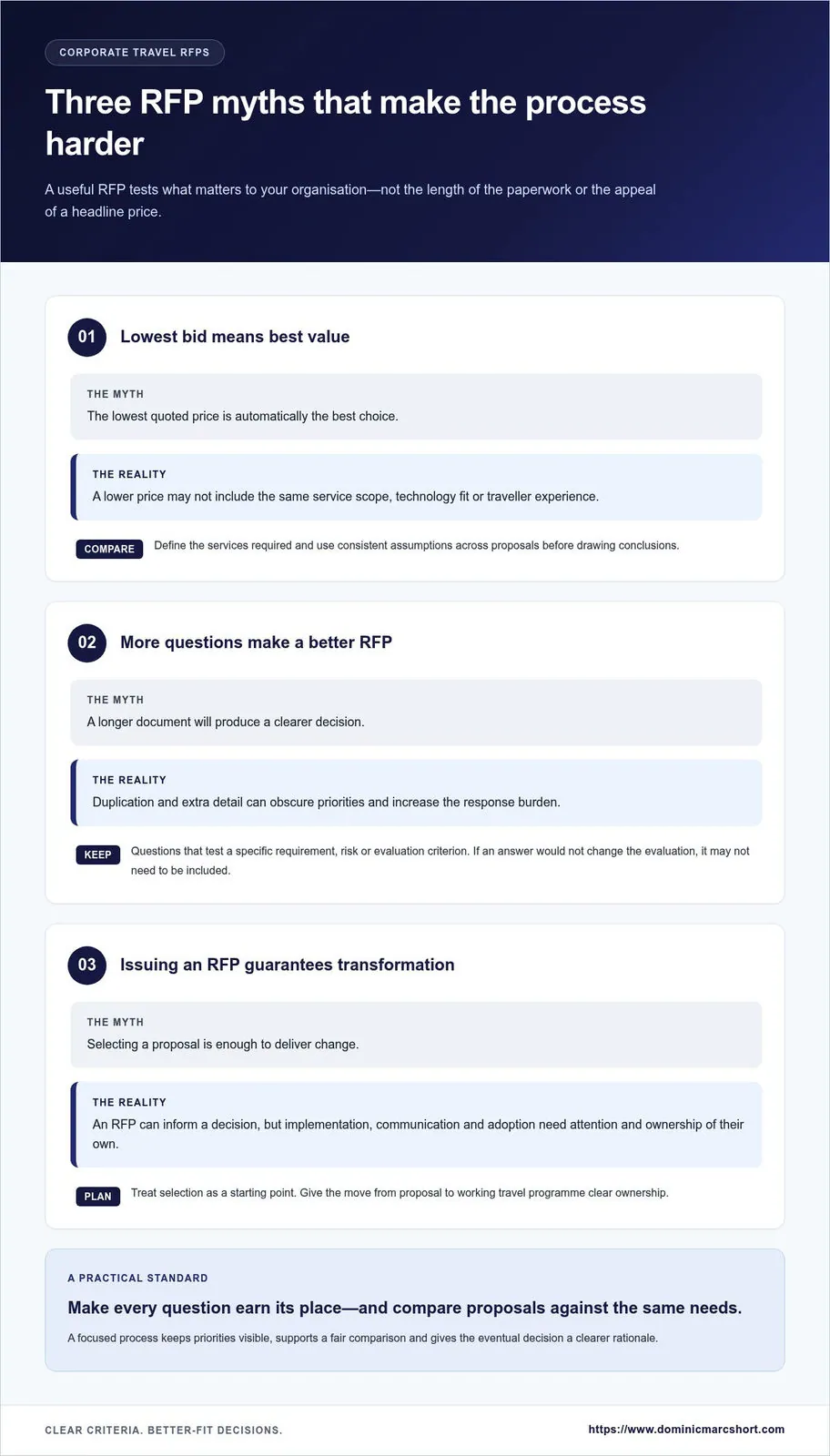
Myth: The lowest bid is automatically the best value.Reality: A lower quoted price may not reflect the same service scope, technology fit or traveller experience. Compare like with like before drawing conclusions.
Myth: More questions make a better RFP.Reality: Questions earn their place when they test a requirement, risk or evaluation criterion. A longer document can make priorities harder to see.
Myth: Issuing an RFP guarantees transformation.Reality: The RFP can inform a decision, but implementation, communication and adoption need their own attention and ownership.
Myth: A Longer RFP Produces a Better Decision
It’s tempting to add another question whenever a concern arises. The result can be duplication, a long response burden and a mountain of detail that obscures the points stakeholders need to decide. Before including a question, connect it to a specific requirement, risk or scoring criterion. If the answer would not change the evaluation, it may not need to be in the RFP.
Concise does not mean superficial. Ask a focused question about how a proposed service would handle a defined business need, then use a targeted follow-up to explore the response. This keeps the request manageable while still making room for meaningful discussion of complex requirements.
Myth: Lowest Cost Means Best Overall Fit
Commercial terms matter, but they are only one part of the assessment. A proposal’s apparent price can be difficult to compare if its scope or assumptions differ from another response. Define the services you require and use consistent assumptions across submissions. That gives evaluators a clearer view of what is being offered, rather than inviting a comparison of figures that may not cover the same things.
Then assess the broader fit: service scope, technology, payment processes and the experience expected by travellers. The right balance depends on organisational priorities; there is no single evaluation model that suits every programme. A clear scorecard helps show where a lower-cost option meets the need, and where a trade-off deserves discussion.
There’s one more misconception to set aside: that issuing the RFP itself creates transformation. It doesn’t. A selection can identify a direction, but translating it into changed processes requires implementation planning, coordination and employee adoption. Treat those as deliberate workstreams, with owners and measures, rather than assuming they will take care of themselves after selection.
For organisations weighing process design alongside wider travel change, independent business travel management consulting can help bring requirements, evaluation and implementation into one considered view. CDABS supports clients with business travel process analysis and optimisation, payment solutions and digital transformation.
How to Compare Corporate Travel RFP Responses Fairly
A fair evaluation starts before proposals arrive. Build the scorecard from prioritised business outcomes, separating essential requirements from preferences. An essential requirement is a condition a proposal must meet; a preference is a benefit that can distinguish otherwise suitable options. This helps evaluators avoid treating every feature as equally important, and gives the corporate travel RFP process a consistent basis for comparing responses.
Turn Business Needs into Measurable Criteria
Translate broad aims into questions that produce evidence. If the goal is greater visibility, specify which travel information decision-makers need and ask for an example of the reporting available. If the aim is a smoother traveller experience, describe the relevant journey or support need and ask how the proposed service addresses it.
Involve the people who understand different parts of the programme, such as travel, finance, procurement, technology and traveller representatives where relevant. Assign an owner to each criterion before scoring begins. That person can clarify what the requirement means and help keep its interpretation steady if priorities start to drift during review.
A practical evaluation matrix connects each dimension to evidence and the decision it informs:
Compare Proposals Without False Precision
Use the same assumptions, evidence requests and scoring definitions for every response. A simple shared scale can work well if evaluators agree what each score means, for example whether a requirement is met with clear evidence, partly addressed, or not addressed. Record the reason behind each judgement, not just the number. The rationale makes differences easier to discuss and decisions easier to explain.
Keep claims distinct from evidence. If a proposal relies on an assumption, excludes an activity or leaves a question unresolved, flag it for clarification rather than scoring it as a proven capability. Where technology investment forms part of the assessment, connect the proposal to the business case for travel management software, so the evaluation considers organisational value as well as features.
A Practical Sequence for Running a Corporate Travel RFP
A clear sequence keeps the work moving without making the process more formal than the decision requires. The corporate travel RFP process should have a named decision owner, defined stakeholder roles, a timetable that reflects the programme’s complexity and one place to record questions, answers and clarifications. That way, nobody is left scoring from a different version of events.
- Define the decision. State what the organisation needs to decide, why the review is happening and what a successful outcome must support. Be clear whether the scope concerns the whole travel programme or a particular part of it.
- Review available information. Use historical travel data to understand travel patterns, processes and areas of friction. Check its quality before relying on it: incomplete or inconsistently categorised records can only provide a partial picture.
- Set requirements and responsibilities. Agree which needs are essential, which are preferences and who owns each evaluation area. Include the perspectives needed to assess travel operations, finance, technology and traveller needs.
- Invite suitable participants. Share the same background, scope, response format and instructions with each shortlisted participant. Set out how questions will be submitted and how answers or clarifications will be shared, so everyone works from consistent information.
- Evaluate responses. Score proposals against the agreed criteria first. Then use structured presentations or clarification discussions to explore material gaps, applying the same approach to each participant.
- Select and document. Record the decision, its rationale, any remaining assumptions and the responsibilities that carry into the next phase.
Prepare the Requirements and Invite Responses
Document the objectives, scope, traveller groups, current process challenges and future needs in practical terms. For instance, describe the workflow or information need behind a broad request for better visibility. Give shortlisted participants consistent context and response instructions, including how to distinguish confirmed capabilities from assumptions. If an existing system review is shaping the brief, a travel management system audit checklist can help identify questions the RFP should address.
Evaluate, Decide and Record the Rationale
Complete the agreed scoring before opening wider discussions about preferences or commercial trade-offs. Where clarification is needed, ask consistent questions and record the answers alongside the relevant requirement. The decision record should explain why the preferred response fits, which assumptions remain open and who will own the next steps. A proportionate timetable helps keep momentum while leaving enough room for meaningful review.
Keep the process proportionate. A focused review may need fewer participants and a simpler evaluation than a programme involving multiple teams, systems or markets. There is no universal timetable or mandatory sequence beyond what the decision needs; set milestones that your stakeholders can realistically meet.
After Selection: Turn the RFP Decision into a Working Travel Programme
A signed agreement is a milestone, not a functioning travel programme. The organisation still needs to move from the selected approach to day-to-day processes that employees understand and teams can manage. Without clear ownership, even a well-considered decision can become a collection of disconnected tasks, each waiting for someone else to take the lead.
Start the transition while the decision is being finalised. Agree who will coordinate the handover, who owns each workstream and how progress or issues will be escalated. Map dependencies between the travel arrangements, payment processes and digital tools so that a change in one area does not catch another by surprise. A simple responsibility plan can make those connections visible.
Plan the Transition Before the Final Decision
Set out the information needed for handover, key responsibilities, dependencies and employee communications. Explain what is changing, when it affects travellers and where they can find guidance. If approval workflows form part of implementation, align them with the wider process; an automated corporate travel approvals guide can help frame the questions around that workstream.
Coordinate the practical details across relevant teams. For example, a new booking workflow may depend on agreed approval steps, payment processes and technology configuration. Bring the owners together to identify hand-offs, test the process from the traveller’s perspective and resolve gaps before the new approach becomes routine. Clear communication helps employees understand not only what is changing, but what they need to do differently.
Review Outcomes and Improve the Process
Agree measures that connect directly to the original objectives and that the organisation can reliably track. These might include whether a defined process is being followed, whether required information is available to the relevant teams, or whether feedback highlights recurring points of friction. Avoid choosing measures simply because they are easy to count; a tidy dashboard is useful only if it helps answer a meaningful question.
Schedule review checkpoints that give the organisation a chance to assess implementation and ongoing fit. Gather input from travellers and stakeholders, then compare what they report with the agreed measures. If employees repeatedly encounter a confusing step, or teams lack information needed to manage the programme, investigate the process behind the symptom. Feedback is most valuable when it leads to a specific action, an owner and a follow-up.
Business needs can evolve, so the original RFP should not be treated as a permanent blueprint. Recurring gaps may call for process optimisation, clearer ownership or adjustments to how travel, payments and digital tools work together. Where requirements or implementation involve several connected workstreams, process analysis can help clarify the issue and support a more coherent improvement plan. CDABS provides business travel management consulting, including process analysis and optimisation, alongside support for payment solutions and digital transformation. That keeps the programme responsive without reopening a full selection exercise for every operational snag.
Make Your Next Travel Decision Count
A useful RFP should create momentum beyond the selection meeting. Treat the decision as an opportunity to strengthen how travel processes support your organisation as its needs change. That means keeping ownership clear, learning from implementation and making improvements when the evidence points to a better way forward. No crystal ball required, just a willingness to review what is working.
If your corporate travel RFP process involves complex requirements or connected changes to processes, payments and digital tools, independent guidance can help bring the moving parts into focus. Dominic Marc Short - Independent Consultant supports organisations with business travel management consulting, process optimisation, payment solutions and digital transformation. Dominic Marc Short brings over 30 years of experience in business travel management, meetings and events, and marketing.
With a clear decision and the right support around it, your next steps can feel considerably more manageable. Here’s to a travel programme that works well for the organisation and the people travelling.
Frequently Asked Questions
What is a corporate travel RFP process?
A corporate travel RFP process is a structured way to invite and assess proposals for managing an organisation’s business travel. It helps decision-makers test whether options can meet defined operational and traveller needs. For example, a company could use it to understand how different approaches handle its booking channels, reporting needs and payment workflows, then decide whether to retain or change its current arrangement.
When should a company issue a corporate travel RFP?
Issue an RFP when there is a clear decision to make, such as whether current arrangements can support a change in travel patterns, organisational structure or programme priorities. A contract review may also prompt an assessment, but the calendar alone is not a reason to launch one. First identify the problem, its impact and whether a competitive review is likely to provide useful evidence for the decision.
Who should be involved in a corporate travel RFP?
Involve the people who will own the decision and those who understand its practical effects. A decision sponsor can resolve competing priorities, while travel, finance, procurement and technology colleagues can assess their respective requirements. Traveller representatives can help test whether proposed processes make sense in practice. Name one person to coordinate the work, consolidate questions and keep the evaluation moving when opinions differ.
What information should a corporate travel RFP include?
Include enough context for participants to respond to the same business need: the programme’s scope, traveller groups, relevant travel patterns, existing challenges and future priorities. Specify the services and evidence you want addressed, plus response instructions and a format for noting assumptions or exclusions. For commercial responses, request figures in CHF and state the basis for comparison so submissions can be reviewed consistently.
How do you compare corporate travel RFP responses fairly?
Give each participant the same requirements, response template and opportunity to clarify material points. Before reviewing submissions, agree how evaluators will interpret each score and what evidence supports it. For example, distinguish a demonstrated capability from a statement of intent, and record any dependencies that could affect delivery. Compare the evidence against your organisation’s priorities, rather than relying on presentation style or a single headline figure.
How long does a corporate travel RFP process take?
There is no universal duration; the timetable depends on the scope, number of stakeholders, complexity of requirements and time needed for review and approvals. A focused assessment may involve fewer steps than a programme spanning several teams or systems. Work backwards from the decision date, allowing time for internal alignment, responses, clarifications and evaluation. Assign an owner to track milestones and flag delays early.
What should happen after selecting a travel management company?
After selection, confirm who owns the transition and how the agreed service, processes and responsibilities will work in practice. Coordinate handover information, technology and payment arrangements, and give employees clear guidance on any changes to their usual steps. Establish a baseline against the programme’s objectives, then gather feedback from travellers and internal teams. Use recurring issues to guide targeted improvements rather than letting them become routine.
Related articles

29 October 2026 · 13 min read
Travel management masterclass for corporate travel teams
Explore a travel management masterclass for corporate teams: practical guidance on policy, costs, suppliers and traveller safety in Swiss workplaces.

28 October 2026 · 14 min read
Corporate travel sustainability strategy: How to cut travel emissions
Discover how a corporate travel sustainability strategy can cut emissions with smarter measurement, rail-first choices, practical targets and greener booking...

27 October 2026 · 13 min read
Corporate Travel Consultants in Switzerland for Executive Travel
Choose a corporate travel consultant Switzerland organisations can trust to align supplier deals, executive journeys and event support with business priorities.