The Business Case for Travel Management Software: A Practical Template
By Dominic Marc Short · 12 October 2026 · 15 min read

What if the strongest business case for travel management software starts with the work around travel, not the software itself? Licence costs are easy to spot. The time spent coordinating bookings, handling changes and reconciling scattered travel data can be much harder to see. Yet that operational picture is where a credible investment case begins, before anyone gets lost in a feature comparison or a little spreadsheet archaeology.
It is reasonable for decision-makers to ask what the organisation will gain and how those benefits can be measured. The challenge is that information may sit across teams and systems, while potential savings and efficiency gains are difficult to prove before implementation. A decision-ready case makes those uncertainties visible rather than disguising them as guaranteed returns.
This practical template will help you describe the status quo, set out transparent assumptions, compare realistic options and recommend a course of action. It also shows how to connect process improvements to measurable outcomes, with clear indicators for tracking adoption and progress. The result is a case grounded in operational evidence, not simply a persuasive tour of software features.
Table of Contents
- Why build a business case for travel management software?
- How to demonstrate the value of travel management software
- How to compare travel management software with other options
- A practical business-case template for travel management software
- Turn the business case into a practical travel technology decision
Why build a business case for travel management software?
A business case is an evidence-led argument for a decision. It explains the business need, the options available and the reasons for recommending one course of action. It is not a software feature catalogue with a budget attached. Before proposing a platform, leaders need to understand why change is being considered and what the organisation needs to improve.
That distinction matters. A review of travel policy asks whether the rules remain appropriate; a programme-performance review examines how well the current approach is working. The business case for travel management software asks a different question: should the organisation maintain its current processes, improve them, or invest in technology to support a defined scope of work? Corporate travel management covers the broader coordination of business travel, including the processes and technology that support a travel programme. Defining that context helps keep the proposed investment focused.
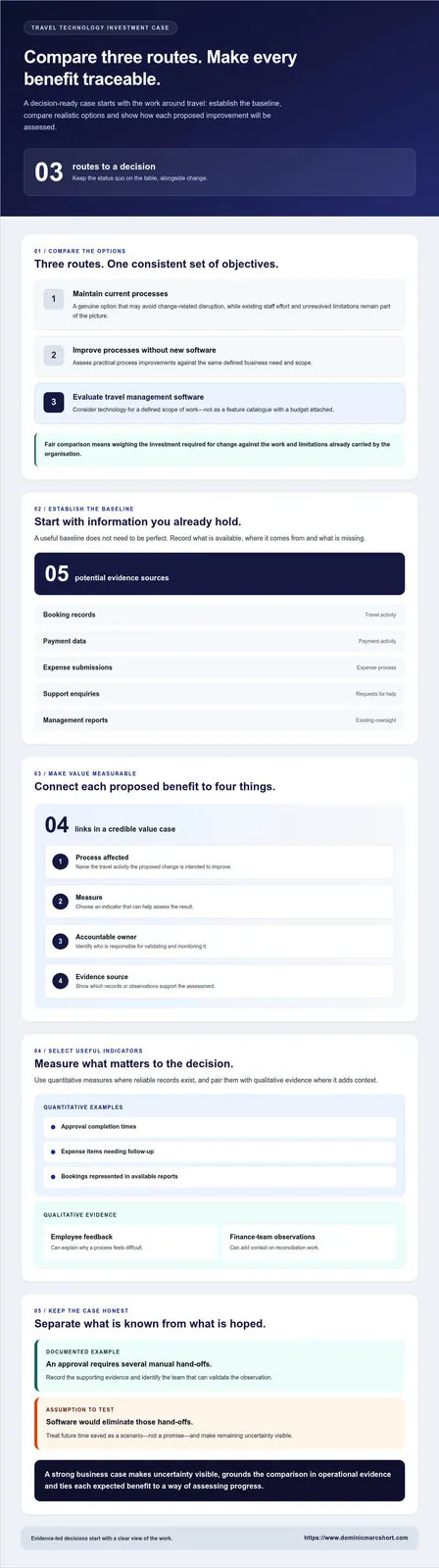
The status quo is a genuine option, not a blank space on the comparison table. It may avoid the disruption of change, but it still uses staff time and may leave limitations unresolved. Describe the effort involved in current processes, the risks of relying on disconnected information and the constraints that affect oversight. A fair comparison considers both the investment required for change and the work the organisation already carries out.
What decision should the business case help leaders make?
State the decision plainly: maintain current processes, improve them without new software, or evaluate travel management software. Identify who will approve the decision and who will live with its consequences. Finance, travel, procurement and employees may each see a different part of the process, so include their perspectives early rather than discovering a missing stakeholder at the approval meeting.
Set clear boundaries, too. Specify whether the proposal covers booking, approvals, payments, expenses, reporting or a defined combination. Without this scope, one team may expect a booking tool while another assumes payment and expense processes are included. That is a recipe for a very tidy presentation and a rather untidy decision.
Which business problems justify investigating software?
Begin with observable friction: repeated manual hand-offs, booking or payment information held in separate systems, inconsistent records, unclear approval steps, or difficulty producing a useful management view. Fragmented workflows can make it harder to see what is happening across the programme, increase the time employees and administrators spend coordinating tasks, and limit managers’ ability to act on reliable information. A structured travel data review can help clarify what information exists and where gaps remain.
Keep evidence separate from assumptions. A documented example might be an approval that requires several manual hand-offs; an assumption might be that software would eliminate them. Record what supports each observation, which team can validate it and what remains to be tested. That discipline turns frustration into a practical reason to investigate, without presenting hoped-for benefits as established facts.
How to demonstrate the value of travel management software
To demonstrate value, show how a defined change could improve specific travel processes, then explain how you will assess the result. Start with information the organisation already holds: booking records, payment data, expense submissions, support enquiries and management reports. The aim is not to manufacture a perfect dataset. It is to establish a useful baseline, note gaps and make clear where the evidence comes from.
For each proposed benefit, connect four things: the process affected, the measure, the accountable owner and the evidence source. For example, if the aim is to reduce time spent on approvals, record how the current workflow operates, identify who can verify the steps and use available timestamps or a documented sample to understand the baseline. Treat any estimate of future time saved as a scenario, not a promise.
Which travel-programme outcomes belong in the analysis?
Choose outcomes that reflect the organisation’s priorities and the scope under consideration. Policy visibility, approval workflows, booking oversight and consistency of travel data may be relevant, as may administrative effort, traveller experience and the work finance teams undertake to reconcile payments and expenses. Include sustainability or duty-of-care objectives only when they matter to the decision and can be assessed with suitable evidence. A long list of desirable outcomes is no substitute for a few meaningful measures.
Use quantitative measures where reliable records exist, such as approval completion times, the volume of expense items needing follow-up, or the proportion of bookings represented in available reports. Pair them with qualitative evidence, including employee feedback or finance-team observations. Keep the two forms distinct: feedback can explain why a process feels difficult, while transaction records may show where the work occurs. Both are useful, but they answer different questions.
How should costs and benefits be compared?
Set out the full cost categories for each realistic option, rather than focusing only on a software subscription. Depending on the proposed approach, these may include implementation, subscription, integration, training and ongoing management. Compare them with evidenced current-state costs and process effort, using the organisation’s own records and agreed methods. If the data does not support a monetary estimate, say so; a carefully described operational benefit is more credible than a precise-looking figure built on guesswork.
Present scenarios to show how assumptions affect the case. A cautious scenario might assume limited process change; another could reflect broader adoption after training. State what each assumes about implementation effort, employee use and the processes included. Do not count the same benefit twice, such as recording reduced administration both as staff time released and as a separate saving unless those are genuinely distinct outcomes.
A simple evidence record keeps the analysis decision-ready:
- Expected benefit: the outcome and process it relates to.
- Measure and owner: how progress will be assessed and who is accountable.
- Evidence and confidence: the source, known gaps and whether the claim is documented, estimated or still to be tested.
This approach helps leaders see not only the potential value, but also what remains uncertain. Business travel management consulting from Dominic Marc Short - Independent Consultant connects process evidence with technology decisions and implementation planning.
How to compare travel management software with other options
A useful comparison tests different ways of meeting the same business objectives. Include the current approach, process improvements that do not require new software, and a software investment. Assess each against agreed needs, such as clearer oversight or less manual coordination, rather than comparing one option’s full feature list with another’s headline price. This keeps the decision focused on fit and trade-offs, not on which presentation has the glossiest screenshots.
Before scoring, separate essential requirements from desirable features. An essential requirement addresses a defined operational need; a desirable feature may improve convenience but should not determine the decision on its own. Record why each criterion matters and who has validated it. A focused travel management software selection process can help keep requirements tied to workflows and outcomes.
Which evaluation criteria make the comparison useful?
Use a simple decision matrix. Give each option a consistent rating, such as strong fit, partial fit or an identified gap, and add a brief explanation or evidence source. Avoid false precision: a score without a reason is merely a number wearing a smart jacket.
- Workflow fit: How does the option support existing booking and approval steps? Would the process need to change, and where?
- Data and reporting: Can the organisation obtain the information it needs for oversight and decision-making? Note any data-quality or reporting gaps.
- Payments and expenses: Assess how the option fits the organisation’s payment processes, expense handling and finance reconciliation needs.
- Usability and governance: Consider the experience for employees and administrators, along with policy oversight and ongoing ownership.
- Implementation and connections: Record the change effort and any relevant connections with existing systems that the approach depends on.
Apply the same criteria to every option, including the status quo. For example, process changes might improve approval clarity but leave fragmented reporting unresolved; software might address that gap while requiring new ways of working. State these trade-offs plainly. The strongest option is the one that best supports the agreed objectives within the organisation’s practical constraints, not a universal winner.
How can the case address risk and adoption?
Describe what could complicate delivery before recommending a route. Common dependencies to examine include data quality, process ownership, implementation capacity, system connections and the disruption involved in changing established routines. For each, record the potential effect, a mitigation, an accountable owner and a point at which progress will be reviewed.
Adoption needs its own plan. Employees may need clear explanations of what is changing and how the revised process affects them; administrators may need role-specific training and guidance. Set out who will prepare communications, gather feedback and monitor early use. These measures will not make a transition friction-free, but they make responsibilities visible and give the business case for travel management software a more realistic account of what delivery requires.
A practical business-case template for travel management software
A useful template gives decision-makers a clear route from the business need to a recommendation, without hiding uncertainty in the footnotes. Keep each entry concise, and attach an evidence source, accountable owner, assumption and confidence level to every material claim. The format below can be adapted to your organisation’s approval process.
What should each business-case section contain?
- Executive summary: State the decision required, the business need, the preferred approach and the principal uncertainties. Make clear whether the recommendation is to maintain current processes, improve them or evaluate software.
- Problem and baseline: Describe the process issues the proposal addresses and the evidence available about current performance. Note important gaps rather than filling them with guesswork.
- Requirements and options: Record the essential needs, then compare the status quo, process improvements and software investment against the same criteria. Explain why each option is included.
- Value and costs: Set out expected operational and qualitative benefits alongside known cost categories. Mark forecasts as assumptions, and show what evidence or validation could strengthen them.
- Risks and recommendation: Summarise delivery dependencies, mitigations and ownership, then state the preferred option and why its trade-offs are acceptable.
- Delivery and measurement: Define responsibilities, change activities, review points and the measures that will indicate progress after implementation.
For each expected benefit, connect the objective to a post-launch measure. If the objective is clearer approval oversight, for instance, define what will be observed, who will review it and when. An implementation framework for travel technology can help translate those objectives into a practical delivery plan.
How can teams make the recommendation decision-ready?
Use a decision matrix to show how each option performs against agreed criteria. Add a short rationale so readers can see what sits behind each assessment; a rating alone can make a weak case look oddly confident.
- Current approach: Record what it supports, where limitations remain and what effort continues.
- Process improvement: Note which issues could be addressed without software, alongside any gaps left unresolved.
- Software investment: Assess workflow fit, data, payments, employee usability, implementation needs and ongoing ownership.
Then explain the recommendation in plain language for finance, leadership and programme stakeholders. Identify which findings are supported by records or validated observations, and which assumptions still need testing. Be candid about trade-offs: a preferred option may address priority needs while requiring process changes, training or additional oversight. Include review measures and consider a travel management system audit checklist as a useful reference for ongoing scrutiny. A transparent recommendation is easier to assess, challenge and approve than one that promises everything and accounts for nothing.
CDABS provides business travel management consulting that connects process analysis, technology decisions and implementation planning. Find an overview of CDABS’s approach to travel technology business cases.
Turn the business case into a practical travel technology decision
Approval is the start of delivery, not the finish line. Turn the business case for travel management software into a scoped plan that names the decision owner, delivery lead and teams responsible for each workstream. Confirm what is in scope, what sits outside it, which decisions require governance approval and what evidence is needed before implementation begins. Clear boundaries help keep a sound decision from expanding into an unplanned programme.
What happens after leaders approve the case?
Translate the approved objectives into milestones and measures. If the case aims to improve approval oversight, for example, define the workflow to be introduced, who owns it and how progress will be reviewed against the agreed baseline. Set review points during delivery as well as after launch, so teams can address issues while they are still manageable.
- Confirm ownership: Name accountable leads for process design, technology decisions, payments, communications and measurement.
- Define milestones: Record key decisions, dependencies and the evidence required to move to the next stage.
- Prepare employees: Explain what will change in day-to-day workflows and provide role-appropriate training for travellers and administrators.
- Review outcomes: Compare actual performance with the baseline, document gaps and capture lessons for future decisions.
Communications and engagement belong in the delivery plan, not in a last-minute email drafted between other priorities. Explain why the process is changing, what employees will need to do differently and where they can raise practical questions. A corporate travel change-management framework can help structure this work around the people affected as well as the technology being introduced.
When can independent consulting strengthen the decision?
An experienced adviser can help connect process analysis with technology choices, payment needs and the practicalities of implementation. This is useful when travel information is spread across teams or when a proposed tool may affect several connected workflows. An independent perspective can help decision-makers test whether the selected scope still addresses the original need as delivery planning becomes more detailed.
Dominic Short brings over 30 years of relevant experience in business travel management, meetings and events, and marketing. That experience informs CDABS’s approach to analysing current processes, identifying opportunities for optimisation and supporting travel technology transformation. It does not remove the need for clear ownership or evidence; it helps keep those elements connected as the organisation moves from approval to action.
Once the solution is in use, record what worked, what required adjustment and which assumptions proved accurate. Those lessons give future decisions a more reliable starting point. A measured discussion about your organisation’s travel management priorities can help clarify the questions to address.
Make your next travel technology decision count
A strong business case for travel management software should remain useful after approval. Treat it as a reference point for checking whether the chosen approach still meets the organisation’s needs as workflows change and practical lessons emerge. If assumptions shift, revisit them openly rather than allowing the original case to become a document filed away and admired only by its author.
Business travel management consulting can connect process analysis, payment needs and technology decisions, then carry that thinking into implementation. Dominic Short’s experience includes delivering over 500 events worldwide, across varied formats and contexts. The value of that perspective lies in asking the right operational questions and helping organisations make decisions grounded in their own priorities, not in promising a particular outcome.
Take the next step with a clear view of what your organisation needs from its travel programme. CDABS supports organisations with travel process analysis and optimisation, global travel management solutions, payment solutions and digital transformation.
Your next decision can be both well-informed and full of possibility.
Frequently Asked Questions
How do you build a business case for travel management software?
Start by stating the decision leaders need to make, then identify the specific travel-process problems behind it. Gather evidence from records and the staff who handle the work, and note where information is incomplete. Compare practical alternatives, including improving the existing process. For the business case for travel management software, make each expected benefit traceable to a measure and owner, then explain the recommendation and the questions that still need answering.
What should a travel management software business case include?
Include a concise decision brief supported by enough detail for leaders to test the reasoning. Cover the business need, current-process evidence, objectives, alternatives, evaluation criteria, relevant costs, dependencies and risks. Add an appendix or evidence register for sources and assumptions, so the main recommendation stays readable. For example, a finance lead should be able to trace a projected reduction in reconciliation effort to the process evidence behind it, not just a confident sentence.
How can you calculate the ROI of travel management software?
Estimate ROI by comparing evidenced benefits with the full investment and operating costs over a clearly stated period. A common calculation is (benefits minus costs) divided by costs, expressed as a percentage. Separate cash-releasing savings from time or service improvements that may not reduce expenditure. If reliable inputs are unavailable, present scenarios rather than a single precise result, and explain which assumptions would need validation after implementation.
Is travel management software worth it for a small business?
It can be, if the organisation’s travel workload, process complexity or oversight needs justify the change. A small business might first map who requests trips, who approves them and how payments and expenses are reconciled. If a few straightforward adjustments address the main friction, software may not be the right next step. Compare options against the actual workload and capacity to manage change, rather than company size alone.
What costs should a business case for travel software consider?
Consider subscription or licensing, implementation, integration, training and ongoing management, as well as internal staff time devoted to the project. Depending on the chosen approach, transition work such as preparing data or supporting new processes may also matter. Distinguish budgeted expenditure from estimated staff effort, and state what the comparison excludes. This helps prevent a low headline price from obscuring the wider commitment needed to operate the solution.
How do you address employee resistance to new travel software?
Find out what employees expect to change before finalising the rollout plan. A short discussion with frequent travellers, approvers and administrators can reveal practical concerns, such as extra steps or uncertainty about who handles exceptions. Use that feedback to shape clear, role-specific guidance and training. After launch, provide a straightforward way to raise issues, then review recurring questions to distinguish a communication gap from a workflow problem.
What metrics should you use to measure travel management software success?
Choose measures that match the approved objectives, and define them precisely before implementation. For example, if the aim is better approval visibility, specify what counts as an approval, where its status will be recorded and who reviews the results. Pair process measures with employee feedback where relevant. Record the data source, owner and review timing for each metric, and avoid generic benchmarks that may not reflect your organisation’s travel patterns.
Related articles

4 September 2026 · 14 min read
The 2026 Guide to Business Travel Risk Management Policy: Balancing Safety and Friction
Did you know that 86% of travel managers worry their current safeguards aren't enough to protect employees on the road? This finding from SAP Concur's…

6 November 2026 · 15 min read
Virtual credit cards for business travel and spending controls
Explore how virtual credit cards for business travel control spending, simplify expenses and keep bookings moving with supplier checks and backup plans.

29 October 2026 · 13 min read
Travel management masterclass for corporate travel teams
Explore a travel management masterclass for corporate teams: practical guidance on policy, costs, suppliers and traveller safety in Swiss workplaces.