Virtual credit cards for business travel and spending controls
By Dominic Marc Short · 6 November 2026 · 15 min read
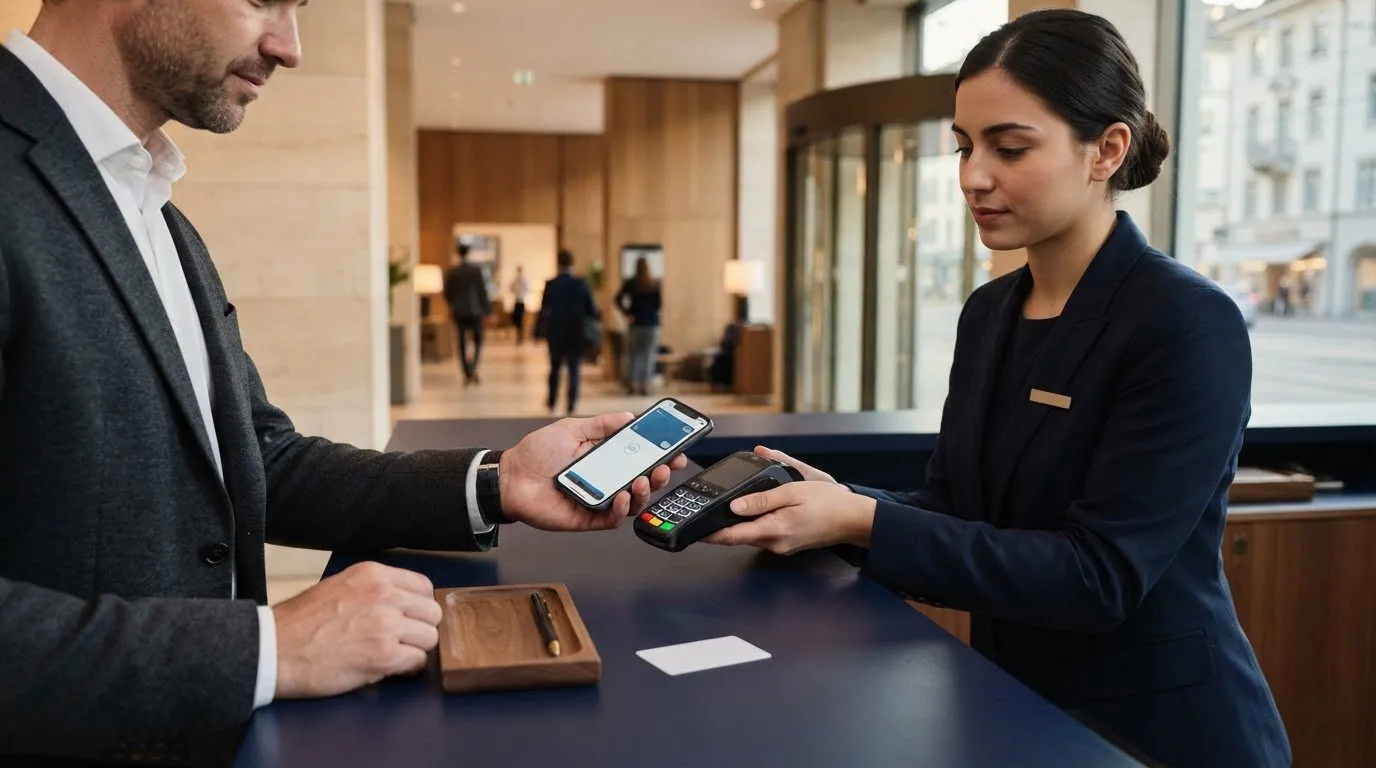
Virtual credit cards for business travel can make supplier payments more secure when each card is configured for its intended transaction and the supplier accepts it. A business can set a spending limit, validity period and purpose, and configure the card to decline payments above the limit or at unapproved vendors. Because the card is restricted to an assigned transaction, it can also reduce exposure to unauthorised charges.
It’s understandable to want tighter control over travel spending without asking employees to put every booking on a personal card. Virtual cards can help, but not every supplier accepts them, so a practical payment plan should include a backup.
This article explains how virtual cards work for supplier payments and ad hoc travel purchases, which spending controls they can support, and how they fit into business travel budgets. It also covers how supplier acceptance and company policy shape the process, including the safeguards and details that need careful planning. The goal is a payment method that makes travel spending easier to manage, not a magic wand.
Table of Contents
- Are virtual cards secure for supplier payments?
- Virtual cards for online and ad hoc business travel payments
- Spending controls and travel policy compliance
- Business travel spending and budgets
- Virtual cards in business travel
- Dominic Marc Short - Independent Consultant: Business Travel Management Consulting
Are virtual cards secure for supplier payments?
Virtual cards can give businesses more control over supplier payments than a traditional credit card. A company can issue a separate card number for a specific booking, limiting the payment details shared with each merchant.
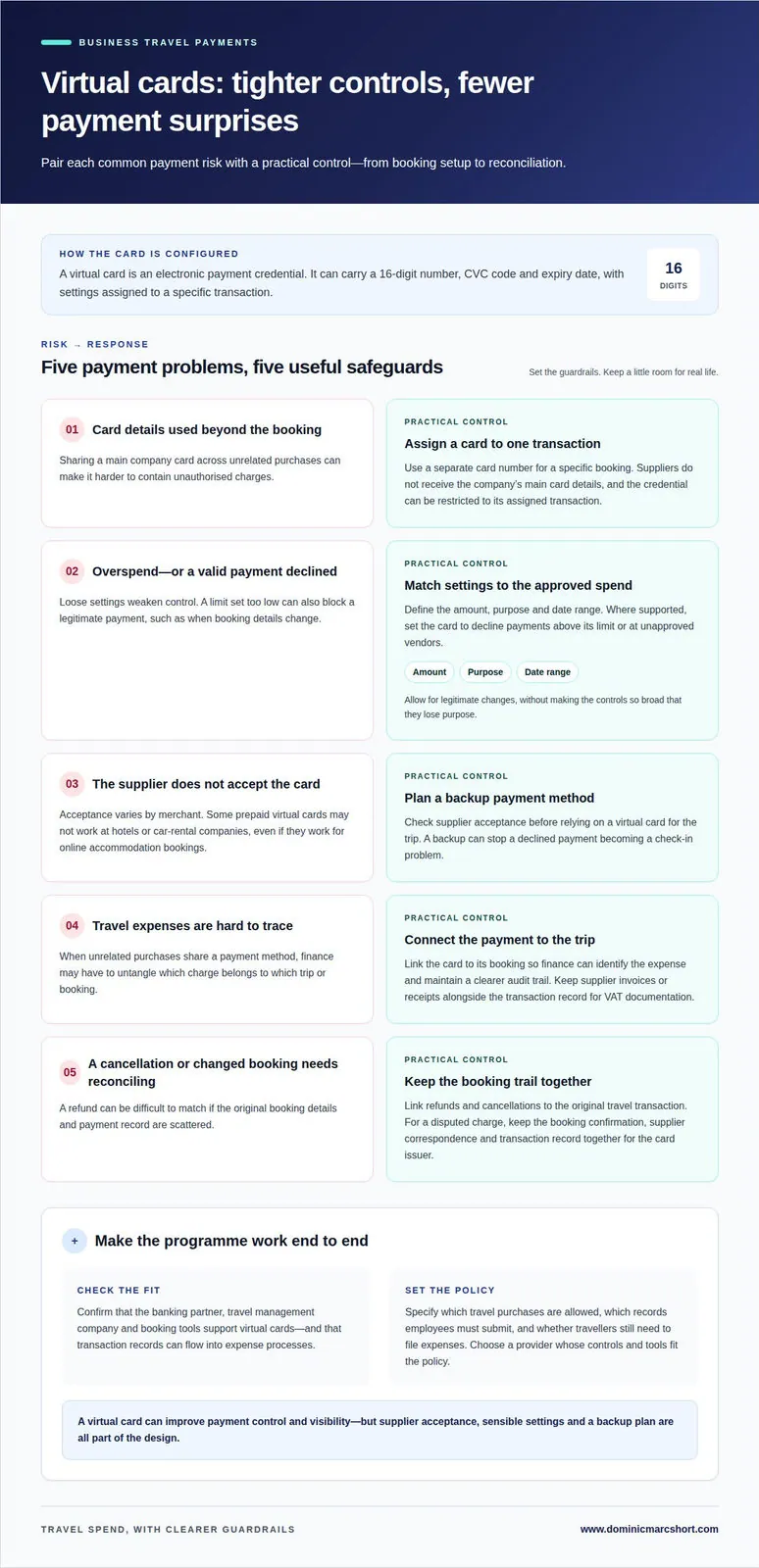
A virtual card is an electronic payment credential, not a physical card. In a travel booking, it can carry a 16-digit number, a CVC code and an expiry date, much like a traditional credit card. The difference is how the company assigns and controls those details. For example, a card created for a hotel booking can be restricted to that transaction rather than shared across unrelated purchases.
Single-use credentials can reduce the risk of unauthorised charges because each card is unique and restricted to its assigned transaction. Suppliers also don’t receive the company’s main card details. If a hotel reservation changes, finance can track the payment against that booking rather than untangling it from unrelated travel expenses.
Virtual card settings can define the amount, purpose and date range. A travel manager might issue a card for a specific hotel booking, with a limit matching the approved spend. Some systems can also decline payments to unapproved vendors or above an employee’s limit. Settings need to allow for legitimate changes: a limit that is too low can block a valid payment, while one that is too broad weakens control.
Adopting virtual cards is a programme decision, not simply a matter of issuing cards. Businesses need to consider whether their banking partner, travel management company and booking tools support them, and how transaction records will flow into expense processes. A card linked to a booking can connect supplier payment details to the trip and give finance a clearer audit trail.
Acceptance varies by merchant. Some prepaid virtual cards may not work at hotels or car-rental companies, even when accepted for online accommodation bookings. Before relying on a virtual card for a trip, establish a backup payment method for suppliers that decline it. A simple contingency can prevent a payment problem from becoming a check-in problem.
For Swiss businesses, internal policy should specify which travel purchases can be paid with virtual cards and what records employees must submit. For VAT documentation, keep supplier invoices or receipts alongside the card transaction record. The transaction shows how the payment was made; the receipt or invoice helps document what the business bought.
Virtual business card availability in Switzerland depends on the issuer and payment platform. Choose a bank or provider whose virtual-card function works with the company’s travel booking and expense tools and supports the controls its policy requires.
Link refunds and cancellations to the original travel transaction so finance can reconcile the returned amount against the booking. Credit-card schemes can make recovery for changed or cancelled bookings easier than relying on banking systems. When disputing a charge, keep the booking confirmation, supplier correspondence and transaction record together for the card issuer.
Virtual cards for online and ad hoc business travel payments
Virtual cards can pay suppliers online or cover travel purchases linked to a specific booking. The right payment channel depends on the supplier, card programme and expense-recording requirements.
Travel Payment Types and Channels
A virtual card is an electronic payment method for transactions such as a hotel booking, transport reservation or event supplier invoice. For business-to-business payments, a company can give a supplier card details for an approved booking instead of using its main credit card. Linking the card to the booking helps finance identify the expense later.
Online reservations are well suited to virtual credentials because travellers can enter the card number at checkout. An ad hoc rail booking, airport transfer or meeting-room purchase may also work if the merchant accepts the card and the transaction meets its settings. Assigning a card to one purchase creates a clearer record than putting unrelated travel expenses on a shared payment method.
Contactless payments follow a separate route. If the card programme provisions the credential to a compatible mobile wallet, a traveller can use the wallet at a contactless terminal. This can be useful for transport on the move, while an online card payment may suit a hotel reservation made before departure. The same card may not work for both channels unless its issuer and programme support them.
For events, distinguish supplier invoices from on-site purchases. A virtual card might be assigned to an online venue or catering payment, while an attendee’s incidental purchase may need separate approval and expense treatment. Define the intended use before issuing the card to keep the payment aligned with the booking and avoid leaving finance to solve a reconciliation puzzle later.
Fees and Currency Charges
Swiss business virtual-card fees, exchange rates and foreign-transaction charges depend on the issuer and card programme. For payments in another currency, the total recorded expense may reflect the programme’s conversion terms and any applicable transaction charges.
For example, when a company pays a hotel in a foreign currency, it should account for the supplier’s charge currency and the card’s settlement terms. If currency conversion applies, the displayed booking amount may differ from the final card transaction. Reviewing the programme’s fee schedule and currency rules helps finance forecast travel expenses without assuming all cards handle foreign payments alike.
Ad hoc purchases need extra attention because several small transactions may each be subject to the programme’s terms. A transport fare, event registration and hotel deposit may therefore need separate coding, even when they relate to one trip. Clear records show which purchase incurred a charge and which exchange terms applied.
For businesses reviewing payment workflows alongside card costs, business travel management consulting can help align payment processes with travel policy and expense administration.
Spending controls and travel policy compliance
Virtual-card controls work best when they reflect company travel policy. Define permitted charges, approval responsibilities and expense-record requirements before setting card rules.
A travel policy should state which expenses employees may pay with virtual cards and whether they still need to submit expense reports. For example, it can distinguish approved accommodation from personal purchases and explain how employees should document each permitted transaction. This gives travellers a usable framework and finance a consistent basis for reconciliation. Without clear guidance, a declined payment may cause confusion, while an approved payment may still need separate documentation.
Set card permissions to match the purchase. A card for a hotel booking might have a defined amount, purpose and date range; a card for a transport reservation can be assigned to that transaction. Where the platform supports them, controls can restrict spending by amount, location or approved vendor. Payments above an employee’s limit or involving an unapproved vendor can be declined.
Meetings and events need their own budget logic. For a conference, venue hire, catering and transport may involve different suppliers and purposes. Separate cards or limits can keep those payments distinct, while policy clarifies which purchases need approval. If the event plan changes, travel managers can adjust card limits instead of waiting for a replacement card. This keeps payment authority aligned with the current plan.
For a global organisation, policy should be consistent across teams even when local booking practices differ. Central rules can define who approves a purchase, which card purpose applies and what records support reconciliation. Local teams can then follow the same control structure for hotel bookings and event expenses, rather than interpreting broad wording differently. A shared platform can simplify oversight by linking transaction details to trip information.
- Purpose: Assign the card to a clear booking or approved expense.
- Amount: Set a limit that reflects the authorised purchase.
- Period: Use a date range that matches the travel or event plan.
- Policy: State whether expense submission remains necessary.
Controls support compliance, but they should allow for legitimate changes. If a meeting venue changes, an outdated supplier restriction could block payment; if the authorised amount changes, the limit may need updating. A clear process for revising permissions keeps the card aligned with approvals. Precise policy wording and transaction records also help explain why a payment was accepted, declined or adjusted.
Business travel spending and budgets
A travel budget is useful only when finance can see how approved spending becomes actual transactions. Virtual card data can link purchases to trips, giving teams a clearer view of how budgets are used.
Centralised spending brings eligible travel purchases into a company-controlled payment process instead of relying only on employees’ personal cards and later expense claims. For example, finance can review a hotel payment linked to a work trip alongside the booking, or code a transport purchase to the same traveller or trip. This gives the team a more consistent basis for tracking business travel expenditure.
Automatic reconciliation can reduce manual work when transaction details match expense or trip records. The State of Corporate Travel and Expense 2026 survey by Skift and Navan found that 29% of surveyed organisations still processed expenses manually. A virtual card programme can help address that administrative burden when transactions connect with the company’s expense platform. Finance can then review exceptions, such as a missing booking reference, rather than entering every payment by hand.
Budget planning also needs to account for purchases made outside preferred booking channels. In the same Skift and Navan survey, 80% of surveyed business travellers said they book off-platform at least sometimes. Those reservations may create gaps between planned spend and recorded spend if payment data is not associated with the right trip. A centralised process can capture eligible transactions across booking channels and make budget reviews more informative.
Point-of-sale cashback may offset eligible purchases, but its value depends on the card programme’s terms. Before counting cashback as a budget saving, finance should identify which transactions qualify, how rewards are credited and whether exclusions apply. A transport purchase at a terminal and an online hotel booking, for instance, may be treated differently. Record cashback separately from gross travel spend so reports show both the original purchase and any reward received.
For a useful review, finance can group transactions by trip, department, supplier or expense category. Comparing them with the approved budget can reveal recurring variances, such as frequent transport purchases or hotel costs above planned amounts. The analysis is strongest when booking, payment and expense records use consistent categories. Without that alignment, even a polished dashboard can leave finance with a spreadsheet mystery.
Virtual cards improve budget visibility, but they don’t replace budget decisions. Finance still needs to set allocation rules, review exceptions and use transaction patterns to inform future planning. Centralised reporting turns payment records into practical evidence, while consistent coding makes comparisons across teams and periods more meaningful.
Virtual cards in business travel
Virtual credit cards for business travel are digital payment credentials linked to a specific trip, booking or traveller. They let a business pay suppliers without requiring employees to use personal cards and seek reimbursement.
Virtual Card Fundamentals
A business virtual card exists electronically and can be assigned to a particular travel transaction rather than used as a general company card. For example, a company can link a card to one hotel booking, making the payment easier to identify alongside that trip’s expenses. This helps employees and finance teams understand which purchase the card was intended to support.
The travel industry has used virtual cards for more than 20 years, but their value depends on how well they fit the company’s payment process. A card can support a supplier payment while keeping the transaction connected to a booking or traveller. That connection is useful when a business needs to understand who travelled, what was paid and which trip the transaction belongs to.
Travel Payment Workflow
A virtual-card workflow links the payment credential to the booking, supplier and expense record. First, the business, its banking partner, travel management company and booking tools need to support virtual-card payments. Then the card is associated with a trip or purchase, such as a hotel reservation, and the supplier receives the details needed to process the payment.
After payment, the transaction can be matched with trip data, helping finance reconcile bookings without relying entirely on manual receipt uploads. Some travel apps and expense tools securely display card details when needed. For example, an employee booking approved accommodation can access the relevant credential through a supported tool instead of handling a shared company card.
Plan for changes, too. If a traveller alters a booking, the payment record should remain clearly linked to the revised trip. Travel managers can adjust card limits when plans change instead of waiting for a replacement card. A clear process should also explain what to do if a supplier cannot accept the virtual card, so employees know which approved payment route to use.
Before launch, map the process from booking to reconciliation: identify which systems create the booking, issue the card and receive transaction data. Assign responsibility for exceptions such as a declined payment or amended reservation. This clarifies partner roles and helps employees understand when to use a virtual card. The key is to connect each card to a defined travel purpose, then build the workflow around it.
Dominic Marc Short - Independent Consultant: Business Travel Management Consulting
Dominic Marc Short, Independent Consultant, provides Business Travel Management Consulting for organisations reviewing travel payment processes. When virtual cards need to fit existing bookings, expense workflows and travel policy, consulting can help assess how those elements work together.
The work can include analysing current processes and developing travel management solutions that meet operational needs. This is relevant when payment controls, supplier acceptance and finance reporting need to work as one coherent programme rather than as separate fixes. Where implementation involves broader organisational change, Global Transformation Management can support the transition.
If your organisation is assessing virtual cards or refining its business travel payment approach, contact Dominic Marc Short, Independent Consultant, to discuss your requirements.
Make your payment approach work for the wider travel programme
Treat virtual credit cards for business travel as part of a broader operating model, not simply a new payment option. Clear ownership across travel, finance and employees helps turn the payment process into a routine people can follow. A well-designed approach should fit the organisation’s bookings, reporting and decision-making, rather than forcing teams to adapt to disconnected tools.
Where payment changes affect established workflows, Business Travel Management Consulting can help assess how the travel programme should evolve. For organisations managing wider operational change, Global Transformation Management can support transformation planning. Meeting and Conference Organization also connects to travel payments when event bookings and supplier processes form part of the same programme.
A practical next step is to identify the decisions, teams and processes that need to align before changing how travel is paid for. This creates a foundation for implementation and gives employees a clearer path forward.
With the right structure in place, your travel payment approach can move forward with purpose and confidence.
Frequently Asked Questions
How do virtual cards help with reconciliation?
Virtual cards can make reconciliation clearer by linking a payment to its booking or trip. Finance can compare a hotel transaction with the related reservation instead of sorting it among unrelated card charges. Matching works best when booking references, traveller details and expense categories are consistent across connected systems. If a transaction cannot be matched automatically, a defined exception-review process helps prevent it from being overlooked.
How do virtual credit cards differ from traditional corporate cards?
A virtual card is an electronic credential, while a traditional corporate card is commonly a physical card with reusable details. A virtual card can be created for an assigned purchase or trip, linking its use more closely to that transaction. For instance, finance may be able to distinguish a supplier booking from an employee’s other business purchases more easily. The specific controls depend on the card programme and its settings.
What is a single-use virtual card, and how does it differ from a multi-use one?
A single-use virtual card is restricted to its assigned transaction, while a multi-use card can cover multiple permitted transactions under its programme settings. A single-use credential may suit a one-off hotel reservation; a multi-use option may suit a recurring supplier relationship. Choose the card type based on the booking pattern, supplier acceptance and the organisation’s reconciliation process.
What kind of data do virtual cards capture automatically?
A virtual-card payment creates a transaction record that may include details such as the merchant and amount; connected tools may also match the payment with trip data. The available information depends on the issuer, payment platform and integrations. For example, a booking reference in the travel system can help finance link a hotel payment to the correct trip. A card record does not replace a supplier invoice or receipt.
How do virtual cards compare with physical corporate cards and travel expense platforms?
A physical corporate card provides a payment method; a virtual card provides electronic credentials that can be linked to a particular booking or purpose. An expense platform records and organises spending, but is not itself a payment card. A company can use these tools together: pay a supplier with a virtual card, then send its transaction record into the expense workflow. Their roles differ, so one does not automatically replace the others.
Can virtual cards be used for hotels, rental cars, flights, and deposits?
Virtual cards can pay travel suppliers when the merchant accepts them and the transaction settings suit the purchase. Acceptance varies by supplier and payment context: a hotel may accept a virtual card for an online booking, while a rental-car counter may require another payment method. Deposits and flight bookings can also follow supplier-specific processes. Keep a backup payment route for bookings where acceptance is uncertain.
How do virtual credit cards integrate with expense management and accounting software in Switzerland?
Integration depends on whether the card issuer, travel booking tools and expense or accounting platform can exchange the required transaction data. A Swiss business should map how payment records reach finance, how they are coded, and how receipts or invoices are attached. For example, a hotel transaction may need a trip reference and expense category before it can be reconciled. Compatibility and data flow determine the practical setup.
What are the security benefits and risks of virtual cards for business travel?
A virtual card assigned to a specific transaction can limit exposure of the company’s main card details and reduce the risk of unrelated unauthorised charges. Risks remain: a supplier may not accept the card, a restrictive setting may block a legitimate payment, or poorly managed credentials may be misused. Match permissions to the booking, protect access to card details and keep a backup payment method for travel suppliers.
Related articles

26 October 2026 · 14 min read
Business Travel Automation for Lower Costs and Smoother Workflows
See how optimizing business travel workflows cuts admin, controls costs and improves compliance, while keeping travellers supported and human judgement in play.

23 October 2026 · 13 min read
Business Travel Leadership Training for Travel Business Managers
Master business travel leadership training to steer your team with a smile! Learn top management skills, balance budgets, and inspire jolly good results.

22 October 2026 · 15 min read
Blended Travel Policy: Rules for Business and Leisure Trips
Master your blended travel policy (business and leisure) with ease! Enjoy seamless trip approvals, clear expense rules, and happy, well-protected travellers.