Corporate travel sustainability strategy: How to cut travel emissions
By Dominic Marc Short · 28 October 2026 · 14 min read

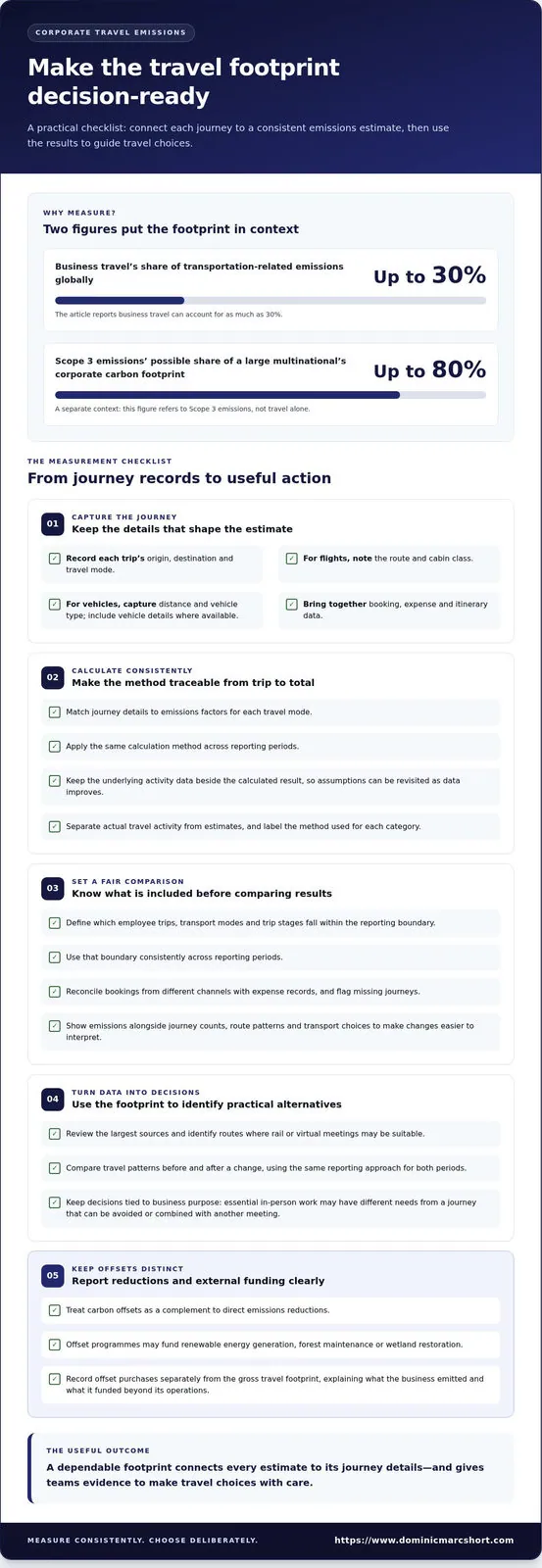
Business travel accounts for as much as 30% of all transportation-related emissions globally. A corporate travel sustainability strategy can reduce that impact by measuring travel emissions, cutting avoidable journeys, choosing lower-emission options such as rail and direct flights, and setting clear targets. The aim is to lessen the environmental, social and economic effects of business travel while preserving its purpose and effectiveness.
That doesn’t mean every trip should be replaced with a video call; some meetings are simply better in person. It does mean making travel choices deliberately, rather than treating the booking process as an emissions-free detail. This guide explains how to measure your organisation’s travel footprint, choose more sustainable suppliers and bookings, set practical targets, and put greener habits into action in Switzerland. You’ll also find examples that can fit into a working travel policy, from considering rail for suitable journeys to reducing unnecessary trips. The result is a clear, manageable approach that supports business needs while keeping emissions in view.
Table of Contents
- 1. What is Sustainable Corporate Travel?
- 2. Measuring travel carbon footprints
- 3. Sustainable supplier, hotel, airline, and booking choices
- 4. Corporate travel policy and sustainability targets
- 5. Examples of sustainable corporate travel practices
- Dominic Marc Short - Independent Consultant: Business Travel Management Consulting
1. What is Sustainable Corporate Travel?
Sustainable corporate travel means reducing the environmental, social and economic effects of business journeys while preserving their purpose. A corporate travel sustainability strategy starts with usable emissions data, helping teams identify which travel choices matter. Business travel accounts for as much as 30% of transportation-related emissions globally. For Swiss organisations, reviewing domestic and international journeys is a practical starting point. The spreadsheet can come along, but it shouldn’t be the one doing all the travelling.
Travel carbon emissions are estimated by matching journey details with emissions factors for each mode. For flights, the route and cabin class affect the estimate; for a vehicle, distance and vehicle type matter. A longer flight route generally involves more flight activity than a shorter one, while cabin class affects how emissions are allocated per passenger. That’s why booking counts alone can hide meaningful differences between journeys.
For useful reporting, record each trip’s origin, destination, travel mode, cabin class and, where available, vehicle details. Apply the same calculation method across reporting periods, then compare emissions by route, team or travel type. Measuring and evaluating business travel emissions requires data systems and common reporting standards. For large multinational companies, Scope 3 emissions can account for up to 80% of the corporate carbon footprint, making consistent travel data relevant to wider sustainability reporting.
Use the results to manage emissions, rather than treating a reported total as the finish line. Establish a baseline from booking and expense records, identify high-emission routes, then assess alternatives such as rail or virtual meetings. Track whether policy changes affect travel patterns and emissions over time. Keep decisions tied to business purpose: a journey enabling essential work may serve a different need from one that can be avoided or combined with another meeting.
Costs and savings depend on the measures chosen, routes, booking systems and traveller needs. Savings can come from fewer trips, lower-emission transport and more efficient bookings. Compare the full travel cost with its emissions impact, since the cheapest fare alone may not be the best operational choice. Consider employee time and the journey’s purpose alongside the booking price.
Address business-class travel, short-haul flights and frequent-flyer incentives through clear policy criteria. Reserve premium cabins for defined business needs, assess rail or virtual alternatives for suitable short journeys, and ensure rewards don’t encourage unnecessary flights. Trade-offs include travel time, employee wellbeing, cost and access to essential in-person meetings. A balanced policy weighs these factors alongside emissions, rather than applying one rule to every trip.
2. Measuring travel carbon footprints
A useful travel carbon footprint is more than a year-end total. It is a traceable record connecting each journey to its emissions estimate and the choices behind it. Start by collecting booking, expense and itinerary data through one reporting process. Match each journey to its mode, route, distance and relevant travel details, then apply a consistent emissions factor. Measuring and evaluating business travel emissions requires data systems and common reporting standards.
Keep the underlying activity data alongside the calculated result. For example, record train journeys separately from flights, and distinguish rental vehicles from public transport. This allows sustainability teams to revisit assumptions as data improves, rather than silently rewriting old totals. If bookings come through different channels, reconcile them with expense records and flag missing journeys. A dependable process makes the footprint more useful for decisions and easier for finance and sustainability teams to understand.
Set a reporting boundary before comparing results. Decide which employee trips, transport modes and trip stages the company includes, then apply that boundary consistently across reporting periods. Separate actual travel activity from estimates, and label the method used for each category. A simple dashboard can show total emissions alongside journey counts, route patterns and transport choices. This helps teams see whether a change reflects lower-emission travel or simply fewer recorded bookings.
Carbon reporting should lead to action. Review the largest sources in the footprint, identify practical alternatives, then monitor whether those changes reduce emissions. For example, compare a team’s travel patterns before and after introducing virtual meetings for suitable internal sessions. Use the same reporting approach for both periods to keep the comparison meaningful. This turns environmental data into a management tool, rather than a figure that appears once in an annual presentation.
Carbon offsets can complement direct reductions. Corporate carbon offsetting funds projects intended to reduce greenhouse gases elsewhere, balancing some travel-related emissions through that external impact. Offset programmes may support renewable energy generation, forest maintenance or wetland restoration. Record offset purchases separately from the company’s gross travel footprint, and explain the distinction in internal and external reporting. This makes clear what the business emitted and what it funded beyond its own operations.
For a stronger measurement process, align booking data, reporting rules and travel decisions across teams. Business travel management consulting can help organisations review those processes and integrate emissions information into travel management. The practical test is simple: can a decision-maker trace a reported result back to journeys, assumptions and actions? If yes, the footprint can guide the next improvement.
3. Sustainable supplier, hotel, airline, and booking choices
Make lower-emission options visible when employees book, not buried in a policy document. Compare rail, air, car and virtual meetings by expected emissions, total journey cost, travel time and business purpose. Virtual collaboration avoids transport emissions for that meeting; rail can suit journeys with practical connections, while air may remain necessary for longer routes. A consistent comparison helps employees make informed choices without turning every booking into a puzzle.
For Swiss journeys, consider national and regional trains, local public transport, and trams or buses for the final leg. These options can replace some short flights, taxis and individual car journeys, depending on the itinerary. Public transport also reduces the need for separate vehicles: an estimated 70 people travelling in private cars use more space and emit more pollution than one bus carrying the same number of passengers.
For flights that remain necessary, encourage direct itineraries where schedules allow. Avoiding connections can reduce emissions associated with additional flight segments. Booking rules can also prioritise efficient routing and display estimated carbon impact alongside fare and timing information. Sustainable flight choices should balance emissions with the trip’s purpose, employee requirements and the availability of workable alternatives.
Hotels matter, too. Lodging can account for up to 30% of a corporate trip’s environmental impact. When comparing accommodation, review whether an accredited certification body has assessed its management of environmental and social issues. Consider how the hotel manages energy, water and waste, rather than relying on a sustainability label without understanding its scope. These criteria give procurement teams a practical basis for consistent supplier decisions.
To reduce travel emissions, first remove journeys that can be handled virtually, then shift suitable routes to rail or public transport. For necessary flights, choose direct options where practical; for ground transfers, consider shared public transport or electric vehicles. This sequence focuses first on avoiding emissions, then on choosing lower-emission ways to travel.
Employee education makes those choices easier to apply. Explain how to compare itineraries, select lower-impact transport and choose accommodation with credible sustainability practices. Include examples in booking guidance, such as taking a train for a suitable Swiss route or selecting a hotel with established energy and waste measures. Keep the process clear: a sustainable business travel policy works best when the preferred choice is easy to find and book.
Booking systems and supplier reviews should reinforce the same priorities. Track whether employees can see rail and public transport options alongside flights, and whether sustainability criteria inform hotel selection. A joined-up approach helps organisations make practical choices without assuming one supplier or travel mode suits every journey.
4. Corporate travel policy and sustainability targets
A travel policy turns climate ambitions into decisions employees can apply during booking. Sustainability was a priority for their company for 89% of business travel industry professionals. Set out which journeys require approval, which alternatives to consider, and how teams should record travel choices. For example, require a comparison of rail, air and virtual meetings when planning suitable journeys. Clear criteria help employees understand the purpose behind each rule.
Start with the organisation’s travel data and identify the largest emissions sources. Then set targets that address those sources, rather than choosing a percentage without a practical plan. The report describes 2030 as the target year for corporations to reduce emissions, and 2050 as the target year to achieve net-zero emissions. Companies can use these years as planning horizons, while defining their own interim milestones and responsibilities.
Make each target measurable through indicators employees and managers can influence. A travel programme might track total travel emissions, trips by transport mode, rail use on suitable routes, and participation in virtual meetings. Assign an owner to each measure, such as procurement for supplier criteria or team leaders for travel approvals. Review progress using the same reporting method as the baseline.
Build the policy around practical booking rules. State when employees should consider a virtual meeting, when rail is preferred, and what information an approver needs for an exception. Include guidance for necessary flights, accommodation selection and local ground transport. A global organisation can set shared principles while allowing regional teams to account for available transport and business needs.
Implementation depends on making the preferred choice straightforward. Add sustainability prompts to booking workflows, explain the reason for each prompt, and train employees using realistic scenarios. For instance, a meeting planner can compare an in-person gathering with a hybrid format before confirming travel. Managers should explain how exceptions work, so urgent or operationally necessary travel isn’t blocked by a rule designed for routine journeys.
Connect targets to governance and communication. Senior leaders can review progress, while travel and sustainability teams resolve data gaps and policy conflicts. Share practical examples with employees, such as choosing a train for a suitable journey or combining meetings into one trip. These actions make climate goals visible in daily decisions, rather than leaving them in a strategy document that no one opens after the launch meeting.
Finally, update the policy when booking patterns or business needs change. Compare results with the baseline, identify which rules influence travel behaviour, and revise unclear instructions. A well-designed policy aligns emissions targets with access to essential meetings, employee needs and operational requirements. That balance keeps the travel programme usable while supporting progress towards the organisation’s climate objectives.
5. Examples of sustainable corporate travel practices
Turn sustainability goals into repeatable practices employees can use before, during and after each trip. For example, ask travellers to choose virtual attendance when a meeting’s purpose allows it, then record the avoided journey in the same travel report. This gives teams a concrete way to measure a change, rather than relying on broad intentions. A short checklist can also prompt employees to consider travel purpose, destination and lower-impact options before booking.
For conferences, offer hybrid participation alongside in-person attendance. Meeting organisers can identify sessions that need face-to-face discussion and provide remote access for information-sharing sessions. This keeps essential networking or workshops in person while giving other participants a practical alternative. After the event, compare attendance patterns and travel records to understand how the format affected journeys and emissions.
Travellers can also pack light. A simple reminder to bring only what the itinerary requires makes this practice easy to adopt without changing the trip’s purpose. For a multi-day meeting, share a packing checklist that accounts for the destination, planned activities and available facilities. Prompts work best when included in booking confirmations or pre-trip communications, where employees are already preparing.
At the destination, use purchasing choices to support local economies and reduce unnecessary resource use. Event planners can prioritise locally sourced catering and reusable service items where suitable. They can also plan meeting materials digitally instead of printing packs for every attendee. These choices make environmental impact part of event design, not an afterthought once participants have arrived.
Communication helps these practices become routine. Give employees practical examples, such as joining a suitable session online or using digital meeting materials. Explain how to record choices consistently, and invite teams to suggest improvements based on actual trips. Recognition or incentive programmes can encourage participation, provided they reward thoughtful choices rather than simply reducing necessary travel.
Measure each practice with a clear indicator. For hybrid meetings, record attendance format and associated journeys; for events, track material choices and supplier decisions. Compare results over time using consistent sources, such as booking records, event plans and expense data. If a measure is difficult to collect, simplify the process before expanding it. The aim is a manageable feedback loop: choose a practice, record what happened, review the evidence and refine the next event or journey.
For practical support aligning business travel processes with sustainability goals, explore business travel management consulting.
Dominic Marc Short - Independent Consultant: Business Travel Management Consulting
Dominic Marc Short, Independent Consultant, offers Business Travel Management Consulting for organisations ready to turn travel sustainability goals into workable processes. This can help when emissions data, booking practices and policy requirements need to align across teams or markets.
Support can include analysing travel processes, identifying opportunities to optimise them, and integrating sustainability considerations into travel management. Where changes affect systems or established ways of working, Global Transformation Management and Change Management Communications Packages can support the transition. For organisations planning lower-impact meetings and events, Meeting and Conference Organization can bring sustainability considerations into the planning process.
Contact Dominic Marc Short - Independent Consultant to discuss your business travel management needs.
Make your next travel decision count
The next step is to turn sustainability intentions into decisions that fit your organisation’s day-to-day travel. Choose one process to improve first, such as how teams approve journeys or plan meetings, then build on what employees can realistically adopt. A corporate travel sustainability strategy gains momentum when responsibilities are clear and improvements become part of normal business practice.
Dominic Marc Short, Independent Consultant, offers Business Travel Management Consulting, Global Transformation Management and Meeting and Conference Organization. These services can support organisations aligning travel processes, managing wider change and planning meetings with sustainability considerations in view. Start with the business challenge that matters most, then shape the next steps around your operational needs.
Thoughtful progress is still progress. With clear priorities and practical ownership, your organisation can make its travel choices work harder for both business objectives and a more sustainable future.
Frequently Asked Questions
What is Sustainable Corporate Travel?
Sustainable corporate travel means organising work journeys to account for environmental, social and economic effects alongside business needs. For example, a company planning a conference can consider how participants reach the destination, whether remote attendance suits some sessions, and how event suppliers manage resources. The aim is to make responsible choices part of trip planning, rather than treating sustainability as a separate activity after bookings are complete.
How Much Does a Ticket Contribute to Carbon Emissions?
A ticket’s emissions depend on the journey, travel mode and, for flights, route and cabin class. The ticket price doesn’t indicate its carbon impact: two fares for the same destination can represent different itineraries or cabins. To estimate emissions, use the itinerary’s travel details with a consistent calculation method. For a multi-leg booking, account for each flight segment rather than treating the destination alone as the whole journey.
What is a corporate travel sustainability strategy?
A corporate travel sustainability strategy is a coordinated plan for managing travel’s environmental impact while supporting business objectives. It connects responsibilities, booking choices, employee guidance and progress measurement. For example, a company might set approval criteria for essential trips, define preferred transport for suitable routes, and assign teams to review emissions data. The strategy works best when these elements reinforce one another, rather than operating as separate policy, procurement and reporting projects.
How can companies measure business travel emissions and set reduction targets?
Companies can begin by grouping travel records by mode, route, business unit and trip purpose. This helps distinguish patterns hidden by a single organisation-wide total, such as repeated journeys for the same internal meeting. Next, select a consistent calculation method, document its assumptions and decide which travel categories the target covers. Set milestones against that defined baseline, then review emissions and business activity together to interpret progress fairly.
What are the latest Swiss and European business travel emissions factors and reporting rules?
There isn’t one emissions factor suited to every journey or reporting purpose. Swiss companies with cross-border operations should identify the reporting framework applicable to their organisation, then use its relevant factor set and document the source, reporting period and calculation method. Separate measured travel activity from estimates, and explain any methodology changes between reports. This makes the figures easier to interpret without treating different routes or reporting approaches as directly comparable.
How can a company create a sustainable travel policy and approval process?
Write the policy around decisions employees actually face: whether a trip is necessary, which transport options fit the route, and who approves exceptions. Give approvers concise criteria, such as meeting purpose, available alternatives and operational requirements. Add those prompts to the booking workflow and explain them through practical examples. A periodic review can reveal unclear rules, recurring exceptions or approval steps that delay necessary travel.
How can companies use a travel management company to track and reduce emissions?
A travel management company can support emissions tracking by providing structured booking records, such as itinerary, transport mode and cabin class. Companies can define the data fields and reporting format needed for internal analysis, then compare those records with expenses to identify gaps. Travel managers can use the resulting patterns to refine policy and booking guidance. Business Travel Management Consulting can help align travel processes and reporting needs, distinct from travel agency services.
Related articles

29 October 2026 · 13 min read
Travel management masterclass for corporate travel teams
Explore a travel management masterclass for corporate teams: practical guidance on policy, costs, suppliers and traveller safety in Swiss workplaces.
27 October 2026 · 13 min read
Corporate Travel Consultants in Switzerland for Executive Travel
Choose a corporate travel consultant Switzerland organisations can trust to align supplier deals, executive journeys and event support with business priorities.

21 October 2026 · 14 min read
Reducing Carbon Footprint from Business Travel: How to Measure and Lower Emissions
Ready to travel smarter? Discover jolly clever ways of reducing carbon footprint from business travel, measuring impact, and keeping journeys eco-friendly!