Corporate Travel Consultants in Switzerland for Executive Travel
By Dominic Marc Short · 27 October 2026 · 13 min read
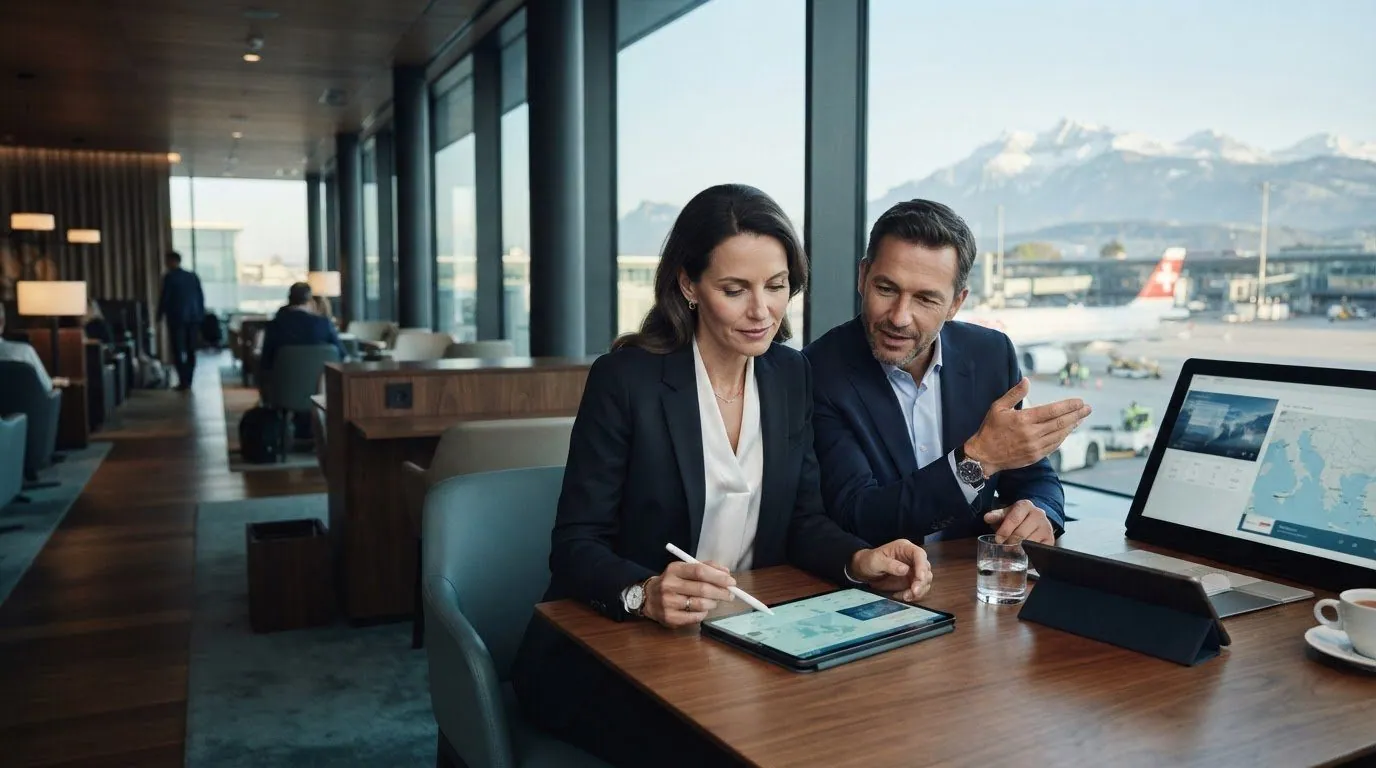
Executive travel is a business programme, not just a sequence of bookings. A corporate travel consultant in Switzerland helps organisations shape travel around business needs, negotiate with suppliers and coordinate support for executives and events. The best arrangements make work travel more considered, without making every journey feel like a committee meeting.
Organisations often need a consultant to bring order to complex travel requirements while keeping the process practical for people on the move. This article explains how to review supplier arrangements, plan executive and event support, and shape a travel programme around organisational priorities.
You’ll also learn what to consider when selecting a consultant and how travel management connects with wider processes, payments and digital transformation. The aim is a clear approach that supports business objectives and travelling teams, from setting the foundations to improving day-to-day operations.
Table of Contents
- Airline, hotel and car-rental negotiations
- Executive travel and event services
- Skills and qualifications
- Tailored corporate travel programmes
- Which corporate travel management companies operate in Switzerland?
- Dominic Marc Short - Independent Consultant: Business Travel Management Consulting
Airline, hotel and car-rental negotiations
Swiss corporate travel consultants can review business-flight, hotel and rail requirements, then support supplier negotiations and programme design. Their work may include analysing travel patterns, comparing options, shaping booking rules and assessing rental-car needs alongside other ground transport.
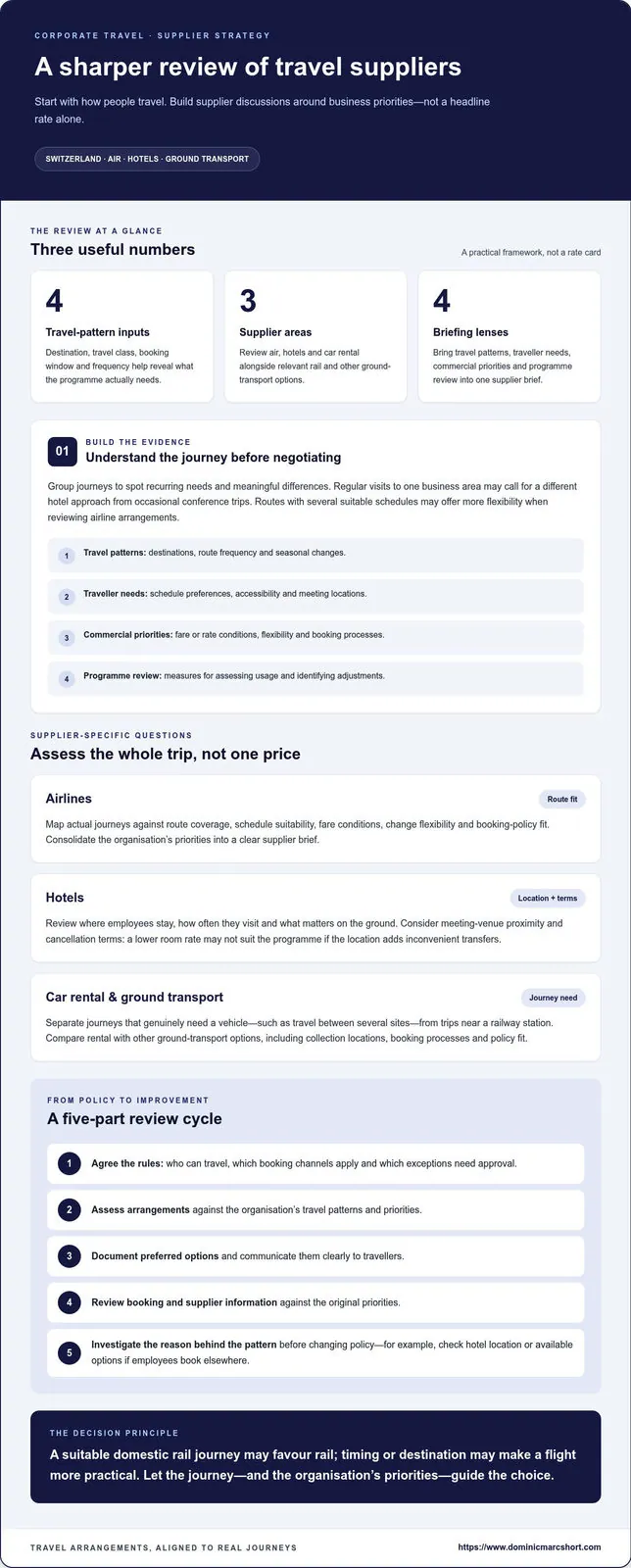
A sound review starts with a clear picture of how employees travel. Group journeys by destination, travel class, booking window and frequency. For example, recurring visits to one business area may call for a different hotel approach from occasional conference trips. Routes with several suitable schedules can also give an organisation more flexibility when assessing airline arrangements.
For airlines, define the organisation’s priorities before discussions begin. These might include route coverage, schedule suitability, fare conditions, change flexibility or booking-policy fit. A consultant can map those requirements against actual journeys and consolidate them into a supplier brief. This keeps negotiations focused on business needs rather than a headline fare alone.
Review hotel needs by destination. Compare where employees stay, how often trips occur and which practical requirements matter, such as proximity to a meeting venue or suitable cancellation terms. Assess each option against the full trip pattern. A lower room rate may not suit the programme if the location adds inconvenient transfers or conflicts with meeting schedules.
For car rental, define the journeys that genuinely require a vehicle. An employee travelling between several sites may have different needs from someone attending a meeting near a railway station. The consultant can compare rental arrangements with other ground-transport options, then consider collection locations, booking processes and policy fit. This prevents “just in case” rentals from becoming the default.
Reviewing suppliers is only one step. First, agree who can travel, which booking channels apply and which exceptions need approval. Then assess arrangements against those criteria, document preferred options and communicate them to travellers. For example, a policy might favour rail for a suitable domestic journey, while allowing flights when timing or destination makes them more practical.
To make supplier discussions productive, prepare a brief covering:
- Travel patterns: destinations, route frequency and seasonal changes.
- Traveller needs: schedule preferences, accessibility and meeting locations.
- Commercial priorities: fare or rate conditions, flexibility and booking processes.
- Programme review: measures for assessing usage and identifying adjustments.
After changes are implemented, review booking and supplier information against the original priorities. If employees regularly choose hotels outside the preferred area, investigate the location or available options before changing the policy. This feedback loop helps keep airline, hotel and rental arrangements aligned with how the organisation actually works.
Swiss-specific support can include reviewing rail needs, analysing travel patterns, shaping booking rules and negotiating supplier arrangements. Consultants can also compare car rentals with other ground-transport options and help set policies that favour rail when it suits the journey.
Executive travel and event services
A corporate travel consultant in Switzerland can help coordinate executive itineraries and business events, bringing travel requirements together with venue and programme logistics. A leadership meeting, for example, may require arrivals, accommodation, local transfers and a coherent schedule to be managed as one plan.
Executive travel planning begins with the purpose of the journey. Identify essential meetings, preferred arrival times, required documents and connections between appointments. An itinerary with several meetings needs to account for each venue and onward journey, not simply the transport booking. This shapes the plan around the executive’s working day.
Set out how the travel process should handle changes. Agree who approves itinerary adjustments, what information assistants need and how revised plans reach travellers. For a board meeting, one named coordinator can gather attendee details and share the latest schedule with relevant internal teams. Clear ownership reduces crossed wires, which rarely improve an agenda.
Events need a separate planning structure, even when travel is part of the same programme. Start with the event’s purpose, audience, format and venue requirements. Then map the attendee journey, including arrival information, accommodation needs, registration, session timings and departure arrangements. A conference schedule can connect speaker arrivals with room access and transitions between sessions.
Event plans should reflect the locations and travel choices participants will actually use. A venue near a railway station may suit a different audience from a site that requires local transfers. Assess accessibility, timing and attendee needs before confirming the format. This keeps logistics in service of the programme, rather than letting logistics become the programme.
Assess savings and service quality by comparing travel spend and booking patterns with a consistent baseline, while also tracking traveller feedback and process performance. Review policy use, itinerary changes, event attendance and post-event comments together, so lower expenditure does not conceal a poorer experience.
Before an executive trip or event, define the brief and assign responsibilities. A practical preparation list includes:
- Purpose: record the business objective and essential outcomes.
- People: identify executives, attendees, assistants and decision-makers.
- Schedule: align meetings, travel, venue access and event sessions.
- Communication: decide who shares changes and where the current itinerary sits.
- Review: gather feedback and compare results with the original objectives.
After the event, compare the planned schedule with what happened. If a speaker’s arrival delays a session, record the cause and adjust the running order for the next programme. Organisations refining executive travel or event coordination can explore business travel planning support as a practical next step.
Skills and qualifications
A Swiss company can choose and hire a corporate travel consultant by defining its requirements, then assessing relevant training, practical experience and consulting skills. In Switzerland, specialised courses or several years of practical experience are routes into travel consulting; career changers may also enter through internal company training or direct employment at a travel agency.
Those routes describe different kinds of preparation. A course can provide structured grounding, while practical experience can show how someone handles real travel operations. For example, a candidate who has worked with changing itineraries may explain how they organise information and communicate decisions. Ask for specific examples, not just a polished description of responsibilities.
Consulting also requires analytical ability. Ask how the consultant would review travel processes, identify inefficiencies and present practical recommendations. A strong answer should follow a clear sequence: understand the organisation’s needs, assess available information, identify priorities and explain proposed changes. This helps distinguish strategic thinking from a list of familiar travel terms.
Communication matters because a consultant works with people who have different responsibilities. A finance lead may focus on reporting, while an employee wants a straightforward booking process. Ask the consultant to explain a complex travel issue in plain language. A concise explanation shows whether they can connect operational detail with decisions colleagues can act on.
Before interviews, write a brief covering the organisation’s size and structure, travel programme challenges, expected outcomes and project boundaries. Include the relevant teams, such as finance, procurement and human resources. For example, a Swiss organisation expanding into Geneva may need support aligning local processes with wider company practices. A precise brief makes candidate responses easier to compare.
Use the same assessment points for each candidate. Consider:
- Relevant preparation: specialised courses or practical experience in travel work.
- Analytical approach: ability to examine processes and explain priorities.
- Communication: clear explanations for executives, travellers and internal teams.
- Project method: defined steps, responsibilities and intended outputs.
- Organisational fit: experience suited to the company’s structure and needs.
Then agree the engagement scope in writing. Set out the work, responsibilities, decision-makers, deliverables and review points. If the project concerns process analysis, specify which workflows are in scope and who will provide the relevant information. Clear boundaries make progress easier to assess and reduce the chance of mismatched expectations.
A strong selection decision rests on evidence of a credible working method and relevant experience. Compare candidates against the same brief, discuss a practical example and select the person whose approach fits the organisation’s priorities. The discussion should feel like a useful working conversation, not an exam in travel terminology.
Tailored corporate travel programmes
A tailored travel programme starts with the organisation’s operating model, not a standard policy template. A Swiss SME with occasional client visits has different needs from a global corporate coordinating travel across business units. The programme should reflect who travels, why journeys take place, how bookings are approved and what information finance needs afterwards.
Begin with a structured review of existing processes. Map how an employee requests a trip, receives approval, books transport and accommodation, and submits expenses. For example, if an assistant arranges executive travel while other employees book independently, document both workflows. This makes duplicated steps, unclear responsibilities and gaps in management information easier to identify.
Next, define policy choices around real business scenarios. A Geneva client meeting may involve a different journey plan from a multi-site visit across Switzerland. Set out how employees choose between suitable transport options, which approvals apply and how exceptions are handled. Clear guidance gives travellers room to make sensible choices without leaving managers to interpret a policy from scratch.
Payment processes also shape the programme. Review which costs are paid centrally, which are handled by travellers and how transactions reach finance. For instance, a company with several business units may need consistent reporting categories, even if teams follow different approval routes. A coherent payment design can make expenditure easier to review and support more useful planning.
Technology should fit those workflows rather than dictate them. Assess how booking, approval and expense information moves between systems, and identify where manual re-entry occurs. If employees enter the same itinerary details in separate tools, identify where integration or process redesign could reduce duplication. The aim is a practical operating model, not another login to remember.
Plan traveller communication before introducing changes. Explain what is changing, why the organisation is changing it and what employees need to do differently. A new approval process, for example, should come with clear instructions for travellers, assistants and line managers. Feedback from these groups can reveal whether the written policy works in daily practice.
Choose programme measures that connect to the organisation’s objectives. Review booking patterns, policy use, process completion and traveller feedback together. If a preferred process is often bypassed, examine whether the cause is unclear guidance, unsuitable options or a cumbersome approval route. Use the finding to make a specific adjustment rather than prompting a blanket rule change.
A practical design sequence is:
- Analyse: document current journeys, approval routes and payment processes.
- Prioritise: agree which business needs the programme must support.
- Design: align policy, technology, responsibilities and communications.
- Implement: introduce the agreed processes and explain them to affected teams.
- Review: use programme data and employee feedback to refine the approach.
This sequence gives decision-makers a clear route from analysis to improvement. A tailored programme should evolve as organisational needs change, while retaining understandable policies and consistent management information. That balance helps travel remain a useful business activity, rather than a paperwork expedition with an itinerary.
Which corporate travel management companies operate in Switzerland?
Organisations can work with global travel management companies, Swiss-based providers or independent consultants. These models differ in scale and scope: a global provider may coordinate a multinational programme, while an independent consultant may focus on analysis, programme design or transformation.
A corporate travel consultant in Switzerland may advise on policy, processes, supplier strategy and programme improvement without acting as a travel agency. A travel management company, by contrast, may manage operational booking services as part of its offer. The distinction matters: decide whether your organisation needs strategic advice, booking operations or both before comparing providers.
Start by defining the work you want delivered. A company reviewing its travel policy may need process analysis and recommendations. A multinational coordinating teams across countries may need broader programme design. An organisation arranging regular bookings may prioritise operational services. These are different requirements, so a label such as “travel management” is not enough to compare proposals.
Build a shortlist based on provider model and fit. For each candidate, review the proposed scope, relevant business travel experience, working method and intended outputs. For example, ask a consultant to describe how they would analyse approval steps, booking processes and management reporting. Ask a travel management company to explain how its operational responsibilities align with your internal teams.
Compare proposals against the same brief. Include the organisation’s locations, traveller groups, current processes, technology environment and expected outcomes. Then examine how each provider proposes to work with finance, procurement, human resources and executive assistants. A clear division of responsibilities helps avoid duplicated work and unowned tasks.
Useful comparison criteria include:
- Service model: distinguish strategic consulting from operational booking management.
- Programme scope: match the proposal to the organisation’s travel needs and structure.
- Delivery method: look for defined analysis, recommendations and implementation steps.
- Information needs: establish what travel and process data will support the work.
- Internal coordination: identify decision-makers, contributors and responsibilities.
For example, a Swiss NGO with varied project travel may value a programme shaped around its operating requirements. A company with established booking operations may instead seek an independent review of processes or digital transformation priorities. In both cases, compare the work itself, rather than assuming providers with similar descriptions deliver identical services.
Once the preferred model is clear, agree the scope, outputs, responsibilities and review points in writing. This gives the organisation a practical basis for evaluating proposals and beginning the engagement. The right comparison starts with the task, not a long list of logos.
Dominic Marc Short - Independent Consultant: Business Travel Management Consulting
Dominic Marc Short, Independent Consultant, provides Travel consulting to help organisations review and improve business travel processes. This is a practical next step when a company needs clearer workflows, more aligned travel arrangements or advice on shaping its programme around business priorities.
For wider organisational change, Travel management executive consulting can support transformation planning, while bespoke communications can help explain changes to affected teams. MICE (Meetings, Incentives, Conferences, Exhibitions) consulting is relevant when business events need structured planning alongside travel requirements.
The right starting point is a defined business challenge, such as reviewing existing travel processes or coordinating an event. A focused discussion can clarify the objective, scope and appropriate consulting approach. To discuss your organisation’s business travel needs, contact Dominic Marc Short - Independent Consultant.
Build a clear starting point for your travel programme
A corporate travel consultant in Switzerland is most useful when an organisation can identify the decision it needs to make, not only the travel challenge it faces. That distinction turns an open-ended review into focused work, whether the priority is clarifying ownership, aligning processes or planning change.
Before taking the next step, write a short brief describing the current obstacle, the teams it affects and the outcome the organisation wants. Note what is already working, too. This keeps the discussion grounded in business needs rather than producing a travel wish list with no clear destination.
Then agree who will shape the work internally and how progress will be judged. A finance lead, travel coordinator and executive sponsor may each bring a different perspective. Bringing those views together early can make the next decision more practical and easier to carry forward.
If your organisation is ready to define that next step, start a conversation with Dominic Marc Short - Independent Consultant.
A clear brief is a strong beginning. From there, your travel programme can move forward with purpose.
Frequently Asked Questions
What does a corporate travel consultant in Switzerland do?
A corporate travel consultant in Switzerland helps organisations improve how they plan and manage business travel. A corporate travel consultant in Switzerland may assess processes, advise on travel management solutions, review payment approaches and support digital transformation. For example, when a company introduces a booking system, the consultant can examine how it fits existing workflows and how employees will use it. The focus is on practical travel operations and the organisation’s business objectives.
Related articles
5 November 2026 · 14 min read
Corporate Event Planning Services in Switzerland for Teams
See how corporate event planning services in Switzerland bring venues, suppliers, guest travel and event-day delivery together for a smooth, engaging team event.

29 October 2026 · 13 min read
Travel management masterclass for corporate travel teams
Explore a travel management masterclass for corporate teams: practical guidance on policy, costs, suppliers and traveller safety in Swiss workplaces.

28 October 2026 · 14 min read
Corporate travel sustainability strategy: How to cut travel emissions
Discover how a corporate travel sustainability strategy can cut emissions with smarter measurement, rail-first choices, practical targets and greener booking...