Corporate Event Planning Services in Switzerland for Teams
By Dominic Marc Short · 5 November 2026 · 14 min read
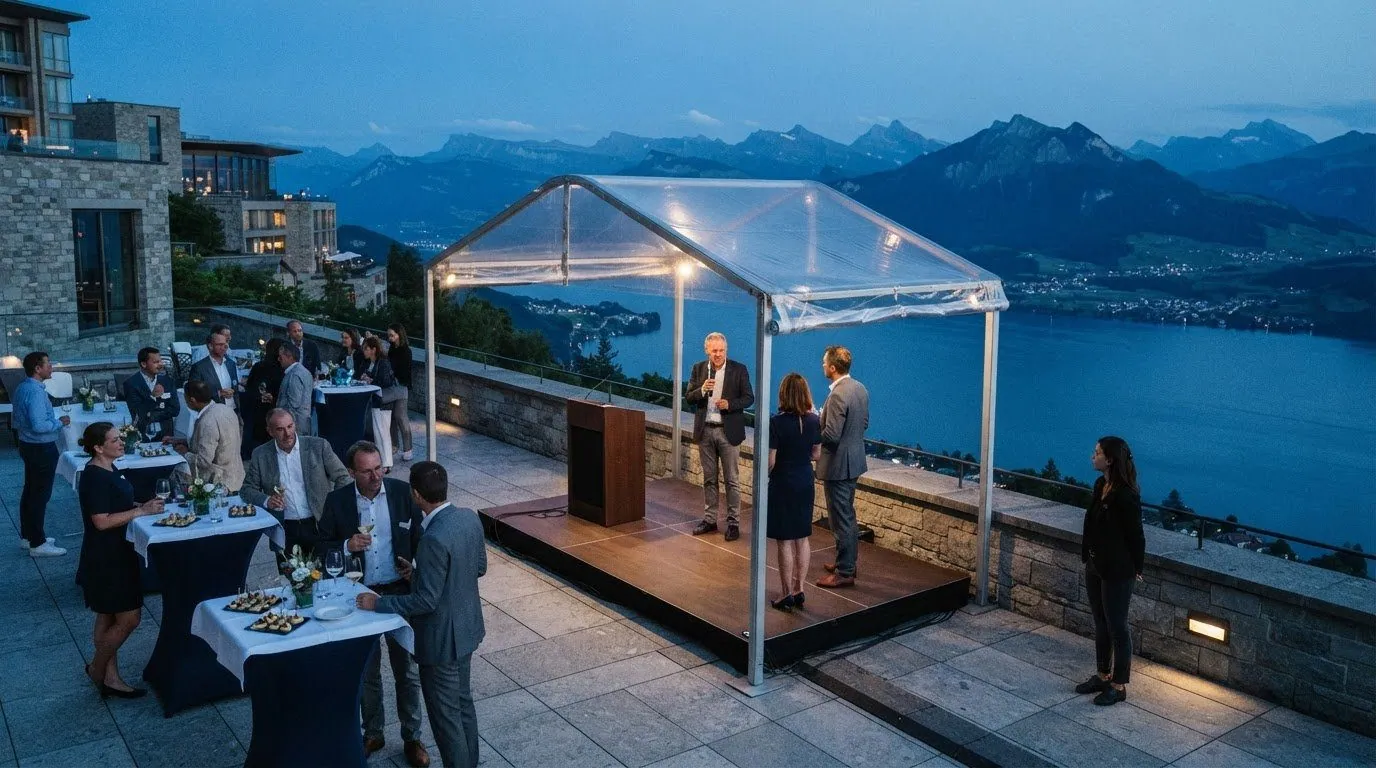
Planning a corporate event in Switzerland from abroad doesn’t have to feel like conducting an orchestra through a closed door. Corporate event planning services in Switzerland can bring planning and coordination together, from venue and supplier management to guest travel, accommodation and event production. A clear process helps turn your event brief into a well-organised gathering.
It’s understandable to want one reliable view of the moving parts, especially when guests, venues and suppliers are spread across different locations. Local expertise can help make regional differences easier to manage and keep decisions, schedules and communications aligned.
This article explains what local event support can cover, how Swiss venue and supplier knowledge informs planning, and what to consider when coordinating guest travel, accommodation and on-site delivery. You’ll also see how a clear event concept connects the practical details, so the technology works, the programme flows and there’s still room for the conversations everyone came for.
Table of Contents
- What are the advantages of working with local event agencies in Switzerland?
- Swiss regional expertise and supplier relationships
- Travel, staffing and accommodation logistics
- Event concept development and production
- Business event agencies by Swiss region
- Dominic Marc Short - Independent Consultant
What are the advantages of working with local event agencies in Switzerland?
Local event partners can connect destination knowledge with practical coordination, from venue planning to supplier relationships. Their value is clearest when one project plan brings decisions, schedules and responsibilities together.
Destination and Project Management
Destination management companies coordinate local arrangements, while professional congress organisers focus on the planning and delivery of meetings and conferences. A Zürich-based congress organiser, for example, can help translate a conference brief into venue, catering and production requirements. Corporate event project management then tracks decisions, schedules, responsibilities and supplier deliverables in one coordinated plan.
Look for a partner whose scope matches the event’s needs. A destination-led programme may need venue and transport coordination; a conference may need detailed session planning and technical scheduling. Set the objective, audience and budget first, then map those requirements against the proposed scope.
Agency Service and Experience Comparisons
Event planners in Switzerland differ in their service mix, experience and client feedback. Compare whether their work covers concept development, supplier coordination, catering, production and event-day management, rather than assuming every agency handles the same tasks. Reviews are most useful when they describe comparable events and specific delivery details.
A Swiss event management agency directory can help identify relevant capabilities. Zürich’s event provider directory includes audiovisual production, lighting, staging, furniture, logistics and shuttle services. Where a directory lists minimum event-management budgets, treat those as a screening point, then compare what the management scope includes and what sits outside it.
There is no single permit that applies to every corporate event in Switzerland. Requirements depend on the venue, canton or municipality, and activities such as public-space use, amplified sound or temporary structures. Include these questions in venue selection and local planning.
Swiss VAT and invoicing depend on the supplier, the services provided and the transaction’s circumstances. Ask for an itemised proposal that separates planning, venue, catering and production components, and ensure the applicable VAT treatment is clearly reflected in the invoice.
Insurance and cancellation planning should match the event’s risks. Review who is responsible for venue damage, public liability, equipment and supplier failure, then document cancellation terms, payment milestones and postponement procedures before making commitments. Safety planning should also assign responsibility for access, crowd movement, technical setup and incident communication.
Swiss regional expertise and supplier relationships
Regional knowledge can help an event reflect its Swiss setting rather than feel interchangeable with a gathering anywhere. Strong supplier relationships can also make coordination clearer, from catering choices to production requirements.
Agency Experience and Event Volume
Ask how an agency’s experience relates to your event’s format, audience and objectives. Annual event volume may indicate breadth, but it doesn’t show whether the team has handled comparable corporate gatherings. Look for relevant examples, a clear division of responsibilities and the people who will lead planning and delivery.
Team size matters in context. A compact team may suit a focused leadership meeting, while a complex brand experience needs clear responsibility across planning, suppliers and event-day coordination. Discuss how the proposed team manages decisions and handovers instead of treating headcount or event totals as measures of quality.
Local Experiences and Destination Knowledge
Destination knowledge can help connect a corporate programme with experiences that suit its purpose. For instance, a Zürich gathering could include a locally grounded food experience, while a programme near Lake Thun might draw on the setting around Oberhofen Castle. The choice should serve the event message, guest needs and available schedule.
Ask how each experience fits the programme, travel arrangements and brand. A memorable moment needn’t be elaborate: a well-timed local activity can give guests something meaningful to share without taking over the business agenda.
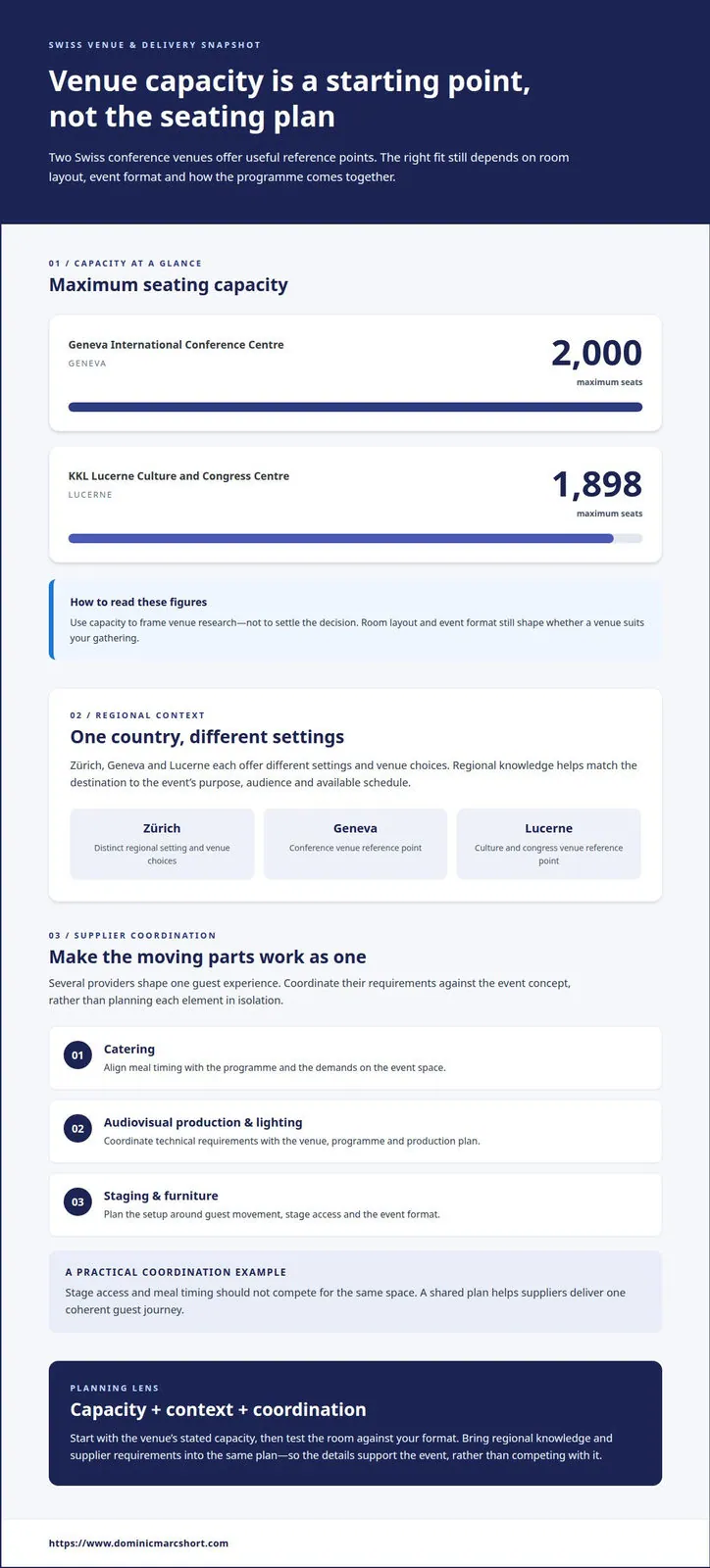
Supplier relationships are especially useful when several providers need to deliver one coherent experience. Catering, audiovisual production, lighting, staging and furniture each affect the guest journey. A planner can coordinate their requirements against the event concept, so stage access and meal timing, for example, don’t compete for the same space.
Swiss regional expertise also means recognising that one destination does not represent the whole country. Zürich, Geneva and Lucerne each offer different settings and venue choices. The Geneva International Conference Centre has a maximum seating capacity of 2,000, while the KKL Lucerne Culture and Congress Centre has a maximum seating capacity of 1,898. These figures help frame venue research, but room layout and event format still shape suitability.
For a brand experience, start with the message and audience, then select an element that reinforces both. A seasonal menu, distinctive setting or carefully chosen activity can make the programme feel memorable. The aim is to create experiences guests remember for the right reasons, not add spectacle for its own sake.
When event planning connects with wider business travel or organisational change, integrated thinking can help align the experience with company processes. Explore corporate event coordination in Zurich as a natural next step for shaping that connection.
Travel, staffing and accommodation logistics
Travel planning connects guest arrivals, accommodation, transfers and event-day responsibilities. In Zurich, a coordinated schedule can help international guests move smoothly from arrival to the final dinner. Corporate event planning services in Switzerland should incorporate travel details into the event programme, rather than leaving them in a separate file.
Guest Logistics and On-Site Delivery
Guest logistics begin with clear information shared before travel. Communicate arrival details, accommodation, transfer arrangements, dress code and the event schedule in advance. A welcome message can also explain the venue entrance, registration point and contact person, giving guests a clear first impression.
On site, assign responsibilities for registration, room access, guest questions and programme transitions. A staffed welcome desk, for example, can direct arrivals while the event team prepares the next session. A written run sheet keeps these handovers visible to everyone involved.
Transfers and Accommodation
Transfers and accommodation planning should reflect where guests arrive, where they stay and when each programme item begins. Grouping hotel information with transfer instructions helps visiting teams understand the routes between key locations. If an event ends with dinner, include the return journey in the schedule rather than leaving guests to work it out afterwards.
For international guests, share the itinerary, accommodation details, dress code and language information together. This gives travellers one practical reference and helps the coordination team identify individual travel needs early.
Roadshows require a deployment plan that can be repeated across locations. For each stop, document venue access, equipment movement, supplier contacts, staffing responsibilities and setup sequence. A product presentation in Zurich followed by another city stop, for example, needs a clear inventory and handover process. For corporate event planning services in Switzerland, consistent arrangements across locations help travelling teams manage equipment and responsibilities.
Staffing plans should connect each task with a named role. Set out who manages registration, supports speakers, liaises with catering and oversees technical checks. For a conference followed by dinner, the schedule can show when the welcome team hands over to the dinner host. Clear assignments help staff focus on guests rather than guess who owns the next task.
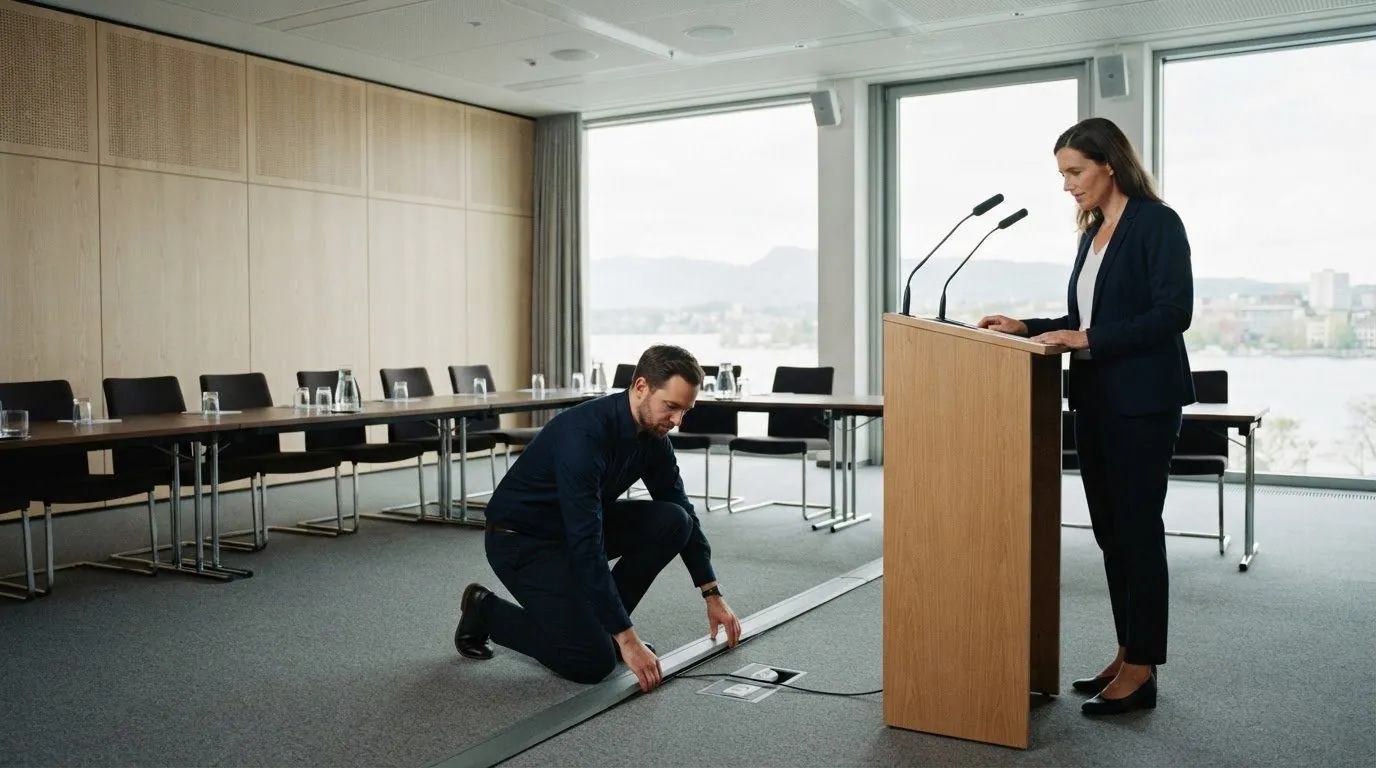
Include technology in the logistics plan from the outset. List microphones, lighting, music, presentations, power, Wi-Fi and stage requirements alongside venue access and setup times. A presentation that depends on slides and microphones needs a technical check before guests arrive. Coordinating these details with room layout and catering timings helps keep transitions orderly.
Keep one working schedule for transfers, staffing, equipment, guest communications and programme changes. Include responsibilities, delivery times and communication points. If a shuttle arrives during registration or a room changes, the schedule shows who responds and how guests receive updated directions. With these details aligned, the event team can focus on delivering a smooth experience.
Event concept development and production
A strong event concept turns a business objective into a coherent experience for employees, customers or partners. Production then connects the creative idea with the programme, venue and delivery plan.
Swiss agencies may coordinate concept development, venue planning, catering, suppliers, technical production and event-day delivery. Their scope can cover corporate parties, product launches and conferences, with responsibilities shaped around the event brief.
Popular formats include conferences, product launches and corporate celebrations. The SwissTech Convention Center in Ecublens can accommodate 3,000 participants in up to three halls, offering a sizeable conference setting.
Event Strategy and Planning
Planning starts by defining the event objective, target audience and central message. These choices guide the concept, programme and production decisions. A product launch schedule might build towards a reveal; an employee gathering could prioritise participation and shared conversation. A clear brief gives creative work a practical direction.
Next, planners map the guest journey from reception through programme transitions and departure. They document routes, setup times, catering, technical checks and responsibilities. This sequence helps identify clashes early, such as a room reset scheduled during a networking break.
Services, Venues, and Event Formats
Venue selection should reflect guest numbers, room layout, technology, accessibility, networking areas and branding options. A multi-hall conference needs a different flow from a product launch centred on one stage. Matching the format to the venue makes the concept easier to deliver and helps guests understand where to go.
For example, planners can build a conference around concurrent sessions or shape a corporate party around dining and informal networking. The production plan then aligns catering, staging and programme timing with the chosen format.
Production requires precision across the programme, not just a polished stage. The plan should account for reception, speakers, transitions, routes, setup periods and supplier responsibilities. A named lead for each deliverable helps the team manage changes without losing sight of the event’s main message.
Technical requirements belong in the concept from the outset. Microphones, lighting, music, presentations, power, Wi-Fi and stage setup influence room design and programme flow. A product launch relying on a presentation, for instance, needs technical checks built into rehearsals and the event schedule.
Street Parade offers a striking example of complex event production in Zurich’s lake basin. It features 30 love mobiles and 9 stages, and can attract up to a million people. A corporate event operates on a different scale, but the example illustrates why clear production roles, movement planning and coordinated technical delivery matter.
Business event agencies by Swiss region
Regional fit depends on the event’s destination, format and delivery requirements. Zürich, Geneva, Lucerne and Ecublens each offer distinct settings, so match an event agency’s local knowledge to the places your guests will use.
In Zürich, an agency directory includes event planning and organisation, alongside audiovisual production, lighting, staging, furniture and logistics. This makes it useful for identifying the range of capabilities available in one city. For a product launch, for example, compare how concept planning, presentations and technical production would be coordinated.
Geneva may suit international conferences where delegates need a recognised meeting destination. Lucerne can offer a different setting for a corporate gathering, while Ecublens provides another option for conference planning. These regional distinctions are starting points, not a substitute for checking how each venue fits the event’s audience, programme and travel arrangements.
An agency’s location can affect how its team coordinates venue visits, local suppliers and event-day delivery. For a multi-city programme, establish which team members will lead each location and how information passes between them. A shared schedule, named responsibilities and clear supplier contacts help keep presentations and production aligned across stops.
Availability and capacity depend on the dates, event format, venue requirements and the agency’s planned responsibilities. A product launch needing staging and technical coordination calls for a different delivery team from a meeting with a simple presentation programme. Set out the required work and key dates together, then assess whether the proposed team structure covers those tasks.
Language requirements also belong in the planning brief. International guests may need event information in more than one language, while speakers, suppliers and staff need clear instructions. Define the languages required for invitations, signage, presentations and on-site coordination, then assign responsibility for each communication.
To choose an event agency, compare its proposed scope against the actual programme. Review relevant event examples, regional experience, supplier coordination and how the agency will manage changes. A conference in one destination followed by a presentation elsewhere, for instance, requires clear ownership of travel transitions, schedules and production handovers.
Before appointing a partner, request a structured proposal showing deliverables, responsibilities, planning milestones and the basis for its budget. This makes it easier to compare agencies on scope rather than headline claims. If the event spans regions, include each destination and its specific requirements in the same project brief.
Dominic Marc Short - Independent Consultant
Dominic Marc Short, an independent consultant, helps organisations bring business events and related travel requirements into a coordinated plan. Turn to this support when a conference involves complex guest logistics or event decisions need to align with wider business processes.
Meeting and Conference Organization supports the planning and coordination of business gatherings. Business Travel Management Consulting can connect event travel requirements with an organisation’s travel processes, while Global Transformation Management and Change Management Communications Packages support broader organisational initiatives. The focus is on clarifying objectives, responsibilities and communication so event delivery fits the organisation’s needs.
For a Swiss event with several moving parts, contact Dominic Marc Short - Independent Consultant to discuss your requirements.
Shape the next event around your business goals
Your next step is to turn the event brief into clear decisions: what the gathering should achieve, who it needs to reach and what a successful experience looks like. Those priorities give the concept and delivery plan direction, instead of leaving the team to make important choices on the fly.
Choosing corporate event planning services in Switzerland can also be an opportunity to connect event delivery with wider organisational needs. Dominic Marc Short - Independent Consultant offers Meeting and Conference Organization, alongside Business Travel Management Consulting and Global Transformation Management. This combination can be relevant when event planning intersects with guest travel or broader business change.
Start with the outcome you want your guests and organisation to take away. A well-defined purpose makes the next planning conversation more focused, practical and productive.
With a clear objective and effective coordination, your next Swiss business event can move forward with confidence.
Frequently Asked Questions
Planning Switzerland from abroad?
Start with a concise brief covering the event’s purpose, audience, preferred dates and decision-makers. Set approval milestones for the concept, venue and programme, so choices don’t accumulate in a last-minute email avalanche. Keep one shared schedule for decisions, supplier tasks and guest communications. Send attendees a practical arrival guide with accommodation, transfers, dress code and event timings before they travel.
What criteria should be used to select an event agency?
Assess whether the agency’s proposed scope matches your event, then examine how it will manage decisions and changes. Ask for a sample project schedule or responsibility matrix, and look for experience with a comparable format, such as a conference or product launch. Client reviews can add useful context when they describe specific delivery outcomes, communication and problem-solving rather than offering general praise.
What makes a professionally planned corporate event?
A professionally planned event connects its purpose with a coherent guest experience and a workable delivery plan. Define what attendees should understand, decide or experience, then build the programme around that outcome. Include a decision log for approvals, a clear escalation route for changes and a post-event review against the original objectives. These steps help the organisation learn from the event, not simply pack away the stage.
Which corporate event planners operate in Zurich, Geneva, Basel, Bern, and Lausanne?
Shortlist agencies by destination and required work, rather than by a city name alone. A regional event directory can help identify planners and related services, while each agency’s published examples show its event formats and delivery scope. For a multi-location programme, prioritise a clear lead contact and consistent coordination across destinations. This approach gives you a useful shortlist without treating every event agency as interchangeable.
How much do corporate event planning services cost in Switzerland?
There is no single fee that applies to every Swiss corporate event. The price depends on the event and is provided after a quote request. Main cost drivers include guest numbers, venue, catering, technology, entertainment, design and the overall scope of planning and production. A proposal should make the work and supplier components clear, so the budget reflects the event’s actual requirements rather than a misleading headline figure.
What factors affect corporate event planning budgets in Switzerland?
Budget choices depend on the event’s objectives and which elements matter most to guests. Guest numbers influence venue and catering requirements; a presentation-led programme may need technical production, while a networking event may need suitable shared spaces. Design, entertainment and the level of coordination also shape the plan. Rank these elements against the desired outcome, then allocate resources to the details that support it directly.
What is the process for hiring a corporate event planner in Switzerland?
Begin by writing a brief with the event purpose, audience, format, location and decision process. Next, compare proposals for scope, responsibilities, planning milestones and budget assumptions. Once appointed, agree approval points and a method for recording decisions. The planner can then develop the programme and coordinate delivery against the agreed brief. A post-event review completes the process by capturing outcomes and useful improvements.
What language, accessibility, and cultural considerations matter for Swiss corporate events?
Plan communications around the languages guests and speakers need, including invitations, signage, presentations and on-site instructions. Check that venue routes, seating and facilities support attendees with different access requirements, and share practical details before arrival. For an international audience, consider dietary preferences, cultural expectations, dress guidance and clear explanations of the programme. A considerate plan helps guests participate comfortably without making assumptions about their needs.
Related articles
3 November 2026 · 12 min read
Corporate Meeting Planning: Roles and Setup Guide
Explore corporate meeting planning services: set clear objectives, assign roles, choose venues and plan follow-up for productive meetings with confidence.

2 November 2026 · 14 min read
Corporate communications for digital change: how to align teams
Corporate communications for digital change can build trust and adoption. Learn to align leaders, choose effective channels and help teams embrace new ways o...

29 October 2026 · 13 min read
Travel management masterclass for corporate travel teams
Explore a travel management masterclass for corporate teams: practical guidance on policy, costs, suppliers and traveller safety in Swiss workplaces.