Scaling a Travel Program for a Growing Company: 2026 Guide
Did you know that global business travel spending is projected to reach a record-breaking $1.71 trillion in 2026? That is an awful lot of airport lounge tea and biscuits. If your business is currently in a growth spurt, scaling a travel program for a growing company is likely at the top of your priority list. We understand the frustration of chasing fragmented data while trying to ensure your team stays safe on the road. It is a bit like herding cats, only the cats have company credit cards and a penchant for last-minute bookings.
The good news is that this transition doesn't need to be a logistical nightmare. You can move away from reactive booking and manual expense reconciliation toward a sophisticated, scalable strategy that grows alongside your firm. In this 2026 guide, we will show you how to implement a centralised management system that delivers cost savings through negotiated rates. We will also cover how to maintain a happy, compliant workforce while navigating new complexities like the UK's Electronic Travel Authorisation. Let's turn that travel chaos into a streamlined engine for success.
Table of Contents
Recognising the Growing Pains of Unmanaged Corporate Travel
Growth is a wonderful thing for any business, but it often arrives with a few awkward side effects. Much like a teenager outgrowing their favourite pair of trousers, your existing travel habits can quickly become tight, uncomfortable, and prone to tearing at the seams. When a company is small, letting everyone book their own flights via consumer sites seems harmless. However, there is a specific "chaos threshold" where this freedom transforms into a significant financial leak. At this stage, scaling a travel program for a growing company becomes less of a choice and more of a survival tactic for your bottom line.
When Does Unmanaged Travel Become a Liability?
The transition from "book-it-yourself" to a formalised structure is often triggered by the realisation that admin time is costing more than the flight savings. If your finance team is spending three days a month chasing receipts from five different booking platforms, you have reached that point. Fragmented data is the enemy of efficiency. Without a centralised view, you lose the ability to perform effective benchmarking or negotiate those lovely corporate rates that help your budget go further. Understanding the foundational principles of Corporate travel management is essential for reclaiming control over these disparate threads.
Beyond the spreadsheets, there is a serious legal dimension. Under the Health and Safety at Work Act 1974, UK employers have a "duty of care" for their staff. If you don't know where your employees are because they booked a boutique hotel through a random app, you are heading for a legal nightmare. Invisible spend, or "maverick spend", doesn't just hurt the wallet; it puts your people at risk. If you are ready to identify these leaks, our strategic checklist for streamlining travel processes provides a clear path forward.
The Hidden Costs of Administrative Overload
The "expense report from hell" is a genuine threat to employee retention. High-performing staff don't want to spend their Sunday evenings wrestling with crumpled taxi receipts and confusing currency conversions. This friction creates a quiet resentment that can lead to talent looking elsewhere. For the finance team, manual reconciliation is a productivity black hole that swallows Friday afternoons whole. With the HMRC mileage rates increasing to 55p per mile in 2026, even small errors in tracking can add up to substantial sums over a fiscal year. Unmanaged travel is a structural barrier that prevents a business from moving from reactive survival to strategic expansion. By scaling a travel program for a growing company, you replace this administrative burden with a steady, experienced hand that guides your team toward more purposeful, productive journeys.
Designing a Scalable Travel Policy and Governance Framework
Governance often sounds like a bureaucratic wet blanket. In reality, it is the structural steel that prevents your organisation from buckling under its own weight. As businesses expand, they often face the challenge of combating organizational overload, where informal agreements simply stop working. Transitioning to a formalised framework is the first step in scaling a travel program for a growing company without losing your corporate soul. By 2026, this means moving away from a dusty PDF rule book toward a strategic guidance framework that empowers employees while protecting the company's interests.
From Restrictive Rules to Strategic Guardrails
A scalable policy must be a living document. What works for a team in London might be completely impractical for a satellite office in Singapore. Instead of rigid mandates, think of your policy as a set of strategic guardrails. You can implement tier-based permissions that automatically adjust based on job roles or trip purposes. This ensures that a senior executive booking a multi-city sales tour has the flexibility they need, while a junior team member attending a local conference stays within sensible limits. Balancing these needs is delicate, and you can find more detail in our The 2026 Guide to Business Travel Risk Management Policy Balancing Safety and Friction.
Aligning Travel with Broader Business Objectives
Travel spend should never exist in a vacuum. It is an investment in sales, recruitment, and client retention. In 2026, your policy must also reflect your Environmental, Social, and Governance (ESG) goals. With regulations like the EU’s Corporate Sustainability Reporting Directive being a major focus, tracking the carbon footprint of every flight is no longer optional. A sophisticated programme uses data to prove the return on investment for every trip taken. It's about making sure every pound spent on a plane ticket contributes to the company's long-term health.
Working with an independent consultant ensures your policy is designed for your specific culture, rather than being skewed by agency commissions or hidden incentives. It allows you to build a framework that is truly unbiased and focused on your growth. If you are looking to refine your approach, exploring a strategic guide for 2026 travel policies can help you set the right foundations today.
Leveraging Technology and Payment Systems for Seamless Growth
If the policy is the structural steel of your programme, then technology is the high-performance engine that drives it forward. Relying on manual processes while your company expands is a bit like trying to win a Formula 1 race in a horse-drawn carriage. It might be charming, but you'll quickly find yourself trailing behind the competition. For any leader focused on scaling a travel program for a growing company, a centralised Online Booking Tool (OBT) is no longer a luxury; it's a non-negotiable requirement for survival in 2026.
Centralising Data with Global Travel Management Solutions
There is a fundamental difference between a simple booking site and a strategic management platform. A booking site just takes your money; a management platform provides the data integrity you need to make informed decisions. By consolidating your travel through global solutions, you ensure that every flight, hotel stay, and train journey is captured in one place. This allows you to integrate travel data directly with your existing ERP or HR systems, creating a seamless flow of information that reduces manual entry errors. If you're operating across borders, our Global Travel Management Solutions In Switzerland A 2026 Implementation Guide offers a deep dive into navigating these digital shifts.
Optimising Payments with Virtual Cards and Automation
The 2026 landscape has seen a decisive shift toward virtual credit cards and centralised billing. Traditional corporate cards often come with a side helping of fraud risk and reconciliation headaches. Virtual cards, however, allow you to generate a unique, single-use number for every transaction. This level of control is a game-changer for high-growth SMEs. It simplifies the auditing process, catching potential errors or policy violations before they ever hit the company ledger. Centralised billing means your finance team isn't chasing dozens of individual statements; instead, they deal with one clear, automated feed. To understand how to implement these tools effectively, take a look at our guide on optimising corporate travel payments.
Automation doesn't just save time; it provides peace of mind. When your payment systems and booking tools talk to each other, you gain a level of transparency that makes scaling a travel program for a growing company feel remarkably controlled. It turns the chaotic "detective work" of expense reconciliation into a streamlined, cheerful process that lets your team focus on what they do best: growing the business.
The 5-Step Roadmap to Scaling Your Travel Operations
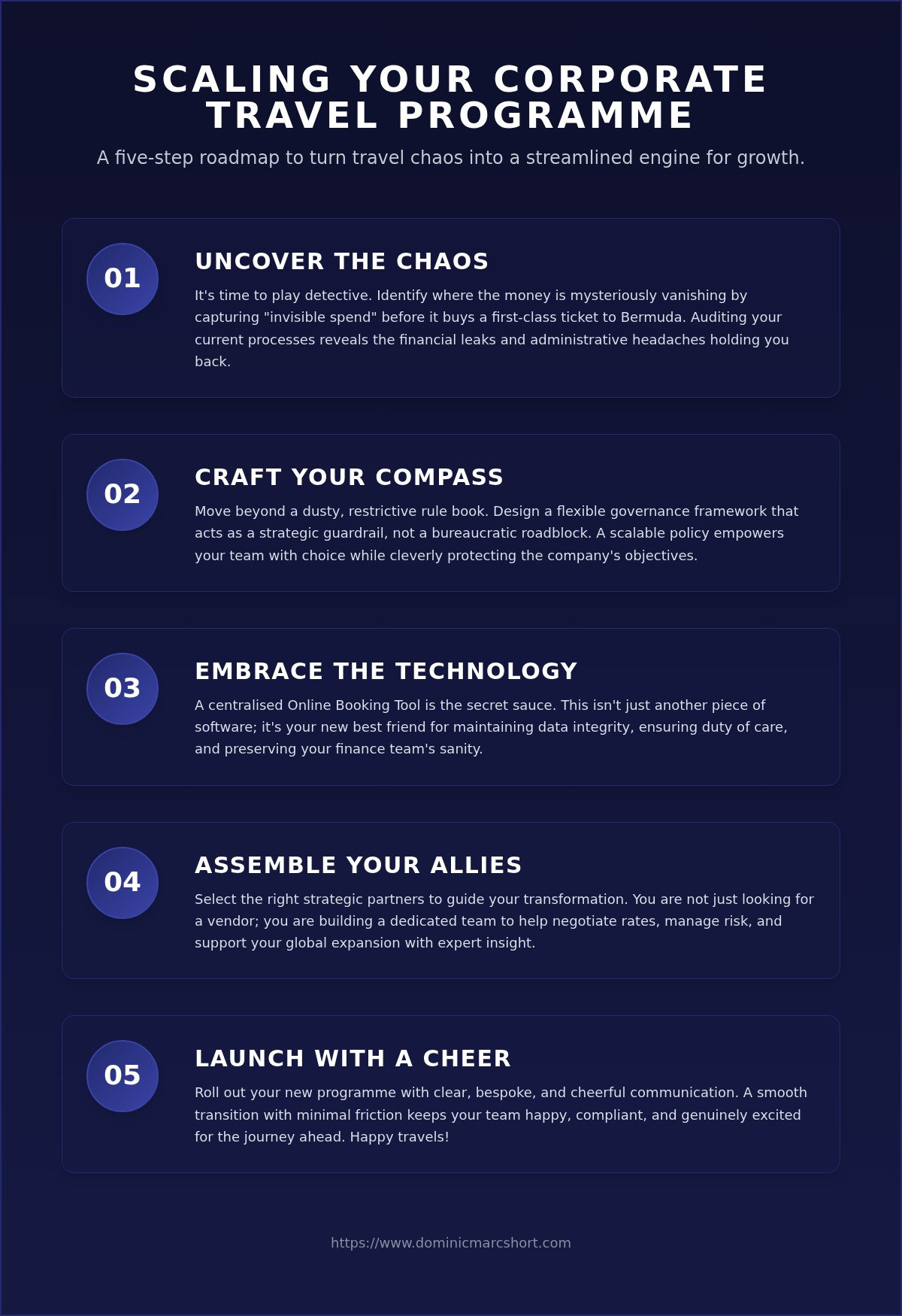
Scaling a travel program for a growing company is not a sprint; it is more of a well-planned expedition. You wouldn't attempt to climb Ben Nevis without a map and a sturdy pair of boots, and the same logic applies to your corporate travel transformation. Success lies in a methodical approach that respects your existing culture while clearing away the administrative undergrowth that stifles progress. By following a structured path, you ensure that your expansion remains sustainable and your budget remains intact.
Step-by-Step Implementation Strategy
The journey begins with a thorough process analysis to identify where your current system is leaking time or money. This audit phase is critical for surfacing bottlenecks, such as a manual approval process that takes forty-eight hours to clear a simple train ticket. Once the gaps are identified, you can move through policy design and technology selection, ensuring your partners, whether they are Travel Management Companies (TMCs) or independent consultants, align with your specific goals. For a deeper look at the initial diagnostic phase, our Executive Guide: Business Travel Analysis for 2026 provides a strategic starting point.
Audit: Surface the hidden frictions in your current workflow.
Policy Design: Create the strategic guardrails that empower your team.
Tech Selection: Implement the booking and payment systems that fit your scale.
Launch: Introduce the new programme to your workforce with clear guidance.
Review: Conduct regular strategic audits to ensure the programme remains fit for purpose.
It is a common misconception that the "Launch" phase is the finish line. In reality, it is just the beginning. The true value of scaling a travel program for a growing company is realised in the months following implementation, as data begins to flow and you can start optimising your negotiated rates based on actual traveller behaviour. This ongoing optimisation ensures you aren't just growing bigger, but growing smarter.
Managing Change and Employee Buy-in
Digital transformation is only successful if your people actually use the tools you provide. This is where bespoke communications become your most valuable asset. Instead of sending out a dry, corporate memo, use "internal marketing" to frame the new booking tool as a way to turn "restricted travellers" into "empowered explorers." Training should be engaging and accessible, acknowledging the joyful challenge of managing cultural differences across global teams. A team in Berlin might value different booking features than a team in New York; recognising these nuances ensures your programme feels like a benefit rather than a burden.
Partnering for Success: How Expert Consulting Drives Scalable Value
Many firms make the mistake of confusing a travel agency with a strategic partner. While a Travel Management Company (TMC) is essential for the actual booking process, their primary focus is often on transactions. Scaling a travel program for a growing company requires a strategic architect who understands the internal plumbing of your business. CDABS provides this end-to-end oversight, acting as a neutral advisor to ensure your processes are built for the long haul. We're here to make sure your travel strategy doesn't just exist, but actually thrives.
The Role of an Independent Hand in Global Transformation
Growth often leads to a "messy middle" where informal systems simply stop working. Navigating this transition requires a seasoned authority who has seen these challenges before. With over 30 years of industry experience, we offer the steady hand needed to guide your digital transformation without the bloated overhead of a massive consulting firm. Being independent means our advice isn't coloured by agency commissions or hidden incentives. We're solely focused on what works for your specific culture and bottom line. If you're ready to explore how this works, see our Strategic Business Travel Consulting: 2026 Guide.
Measuring ROI and Long-Term Success
In 2026, success is measured by more than just finding the cheapest flight to Frankfurt. While cost savings are vital, true value creation involves looking at the bigger picture of organisational health. We help you define success through a balanced scorecard of metrics that reflect your actual business goals:
Compliance rates: Ensuring your team stays within the strategic guardrails you've built.
Traveller satisfaction: Reducing friction so your staff remains cheerful and productive on the road.
Carbon reduction: Meeting the rigorous ESG standards that are now a core part of the 2026 regulatory environment.
Operational efficiency: Slashing the hours your finance team spends on the "detective work" of manual reconciliation.
Future-proofing your programme means building a system that can handle whatever the next decade of business travel throws at it. When the components of your travel ecosystem work in harmony, the result is a well-oiled machine that supports your staff rather than stressing them. There's a genuine sense of happiness in knowing your people are safe, your data is clean, and your growth is sustainable. Scaling a travel program for a growing company shouldn't be a chore; with the right partner, it is a strategic victory that sets you up for years of success.
Future-Proofing Your Corporate Journeys for Sustainable Growth
Transitioning from a chaotic booking culture to a sophisticated framework is a milestone worth celebrating. It's the moment your business moves from simply "getting there" to strategically "arriving." By addressing fragmented data and implementing robust governance, you ensure that scaling a travel program for a growing company remains a smooth and rewarding process. You've seen how to leverage 2026 technology to catch errors before they hit the ledger and how to turn restrictive rules into empowering strategic guardrails.
With over 30 years of global expertise, CDABS provides the independent, unbiased perspective needed to navigate these complex transitions. We act as a steady, experienced hand, ensuring your digital transformation is as cheerful as it is efficient. Whether you're an SME or a global corporate, the right oversight turns travel from a financial leak into a scalable asset that supports your broader business objectives.
Your journey toward a more professional, cost-effective, and happy workforce starts with a single, well-planned step. Let's make your corporate travel a competitive advantage for the decade ahead.
Frequently Asked Questions
How do I know if my company is ready to scale its travel programme?
You'll likely notice the "chaos threshold" when your finance team spends more time chasing crumpled receipts than on actual accounting. If your travel spend is rising but your data is scattered across five different consumer booking sites, it's a clear sign. Scaling a travel program for a growing company becomes essential once manual processes start costing you more in admin time than you're saving on flight tickets.
What is the difference between a travel agency and a travel management consultant?
A travel agency is primarily transactional, focusing on booking flights and hotels for a fee. An independent consultant like CDABS provides strategic, end-to-end oversight of your entire travel ecosystem. We don't sell tickets; we optimise your processes, technology, and payment systems. This neutral perspective ensures your programme is built for your specific business goals rather than being driven by agency commissions or hidden incentives.
How can a growing company reduce travel costs without upsetting employees?
The secret lies in removing friction rather than simply slashing budgets. You can achieve significant savings by negotiating corporate rates and implementing a centralised booking tool that offers better choices. When you use bespoke change management communications, employees feel empowered rather than restricted. They appreciate the ease of use and the reduction in manual expense reporting, which keeps the workforce cheerful and compliant throughout the transition.
What are the most important features of a scalable travel booking tool?
A scalable tool must offer high-quality data integrity and seamless integration with your existing ERP or HR systems. Key features include:
Tier-based permissions that automatically adjust for different job roles.
Automated policy compliance checks at the point of sale.
Real-time reporting capabilities for global oversight.
These features allow the system to grow with your business, ensuring that your travel governance remains robust as your headcount increases.
How does a centralised travel programme improve duty of care?
Centralisation provides the "single source of truth" needed to track employee safety effectively. When bookings are fragmented, you simply don't know where your people are during an emergency. A managed programme ensures every itinerary is captured, allowing for real-time alerts and rapid support. This isn't just about safety; it's a legal requirement under the Health and Safety at Work Act 1974 for UK employers to protect their staff.
Can a small company benefit from global travel management solutions?
Absolutely, as even small firms often operate across borders in our digital age. Implementing global solutions early prevents the "messy middle" phase of growth where unmanaged travel becomes a financial leak. Small companies gain access to sophisticated reporting and payment tools that were once reserved for corporate giants. It's a proactive way to ensure that scaling a travel program for a growing company happens on a solid, professional foundation.
What is the role of virtual credit cards in scaling corporate travel?
Virtual credit cards are a game-changer for reconciliation and fraud prevention. They allow you to generate a unique, single-use number for each transaction, which maps directly to a specific trip or employee. This level of automation catches errors before they hit the ledger and removes the need for employees to use personal cards. It simplifies the life of your finance team and keeps the ledger remarkably tidy and error-free.
How long does it typically take to implement a managed travel programme?
While every business is unique, a typical transformation takes between three to six months from the initial audit to the full launch. This timeline allows for thorough process analysis, technology selection, and the rollout of bespoke change management communications. It's a methodical journey that ensures your new systems are fully integrated and your team is well-trained, providing a steady, experienced hand during the transition to a sophisticated strategy.



Comments