Outsourced Travel Manager Services Compared With Other Options
By Dominic Marc Short · 4 November 2026 · 13 min read

The best travel-management choice for a Swiss SME isn’t necessarily full outsourcing. There’s no set number of employees or trips that determines when to outsource: the right fit depends on the workload, internal capacity and level of control you need. Outsourced travel manager services can provide hands-on programme support, while a consultant advises your team and self-service or in-house management keeps more tasks with employees.
Cost matters, but the decision also affects supplier negotiations, spending visibility and who handles the work when plans change. This comparison explains how outsourced, self-service and in-house approaches differ, when a blended model may make sense, and what to consider when selecting support. You’ll find a practical way to match the approach to your organisation without assuming one option suits every business or that more travel automatically requires more management.
Table of Contents
- How do business travel management options compare?
- Supplier negotiations and travel cost optimisation
- Should SMEs Outsource Travel Management?
- Comparing outsourced, self-service and in-house management
- Selecting a travel management outsourcing provider
- Dominic Marc Short - Independent Consultant: Business Travel Management Consulting
How do business travel management options compare?
The main differences are who makes decisions, who does the work and how much support sits within the business. For Swiss SMEs, the right arrangement depends on travel needs, internal capacity and the level of control required.
Outsourced Travel Managers
An outsourced travel manager can take on defined tasks within a company’s travel operation, such as coordinating bookings, applying travel processes and working with internal stakeholders. The role may sit close to the client’s team, while a travel management company (TMC) typically provides travel services, booking tools or account management. A consultant, by contrast, advises and recommends; the company decides whether to act.
Outsourced travel manager services can suit organisations that need practical support without adding an internal role. Some providers offer assistance with disruptions, changes and cancellations, but the hours and scope depend on the arrangement. A TMC may provide traveller support as part of its service, while self-service platforms let employees manage approved bookings themselves.
For Swiss businesses, outsourced work should be organised around applicable data-protection and employment obligations. Set out who may access traveller data, what instructions govern the work and how responsibilities are supervised. These practical controls help distinguish the external manager’s assigned role from internal decision-making.
Levels of Outsourced Support
Support can cover a whole travel programme or selected tasks, such as reviewing a booking process, a complex itinerary or travel policy. A business dealing with frequent booking changes may value operational improvements, while an organisation with occasional trips may need policy advice or help with specific journeys. There is no set employee or trip threshold for outsourcing.
Signs that specialist support may be useful include travel tasks competing with core work, inconsistent use of company policy, limited spend visibility or difficulty coordinating multiple suppliers. SMEs, NGOs and globally operating corporates can all benefit from travel-management consulting, although their needs differ. An NGO may need processes that work across varied destinations; a global corporate may need consistent oversight across offices.
Travel emergencies and changes call for clear responsibilities. A company should define how travellers escalate a disrupted trip, who approves a change and which support channel handles it. Some outsourced providers offer around-the-clock assistance, but this is not a feature of every arrangement. Employees should know the process before they need it, not while watching a departure board change its mind.
Choose by matching the work that needs attention with the control, expertise and support your organisation wants to retain.
Supplier negotiations and travel cost optimisation
There’s no single standard fee for outsourced travel management in Switzerland. The total depends on the scope of work, booking volume, support requirements and systems involved.
Fees may be charged per transaction, through a management fee or as service fees. The model determines whether costs rise with bookings or reflect an agreed scope of support.
Supplier Negotiations and Travel Savings
A travel management company may use supplier relationships, technology or collective buying power when seeking rates and terms. A consultant can review supplier arrangements and identify opportunities, but doesn’t automatically secure lower prices. Negotiated vendor rates can differ from those a company obtains directly.
Begin with a clear view of current travel spend. Separate air, hotel and car costs, then identify repeated routes, booking patterns and policy exceptions. This focuses discussions on what the business actually buys, rather than a headline discount employees rarely use.
Programme Costs and Savings
Programme analysis compares the full cost of managing travel with the value of the work performed. Include internal staff time, tools, supplier terms, booking support and the effort needed to oversee the programme. An apparent saving on fares can disappear if administration grows or travellers routinely book outside agreed channels.
Upfront investment may include implementation, training or changes to booking processes. Set out these costs separately from ongoing management and transaction charges. Then assess costs and potential savings over a consistent period and scope, so an initial setup expense isn’t mistaken for a lasting increase in travel costs.
In-house coordination and a virtual assistant also have different cost profiles. An employee’s cost includes salary, benefits, management time and cover when responsibilities shift. A virtual assistant may charge for agreed tasks or hours, but still needs instructions, access and oversight. Compare the total work delivered, not just the visible fee.
For example, a business might keep routine bookings in-house while assigning a specialist to review supplier terms and policy exceptions. Another may outsource selected air bookings if that category drives budget concerns. In either case, define who approves exceptions and who owns the supplier relationship. Clear boundaries reduce duplicated work.
- Baseline: Group spend by supplier, travel type and route.
- Scope: List internal tasks, external support and tools required.
- Value: Track usable savings alongside service and administration costs.
- Review: Reassess terms and booking patterns as business needs change.
Businesses managing travel themselves can still negotiate directly, especially when purchasing patterns are clear. External consulting adds expertise and structured analysis, while internal teams retain direct control. Neither route guarantees cost savings; the useful comparison is the net result after fees, staff time and supplier terms.
A focused travel programme cost review can help clarify which costs to compare and where negotiations deserve attention.
Should SMEs Outsource Travel Management?
For an SME, the decision depends on how bookings, expenses and reporting work together. Outsourcing can centralise these tasks, while a self-service platform keeps routine booking with employees.
Centralised Bookings and Spend Visibility
A central booking channel brings reservations into one view, making it easier to review travel spend by department, destination or supplier. For example, an SME can compare hotel bookings across teams and spot where employees regularly book outside its preferred process.
Travel platforms can combine booking records with expense data and reporting. That gives managers a clearer picture of trip costs and policy use, rather than relying on scattered receipts and separate spreadsheets. A well-managed programme can also let employees book approved options themselves while the business retains consolidated oversight.
Itinerary Coordination
Coordinating an itinerary means aligning flights, accommodation, ground transport and meeting times in one workable plan. For a Zurich-based employee travelling to Geneva for a client meeting, that could mean matching train or flight choices with hotel location and meeting schedule.
A consultant can help improve processes for managing complex itineraries and changes across connected arrangements. A booking platform may handle straightforward trips efficiently, while a person can help resolve details that require judgement, such as adjusting a hotel stay after a meeting moves.
Policies and Booking Processes
A travel policy sets the boundaries for booking, approval and exceptions. A practical process explains who approves a trip, which options employees may select and how they record expenses. These steps turn a written policy into decisions employees can follow when booking.
Technology can apply policy rules during a booking and capture records for reporting. For instance, an SME may require manager approval for an itinerary outside its usual parameters. Clear instructions also prevent employees, managers and external advisers from making conflicting decisions about the same trip.
Outsourcing Risks
Outsourcing can create gaps if an external adviser lacks access to relevant systems, internal stakeholders or travel data. Employees may also be unsure whether to approach the adviser or their own team. Assigning a named internal owner helps resolve questions and monitor whether agreed tasks are completed.
Dividing responsibilities between an SME and an external provider can increase coordination work. Set out who owns bookings, approvals, reporting and supplier communication, then document how exceptions are escalated. A company outsourcing its full programme still needs an informed internal person to review service quality and contract delivery.
Protecting data and maintaining appropriate access are also important. Define which traveller information the external team needs, what systems it may use and how access is managed. These controls help balance useful reporting with sensible limits on who can see employee travel details.
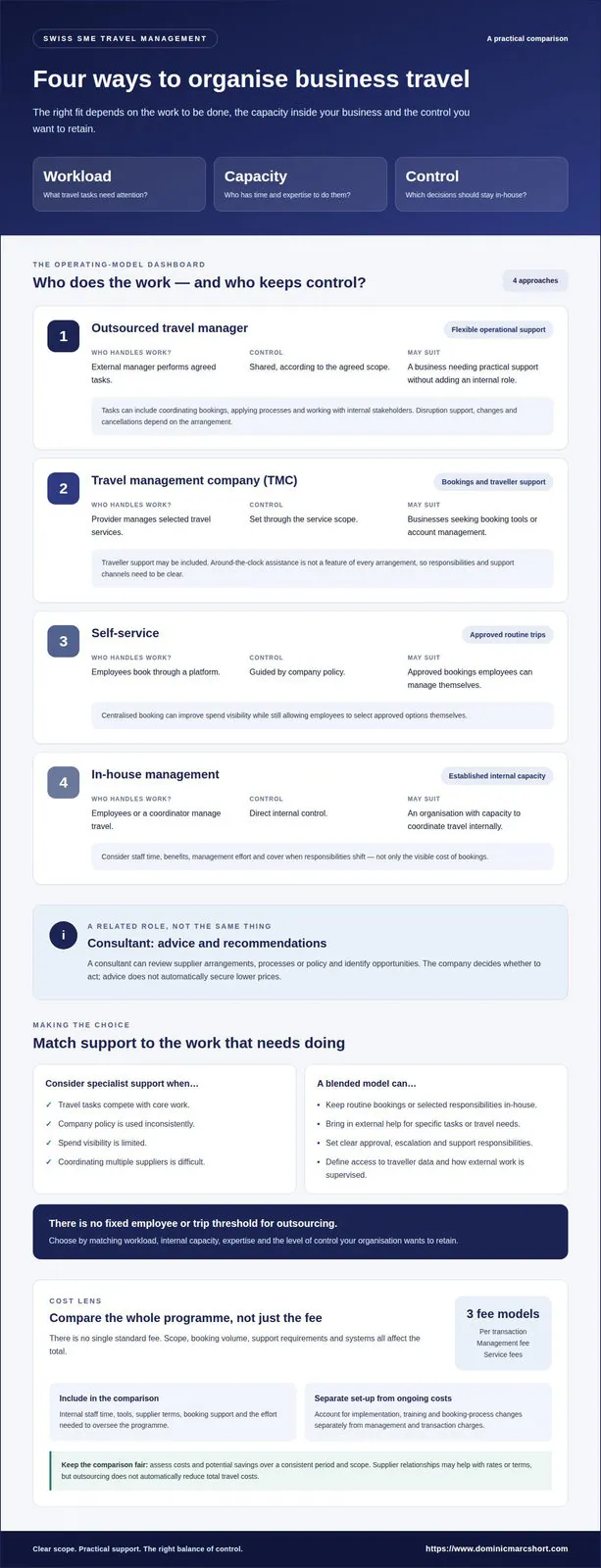
Comparing outsourced, self-service and in-house management
Each model places travel decisions and day-to-day work in different hands. For a growing Swiss business, compare complexity, traveller preferences and the capacity of existing teams before choosing.
Consulting can add specialist knowledge without adding an internal role. Its limitations include less direct access to internal stakeholders and data, plus extra coordination when responsibilities are split. A travel management company can complement an in-house manager rather than replace one.
Company size alone doesn’t settle the choice. A small organisation arranging complex international itineraries may need more support than a larger company with predictable routes and established processes. Assess trip complexity, approval demands, booking exceptions and reporting needs, not headcount alone.
Traveller preferences matter too. Some employees value choosing approved options themselves; others need help coordinating several journey legs or adapting plans. Company culture shapes this balance. A decentralised business may prefer employee-led booking, while a central finance team may prioritise consistent approvals and spend oversight.
Departmental coordination can make or break the model. Finance needs reliable expense records; human resources may manage traveller details; managers approve trips; and employees need workable booking instructions. Assign an owner for each responsibility, then document how information and decisions move between teams and any external adviser.
- Choose self-service when trips are straightforward and employees can follow clear booking rules.
- Choose in-house management when internal staff have the capacity and knowledge to coordinate travel.
- Choose external support when complexity or workload exceeds internal capacity, or specialist oversight is needed.
- Combine models when routine bookings work well internally but selected tasks require extra expertise.
Before deciding, map a typical trip from request to expense report. Mark who approves, books, supports changes and reviews spend. If hand-offs create delays or gaps, adjust the allocation of work. This practical test matches the model to actual operations, rather than company size or a preference for one approach.
Selecting a travel management outsourcing provider
Select a consultant or provider by matching their responsibilities to your travel programme, not by choosing the broadest package. For a Swiss company, compare advice on booking choice, change processes, reporting, policy controls, flexibility and coordination with internal teams.
To transition corporate travel management, document the current process, agree the external provider’s scope and assign internal owners. Then transfer the relevant workflows, systems access and traveller guidance before reviewing how the arrangement operates.
Start with a clear service brief. Specify whether the external adviser will review bookings, selected travel types, reporting, supplier relationships or programme oversight. For example, a company may retain approval decisions internally while engaging a consultant to improve itinerary coordination and travel-spend reporting. Defined boundaries prevent duplicated tasks and unanswered requests.
Assess operational fit through the actual traveller journey. Consider how the proposed process handles a routine flight and hotel booking, then a disrupted itinerary or cancellation. Establish which channel travellers use, who authorises exceptions and how unresolved issues are passed to the company.
Technology and information access deserve equal attention. Map the booking platform, expense tools and reporting systems involved. Agree which information the external adviser needs, who grants access and how internal staff receive reports. A consultant unable to work smoothly with existing processes may add manual steps instead of reducing them.
Supplier relationships are another selection criterion. Clarify who manages communication with an airline, hotel or other travel supplier, and how supplier terms feed into programme reporting. The aim is not simply to obtain a discount; it is to make supplier arrangements, traveller needs and company policy work together.
Set measurable expectations in a service-level agreement. Corporate travel management commonly uses these agreements to define service quality and reporting timelines. Include responsibilities for routine bookings, changes, escalations and management information. A clear agreement gives both parties a shared reference when priorities shift.
Use a structured transition:
- Map current work: Record booking channels, approvals, suppliers and reporting responsibilities.
- Define ownership: Name internal decision-makers and the provider’s assigned responsibilities.
- Prepare the handover: Transfer agreed process documents, system access and traveller instructions.
- Review delivery: Compare actual booking support and reports with the agreed service expectations.
Keep an informed internal owner after the handover. This person can review service quality, coordinate departments and identify gaps between agreed expectations and daily delivery. Choosing carefully means evaluating how the working relationship functions, not simply how polished a presentation looks.
Dominic Marc Short - Independent Consultant: Business Travel Management Consulting
Dominic Marc Short - Independent Consultant helps organisations assess and improve business travel through Business Travel Management Consulting. Turn to this support when bookings, policies, supplier arrangements or reporting need a clearer, more coordinated approach, or when you’re weighing internal management against external support.
The work can begin with analysing existing processes and identifying practical changes for your organisation. Where a travel programme also involves wider organisational change, Global Transformation Management or Change Management Communications Packages can support the transition. For businesses coordinating travel around larger gatherings, Meeting and Conference Organization may also be relevant.
Share the travel-management challenge you’re working through and the outcome you need. Contact Dominic Marc Short on WhatsApp to discuss the next step.
Make your next travel-management decision actionable
Before changing your arrangement, define the business outcome you want the travel programme to support. It might be clearer reporting, smoother coordination across teams or a more consistent experience for travellers. Then identify a focused area where outsourced travel manager services could contribute, and agree how you’ll assess whether the approach is working.
This turns a broad sourcing decision into a practical improvement plan. It also gives internal teams and external specialists a shared purpose, rather than simply moving tasks from one desk to another. A thoughtful next step can be modest, clear and aligned with how your organisation works.
With a well-defined objective, your organisation can move forward with greater clarity and confidence.
Frequently Asked Questions
How Is This Different From A Travel Agent?
A travel agent primarily arranges or sells travel, while a travel manager focuses on how a company governs business travel. That can include shaping policy, reviewing processes, managing supplier relationships and analysing travel information. For example, a manager may examine why employees repeatedly choose non-compliant fares, then recommend a process change. The distinction is the broader organisational remit, rather than arranging an individual holiday or itinerary.
What If My Travel Needs Change Over Time?
Adjust the scope as your organisation’s travel patterns change. If a new office creates regular international trips, you might add itinerary coordination or reporting support; if travel slows, you could retain only policy or supplier oversight. Review responsibilities whenever your operating model changes, such as entering a new market or reorganising teams. A staged arrangement allows support to evolve without redesigning the whole programme at once.
How to choose an outsourced travel manager in Switzerland?
Choose someone whose experience matches your programme’s needs and whose responsibilities can be clearly defined. For a Swiss organisation, discuss how the arrangement will work across your locations, teams, booking processes and existing systems. Use a realistic scenario, such as an employee changing a multi-stop trip, to explore decision rights and handovers. Agree how performance will be reviewed, what information will be reported and how the scope can adapt.
How does an outsourced travel manager handle travel policy, bookings, expenses, and reporting?
The manager works to the responsibilities and decision rights agreed with the organisation. For instance, a company may retain trip approval while the manager supports policy implementation and reviews booking or expense patterns. Reporting can highlight recurring exceptions, such as repeated changes to a particular route. The practical value comes from connecting policy, booking behaviour and expense information, then turning those observations into clear recommendations for internal decision-makers.
What service levels and support hours should a travel management contract include?
Set service expectations around the actual work and disruption risks your travellers face. Define operating hours, channels for routine requests, escalation steps for urgent changes, ownership of unresolved cases and reporting frequency. For example, the agreement can distinguish a routine itinerary question from a same-day cancellation. Specify who is responsible at each stage, including outside agreed support hours, so travellers and internal teams understand the process before plans change.
Related articles

6 November 2026 · 15 min read
Virtual credit cards for business travel and spending controls
Explore how virtual credit cards for business travel control spending, simplify expenses and keep bookings moving with supplier checks and backup plans.

5 November 2026 · 14 min read
Corporate Event Planning Services in Switzerland for Teams
See how corporate event planning services in Switzerland bring venues, suppliers, guest travel and event-day delivery together for a smooth, engaging team event.

30 October 2026 · 14 min read
Improving employee travel experience with smoother work trips
Discover how improving employee travel experience with comfort, flexibility and simpler booking and expenses can support lasting satisfaction and retention.