Improving employee travel experience with smoother work trips
By Dominic Marc Short · 30 October 2026 · 14 min read

A corporate trip is part of the employee experience, not simply a journey between meetings. Travellers value comfortable transport and accommodation, practical flexibility, clear choices, and straightforward booking and expense processes. Improving employee travel experience means bringing these priorities together so the trip supports the work instead of becoming another task to manage.
Business travel should be organised around people as well as schedules. Employees need journeys that allow for rest, accommodate changes, and come with processes that are easy to understand. When improving employee travel experience, even small details matter: a productive meeting can lose its value after an exhausting journey or an expense process that follows someone home.
This article explores what corporate travellers expect and how comfort, flexibility, and simpler arrangements can support satisfaction and retention. It offers practical ways to improve employee travel experience, from accommodation and trip planning to reimbursement and the wider role business travel plays in the employee experience.
Table of Contents
- 1. Bleisure travel and work-life balance
- 2. Comfortable accommodation and reliable transport
- 3. Employee satisfaction and retention
- 4. Streamlined business travel booking and reimbursement
- 5. Business travel as part of the employee experience
- Dominic Marc Short - Independent Consultant: Business Travel Management Consulting
1. Bleisure travel and work-life balance
Bleisure travel means extending a business trip for personal time. Companies can allow this flexibility while keeping work expenses separate from personal arrangements. For example, an employee attending meetings in another Swiss canton might add personal time after the final work commitment. Clear policy wording should explain approval steps, eligible business costs, and responsibility for personal expenses. This makes the choice transparent without turning the work itinerary into an open-ended extension.
Seasonal fluctuations can make that choice more useful. A busy conference period may bring several trips close together, while quieter periods can leave more room for recovery. Managers can review upcoming travel alongside team workloads and avoid stacking demanding trips around important deadlines. A seasonal planning check also helps employees arrange personal commitments around confirmed work dates, rather than discovering late changes when calendars are already full.
Work-life balance depends on the rhythm of each trip, not just its destination. Travellers can choose a habit to maintain on the road, such as taking a walk before dinner or setting aside time for a regular call home. A practical starting point is to recreate fulfilling activities from home at the destination. Small routines can make an unfamiliar hotel room feel less like a temporary office with better curtains.
How can employers support employee safety, wellbeing, and accessibility while travelling? They can provide clear itineraries, emergency contacts, and local office details, while considering each traveller’s access needs when planning transport and accommodation. To support wellbeing, choose options that make movement, mindfulness, or rest practical, such as a hotel with a fitness centre.
Frequent business travel can disrupt routines, reduce time at home and make fatigue harder to manage. Employers can reduce these pressures by limiting overly long itineraries, building in sensible rest periods and allowing a night-before arrival for an early meeting. Employees who travelled more than 50% of each month, as Jennifer Brick described, illustrate why trip frequency deserves attention alongside destination and meeting schedules.
Policy should make flexibility practical and fair. For a Swiss business trip, employers can explain how personal extensions affect approvals, booking arrangements, and reimbursement before plans are made. They can also distinguish costs related to the business itinerary from those belonging to the personal portion. Clear examples help employees understand how the rules apply, without turning a simple extension into a guessing game.
When companies treat rest and personal time as planning considerations, business travel can fit more comfortably into employees’ lives. Invite travellers to share which parts of a trip create strain, then use that feedback to adjust timing, accommodation choices, and seasonal schedules. A thoughtful approach balances business needs with individual circumstances, supporting work-life balance without turning every trip into a holiday itinerary.
2. Comfortable accommodation and reliable transport
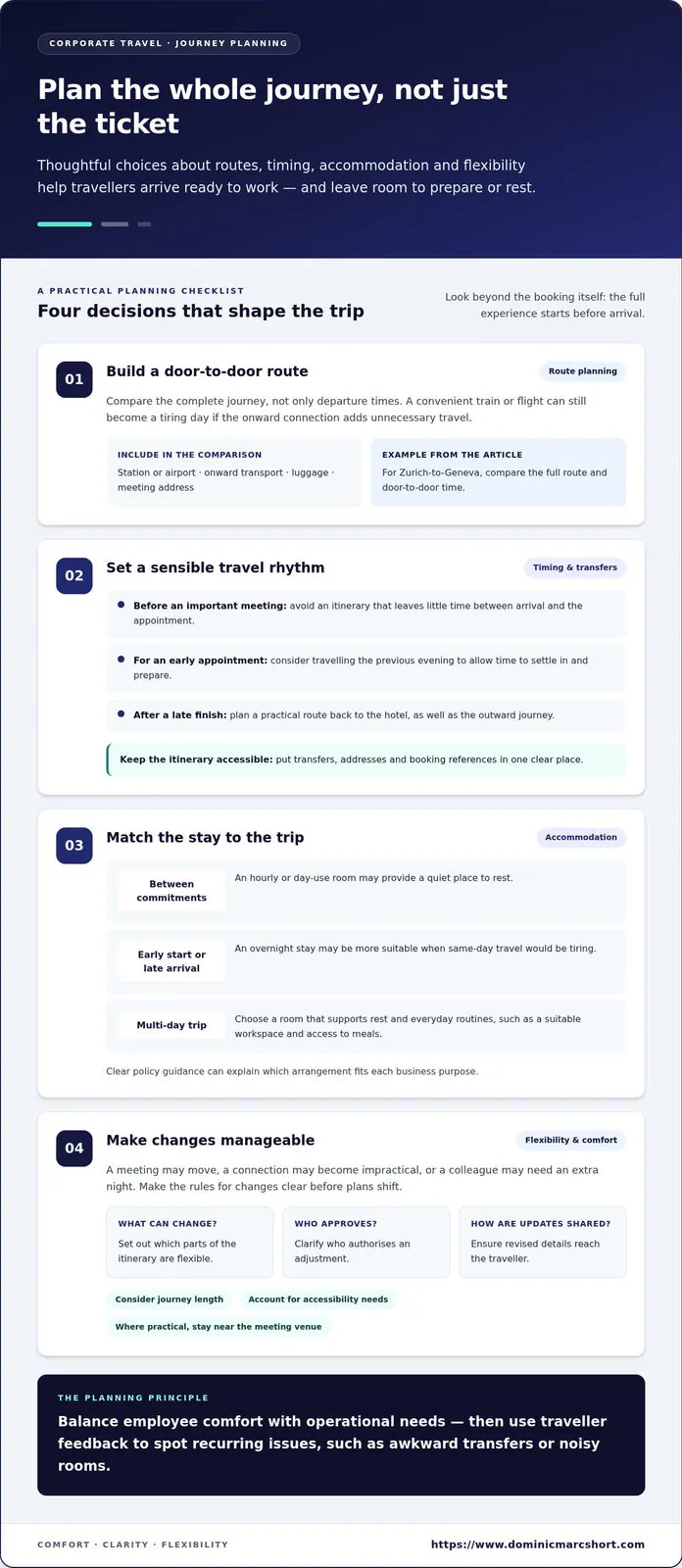
A work trip in Switzerland can involve several transfers before the first meeting. For a Zurich-to-Geneva journey, compare the full route, not just departure times. Consider the station or airport, onward transport, luggage, and meeting address. A convenient flight or train can still make for a tiring day if the final connection adds unnecessary travel. Planning around door-to-door time helps employees arrive ready to work.
Reliable transport also depends on sensible timing. Avoid itineraries that leave little room between arrival and a client meeting. For an early appointment, travelling the previous evening can allow time to settle in and prepare. After a late finish, a practical route back to the hotel matters as much as the outward journey. A clear itinerary should put each transfer, address, and booking reference in one accessible place.
Accommodation needs vary with trip length. An hourly or day-use room may suit a traveller who needs a quiet rest between commitments. An overnight stay is more suitable when an early start or late arrival makes same-day travel tiring. Multi-day trips call for a room that supports rest and ordinary routines, such as a suitable workspace and access to meals. Policies can explain which arrangement fits each business purpose.
Flexible itineraries help employees respond to changes without rebuilding the whole trip. A meeting may move, a connection may become impractical, or a colleague may need an extra night. Set out which elements can change, who approves adjustments, and how revised details reach the traveller. Where practical, keep accommodation close to the meeting venue. This can reduce commuting after arrival and leave more time to prepare or rest.
Flight comfort depends on timing, journey length, and the traveller’s needs. Where schedules allow, offer reasonable flight-time choices and avoid itineraries that leave employees exhausted before important work. Accommodation should also reflect accessibility requirements and the purpose of the visit. A traveller with consecutive meetings may value a quiet room near the venue; someone attending a longer event may need reliable space to prepare.
These decisions shape corporate culture as well as logistics. When employees can explain why a route or room works better, managers can balance comfort with operational needs. Gather feedback after trips and note recurring issues such as awkward transfers, noisy rooms, or arrival times that leave little time to prepare. Use those examples to refine standards and improve engagement. A seamless process is not about luxury, but about removing avoidable friction from the working day.
Organisations reviewing their travel arrangements can consider how route planning, accommodation choices and policy fit together. A focused review of corporate travel planning can help identify practical improvements that support traveller comfort and productivity.
3. Employee satisfaction and retention
Employee travel affects how people experience their workplace. A demanding trip can feel especially draining after a busy working week. A well-planned visit, by contrast, can help employees feel trusted and prepared. Managers can ask travellers which parts of a journey support their work and which cause avoidable strain. Their answers give the organisation practical insight for improving its travel approach.
Satisfaction grows when employees understand how travel decisions are made. Explain each trip’s purpose, how options are assessed, and where travellers can express preferences. A colleague attending a client meeting, for instance, may value a direct route over a lower-cost itinerary with several changes. Clear criteria make decisions easier to understand and reduce the sense that comfort depends on who asks.
Retention also depends on whether the employee experience feels consistent. Strong employee experience programmes in travel and tourism can reduce turnover rates by up to 30%. This is not a reason to treat travel as a retention shortcut. It is a prompt to examine the whole experience, including recognition, workload, opportunities to raise concerns and whether work trips remain manageable over time.
Productivity and satisfaction can move together, but the conditions matter. Engaged employees are 22% more productive. A company can support engagement by setting realistic objectives for each trip, protecting time to prepare and recognising the work completed afterwards. A short debrief after a conference can identify useful contacts, follow-up tasks and travel issues. That makes the trip’s contribution visible, rather than leaving its value buried in a calendar.
Positive employee experience can increase employee loyalty by 35%. Employers can reinforce that loyalty through fair treatment and meaningful recognition. For example, a manager might acknowledge an employee who represented the organisation at an important meeting or helped colleagues through a complex event. Recognition should be specific and timely. A generic thank-you is pleasant; linking appreciation to the employee’s actual contribution gives it more weight.
Job satisfaction is shaped by more than the journey itself. Employees also notice whether travel supports development, gives them useful autonomy, and fits their wider responsibilities. Before approving recurring trips, managers can discuss the employee’s workload and the purpose of each visit. If the same meeting could be handled remotely, comparing the options helps reserve travel for situations where in-person collaboration adds value.
Incentive travel can also communicate appreciation when it recognises shared achievements. In an Incentive Research Foundation study, 77% of respondents said a travel experience is the most effective reward. A reward works best when its criteria are clear and its design reflects the team’s contribution. Thoughtful recognition can enhance workplace culture, while a poorly explained selection process may undermine the positive intent.
Track employee feedback alongside retention and programme performance. After a trip, ask about preparation, workload, support, and whether the purpose was achieved. Review recurring comments with managers, then make a specific policy or process adjustment. This turns satisfaction into an ongoing management practice rather than a one-off survey. It also helps companies assess whether changes improve employees’ actual experience.
4. Streamlined business travel booking and reimbursement
A convenient booking system should make approved choices easy to compare. Assess platforms against clear criteria: route options, policy controls, itinerary access, change handling, and expense reporting. For example, test whether an employee can compare train and flight options, understand approval steps, and retrieve booking details without switching between several tools. The right fit supports the workforce’s actual travel patterns, not just a polished demonstration.
Transparent payments reduce uncertainty before and after a trip. Explain which costs employees pay directly, which use a company payment method, and what evidence reimbursement requires. A policy might clarify how to record a rail ticket, hotel bill, or client meal. Keep approval routes visible and expense categories easy to understand. Simple instructions help employees submit complete claims without turning receipt management into an evening hobby.
How do companies compare travel management platforms and corporate booking services? Test each against real journeys, policy requirements, traveller experience, and the ability to manage changes and expenses in one process. A pilot using common Swiss routes can show whether employees can book suitable options and finance teams can access useful reporting.
Booking flexibility should have sensible boundaries. Let employees select policy-compliant options, while defining when a different route or schedule needs approval. If a meeting moves, the process should explain how to amend transport and accommodation and where to find the updated itinerary. This balance gives travellers choice without leaving managers to untangle bookings across separate email threads.
Pre-booking food and beverages can make travel more comfortable, particularly for employees with dietary preferences or tightly scheduled connections. Let travellers add meal requirements during booking where the system allows, and explain how eligible meal expenses are recorded. For a team travelling to an event, an organiser can collect preferences in advance and share practical meal arrangements before departure.
How can employers balance employee travel comfort with cost control? Set standards based on trip purpose, journey time, policy-compliant options, and each traveller’s needs. Compare the full itinerary, including transfers and arrival timing, rather than choosing solely by ticket price.
How can companies improve sustainable business travel options in Switzerland? Make rail options visible for suitable journeys, compare them with flights based on total travel time and connections, and use virtual meetings where in-person attendance adds little value. Record decisions to identify practical opportunities for future trips.
What Swiss employment rules apply to business travel time, expenses, and rest periods? Employers should assess travel time, necessary expense reimbursement, and rest in line with applicable Swiss employment requirements and each employee’s working arrangements. Written policies should explain how time is recorded, which costs are reimbursed, and how itineraries allow for rest.
Well-designed travel programmes can turn booking from a series of disconnected tasks into a more consistent process. Review traveller feedback and expense patterns, then adjust the system, policy, or communications. Clear guidance can support comfort and efficiency while reducing administrative hurdles between booking and reimbursement.
5. Business travel as part of the employee experience
A business trip can shape how employees experience their organisation, not just how they reach a meeting. A visit to Basel might build client relationships, give colleagues time to solve problems together, and expose a team to new working environments. These benefits are strongest when the trip has a clear purpose and employees understand how their contribution supports shared success.
Travel policies shape that experience at every stage. Before departure, employees need to understand why attendance matters and what preparation is expected. During the trip, clear itineraries and practical support help them focus on work. Afterwards, managers can discuss outcomes, recognise useful contributions, and capture lessons for the next journey. This connects business travel with everyday workplace culture instead of treating it as an isolated booking.
Shared travel can help colleagues see how others approach challenges. For example, a team travelling to a meeting in Bern could use the journey to discuss priorities before arriving. A collaborative session with colleagues from another office can build understanding across teams. Travel can also expose employees to unfamiliar situations, helping develop creative thinking and problem-solving through real work, not a motivational poster promising to change everything.
How can companies gather and measure employee feedback on business travel? Send a short post-trip survey asking about the trip’s purpose, workload, support, and practical obstacles. Review responses alongside programme information such as spending, policy compliance, and supplier performance, then identify recurring themes and actions.
Feedback becomes useful when someone acts on it. If employees report that a particular connection makes a meeting day difficult, assess the itinerary and consider a more workable option. If travellers find instructions confusing, simplify the relevant policy guidance. Share the resulting changes so employees can see that their feedback improves the travel experience rather than adding another form to complete.
Travel rewards can recognise a team’s shared achievement, especially when they reflect company culture. A local or regional experience may suit a team that values time together without a long itinerary. Define the achievement being recognised, explain the selection approach, and make the activity inclusive. A meaningful reward shows appreciation; a clear process helps maintain trust among colleagues who contributed to the same success.
Assess travel as part of the employee experience by connecting trip purpose, feedback, and outcomes. Managers can review recurring concerns, recognise effective collaboration, and adjust programme design accordingly. This creates a practical cycle: plan with employees in mind, learn from each trip, and improve the next one. The aim is not simply more travel, but purposeful journeys that support work, relationships, and retention.
Dominic Marc Short - Independent Consultant: Business Travel Management Consulting
Dominic Marc Short, Independent Consultant, can help organisations assess how their travel programme supports employee needs and business priorities. Business Travel Management Consulting is a practical next step when booking processes, travel policies, or traveller feedback reveal opportunities for improvement.
The work can include reviewing existing processes, identifying friction across the travel journey, and shaping practical improvements. When change involves new systems or ways of working, Global Transformation Management and Change Management Communications Packages can support implementation and employee understanding. Meeting and Conference Organization is relevant when business gatherings form part of the travel experience.
If your organisation is ready to turn traveller feedback into a clearer, more consistent programme, contact Dominic Marc Short, Independent Consultant, to discuss your business travel management needs.
Make the next trip a better one
A useful next step is to choose one friction point and assign clear ownership. Improving employee travel experience becomes practical when someone is responsible for turning feedback into a policy, process, or planning change. That might mean reviewing how travel options are presented, clarifying who approves itinerary changes, or making trip feedback part of regular programme discussions.
Set a clear direction for the next review: what should feel easier for travellers, and what would show the change helped? Agreeing on this with employees and managers keeps improvements grounded in real working needs. It also creates room to learn, adapt, and build a travel approach that supports people and business priorities.
Dominic Marc Short, Independent Consultant, can help organisations assess and develop their business travel approach through Business Travel Management Consulting, alongside relevant transformation and meeting support.
Each thoughtful adjustment can make the next work trip more purposeful. Start with one practical improvement and build from there.
Frequently Asked Questions
What do corporate travellers expect?
Corporate travellers expect trips that let them focus on their purpose, whether meeting a client, attending an event, or working with colleagues. They value predictability: knowing where to find current itinerary details, how to handle a change, and whom to inform. Travellers may also have individual needs, such as accessible transport or specific meal arrangements. Asking about these before booking helps prevent avoidable difficulties during the journey.
What are the key factors that improve employee business travel experience?
Start with the reason for travel, then match the itinerary to the work required. A team attending a conference may need time to prepare together, while a client visit may call for a quiet place to work beforehand. Clear expectations, appropriate support, and a way to share feedback all matter. Review comments after trips to identify recurring obstacles, then assign someone to assess and address each one.
Which travel booking tools and policies make business trips easier for employees?
Useful tools let employees compare available options, access itinerary details, receive travel alerts, and manage changes. Policies should explain which choices employees can make independently, when approval is needed, and how exceptions are handled. Managers can also review programme data on spending, compliance, and supplier performance alongside traveller feedback. This gives the organisation a fuller picture than booking volume alone and helps determine whether the tool and policy work well together.
What steps can employers take to simplify travel approval, booking, and expense reimbursement?
Use a clear sequence: define the trip’s business purpose, set an approval route, make approved options easy to find, and explain how to record expenses. Give employees one place to access booking details and claim instructions. After travel, review rejected or incomplete claims for recurring causes, such as unclear expense categories or missing guidance. Addressing these causes can make the process easier for travellers and finance teams alike.
Related articles

26 October 2026 · 14 min read
Business Travel Automation for Lower Costs and Smoother Workflows
See how optimizing business travel workflows cuts admin, controls costs and improves compliance, while keeping travellers supported and human judgement in play.
22 October 2026 · 15 min read
Blended Travel Policy: Rules for Business and Leisure Trips
Master your blended travel policy (business and leisure) with ease! Enjoy seamless trip approvals, clear expense rules, and happy, well-protected travellers.
6 November 2026 · 15 min read
Virtual credit cards for business travel and spending controls
Explore how virtual credit cards for business travel control spending, simplify expenses and keep bookings moving with supplier checks and backup plans.