Maximising Value from a Business Consultant: The 2026 Executive Checklist
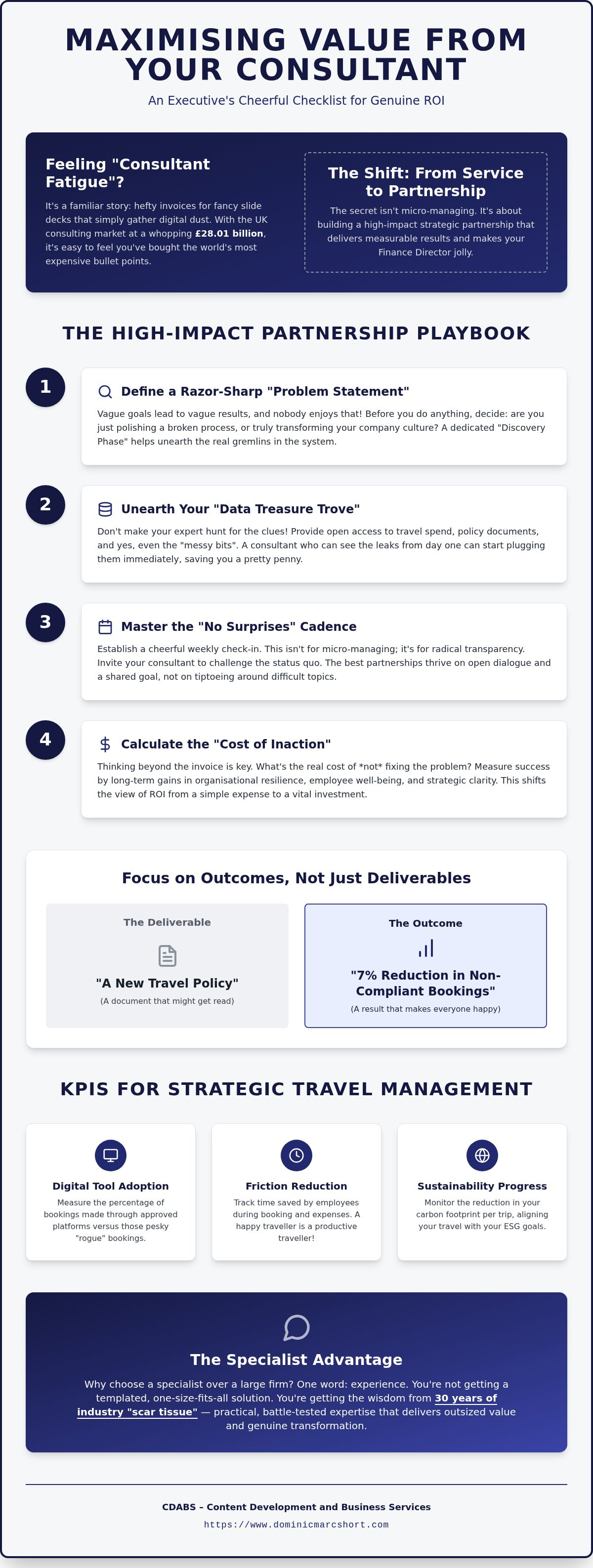
With the UK management consulting market reaching a rather hefty £28.01 billion in 2026, it's clear that businesses are spending more than ever on external advice; yet, many leaders feel they’re paying for fancy slide decks that eventually just gather digital dust. You’ve likely felt that familiar pang of "consultant fatigue" when a project drifts or the invoice arrives without a corresponding leap in efficiency. It’s frustrating to see high fees lead to little more than internal friction, leaving you wondering if you’ve just purchased the world’s most expensive collection of bullet points. The good news is that maximising value from a business consultant isn't about micro-managing or hovering over their shoulder.
Instead, it’s about shifting the relationship from a transactional service to a high-impact strategic partnership that delivers a genuine, measurable ROI. This guide provides a practical executive checklist for the year ahead, covering everything from curbing scope creep to achieving genuine cost savings in travel and operations. We’ll also look at how a steady hand can help you navigate digital transformation without the usual headaches, ensuring your organisational growth remains robust and remarkably stress-free.
Table of Contents
The Strategic Foundation: Defining Clear Objectives and Success Metrics
It’s a bit of a classic blunder. A firm hires an expert, shakes hands, and says, "Make us more efficient." Six months later, they’re staring at a pile of reports that don't actually change anything. The golden rule of Management consulting is simple: vague goals lead to vague results. If you want to succeed in maximizing value from a business consultant, you must start with a laser-focused "Problem Statement". Are you simply trying to mend a clunky travel approval process, or are you looking to transform the very culture of how your team moves and works?
A dedicated "Discovery Phase" is your best friend here. It’s the time to poke around in the dark corners of your operations to find the hidden bottlenecks that everyone’s been ignoring. Once those are out in the open, you can set SMART goals that actually align with your 2026 strategy. Whether it’s navigating the latest digital shifts or meeting new sustainability targets, your objectives need to be specific and measurable. This proactive approach is the cornerstone of maximizing value from a business consultant, turning a standard engagement into a high-octane partnership.
Aligning Consultant Goals with Business Outcomes
Don’t get bogged down in a list of "deliverables" like policy documents or slide decks. Instead, focus on tangible outcomes. A "new travel policy" is just a piece of paper; a "7% reduction in non-compliant bookings" is a result that makes the Finance Director smile. It’s also vital that your consultant understands your organisational DNA. You aren't just another corporate entity on a spreadsheet, so drafting a "Success Charter" that both parties sign off on ensures everyone is pulling in the same direction from day one.
Establishing KPIs for Strategic Travel Management
In 2026, measuring success is about more than just looking at the bottom line. You should be tracking digital adoption rates for new travel technology and monitoring how much "friction" you’re removing from your employees' lives. Consider these metrics to keep your project on track:
Digital Tool Adoption: The percentage of bookings made through approved, modern platforms rather than "rogue" bookings.
Friction Reduction: The time saved by employees during the booking and expense process, measured through user feedback.
Sustainability Progress: Measurable reduction in carbon footprint per trip in line with your ESG goals.
ROI in the context of business travel is the balance of fiscal savings and employee well-being. To understand how these metrics translate into long-term growth, you can explore the details in our article on the real ROI of business travel consulting.
Pre-Engagement Checklist: Preparing Your Organisation for Impact
Before your chosen expert even logs into their first briefing, the real work begins within your own four walls. You wouldn't invite a world-class chef into a kitchen without any ingredients, and the same logic applies here. Preparation is the secret sauce for maximizing value from a business consultant. If your internal house isn't in order, you'll end up paying premium rates for someone to simply tidy up your data rather than architecting your future. It’s about ensuring that when the project kicks off, the momentum is already building.
Data Transparency and Access
One of the quickest ways to stall a project is by "hiding the messy bits." We all have them; legacy systems that don't talk to each other or historical payment logs that look like they were written in code. However, providing an honest "Data Treasure Trove" of travel spend and policy documents is essential. If a consultant can't see where the leaks are, they certainly can't plug them. To get your numbers in front of a steady hand, you might want to review our guide on Travel Data Management Consulting to ensure your audit trail is ready for inspection. Transparency isn't just a buzzword; it’s a direct contributor to your final ROI.
Securing buy-in from IT and Finance is equally critical. These departments often hold the keys to the kingdom, and finding out in week three that IT won't grant access to a booking tool is a headache nobody needs. By involving them early, you turn potential gatekeepers into project partners.
Winning Hearts and Minds: The Change Management Piece
There is often a lingering "consultant-phobia" in many offices, where employees fear an external eye is only there to cut heads or budgets. You must frame the engagement as a "helper" rather than a "hatchet man." Using bespoke communications to explain the "why" behind the change can transform the atmosphere from one of suspicion to one of cautious optimism. It’s helpful to identify your internal "Sceptics" and "Advocates" early. While advocates help spread the word, the sceptics often provide the most valuable feedback on where a new process might actually fail in the real world.
Transformation rarely follows a straight line. You should prepare your leadership team for the "J-Curve," that slightly uncomfortable period where things feel a bit harder before the improvements kick in. A seasoned strategic architect can help you navigate these choppy waters with a calm, controlled perspective. By planning for this dip, you ensure the project doesn't lose steam just as it’s about to deliver its best results.
Finally, appoint an Internal Champion. This person acts as the vital bridge between the consultant and the C-suite. They don't need to be the most senior person in the room, but they do need the authority to clear roadblocks and the knowledge to provide context that a spreadsheet simply can't capture.
Collaborative Execution: Navigating the Project Lifecycle with Agility
Once the ink is dry and the data is shared, the real magic happens in the day-to-day collaboration. Successfully maximizing value from a business consultant requires a shift from a "set and forget" mentality to an active, agile partnership. We recommend a strict "No Surprises" rule. By establishing a weekly cadence for updates, you ensure that small hurdles don't transform into insurmountable barriers. It’s much easier to nudge a project back on track on a Tuesday morning than it is to perform a full rescue mission three months down the line.
You aren't paying for a "yes man" or a simple pair of hands. You’re paying for a steady hand that has navigated these transitions before. Empower your consultant to challenge the status quo without fear. If they suggest that your current travel approval process is as efficient as a chocolate teapot, listen to them. It’s this external perspective that provides the real breakthrough. Of course, every project faces the tempting siren song of "scope creep." It’s vital to manage this with a cheerful but firm hand. If new ideas pop up, place them in a "future phase" bucket so the current delivery remains sharp and focused.
The Role of the Transformation Advisor
Think of your consultant as a Strategic Architect rather than a temporary fix. They bring a wealth of industry "scar tissue" and high-level connections that your internal team simply won't have. For a deeper look at how this role has evolved, see our guide on The Role Of A Corporate Travel Transformation Advisor. Leveraging their external network for benchmarking allows you to see how your peers are handling similar 2026 digital shifts, ensuring your programme stays ahead of the curve.
Feedback Loops and Course Correction
Even the best-laid plans need a bit of a pivot now and then. Creating a safe space for "brutal honesty" sessions allows you to address the "Mid-Project Blues" before they drain the team's energy. Initial excitement often fades when the hard work of implementation begins, so these sessions are vital for morale. Use agile methodology to course-correct based on real-time data. Perhaps a specific digital tool isn't landing well with the pilot group; don't be afraid to change tack. Celebrating small wins early, such as the successful first week of a new payment system, keeps the momentum high and the maximizing value from a business consultant process feeling like a shared victory.
Measuring the Real ROI: Beyond Simple Cost-Savings in 2026
Many businesses still fall into the trap of using the old "Invoice vs Savings" calculation to judge a project’s success. It’s a bit like measuring the value of a gym membership solely by the price of the trainers; it misses the point of the actual transformation. In 2026, maximizing value from a business consultant requires a much broader lens. You must consider the "Cost of Inaction." What’s the price of staying with a clunky, manual process that frustrates your top talent? You aren't just losing out on direct discounts; you’re burning through man-hours and risking organisational stagnation. True ROI is found in the time your team gets back to focus on their core roles.
Quantitative vs Qualitative Value
While cash saved is a lovely metric to present to the board, don't overlook qualitative wins like employee satisfaction and retention. A streamlined travel process reduces the "friction" that leads to burnout. Think about risk mitigation as well. Developing a robust travel risk management policy has a value that’s hard to put on a spreadsheet until you actually need it. Protecting your staff is both a moral duty and a financial necessity. For a comprehensive breakdown of these hidden gains, explore our analysis on The Real ROI of Business Travel Consulting. It helps you see the bigger picture of organisational health.
The Long-Term Legacy of the Engagement
A successful project shouldn't leave your team dependent on external help. The true indicator of maximizing value from a business consultant is the quality of the knowledge transfer. You want your internal team to feel empowered, not confused. Evaluate your "Digital Maturity" once the consultant has stepped back. If your team is confidently navigating new systems and making data-driven decisions, the engagement has been a triumph. It’s about building internal capability so that the improvements stick long after the final invoice is paid.
The final wrap-up should never be just a dusty report sitting on a hard drive. It needs to be a living strategy that your team owns and evolves. By assessing the man-hours saved through process optimisation, you can clearly see the impact on your bottom line. When your staff are no longer bogged down by administrative debt, they can drive the innovation your business needs to thrive. It's about ensuring your travel programme is ready for whatever the 2026 market throws at it.
The Independent Advantage: Why Specialist Expertise Delivers Outsized Value
Large firms often arrive with a polished template and a fleet of junior analysts who are still learning the ropes. While their brand names carry weight, the reality of maximizing value from a business consultant often comes down to who is actually doing the work. Choosing an independent specialist means you’re hiring the person, not just the logo. Dominic Marc Short - Independent Consultant offers 30 years of industry "scar tissue" and a network of high-level connections that a junior associate simply hasn't built yet. This "Steady Hand" approach ensures that complex transitions are managed with a calm, controlled perspective that helps everyone sleep a bit better at night. It’s about having a facilitator who has already navigated the very hurdles you’re currently facing.
Dominic Marc Short - Independent Consultant functions as a strategic architect, bridging the gaps between marketing, travel, and finance departments that often speak different languages. It’s about more than just booking a flight; it’s about aligning your travel strategy with your broader corporate health. By having an expert who understands the nuances of each department, you avoid the siloed thinking that leads to operational friction. This integration is vital for ensuring that your digital transformation remains seamless and results-oriented across the entire organisation.
Bespoke Solutions for SMEs and Corporates
Off-the-shelf travel solutions often fail in complex global environments because they ignore the unique organisational DNA of your business. A "one-size-fits-all" approach is usually a suit that fits nobody properly. Dominic Marc Short - Independent Consultant focuses on tailoring every aspect of the engagement, including specialised Change Management Communications Packages, to match your specific brand voice. This ensures that when new policies are introduced, they feel like a natural evolution rather than a corporate mandate. For a deeper dive into how this tailored approach works in practice, you can explore our Strategic Business Travel Consulting: 2026 Guide. It’s this level of bespoke customisation that ensures the change actually sticks and delivers that measurable ROI.
Next Steps: From Reading to Executing
Execution is where the true transformation happens. If you’re ready to move beyond the checklist and start maximizing value from a business consultant, the process is refreshingly simple. We recommend starting with a chemistry call with Dominic Marc Short - Independent Consultant to ensure this pragmatic style aligns with your vision. There’s no pressure; just a professional conversation about your goals and how we can help you reach them.
The most pragmatic first step is often a comprehensive travel process analysis. This allows us to identify those quick wins and long-term strategic shifts we’ve discussed throughout this guide. Let’s turn your travel programme into a high-impact asset rather than a departmental headache. As the old saying goes, the best time to optimise was yesterday; the second best time is today!
Transforming Strategy into Sustainable Success
Navigating the complexities of 2026 requires more than just a temporary fix; it demands a strategic architecture built on transparency and collaboration. We’ve explored how defining sharp problem statements and fostering internal buy-in are the true engines of transformation. By shifting the focus from simple invoices to long-term digital maturity, you ensure that every project leaves a lasting legacy of efficiency across your whole organisation.
Achieving this level of impact isn't about luck; it’s about a methodical approach to maximizing value from a business consultant. Whether you’re refining travel spend or overhauling global operations, the independent advantage of a steady hand with 30 years of high-level management expertise makes all the difference. With bespoke change management communications and a results-driven methodology, your path to organisational growth becomes clear and remarkably manageable.
The road to a more resilient business is paved with pragmatic decisions and expert guidance. There’s no better time to take that first step towards a leaner, more agile future. Let’s get started on your transformation journey today!
Frequently Asked Questions
How do I know if my business is ready for a consultant?
Readiness is less about your size and more about your ambition. If you've reached a strategic plateau where internal teams are too close to the problems to see the solutions, it's likely time for an external eye. Dominic Marc Short - Independent Consultant provides that essential outside perspective to break through the noise. It's for leaders who want to stop firefighting and start architecting a future where growth feels less like an uphill struggle and more like a well-planned journey.
What is the typical duration of a travel management consulting project?
While every project is unique, most engagements follow a three to six-month cycle. This allows for a thorough discovery phase, the design of new frameworks, and the initial implementation of global transformation management. Dominic Marc Short - Independent Consultant ensures the pace is methodical but never sluggish, providing enough time to embed new habits without letting the initial enthusiasm for the project wane. It’s about building momentum that lasts long after the final meeting.
How much should I expect to pay for a business consultant in 2026?
With the UK market valued at £28.01 billion in 2026, the cost landscape is varied. However, maximizing value from a business consultant often means moving away from the high overheads of big firms. Dominic Marc Short - Independent Consultant offers a project-based fee structure that reflects the specific complexity of your needs. This ensures your budget is spent on expert advice and hands-on facilitation rather than paying for a large firm’s expensive city-centre office space and junior staff training.
Can a consultant help with internal employee resistance to new technology?
Absolutely. Overcoming the "fear of the new" is a core part of the service. Dominic Marc Short - Independent Consultant uses Change Management Communications Packages to translate technical jargon into human benefits. By framing technology as a tool for empowerment rather than a replacement for talent, we help dissolve resistance. It’s about creating a cheerful environment where employees feel heard and supported throughout the transition, making the digital shift remarkably smooth and even quite exciting.
What is the difference between a travel agent and a travel management consultant?
A travel agent is a transactional partner focused on booking tickets, whereas Dominic Marc Short - Independent Consultant is a strategic advisor focused on your entire ecosystem. We don't sell travel agency services or leisure bookings. Instead, we provide unbiased analysis of your processes, payments, and technology. This independence ensures that every recommendation is made solely in your best interest, without the conflict of interest that comes from earning booking commissions from specific suppliers.
How do I ensure the consultant doesn’t just leave us with a report we can’t use?
To ensure maximizing value from a business consultant, we focus on creating a "living strategy" rather than a static document. Dominic Marc Short - Independent Consultant stays involved through the implementation phase to ensure the roadmap is actually followed and adjusted as needed. By providing your team with the necessary training and tools, we ensure the knowledge transfer is complete. This means your organisation continues to thrive and evolve long after the formal engagement has concluded.
What data do I need to provide for a travel process analysis?
We look for a "Data Treasure Trove" that includes more than just total spend. To get the best results, you should provide credit card statement feeds, travel management company logs, and current expense policy documents. Dominic Marc Short - Independent Consultant uses this information to perform a deep-dive travel process analysis. This data-driven approach ensures that our recommendations are based on hard facts rather than guesswork, leading to more precise, effective, and cheerful optimisations.
Is an independent consultant better than a large firm for an SME?
For many SMEs, the answer is a resounding yes. Large firms often delegate tasks to junior staff, but with Dominic Marc Short - Independent Consultant, you get the senior expert every single time. You benefit from 30 years of high-level management expertise and a personal touch that templated approaches simply cannot replicate. It’s the difference between being a small fish in a big firm’s pond and having a dedicated strategic partner who is personally invested in your success.



Comments