Independent Consultant vs Large Consulting Firm: The 2026 Executive Comparison
The safety of a global brand name might actually be the riskiest move for your 2026 travel budget. It's a bit like paying for a five-star chef but finding a first-year student flipping your burgers; the logo on the apron is lovely, but the results lack a certain seasoning. You've likely felt the sting of paying for mahogany boardrooms and massive overheads while your project is handed to a "B-team" of junior staff. When debating the merits of an independent consultant vs large consulting firm, the real value lies in whether you're buying a brand or buying actual, battle-hardened expertise.
We agree that you deserve a partnership that feels personal and accountable rather than bureaucratic and slow. This guide promises to equip you with a clear framework to justify your choice to the board, ensuring you maximise the ROI on your travel spend optimisation. We'll break down the essential differences in agility and seniority that will define successful business travel strategies in the coming year, helping you find a consultant who acts as a strategic architect rather than just another line item on an invoice.
Table of Contents
Navigating the Consulting Landscape: The 2026 Conundrum
The corporate travel world has certainly kept us on our toes lately. By 2026, the complexity of digital transformation and shifting global markets has turned a once-steady role into something of a high-wire act. Travel managers are currently seeking a sense of stability while everything from AI-driven booking tools to sustainable fuel mandates changes the game. Decision-makers are no longer swayed by the sheer number of staff a firm can deploy. Instead, they're looking for surgical precision in their travel strategy. This transition has sparked a lively debate in boardrooms regarding the most effective partnership model for the coming years. It's no longer about how many consultants you can throw at a problem; it's about the quality of the insight they bring. We've entered the era of "Value over Volume," where the decision between an independent consultant vs large consulting firm can make or break your department's annual ROI.
The Evolution of Corporate Travel Needs
Standard solutions are starting to look a bit dusty. Large firms often rely on templates that might work for a generic conglomerate but fail to address the nuances of diverse national teams. Digital tools have moved from being a luxury to a baseline requirement, which means your advisor needs more than just a shiny slide deck. They need to understand the plumbing of your travel systems. As businesses pivot towards agile operations, the "Fractional Expert" has risen to prominence. These are seasoned professionals who provide high-level strategy without the permanent headcount costs. It's a refreshing shift; you get the brainpower you need, exactly when you need it, without the unnecessary fluff. A fractional expert doesn't just suggest change; they walk you through the implementation with a steady, experienced hand.
Defining the Two Contenders
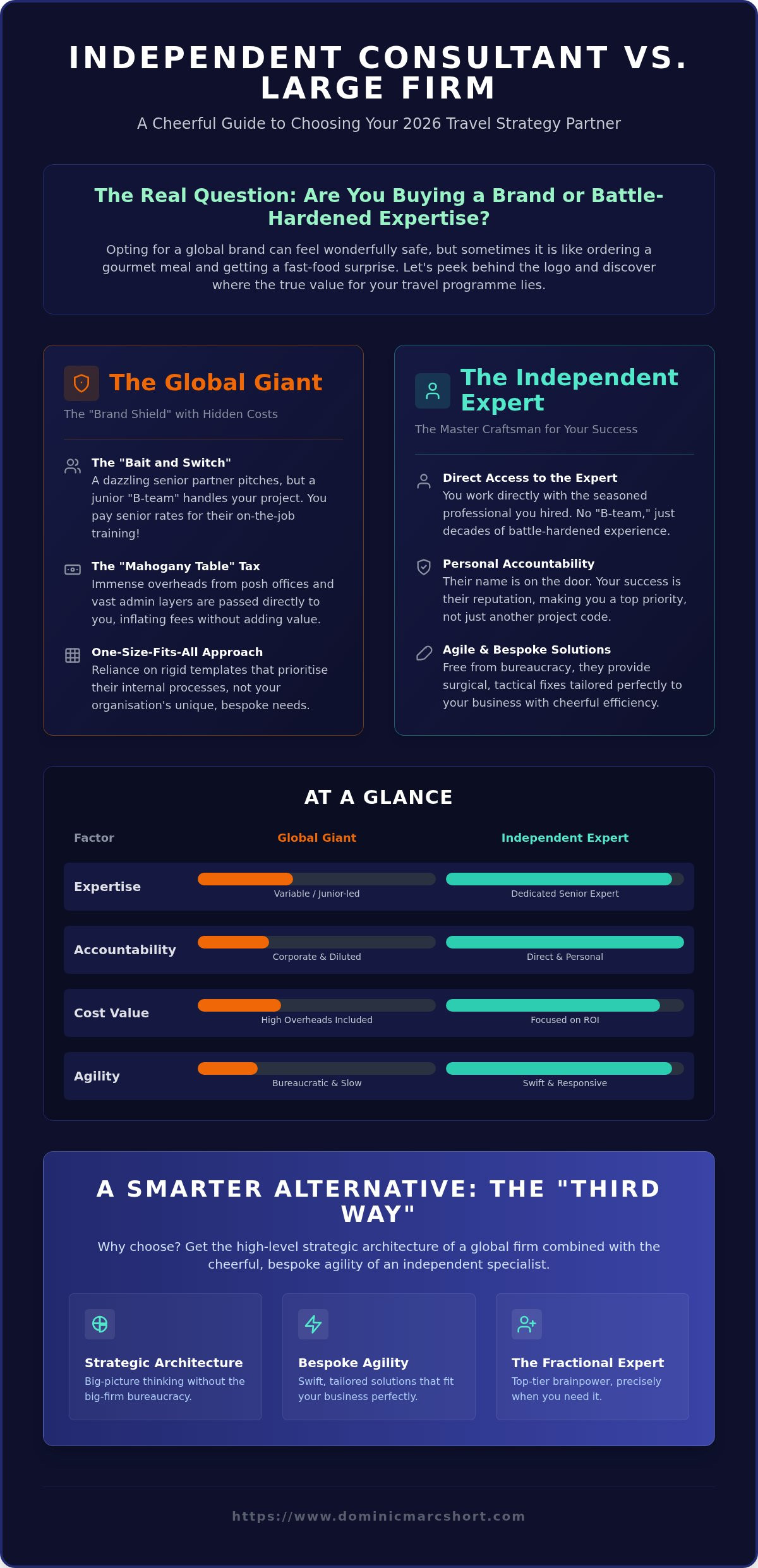
To make an informed choice, we must look at the two main players in the management consulting arena. On one side, we have the global giants, often referred to as the "Big Four" or Tier 1 firms. They bring brand prestige and massive resources, yet they often come with a "Mahogany Table" tax. You're paying for their expensive city-centre offices as much as their advice. The large firms offer a "one-stop-shop" feel, but that often means you're subsidising departments you'll never use. On the other side sits the independent consultant. These experts typically possess decades of niche experience and offer a direct line of accountability. When you hire an independent, you aren't just another project code in a database; you're a priority for the person whose name is on the door. Choosing between an independent consultant vs large consulting firm often comes down to whether you want a massive machine or a master craftsman who is deeply committed to your success.
The Large Consulting Firm Model: Scale vs Submerged Costs
There's a certain comfort in hiring a global giant. It's the "brand shield" that protects executives; after all, there's an old saying that no one ever got fired for hiring a Big Four firm. However, this perceived safety often masks significant submerged costs. When comparing an independent consultant vs large consulting firm, it's vital to look past the glossy brochures. Large firms carry immense overheads, from expensive city-centre leases to vast administrative layers. These costs are inevitably passed on to you, often inflating project fees without adding a single percentage point to your travel programme's efficiency. It's a bit like paying for a luxury cruise but spending the entire trip in the engine room.
We've all seen the "Bait and Switch" dance. A charming senior partner with decades of experience delivers a flawless pitch, promising the moon and the stars. Once the contract is signed, they disappear into the ether, replaced by a "B-team" of junior associates. It's a bit like buying a ticket for a West End show only to find the lead actor has been replaced by the stagehand's cousin. While these graduates are undoubtedly bright, they often lack the lived experience to handle complex global shifts. You're essentially paying senior rates for a junior's learning curve. This rigid structure can also stifle innovation. Large firms often rely on "one-size-fits-all" templates that prioritise their internal processes over your bespoke needs.
The Advantage of Global Resources
Large firms do have their place. When your organisation requires 24/7 global coverage across sixty countries, sheer manpower becomes non-negotiable. They offer access to proprietary databases and massive historical benchmarks that can be useful for travel management for global corporates. If your project is purely a volume game, the scale of a global giant provides a sturdy, albeit expensive, foundation. They possess the weight to move large mountains, even if they occasionally trip over the smaller pebbles.
The Hidden Friction of Bureaucracy
Agility is often the first casualty of scale. In the fast-moving world of 2026 travel tech, waiting weeks for a steering committee to approve a minor strategy shift is a recipe for obsolescence. Large firms struggle with the nimble pivots required to stay ahead. Interestingly, research suggests that over 80% of large corporations plan to increase their reliance on independent consultants to bypass this exact friction. Too many cooks can indeed spoil the strategic broth, especially when those cooks are more worried about their internal reporting than your specific bottlenecks. If you're looking for a partner who stays in the kitchen until the meal is served, you might find that a seasoned expert offers a much more refreshing approach.
The Independent Consultant Advantage: Agility and Accountability
When you choose an independent expert, you're essentially hiring the person whose name is on the door. There's no hiding behind a corporate curtain or a labyrinth of junior associates. This direct line of accountability is a breath of fresh air for executives tired of the "B-team" shuffle mentioned earlier. In the debate of an independent consultant vs large consulting firm, the "30-Year Rule" often settles the matter. You're buying three decades of scars, successes, and industry secrets, not a graduate's first attempt at a spreadsheet. This seniority allows for a level of intuition that templates simply can't replicate. It's the difference between a sat-nav that only knows the main roads and a local driver who knows every shortcut to avoid the traffic.
Flexibility is the second great gift of the independent model. Market conditions in 2026 move at a blistering pace, and your travel strategy needs to keep up. An independent specialist offers the agility to adjust course instantly without triggering a "change-order" nightmare that requires three layers of committee approval. They have the freedom to pivot because their primary loyalty is to your results, not to a rigid internal methodology. This creates a partnership that feels personal and deeply committed to your specific outcomes.
Bespoke Solutions for National Growth
Independents excel at tailoring programmes for SMEs and growing national teams that might otherwise get lost in a large firm's database. Rather than forcing your business into a pre-packaged box, they build a framework around your unique culture and goals. This often involves a "Consultant as Mentor" approach, where the expert works alongside your team to build internal capability. By following a strategic guide for SME travel management, you ensure that the transformation is sustainable. Crucially, this includes strategic change management, a vital step that many global giants skip. They don't just hand over a report; they ensure your people actually embrace the new way of working.
Cost-Efficiency without Quality Compromise
The financial logic is quite cheery too. When you hire an independent, your money goes exactly where it should: into high-level expertise. You aren't subsidising a palatial office in a city centre or an army of administrative staff you'll never meet. This "lean" project lifecycle leads to faster delivery through direct, jargon-free communication. There's a genuine sense of investment in your long-term success because an independent's reputation is built on their last project, not their firm's marketing budget. It's a high-stakes commitment that ensures they stay focused on delivering maximum ROI for your travel spend.
How to Evaluate Your Business Travel Consulting Needs
Deciding between an independent consultant vs large consulting firm isn't a task for the faint-hearted; it's a bit like choosing between a Swiss Army knife and a specialist scalpel. You need to start by defining your scope. If you're looking for a tactical fix, such as troubleshooting a single booking tool, a specialist's scalpel is usually the better bet. However, a massive strategic overhaul involving multiple global departments might lead you towards the scale of a larger firm. You must also audit your internal bandwidth. Be honest: do you need a leader to drive the vision or a doer to handle the heavy lifting? Large firms are great for sheer "doing" power, while independents often shine as strategic leaders who mentor your existing team.
Complexity is the next hurdle. Does your problem require a global army or a sharp, focused mind? If your needs are niche, the "army" approach often results in unnecessary bureaucracy. Then there's the "Chemistry Factor." Your consultant will be living in your pockets for months, so they must fit your corporate culture. A stiff, corporate personality might clash with a vibrant SME, just as a very informal approach might ruffle feathers in a traditional boardroom. Finally, review the ROI beyond the initial fee. A cheaper day rate is no bargain if the project drags on for twice as long as expected.
The Strategic Audit Checklist
Before signing anything, conduct a "chemistry meeting" to see if the expert truly understands your world. Ask who will actually be doing the work; if the answer is vague, you've spotted a red flag. Reviewing an Executive Guide: Business Travel Analysis for 2026 can help you prepare the right questions. Watch out for proposals that feel like "cut and paste" jobs. If they haven't mentioned your specific pain points, they aren't listening. A cheery, transparent proposal is usually a sign of a partner who values clarity over corporate jargon.
Measuring Success in 2026
In 2026, we've moved past simple cost savings. Success is now measured through process excellence and employee satisfaction. If your travellers hate the new system, it doesn't matter how much money you've "saved" on paper. Change management is the secret sauce here, ensuring that your team actually uses and enjoys the new tools. Consulting ROI is the intersection of efficiency and adoption.
Why CDABS Offers the "Third Way" for Modern Travel Management
The choice between an independent consultant vs large consulting firm often feels like a forced compromise between scale and soul. You either opt for the global brand with its layers of bureaucracy, or the agile specialist who might lack the strategic depth for a global transformation. CDABS provides a "Third Way" that bridges this gap perfectly. We offer the strategic architecture you'd expect from a global giant, but with the bespoke, hands-on facilitation that only a dedicated expert can provide. This isn't just about travel; it's a unique blend of travel management, high-level events, and strategic marketing expertise. This multidisciplinary approach ensures your travel strategy isn't just a siloed project, but a core part of your organisational health.
Our "Seasoned Hand" philosophy is about more than just giving advice; it's about navigating complex transitions with a sense of calm authority that reassures your entire board. We've seen the shifts, we've navigated the digital transformations, and we've built systems that actually last. By including bespoke change management communication packages, we ensure that the human element of your business is never left behind. We don't just build the machine; we make sure everyone knows how to drive it with a smile. It's a pragmatic, results-oriented partnership that values your success as much as you do.
End-to-End Transformation without the Ego
Dominic Short personally oversees every project from the initial analysis to the final delivery. You aren't being handed off to a junior associate; you're working with a founder who brings over 30 years of industry experience to your table. As a keynote speaker and masterclass teacher, Dominic understands how to translate complex data into actionable wisdom. This ensures an end-to-end service that is thorough, methodical, and entirely focused on your specific outcomes. For a deeper look at this approach, you can explore our Strategic Business Travel Consulting: 2026 Guide.
Ready to Optimise Your Travel Programme?
It's time to stop paying for expensive city-centre office rents and start paying for actual outcomes. Choosing the right partner in the independent consultant vs large consulting firm debate shouldn't be a source of stress. We believe that complex transitions can actually be quite enjoyable when you have the right guide by your side. This is what we call the "Happiness Factor." By focusing on process excellence and personal accountability, we turn the daunting task of travel transformation into a rewarding journey for your whole team. If you're ready to see what a truly bespoke partnership looks like, let's start a conversation today.
Securing a Future-Proof Travel Strategy
Choosing the right partnership for your organisation is about recognising that a 2026 travel strategy requires a steady, experienced hand rather than a massive, bureaucratic machine. You've seen how the "Bait and Switch" of global firms can dilute your ROI, while the agility of a specialist ensures your programme remains nimble and effective. It's about finding that sweet spot where strategic architecture meets personal approachability and genuine care. This ensures your transformation isn't just a document on a shelf, but a living, breathing success story.
Ultimately, the decision between an independent consultant vs large consulting firm boils down to whether you want a generic template or a bespoke architectural plan. With over 30 years of business travel expertise, CDABS provides that rare blend of global transformation capability and direct senior-level accountability. We even include bespoke change management communication packages to ensure your team actually embraces and enjoys the new way of working. It's a results-oriented approach that prioritises your long-term organizational health over our own overheads.
Your business travel deserves more than a standard solution; it deserves a partnership built on trust and tangible results. Let's work together to make your next transformation the most successful and cheery project on your calendar.
Frequently Asked Questions
What is the main difference between an independent consultant and a large firm?
The primary distinction lies in who actually performs the work. In the independent consultant vs large consulting firm debate, a large firm offers brand prestige but often delegates tasks to junior associates. Conversely, an independent specialist provides a direct line of accountability to a senior expert. You aren't just another project code; you're working with the person whose reputation depends on your success. This personal investment often leads to more bespoke and agile outcomes.
Is an independent consultant capable of managing a global travel transformation?
Absolutely, especially when that consultant brings three decades of industry experience to the table. Managing a global transformation is less about sheer numbers of staff and more about the quality of the strategic architecture. An independent expert acts as a hands-on facilitator, coordinating with your internal teams and external suppliers to ensure a seamless transition. It's a methodical approach that prioritises precision and operational excellence over bureaucratic layers.
How do consulting fees compare between independent experts and large firms?
Fees for independent experts are typically more transparent and results-oriented because they don't carry the massive overheads of global giants. When you hire a large firm, a portion of your fee covers expensive city-centre leases and administrative staff you'll never meet. With an independent, your investment goes directly towards seasoned expertise. This lean model often provides a significantly better ROI, as you're paying for actual outcomes rather than corporate infrastructure.
What happens if an independent consultant is unavailable or ill during a project?
Professional independents maintain a robust network of trusted partners to ensure project continuity. While the one-to-one relationship is a primary benefit, a seasoned expert always has a contingency plan in place. Because they operate with a high level of personal accountability, they are often more proactive in managing timelines and deliverables than a large firm where your project might get lost in the shuffle of a hundred other clients.
Do large consulting firms provide better technology benchmarks than independents?
Large firms certainly have access to vast datasets, but these benchmarks can sometimes be too generic to be useful. An independent consultant offers deep, niche experience that provides a more nuanced perspective on what actually works in practice. They don't just look at what a thousand other companies are doing; they focus on what will drive efficiency and modernisation for your specific business environment. It's about finding the right fit, not just the biggest data pool.
How long does a typical business travel consulting engagement last?
The duration varies based on whether you're seeking a tactical audit or a full-scale digital transformation. A focused process analysis might take a few weeks, while a global implementation can span several months. The beauty of the independent model is its inherent flexibility. You aren't locked into a rigid, year-long contract if the project can be delivered more efficiently. We move at the steady pace of your business needs, ensuring thorough oversight throughout the lifecycle.
Can an independent consultant help with change management and employee communication?
Yes, and it's a critical part of the service we provide. Many large firms focus solely on the technical aspects, but we believe that successful transformation requires your team's buy-in. CDABS offers bespoke change management communication packages to ensure that new systems are embraced by your employees. This human element is what turns a good strategy into a great one, making the transition feel supportive and even a bit cheery for everyone involved.
What is the "bait and switch" in the consulting industry?
This common industry practice occurs when a senior partner sells the project but then hands the execution to a "B-team" of juniors. It's a bit like paying for a master chef but having the kitchen porter cook your meal. In the independent consultant vs large consulting firm comparison, the independent model eliminates this risk. You get the seasoned authority you were promised from the very first meeting until the final implementation is complete.



Comments