How to Measure Event ROI: A Practical Guide for 2026
A well-attended event can still be a poor investment. Attendance may look impressive and positive feedback is welcome, but neither tells the whole story. To understand how to measure event ROI, connect event costs with attributable financial returns, attendee behaviour and the strategic progress the event was designed to support.
Event success can be difficult to pin down. Financial results may take time to emerge, while benefits such as stronger relationships or increased awareness don’t fit neatly into a spreadsheet. The answer isn’t to ignore these less tangible outcomes. Define what matters before the event, then assess each result using clear and consistent evidence.
This guide explains how to set measurable objectives, track costs and returns, assess wider outcomes and present useful findings to decision-makers. Dominic Marc Short - Independent Consultant's experience organising more than 500 events in varied formats and contexts worldwide informs its practical approach to connecting planning with post-event evaluation. The goal is a balanced view of performance and better-informed decisions about what to repeat, refine or rethink.
Key Takeaways
Learn how to measure event ROI by linking each objective to an outcome, rather than treating attendance as proof of success.
Use a consistent formula to compare attributable financial returns with event costs, and report the result clearly as a percentage.
Assess strategic outcomes, such as learning and relationship-building, alongside financial performance using suitable evidence.
Build a repeatable measurement process with clear measures, evidence sources and owners before the event begins.
Use the findings to guide future investment, recognising both financial results and wider outcomes without glossing over either.
Table of Contents
How to measure event ROI: define success before the event
Event return on investment (ROI) compares the value generated with the resources invested. It helps decision-makers judge whether an event supported its purpose and what to change before committing to another one. The familiar Return on Investment (ROI) concept is a useful starting point, but it shouldn’t be stretched to make every benefit look like immediate revenue.
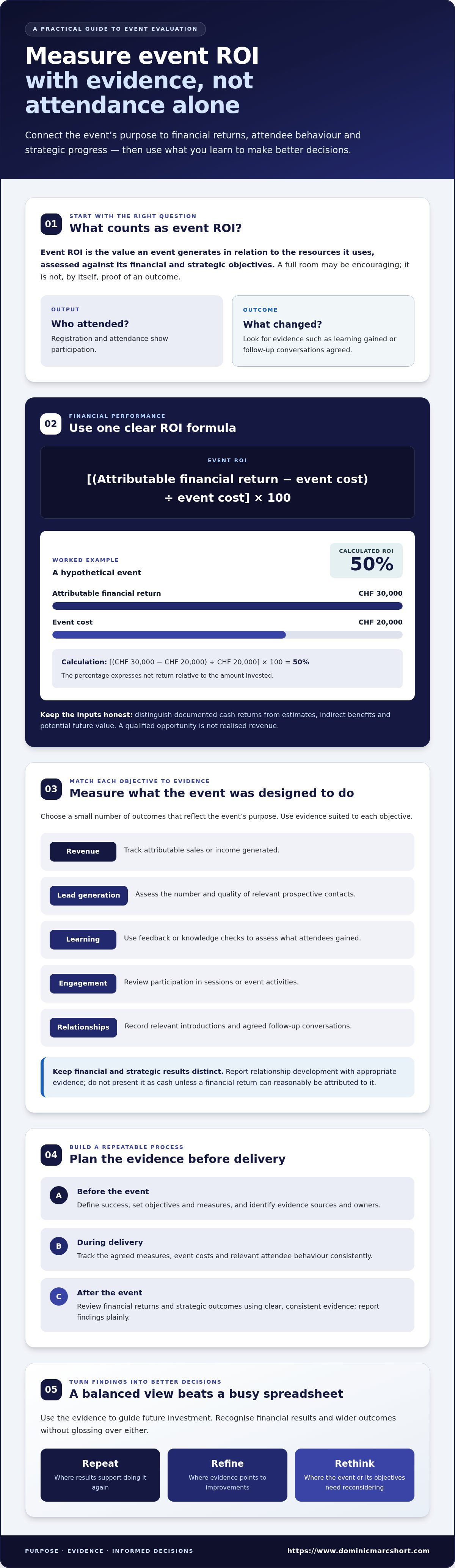
Event ROI is the value an event generates in relation to the resources it uses, assessed against the financial and strategic objectives set for it. Attendance is an output: it tells you how many people came. An outcome is what changed as a result, such as a qualified relationship that leads to a useful follow-up conversation. A full room may be encouraging, but it isn’t a result in itself.
What does event ROI mean in practice?
Compare financial returns with event costs, then report strategic outcomes separately using evidence suited to each objective. For example, an association conference might aim to strengthen connections between members. Registration numbers show participation; documented introductions and follow-up discussions offer evidence of relationship development. Don’t present either as cash unless a financial return can reasonably be attributed to it.
Set objectives and measures before delivery, rather than choosing the easiest figures to report afterwards. That discipline links planning decisions to the evidence you’ll later review. CDABS organises meetings, events and conferences for corporates and associations, bringing event objectives into the planning and delivery process.
Which event objectives can be measured?
Start with the event’s purpose, then choose a small number of outcomes that show whether it served that purpose. Common objective areas include:
Revenue: track attributable sales or income generated.
Lead generation: assess the number and quality of relevant prospective contacts.
Learning: use feedback or knowledge checks to assess what attendees gained.
Engagement: review participation in sessions or event activities.
Relationship development: record relevant introductions and agreed follow-up conversations.
A commercial launch may prioritise leads and revenue, while a member conference may focus on learning and connections. Choose measures that reflect the event’s purpose. Trying to make every event serve every objective can create a busy spreadsheet and an unclear conclusion.
Calculate event ROI with a clear cost-and-return formula
Once the event’s objectives are clear, calculate financial ROI using costs and returns you can support with evidence. The formula is:
Event ROI (%) = [(attributable financial return − event cost) ÷ event cost] × 100
For a simple hypothetical example, an event costs CHF 20,000 and generates CHF 30,000 in attributable financial returns. The calculation is [(CHF 30,000 − CHF 20,000) ÷ CHF 20,000] × 100, giving an ROI of 50%. This percentage expresses the net return relative to the amount invested. Use the same convention whenever you report results so decision-makers can compare like with like.
An ROI figure is only as reliable as its inputs. Keep documented cash returns distinct from estimates, indirect benefits and potential future value. A promising opportunity may matter, but it isn’t revenue until it is realised. Cvent’s comprehensive guide to event ROI also explores the wider measurement process, from setting goals to reviewing results.
Which costs belong in an event ROI calculation?
Build the cost figure from your organisation’s actual approved costs, recorded in CHF. Include the resources needed to deliver and evaluate the event, not just the headline supplier budget.
Venue, production and event technology
Staffing, including internal time where it can reasonably be valued
Travel and promotion
Post-event follow-up, where relevant and reasonably measurable
Apply the same cost rules each time. If you include internal hours for one event but omit them for another, the comparison may say more about the accounting method than the events themselves.
How should event returns be attributed?
Count direct revenue when records show a credible connection to event participation. Report qualified opportunities separately, with their value and status clearly labelled instead of adding them to realised revenue. Agree an attribution window that reflects the organisation’s sales cycle, then apply it consistently. Because returns can emerge well after an event, an early review may not show the full picture.
Document how you linked revenue or opportunities to the event, including assumptions and other contributing channels. Don’t assign all later business to one event simply because a contact attended. If you’re looking to connect event delivery with disciplined evaluation, explore Dominic Short’s meetings and event experience.
Measure event outcomes beyond immediate revenue
A financial ROI calculation is useful, but it can’t capture every benefit an event is designed to create. Learning, engagement and stronger working relationships may support organisational goals without producing immediate, attributable income. Rather than forcing every benefit into CHF, define meaningful indicators and report them separately from financial results.
When deciding how to measure event ROI, connect each indicator to an objective. A long list of metrics can look impressive, but measures without a clear purpose make it harder to see what the event achieved. The table below separates financial performance from strategic evidence.
Which non-financial event measures are useful?
Choose measures that match the event’s purpose. A learning event might assess knowledge gained; a relationship-focused gathering could record relevant introductions, stakeholder engagement and agreed follow-up behaviour. Attendee satisfaction adds context, but positive feedback alone doesn’t demonstrate learning or lasting impact.
Use consistent survey questions and a defined response period when comparing events. Differences in wording or timing can otherwise cloud the picture. Keep the process proportionate: a short, targeted survey can provide clearer insight than a questionnaire that asks attendees to review every canapé and conversation.
How can you report strategic value credibly?
For each outcome, state the indicator, evidence source, collection date and related objective. Label comments and open-text survey responses as qualitative feedback, and distinguish them from verified financial results. This helps decision-makers understand what the evidence supports and where interpretation is involved. MCI’s step-by-step guide offers further perspective on structuring event measurement.
CDABS organises corporate and association meetings, events and conferences. Linking objectives with delivery gives the team a practical basis for evaluation. Defined indicators won’t turn every strategic benefit into a precise financial figure, but they can make the evidence clearer and more useful than a guess.
How to measure event ROI before, during and after delivery
Credible event evaluation starts before invitations are sent. Agree objectives, baselines and evidence sources in advance, so the team isn’t left trying to reconstruct what success was meant to look like after the room has been cleared.
A repeatable process gives each measure an owner and a practical evidence source. It also helps teams distinguish a delivery issue from a measurement gap. Use the steps below to make how to measure event ROI part of event planning, not an afterthought.
Before the event: agree what success means
Record the event’s objectives, intended audience and expected outcomes. If an objective involves change, such as increased knowledge or stakeholder confidence, capture a relevant baseline before the event so you have something meaningful to compare later.
For each measure, agree the evidence source, collection point, measurement window and responsible colleague. Confirm which cost categories to include and choose indicators the team can realistically collect and interpret. A simple measurement plan could include:
Objective: what the event is intended to achieve.
Indicator and baseline: what will be assessed and the starting position, where relevant.
Evidence source and owner: where the information will come from and who will gather it.
Timing: when data will be captured and reviewed.
For example, if the aim is to improve understanding of a topic, decide in advance how to assess that change and who will review the responses. This keeps the measure connected to the objective, rather than selected simply because it’s easy to count.
During and after the event: capture, review and report
During delivery, record attendance, participation and relevant changes to the event plan. Assigning responsibility in advance helps prevent useful details from disappearing into someone’s notebook or the mysterious territory known as “I thought you were tracking that”.
Afterwards, collect feedback promptly while the experience is fresh. For outcomes that take time to develop, such as follow-up activity or progress towards a business opportunity, schedule a later review within the agreed measurement window. Where the objective requires comparison, use the same questions or method as the baseline.
Bring the evidence together in a concise report. Summarise results against the original objectives, identify missing or incomplete data, and distinguish observed outcomes from interpretation. Include lessons and actions for the next event. A useful report doesn’t need to be lengthy; it needs to show what was measured, what the evidence indicates and what the team will do next.
Turn event ROI findings into better decisions for future events
Measurement is useful when it helps you decide what to do next. Interpret results against the objectives agreed before delivery, the assumptions behind your calculations and the quality of the evidence collected. Complete, consistent records support stronger conclusions than partial data or impressions, so make the difference clear.
Keep financial and strategic findings separate. A negative financial ROI shouldn’t be disguised by highlighting strong satisfaction scores. Equally, it doesn’t erase evidence that an event supported learning or stakeholder relationships. Report both honestly, then decide whether the event met its purpose overall and what should change.
How should an event ROI report present its findings?
Give decision-makers a concise account they can act on. Start with the event objectives, then present headline results, the calculation method and any important limitations. Show financial outcomes separately from strategic indicators, with a brief explanation of the evidence behind each.
Finish with decisions, named owners and proposed changes for the next event. For example, if the intended audience attended but follow-up activity was limited, review the follow-up approach rather than simply increasing promotion. Tie each action to the finding and make clear who will take it forward.
How can results guide future investment?
Compare events only when their objectives, audiences and measurement methods are sufficiently similar. A focused member meeting and a large commercial conference may both be well organised, but comparing their headline results directly could mislead. Note differences in format, audience or evidence collection before drawing conclusions.
Use the review to test the assumptions behind the event plan. Did the format reach the intended participants? Were the chosen indicators useful? Was the evidence strong enough to support the conclusion? The answers can help you repeat what worked, adjust what fell short or reconsider the event’s purpose.
CDABS organises corporate and association meetings, events and conferences. Connecting objectives with planning and delivery from the outset can make evaluation more practical, while recognising that each event’s results depend on its own circumstances.
Ultimately, how to measure event ROI is not just a question of calculating a percentage. It’s about presenting credible evidence, learning from the outcome and making a considered decision about future investment. If your organisation would benefit from experienced support with meeting and conference organisation, consider aligning the event plan with its objectives and evaluation.
Make your next event a more informed investment
Knowing how to measure event ROI starts with defining success before the event and choosing evidence that matches its objectives. Calculate financial returns consistently, then report strategic outcomes such as learning, engagement and relationship development separately. Together, these measures give decision-makers a clearer basis for deciding what to repeat, improve or rethink.
Keep the findings honest. A negative financial result and a valuable strategic outcome can exist side by side, while evidence quality should shape how confidently you interpret either. This balanced view turns evaluation into a practical planning tool, not just a number for the final slide.
Dominic Short brings more than 30 years of experience across meetings, events and marketing, and has delivered more than 500 events in varied formats and contexts worldwide. That experience informs CDABS’s work organising meetings, events and conferences, connecting objectives with delivery without promising a particular result.
With clear objectives and thoughtful evaluation, each event can leave your organisation better prepared for the next.
Frequently Asked Questions
How do you calculate event ROI?
Subtract the event cost from its attributable financial return, divide the result by the event cost, then multiply by 100. The formula is: [(attributable return − event cost) ÷ event cost] × 100. If documented returns equal the event cost, financial ROI is 0%, meaning the event broke even financially. To measure event ROI fairly, use consistent inputs and explain how returns were attributed.
What costs should be included when measuring event ROI?
Include the actual approved costs required to plan, deliver and evaluate the event. Relevant categories may include venue, production, technology, staffing, travel and promotion. Include internal staff time and post-event follow-up if your organisation can reasonably value them. Record monetary amounts in CHF and apply the same cost rules across events. A consistent calculation is more useful than a precise-looking figure built from selectively omitted costs.
Can you measure event ROI without direct sales?
Yes. You can assess strategic outcomes even if an event produces no direct sales, but report these separately from financial ROI. Depending on the objective, evidence might include knowledge gained, participation, relevant introductions or agreed follow-up actions. Define indicators in advance and collect evidence consistently. Don’t convert satisfaction or relationship feedback into a cash return without a defensible basis. Clear reporting is more credible than trying to make every benefit fit one formula.
When should you measure event ROI?
Start before the event by agreeing objectives, measures, costs, evidence sources and relevant baselines. During delivery, capture attendance, participation and changes to the plan. Collect immediate feedback soon afterwards, while the experience is fresh. Some outcomes, such as follow-up activity or sales opportunities, may need a later review. Set a measurement window that reflects the objective and, for financial returns, the organisation’s sales cycle.
What is a good ROI for an event?
There isn’t one universally suitable ROI target for every event. The right assessment depends on its purpose, costs, expected returns and evidence quality. A positive financial ROI means attributable financial returns exceeded costs; 0% means they matched. Neither figure alone captures learning, engagement or relationship outcomes. Compare results with the event’s original objectives, and use like-for-like events as a reference only when their context and measurement methods are sufficiently similar.
What should you do if an event has a negative ROI?
First, check that the cost and return figures are complete, consistently calculated and supported by evidence. Review attribution assumptions and consider whether returns may emerge later within the agreed measurement window. Then assess the event against its original objectives, including strategic outcomes, without using them to disguise a financial shortfall. Identify practical changes, such as refining the format or follow-up approach, and assign owners before deciding whether to repeat, adapt or stop the event.



Comments