Global Travel Management Solutions in Switzerland: A 2026 Implementation Guide
The most expensive component of your corporate travel programme isn't the business class flight to Singapore; it's the invisible cost of a fragmented system that your team secretly hates using. If you are evaluating global travel management solutions Switzerland, you've likely felt the sting of opaque pricing from traditional agencies and the headache of data that refuses to sync with your ERP. It's a bit like trying to assemble a fine timepiece with a mallet; messy, expensive, and ultimately quite frustrating. We agree that the old ways of "book and hope" no longer suffice in a market where efficiency is king.
This guide promises to show you how to architect a modern programme that balances Swiss precision with genuine traveller satisfaction. You'll discover how to move beyond simple ticket savings to achieve a measurable ROI that makes your CFO smile. We'll explore the seamless integration of high-tech payment systems and the strategic steps needed to ensure your global travel operations are as transparent as a mountain lake. Let's transform your travel from a procurement chore into a strategic asset that actually works for your people and your bottom line.
Table of Contents
The Landscape of Global Travel Management Solutions in Switzerland
Switzerland has long been the preferred cockpit for multinational corporations, and for good reason. In 2026, the definition of global travel management solutions Switzerland has shifted away from simple transaction processing toward sophisticated, integrated business service management. It's no longer enough to just get a traveller from point A to point B. You must now account for a complex web of biometric requirements under the new Schengen Entry/Exit System (EES) and stringent cross-border tax reporting. Managing these variables requires the same level of precision one might expect from a Swiss chronometer, albeit with fewer gears and more data points.
Effective Corporate Travel Management in this environment involves balancing high Swiss quality standards with the messy reality of global scalability. This isn't just about procurement. It's a digital transformation project that touches on several critical areas:
Regulatory Compliance: Tracking teleworking time for cross-border employees to satisfy 2026 tax and social security rules.
Financial Accuracy: Managing multi-currency payments while respecting Swiss VAT and specific expense regulations.
Duty of Care: Ensuring traveller safety in a world where border crossing times and biometric protocols are constantly evolving.
Why Switzerland Requires a Specialised Approach
Swiss business culture values independence and transparency, yet many traditional agencies still operate on opaque commission models. This creates a natural friction. To architect a truly global programme from a Swiss HQ, you need a neutral perspective that isn't tethered to specific vendor incentives. It's about finding that sweet spot where local Swiss nuances, such as the preference for mid-range hotels or specific rail integrations, meet the rigorous demands of international corporate policy. We call this "Swiss-made globalism," and it's quite a delight when it works correctly.
The Evolution of Corporate Travel in 2026
The rise of AI has turned "bleisure" from a buzzword into a manageable reality. Modern systems now use predictive analytics to balance the 2026 mileage reimbursement rate of CHF 0.75 per kilometre against rail alternatives, all while keeping an eye on the company's carbon footprint. We've moved beyond simple ticket savings. The focus has shifted to value-based outcomes where traveller wellbeing and operational health are the primary metrics of success. If you're looking to modernise your approach, exploring business travel management consulting is a brilliant first step toward a more integrated future.
Designing a Robust Global Travel Framework
A shiny new booking platform is a bit like a high-end espresso machine; it's only as good as the beans you put in and the person pulling the shot. Many organisations leap straight into technology selection without first sketching the architectural blueprints. To build truly effective global travel management solutions Switzerland, you must start with a cold, hard look at your current reality. This means mapping every touchpoint from the moment a traveller thinks about a trip to the second the final CHF is reconciled in your accounts. We often find that the most significant friction isn't the price of a ticket, but the three levels of manual approval required to buy it.
Success in this arena isn't defined by a colourful dashboard alone. It's measured by high traveller compliance, automated financial workflows, and an ROI that accounts for the time saved by your administrative staff. When you set your strategic objectives, ask yourself if your programme is designed for the world of 2020 or the reality of 2026. If your team is still manually tracking the 2026 flat-rate lunch allowance of CHF 30, you're leaving efficiency on the table.
Process Optimisation and Strategic Alignment
Mapping the project lifecycle requires a steady hand and a bit of foresight. You'll need to align your travel policy with 2026 sustainability goals, perhaps by prioritising rail travel for trips where the environmental cost outweighs the time saved. When building this framework, staying abreast of Swiss business travel requirements ensures that your policy remains compliant with international standards while respecting local labour laws. This alignment creates a digital roadmap that supports global growth without sacrificing the specific quality standards your Swiss HQ demands.
Modernising Payment and Expense Solutions
The administrative burden of "pay and reclaim" is a relic that belongs in a museum. Modern global programmes thrive on virtual cards and automated reconciliation, which turn a mountain of receipts into a neat stream of data. Digital transformation in travel is the integration of siloed data into a unified management system. By removing these silos, you allow your finance team to breathe again. If you're ready to refine your own framework, seeking independent consulting can help align these moving parts into a cohesive, joyful whole.
TMCs vs. Independent Consulting: Making the Right Choice
Choosing between a Travel Management Company (TMC) and an independent consultant is a bit like choosing between a supermarket and a personal nutritionist. One provides the goods; the other ensures you're actually healthy. When you're searching for global travel management solutions Switzerland, it's easy to be dazzled by the "all-in-one" promises of large agencies. However, agencies are transactional facilitators by nature. They thrive on volume and often have commercial ties to specific airlines or tech platforms. This inherent conflict of interest means their advice might be coloured by their own bottom line rather than yours. Implementing global travel management solutions Switzerland requires a partner who isn't trying to sell you a specific software package but rather the best outcome for your business.
Independent oversight is your best defence against "contract creep." A consultant acts as a neutral auditor, ensuring that your global travel programme is as efficient as it claims to be. For example, a major compliance hurdle in the Swiss market involves Defining working hours for business travel. A consultant will bake these legal requirements directly into your policy, protecting you from the legal headaches that a simple booking tool might overlook. We act as strategic architects, sketching the blueprints before any bricks are laid.
The Value of Unbiased Strategic Oversight
A seasoned advisor brings a magnifying glass to the RFP process, identifying hidden fees that often lurk in the fine print of agency contracts. We look for those pesky management fees that don't seem to manage much at all. By focusing on the ROI of business travel consulting, you move beyond simple ticket savings and start seeing the value in process optimisation and traveller satisfaction. It's about building a framework that lasts through market shifts and global changes.
When to Engage a Travel Transformation Advisor
You'll know it's time for a change when your travellers start complaining that your booking tool is more difficult to use than a 1990s VCR. If you're preparing for a merger or rapid global expansion, you need a strategic architect who can harmonise your systems without losing that essential Swiss quality. We specialise in bridging the gap between rigid procurement rules and the fluid needs of your frequent flyers. This ensures your travel programme isn't just a line item, but a competitive advantage that keeps your team smiling and productive.
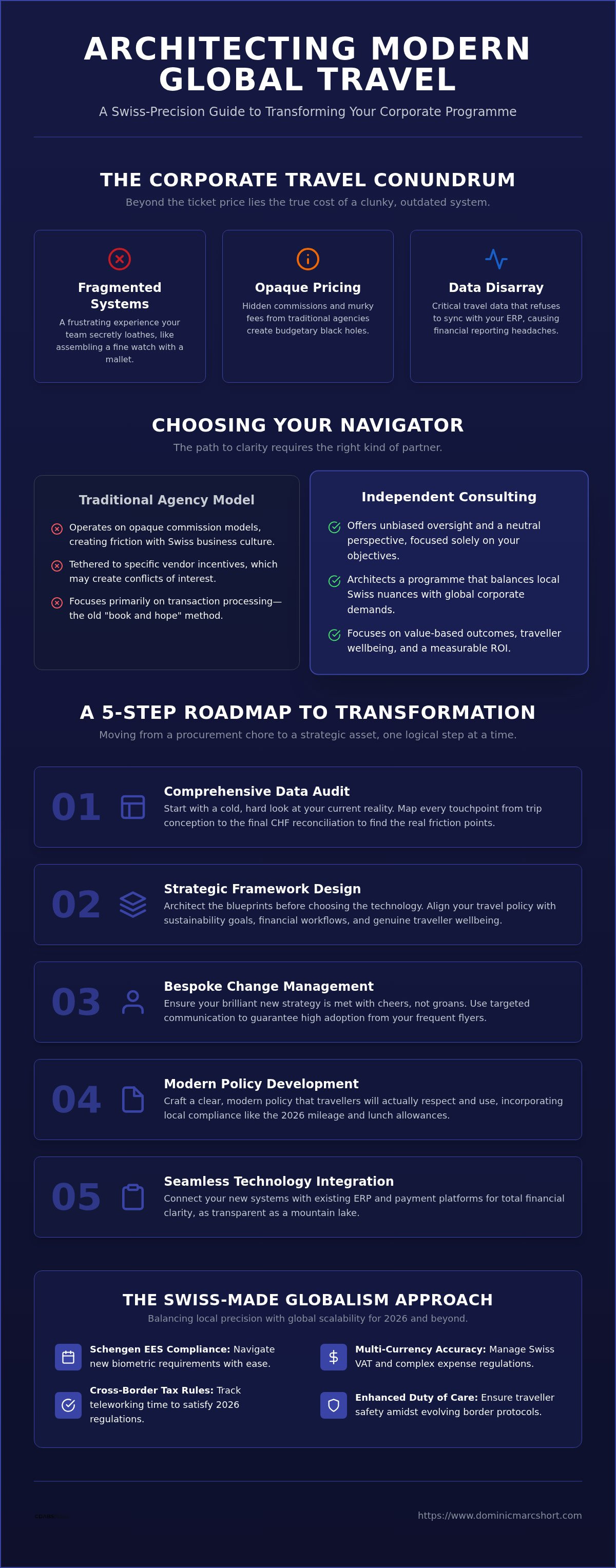
How to Implement Global Travel Solutions: A 5-Step Roadmap
Implementing global travel management solutions Switzerland is a bit like planning a journey across the Gotthard Pass; you need the right vehicle, a firm grasp of the terrain, and perhaps a decent supply of chocolate for the road. It isn't a weekend project that you can simply "set and forget." Instead, it requires a methodical transition that moves from deep analysis to continuous refinement. We've found that the most successful programmes follow a logical progression that respects both the bottom line and the human beings who actually have to do the travelling.
Step 1: Comprehensive Audit. You can't know where you're going if you don't know where you've been. Assess your global data and current vendor contracts to find the gaps.
Step 2: Policy Development. Craft a bespoke, modern corporate travel policy. If your current rules don't account for the 2026 mileage rate of CHF 0.75 per kilometre, you're already behind the curve.
Step 3: Technology Selection. Choose the right Online Booking Tool (OBT) and expense systems that play nicely with your existing ERP.
Step 4: Implementation & Change Management. This is the rollout phase. It's where you win hearts and minds through clear, cheerful communication.
Step 5: Ongoing Optimisation. Use data management to drive continuous improvement. A travel programme should be a living entity that evolves with your business.
Step-by-Step Implementation Guidance
A robust policy is the foundation of any global programme. It ensures compliance while remaining flexible enough to handle the 2026 reality of "bleisure" and traveller wellbeing. When you're managing travel management for global corporates, the transition period is critical. You must communicate the "why" behind the change to avoid operational disruption. Nobody likes a surprise at the airport, especially one that involves a rejected booking or a confusing new expense app. We recommend a phased rollout that allows your team to get comfortable with the new systems before the old ones are retired.
Leveraging Data for Strategic Insights
Setting up your travel data management systems for real-time reporting is no longer a luxury; it's a necessity. This allows you to identify "leakage," which is a polite way of saying your travellers are booking outside the global solution because they found a cheaper flight on a website that looks like it was designed in 1998. By bringing this data into a unified dashboard, you can see exactly where your money is going. Data management is the cornerstone of 2026 travel ROI. If you're ready to stop guessing and start knowing, you can start your implementation journey with a professional audit today.
Driving Success through Change Management and Communication
You've architected the framework and selected the technology. Now comes the part where even the most brilliant projects can stumble: the people. Implementing global travel management solutions Switzerland is as much a psychological exercise as a technical one. If your frequent flyers feel like they're being forced into a digital straightjacket, they'll find ingenious ways to bypass the system. We focus on turning that potential resistance into genuine enthusiasm by demonstrating exactly how the new programme makes their lives easier. It's about moving from "I have to use this" to "I actually want to use this."
Engaging stakeholders requires a dual-track approach. The C-suite needs to hear about the 2026 mileage reimbursement rate of CHF 0.75 and the resulting ROI. Your travellers, however, care more about whether the new system understands the 2026 Schengen biometric requirements or if it will make their next trip to London less of a faff. Dominic Marc Short - Independent Consultant acts as the strategic facilitator, ensuring that the C-suite's goals and the travellers' needs aren't just aligned, but actively supporting one another.
Bespoke Change Management Packages
Generic internal emails are often treated with the same level of excitement as a Tuesday morning fire drill. To drive real policy compliance, you need a strategic change management framework that speaks your team's language. We provide masterclasses and interactive training sessions that empower your travel managers to become internal champions. This is far more effective than sending out a 50-page PDF manual that will inevitably end up in the digital equivalent of a dusty desk drawer. We make the learning process engaging, and dare we say, a bit of a laugh.
The Human Element of Digital Transformation
At its heart, technology should be invisible. The ultimate goal of any global solution is to reduce friction, allowing your team to focus on their work rather than their receipts. By ensuring your global travel management solutions Switzerland reflect your company's unique culture, you create a sense of ownership among staff. This human-centric approach is what separates a successful implementation from a costly digital paperweight. If you're ready to lead your team through a positive transition, you can enquire about bespoke change management packages with Dominic Marc Short - Independent Consultant to ensure your project lands perfectly and stays on track.
Architecting Your Future-Ready Travel Programme
Building a world-class travel programme in 2026 requires more than just a functional booking tool; it demands a strategic vision that balances Swiss precision with global agility. We've explored how independent oversight protects your bottom line and why a methodical roadmap is essential for navigating complex digital transformations. By focusing on the human element through bespoke change management, you ensure that your team remains productive and genuinely happy on the road. It's much better than chasing lost receipts in a panic, isn't it?
Achieving excellence in global travel management solutions Switzerland is a journey best taken with a seasoned guide who understands the nuances of the local market and the demands of international scale. With over 30 years of strategic experience and a proven digital transformation methodology, CDABS provides the independent, unbiased advice you need to thrive. It's time to turn your travel operations into a streamlined asset that delivers measurable value beyond simple ticket savings.
Optimise your global travel programme with CDABS consulting today and discover how pleasant a well-oiled system can be. We're here to help you reach your strategic destination with confidence and a smile.
Frequently Asked Questions
What are the main benefits of global travel management solutions in Switzerland?
The primary advantages include total pricing transparency, higher traveller compliance, and the consolidation of fragmented data. In the context of global travel management solutions Switzerland, businesses gain a significant edge by aligning their travel spend with broader strategic goals. You'll likely see a sharp reduction in "leakage" where staff book outside the policy, while your finance team will certainly appreciate the automated reconciliation that replaces the dreaded manual receipt chasing.
How does an independent travel consultant differ from a Travel Management Company (TMC)?
An independent consultant provides unbiased strategic oversight without being tethered to specific vendor commissions or booking quotas. While a TMC focuses on transactional bookings and often has commercial incentives to push certain platforms, a consultant acts as your strategic architect. We audit contracts, manage RFPs, and ensure your technology stack actually serves your interests. It's the difference between buying a pre-packaged holiday and having a bespoke itinerary designed for you.
Can CDABS help with the digital transformation of our existing travel processes?
Yes, CDABS specialises in the end-to-end digital transformation of business travel processes for both SMEs and global corporates. We help you move away from siloed legacy systems and integrate modern payment solutions with your existing ERP. This transformation isn't just about shiny new software; it's about creating a unified data stream that provides real-time insights. We guide you through the entire lifecycle, from initial analysis to final delivery.
What role does change management play in a global travel rollout?
Change management is the essential bridge between a new technical solution and actual employee adoption. Without clear, bespoke communication, even the most sophisticated global travel rollout can face internal resistance. We provide tailored packages that include masterclasses and training sessions to win over stakeholders. By explaining the "why" behind the change and demonstrating its benefits, we turn potential sceptics into advocates for your new, more efficient way of working.
How do we ensure our global travel programme remains compliant with Swiss regulations?
We bake Swiss regulatory requirements directly into your travel policy to ensure total compliance from day one. This includes tracking teleworking hours for cross-border employees and adhering to the 2026 tax-deductible mileage rate of CHF 0.75 per kilometre. We also ensure your programme respects the Swiss Labour Code regarding travel time as working hours. Staying compliant doesn't have to be a headache when your framework is designed with these local nuances in mind.
Is travel management consulting suitable for SMEs as well as large corporates?
Consulting is highly suitable for SMEs, as they often lack the internal resources to manage complex global travel audits or vendor negotiations. CDABS provides the same level of strategic rigour to smaller firms as we do to global corporates. An optimised travel programme can be a significant growth lever for an SME, freeing up administrative time and ensuring that every CHF spent on travel contributes to the company's broader operational health.
How can we reduce corporate travel friction for our frequent flyers?
Reducing friction starts with a user-friendly booking tool and a policy that prioritises traveller wellbeing. We help you implement systems that include automated expense reconciliation and mobile-first support. By integrating features like the 2026 flat-rate lunch allowance of CHF 30 directly into the expense app, you remove the administrative burden from your staff. Happy travellers are more productive, and they're much less likely to "go rogue" and book outside your corporate programme.
What are the expected ROI metrics for a travel management optimisation project?
Expected ROI metrics extend far beyond simple ticket savings. You should track the reduction in administrative hours spent on manual expense processing and the increase in policy compliance rates. Other critical metrics include the recovery of VAT and the strategic value of consolidated data for vendor negotiations. A well-optimised project should also see a decrease in travel "leakage," ensuring your global travel management solutions Switzerland are delivering maximum value for every franc invested.



Comments