Duty of Care for Swiss Corporate Travellers: 2026 Guide
Did you know that 60% of business travellers would consider leaving their employer if they felt their personal safety was not treated as an authentic corporate priority? This striking statistic from 2026 research proves that establishing a robust duty of care for corporate travellers Switzerland is far more than a legal formality; it is the foundation of a resilient and happy workforce. You likely feel the weight of Article 328 of the Code of Obligations and worry about the fine line between keeping people safe and creating unnecessary travel friction.
This guide promises to help you master these legal nuances while showing you how to turn safety protocols into a strategic advantage that actually empowers your team. We will walk through the latest Swiss risk intelligence, explain how to integrate 2026 technology seamlessly, and provide a clear framework for a safer, more confident travel culture. Let's ensure your team can represent your business across the globe with a genuine spring in their step, knowing they are supported by a steady and experienced hand. By the end of this guide, you will have the tools to reduce travel anxiety and ensure your organisation remains a leader in modern corporate governance.
Table of Contents
Understanding Duty of Care in the Swiss Corporate Context
In the world of Swiss business, duty of care is much more than a box-ticking exercise for the HR department. It represents a fundamental promise between an employer and their team. When we discuss duty of care for corporate travelers Switzerland, we're looking at a commitment that spans from the moment a suitcase is packed until the traveller returns safely to their front door. It's about ensuring that every journey is backed by a robust strategy, not just a hope that nothing goes wrong. While some might think "we've got insurance for that," 2026 requires a far more proactive stance. Insurance is a reactive safety net, but true duty of care is the proactive framework that prevents the net from being needed in the first place.
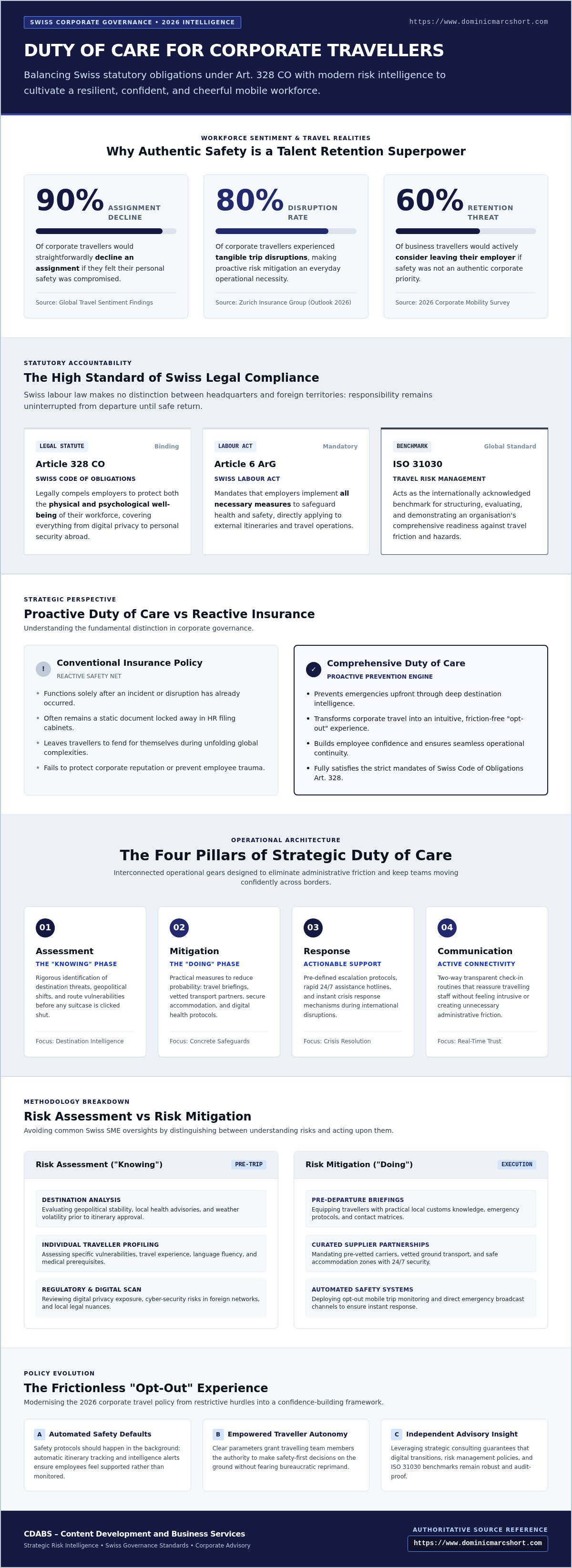
The "Swiss Standard" for employer responsibility is exceptionally high. Under the legal duty of care doctrine, specifically Article 328 of the Swiss Code of Obligations (CO), companies are legally bound to protect the physical and psychological well-being of their staff. This isn't just about avoiding a nasty flu; it's about managing everything from digital privacy to physical safety in unfamiliar territories. When you get this right, you don't just avoid legal headaches. You actually reduce corporate friction and give your team the confidence to focus on their mission rather than their safety. It's a wonderful way to ensure everyone stays smiling, even when flight schedules decide to be less than cooperative.
The Legal Foundation for Swiss Employers
Swiss labour law doesn't stop at the office door. Article 6 of the Labour Act (ArG) mandates that employers take all necessary measures to protect health and safety, which extends directly to business trips. There's often a bit of a muddle regarding where "work time" ends and "travel time" begins, but for safety purposes, the responsibility is constant. Failing to meet these standards carries consequences that go far beyond a simple fine. Negligence can lead to severe reputational damage and a breakdown in employee trust that takes years to rebuild. It's why many firms are now looking at a strategic risk management policy to ensure they stay on the right side of the law while keeping their teams moving.
Moral Obligations: The Human Side of Travel
Beyond the legalities, there's a deeply human element to this. Recent 2026 data shows that 60% of business travellers would leave their employer if they felt their safety wasn't a genuine priority. People want to feel supported, not just "covered" by a policy document gathering dust in a drawer. When 90% of travellers say they'd decline an assignment if they felt unsafe, it becomes clear that a culture of safety is a major tool for talent retention. By avoiding "lost in translation" dramas during global disruptions, you show your team that they're valued members of the family, not just entries on a spreadsheet. It turns a potentially stressful trip into a successful adventure, keeping morale high across the globe.
The Core Pillars of a Strategic Duty of Care Framework
Building a robust framework for duty of care for corporate travelers Switzerland isn't about creating a massive binder of rules that stays on a shelf. It's about structural integrity. According to the Zurich Insurance Group's Business Travel Outlook 2026, 80% of corporate travellers experienced trip disruptions recently. This makes risk management an everyday operational requirement rather than a rare emergency plan. A strategic framework rests on four essential pillars: assessment, mitigation, response, and communication. By treats these as interconnected gears rather than separate silos, you create a system that moves smoothly even when global conditions get a bit bumpy.
Risk assessment is the "knowing" phase, where we identify threats before a suitcase is even clicked shut. In contrast, risk mitigation is the "doing" phase, involving practical steps to reduce the likelihood of those incidents occurring. It's quite common for Swiss SMEs to accidentally skip the assessment phase, but that's a mistake that leaves you reactive rather than prepared. When you understand the specific risks of a destination, you can implement tailored solutions that keep your team safe without drowning them in red tape.
Pre-Travel Preparation and Education
Education is your most powerful tool. Before any employee departs, they should receive a destination-specific briefing that covers everything from local health advice to cultural nuances. It's also vital to train your team on how to use corporate booking and safety tools effectively. If they don't know how to check in or trigger an alert, the most expensive technology in the world won't help them. For a deeper look at how to structure these rules, consult our Corporate Travel Policy Strategic Guide for 2026. This ensures safety becomes a natural part of their travel rhythm, not an annoying hurdle.
Real-Time Monitoring and Support
Once your team is in the air, the focus shifts to real-time support. Modern tracking technology is essential, provided it respects the strict transparency mandates of the revised Swiss Federal Act on Data Protection (nDSG). You want event-triggered, privacy-centric apps that keep you informed without being intrusive. This level of oversight helps you meet the standards set by Article 328 of the Swiss Code of Obligations, which requires employers to use state-of-the-art technology to protect staff. Digital transformation allows for instant safety updates, ensuring your travellers are never left wondering what to do next during a sudden disruption.
Incident response and clear communication channels complete the circle. Your travellers need to know exactly how to access help at any hour, without hesitation. If you're feeling a bit overwhelmed by these moving parts, seeking expert travel management consulting can help you integrate these pillars into a seamless, human-centric strategy. This approach not only protects your team but also fosters a culture of trust and confidence that resonates across your entire organisation.
Risk Assessment vs. Risk Mitigation: Finding the Balance
In the world of Swiss travel management, it's easy to confuse knowing with doing. Assessment is the intellectual exercise of identifying variables, whereas mitigation is the physical act of implementing safeguards. Many Swiss SMEs fall into the trap of skipping the assessment phase entirely, often because they're busy or assume their usual destinations are inherently low-risk. This is a significant oversight. Without a clear understanding of the "why" behind your safety choices, your efforts to provide duty of care for corporate travelers Switzerland can become fragmented and inefficient. A strategic audit often reveals that the biggest safety gaps aren't in the destination itself, but in the lack of a structured process before the trip even begins.
The goal is to find a sweet spot where safety doesn't create unnecessary "travel friction." You want your team to feel protected without feeling like they're being managed by a drill sergeant. Keeping the process cheerful and efficient ensures that safety protocols are embraced rather than bypassed. When you balance these elements correctly, you transform a legal obligation into a seamless part of your corporate culture, allowing your team to represent your business with a genuine sense of security.
The Assessment Phase: Identifying the Variables
Effective assessment follows the ISO 31030 travel risk management guidance, which provides a global benchmark for evaluating destination risk, traveller health, and specific activity types. It's about using data to drive better decisions. For instance, knowing that a specific region has a high incidence of transport disruptions allows you to choose providers who offer flexible, pre-vetted alternatives. To see how your current information flow stacks up, our Travel Data Management Consulting Strategic Audit Checklist offers a methodical way to evaluate your existing variables and identify hidden gaps.
The Mitigation Phase: Practical Safety Measures
Mitigation is where your plan comes to life through practical, tangible actions. This involves creating "Safe Hotels" lists or partnering with transport providers who meet your high Swiss standards for reliability and security. There's a massive psychological benefit here; when employees know there's a solid plan in place, their travel anxiety drops significantly. We can keep the mood upbeat even when discussing "worst-case scenarios" by framing these measures as a corporate superpower. It's about giving your team the freedom to succeed, knowing the foundation is rock solid. Safety should be invisible, much like a well-tailored suit that moves with the wearer rather than restricting their movement.
Integrating Duty of Care into Your 2026 Travel Policy
Integrating safety into your 2026 travel policy's about making protection a default setting rather than an optional extra. We often see organisations treat safety as an 'opt-in' feature, where the traveller must manually request briefings or tick specific boxes. This often leads to 'leakage', where 20% to 30% of travel spend occurs off-channel, according to TripGain Travel Governance Insights. In a modern Swiss context, the most successful policies flip this script, making safety an 'opt-out' experience. This ensures every trip automatically triggers the necessary risk assessments. It's a fundamental shift that solidifies your duty of care for corporate travelers Switzerland without adding extra work for your busy team.
When designing these policies, it's vital to distinguish between a Travel Management Company (TMC) and an independent consultant. While a TMC provides the essential booking technology, an independent advisor offers the strategic oversight needed to ensure those tools actually serve your safety goals. For a deeper dive into finding this equilibrium, see The 2026 Guide to Business Travel Risk Management Policy Balancing Safety and Friction. A well-crafted policy avoids the 'boring manual' trap by focusing on clear, actionable instructions that travellers actually want to follow.
Policy Design for SMEs and NGOs
Swiss SMEs and NGOs often operate with leaner teams. A one-size-fits-all policy usually fails here because it lacks the flexibility these organisations require. Bespoke solutions allow you to maintain high safety standards while respecting employee autonomy. It's about being clever with your resources. Ensuring compliance is achieved through smart process design rather than rigid, unenforceable rules that everyone ignores anyway.
Change Management: Getting the Team on Board
Even the best policy's useless if no one reads it. This is where change management becomes your best friend. Using a touch of humour and clear, human-centric communication can transform a dry update into something the team actually embraces. A strategic consultant plays a key role here, helping you navigate the 'people' side of the transition while maintaining a high standard of duty of care for corporate travelers Switzerland. You can learn more about this process in our Strategic Change Management for Corporate Travel: A 2026 Framework.
Why Strategic Consulting is the Key to Modern Travel Safety
There's a world of difference between a travel broker who merely sells a product and a strategic advisor who shapes your operational ecosystem. While a broker might hand you an insurance policy and wish you bon voyage, a strategic advisor looks at the entire travel lifecycle. This distinction is critical when establishing a comprehensive duty of care for corporate travelers Switzerland. At CDABS, we help Swiss firms navigate the complex 2026 digital and safety shifts by embedding safety protocols directly into your corporate DNA. The return on investment here goes far beyond avoiding costly lawsuits. It's about achieving true operational excellence and fostering an environment where your team can thrive.
When your employees feel secure, their productivity naturally rises. A happy traveller is a safe, creative, and highly effective representative of your business. By looking at safety through a strategic lens, you transform a required compliance checkbox into a powerful tool for organisational health and employee satisfaction. It's a wonderful way to ensure your business operations run like clockwork, no matter where in the world your team needs to be.
The CDABS Approach: Seasoned Authority Meets Personal Touch
Led by Dominic Short, CDABS brings more than 30 years of industry experience to solve modern safety puzzles for SMEs and NGOs. We believe that an independent, unbiased view is absolutely essential for conducting effective safety audits. Because we aren't a travel agency, we don't have a vested interest in selling you specific booking platforms or insurance packages. Instead, we offer a bespoke, human-centric approach that aligns your safety protocols with modern digital transformation. We invite you to undergo a comprehensive process analysis with us to identify your organisation's safety blind spots before they turn into real-world disruptions.
Taking the Next Step for Your National Team
You don't need to overhaul your entire corporate structure overnight to make a meaningful impact. Starting a small-scale safety audit today can immediately highlight areas where your current policy might be falling short of 2026 benchmarks. The long-term benefits of a resilient, well-structured travel programme include enhanced talent retention, reduced travel anxiety, and total peace of mind for your executive leadership team. It's an investment in your company's future that pays dividends in employee trust and operational security every single day.
Securing the Future of Your Global Team
Mastering duty of care for corporate travelers Switzerland is much more than a legal necessity; it's a strategic investment in your organisation's resilience. By balancing rigorous risk assessment with proactive mitigation and seamless technology, you empower your team to venture across the globe with total confidence. We've explored how a human-centric travel policy, integrated with modern risk intelligence, transforms safety from a friction point into a genuine corporate superpower.
With over 30 years of business travel management expertise, CDABS provides the independent, unbiased consulting that Swiss SMEs and NGOs need to navigate these complex transitions. We specialise in digital transformation and safety policy integration, ensuring your protocols are as sophisticated as the markets you serve. It's time to move beyond reactive insurance and build a proactive culture of safety that reflects your professional values.
Your team is your greatest asset. When they feel supported by a steady and experienced hand, there's no limit to what they can achieve on the global stage. Let's make every journey a successful one.
Frequently Asked Questions
What is the legal definition of Duty of Care for Swiss employers?
Swiss law defines this through Article 328 of the Code of Obligations and Article 6 of the Labour Act. Employers must implement all measures deemed necessary by experience and state-of-the-art technology to protect an employee’s health and physical integrity. This duty of care for corporate travelers Switzerland extends beyond the office, covering every aspect of a business trip to ensure teams feel safe, respected, and supported throughout their professional journey abroad.
Does standard corporate travel insurance cover all Duty of Care requirements?
Standard insurance is rarely enough on its own. While insurance provides a reactive financial safety net for medical costs or cancellations, duty of care is a proactive commitment to prevention. It involves destination vetting, risk assessment, and real-time communication. You can't simply buy a policy and assume your moral and legal obligations are met; you need a robust, human-centric strategy that stops incidents from happening in the first place.
How can a small Swiss SME implement Duty of Care without a huge budget?
You don't need a massive budget to build a safer travel culture. Start by optimising your internal processes and creating a clear, bespoke travel policy that prioritises traveller welfare. Independent consulting can help you identify high-impact, low-cost digital tools that provide tracking and alerts without the overhead of a large agency. By focusing on smart policy design and transparent communication, small teams can achieve elite-level safety standards quite efficiently.
What are the most common safety risks for business travellers in 2026?
Data from 2026 indicates that 80% of corporate travellers face significant trip disruptions, making logistics the primary daily risk. Additionally, 53% of travellers encounter a direct emergency while abroad. Beyond physical safety, psychological strain and digital privacy breaches are major concerns. Swiss organisations must also navigate the revised Federal Act on Data Protection (nDSG), ensuring that location tracking remains transparent and respectful of the traveller’s personal privacy rights.
How does digital transformation help with Duty of Care compliance?
Digital transformation replaces outdated manual systems with agile, real-time solutions. By integrating modern safety technology, you can provide instant alerts and privacy-centric location sharing that complies with the latest Swiss data laws. This ensures that duty of care for corporate travelers Switzerland is managed through a seamless, digital workflow. It allows for better data oversight and provides your team with the modern tools they expect to stay connected and safe.
What is the difference between travel risk management and Duty of Care?
Duty of care is your legal and moral obligation to look after your people. Travel risk management is the actual system of processes you use to fulfil that promise. Think of duty of care as the "what" and the "why," while risk management is the "how." One is the commitment to safety, and the other is the strategic framework, including audits and assessments, that makes that safety a reality.
How often should a corporate travel safety policy be audited?
We recommend auditing your policy at least once a year. However, you should also trigger a review whenever there are significant shifts in global risk or new legal benchmarks, such as the ISO 31030 standard. Regular audits help you catch "leakage" in your booking channels and ensure your technology remains state-of-the-art. It's a wonderful way to keep your safety protocols fresh, relevant, and perfectly aligned with your business goals.
Can an employee refuse to travel if they feel the Duty of Care is insufficient?
They certainly can, and research shows that 90% of business travellers would decline a journey if they deemed conditions unsafe. If an employer fails to provide adequate protection as required by Article 328 CO, the employee has a strong legal and moral ground to refuse the assignment. Building a culture of trust ensures these conversations happen early, allowing you to address concerns and provide the support needed for a successful trip.



Comments