Managing Corporate Travel for Swiss SMEs: 2026 Guide
Handing employees a company card and hoping for the best is rarely a genuine strategy; it is usually an administrative headache waiting to happen. If you have ever watched your finance team lose an entire afternoon reconciling crumpled paper receipts, or wondered whether anyone has clear oversight of travelling staff, you aren't alone. Successfully managing corporate travel for SMEs in Switzerland requires far more than merely buying tickets. It calls for smart, well-designed process architecture that makes everyday business journeys straightforward and dependable.
You shouldn't have to drown in disconnected booking portals and manual spreadsheets just to keep company trips running smoothly. In this guide, you will discover how to transform your SME travel operations into a streamlined, cost-effective programme that keeps employees happy and budgets intact. We will walk through establishing lean policies your team will actually want to use, automating tedious expense workflows, and securing complete visibility over your national and international corporate spend without losing flexibility.
Table of Contents
The Real Cost of Unmanaged Corporate Travel for Swiss SMEs
Allowing team members to book business trips independently might feel like a triumph of workplace autonomy. In practice, ad-hoc arrangements quietly erode financial margins across the domestic market. When staff book trips without a unified framework, companies miss out on negotiated corporate rates and forfeit valuable volume discounts. Beyond missed commercial perks, the lack of consolidated expenditure data severely handicaps future vendor negotiations. After all, you cannot negotiate better rates with transport providers or hotel groups if you cannot accurately prove your historical travel volume.
The administrative burden this fragmentation places on internal finance teams is equally punishing. Sorting through a shoe-box collection of paper receipts, credit card statements, and multi-currency invoices consumes valuable working hours that could be spent on strategic business analysis. Professional corporate travel management addresses these invisible leaks by turning arbitrary spending habits into an orderly, structured operational asset.
Spotting the Traps of Decentralised Booking
Decentralised bookings look harmless until a disruption occurs. When employees use personal consumer websites, itineraries end up scattered across personal inboxes. This leaves leadership blind to traveller locations during unexpected transport delays, creating real duty of care vulnerabilities. Rogue consumer bookings also create compliance headaches. Swiss businesses frequently forfeit tax reclamation opportunities on domestic hotel stays or meals simply because informal receipts lack proper corporate VAT details. A well-designed approach to strategic business travel consulting helps prevent these costly administrative oversights before they happen.
Balancing Fiscal Prudence with Traveller Happiness
Solving rogue expenditure does not require imposing rigid, joyless rules that treat colleagues like errant schoolchildren. Excessively punitive travel guidelines stifle commercial agility and swiftly damage employee morale. When travelling team members face awkward flight connections or sub-par accommodation just to shave a few francs off the bill, job frustration mounts quickly. Modern systems for managing corporate travel for SMEs in Switzerland treat the booking journey as an enabler of productive, enjoyable work. By designing intuitive frameworks that remove logistical friction, you protect both the bottom line and employee retention.
Core Pillars of an Agile Travel Management Framework
Building an effective travel framework does not require copying bloated enterprise manuals that gather dust on a shared drive. Instead, a resilient programme rests on three agile pillars: transparent behavioural guidelines, automated payment workflows, and sensible traveller care. A study from Harvard's Growth Lab highlights the profound economic impact of business travel on knowledge sharing, proving that moving experts across borders fuels commercial success. For growing companies, establishing the right operational architecture unlocks those benefits without inflating administrative overheads.
Drafting a Sensible, Readable Travel Policy
Start by retiring the dense, twenty-page rulebook. Nobody enjoys deciphering corporate legalese before booking a simple train journey. A modern corporate travel policy should fit onto two concise, cheerful pages. Define transparent spending bands for standard accommodation, domestic rail, and flights, while leaving room for personal discretion. Setting practical booking windows alongside room for urgent client meetings encourages compliance naturally, keeping your teams focused on commercial results rather than paperwork.
Modern Payment and Centralised Expense Solutions
Hunting down missing invoices at month-end is nobody's idea of a good time. Modernising corporate payment rails instantly removes this friction. By introducing virtual credit cards and lodge cards connected to specific cost centres, companies capture itemised digital invoices at the point of sale. Integrating automated expense audits with optimised corporate travel payments matches charges with transaction data automatically, sparing finance teams countless hours of manual reconciliation.
Fulfilling Duty of Care without Smothering Travellers
Swiss employment regulations place clear obligations on businesses to protect the health and safety of their staff when away on corporate business. Fulfilling this duty doesn't mean hovering over employees with heavy tracking software. When successfully managing corporate travel for SMEs in Switzerland, you capture itinerary data digitally so you know where personnel are if severe weather or transport strikes hit. If you want to streamline this operational engine without adding corporate bloat, collaborating with an independent specialist in business travel management consulting gives you expert guidance tailored precisely to your company culture.
Evaluating Operating Models: Internal Admin vs Agency vs Strategic Consulting
Selecting the right operating framework often determines whether your travel programme runs like clockwork or constantly drains internal productivity. Many businesses default to overburdening their executive assistants, while others outsource everything to legacy travel desks without scrutinising the actual return. When managing corporate travel for SMEs in Switzerland, you need an operational setup that balances control, cost, and administrative simplicity without creating needless bureaucracy.
The Limitations of Traditional Travel Agencies
Handing everything over to a traditional corporate agency sounds wonderfully hands-off, yet it often introduces hidden friction. Conventional booking desks frequently rely on supplier commissions and transaction fees for every minor modification. When an executive needs to alter a morning rail departure or rebook a hotel room, waiting on hold for an external agent wastes precious time. Outsourcing bookings fails to fix broken expense workflows inside your business; it merely adds another external intermediary to the monthly invoice run.
The Power of Independent Strategic Programme Design
Engaging an objective advisor shifts the focus from merely buying tickets to engineering an efficient internal ecosystem. An independent consultant audits existing workflows, helps you choose the best self-booking tools, and establishes lean payment connections without pushing preferred supplier contracts. Tapping into industry expertise unlocks measurable ROI beyond basic savings, building internal capabilities that stay within your company permanently. By aligning digital workflows with global best practices for future-proofing your travel strategy, Swiss enterprises gain the freedom to run agile, transparent travel operations on their own terms.
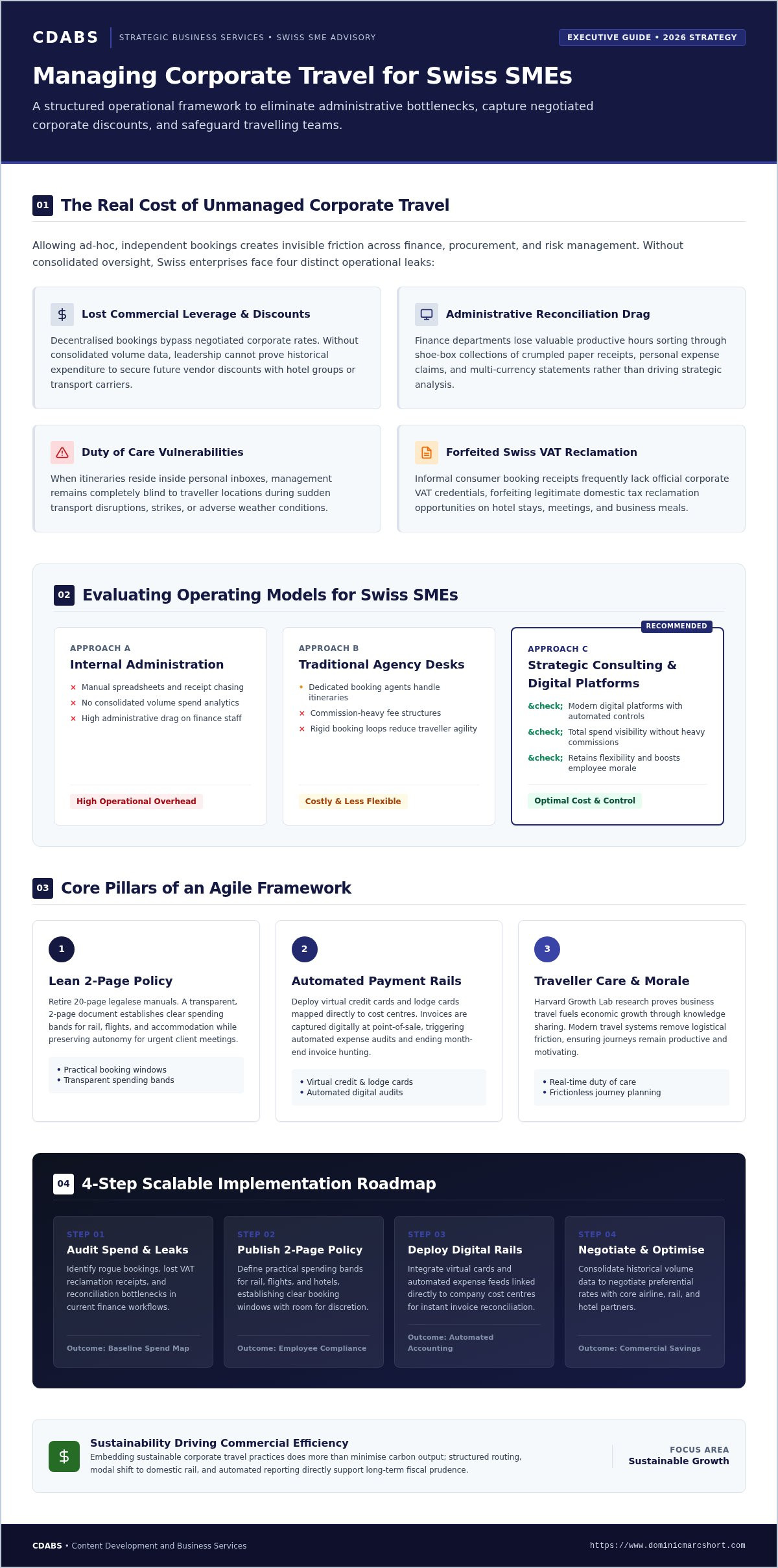
How to Build a Scalable SME Travel Programme: A 4-Step Roadmap
Modernising your company's travel operations does not require an overhaul that disrupts daily business. It simply demands a structured rollout that unites technical workflows with day-to-day employee habits. By taking strategic principles from global travel management solutions and tailoring them for Swiss enterprises, any growing business can build an agile, pleasant booking ecosystem that easily scales alongside headcount.
Step 1: Auditing Historical Spend and Travel Patterns
You cannot improve what you haven't measured. Begin by pulling twelve months of corporate credit card logs, expense claims, and transport receipts into a single view. Look closely for regular journeys between major client hubs, frequent hotel choices, and seasonal spikes. This audit quickly reveals booking leakage, showing precisely where team members step outside company channels because existing processes feel too cumbersome.
Step 2: Selecting and Integrating Agile Digital Platforms
Small and mid-sized enterprises rarely need heavyweight, convoluted platforms designed for multinational conglomerates. Instead, choose intuitive self-booking tools that your staff can easily operate on their mobile devices during a quick commute. Ensure the platform synchronises clean booking data directly with your accounting software, incorporating sensible pre-trip approval triggers that flag genuine policy exceptions without stalling straightforward trips.
Step 3: Communicating Change and Driving Team Adoption
Even the slickest software platform falls flat if employees view it as an unwanted corporate constraint. Address operational questions with genuine enthusiasm and open ears. Organise brief, cheerful onboarding sessions that highlight personal perks, such as automated expense receipts and centralised itinerary updates. When colleagues realise the new framework eliminates tedious paperwork, genuine enthusiasm replaces pushback, cementing success when managing corporate travel for SMEs in Switzerland.
Future-Proofing Your Travel Strategy: Sustainability and Long-Term Value
Thinking about sustainability doesn't mean clipping your team's wings or grinding business expansion to a halt. In truth, thoughtful green policies usually walk hand-in-hand with substantial financial savings. When managing corporate travel for SMEs in Switzerland, aligning transit choices with ecological responsibility produces a leaner, more resilient operating model. By cutting unnecessary one-day flights and encouraging purposeful journeys, your business trims travel spend whilst making a genuine contribution towards corporate climate goals.
Embedding Carbon Mindfulness and Smart Transit Choices
Rail travel across the national network and into neighbouring European markets offers a prime example of where environmental stewardship pays immediate dividends. Swapping short-haul flights for trains provides mobile employees with peaceful working time, reliable Wi-Fi, and far fewer airport security queues. To build a modern programme, consider these practical adjustments:
Incentivise smart rail routes: Make first-class rail standard for itineraries where train connections match total door-to-door flying time.
Consolidate client trips: Encourage staff to schedule multiple partner meetings across a single extended visit rather than taking three separate, tiring day trips.
Capture transparent emissions data: Track carbon figures within your booking platform to breeze through enterprise client ESG questionnaires.
Securing Strategic Advantage with Independent Guidance
Travel programmes are living systems; they quickly drift off course if left completely unattended. Without regular health checks, manual workarounds and rogue expense habits inevitably creep back into daily operations. Independent audits ensure your booking workflows, supplier terms, and tech integrations continue serving your commercial goals as team numbers expand. Partnering with seasoned advisors gives leadership total clarity over expenditure without agency bias. Discover how expert business travel consulting empowers Swiss SMEs to travel smarter, turning routine logistical processes into a lasting competitive advantage.
Taking the Next Step Towards Smarter Corporate Journeys
Transforming your travel operations isn't about clamping down on team autonomy; it is about building an intelligent, dependable engine that actively supports company growth. Replacing chaotic booking habits with transparent guidelines, automated payment workflows, and sustainable transit choices protects both your financial margins and your employees' day-to-day happiness. Successfully managing corporate travel for SMEs in Switzerland comes down to designing practical systems that work effortlessly for real people. With over three decades of corporate travel management and strategic consulting leadership, CDABS delivers completely independent advisory services free from supplier bias, backed by a proven track record across business process optimisation and digital change management.
With the right operational framework in place, business travel shifts from an exhausting administrative burden into a cheerful, reliable driver for your long-term commercial success. You can empower your travelling team, delight your finance department, and embark on every upcoming journey with complete confidence.
Frequently Asked Questions
What exactly distinguishes managed travel from unmanaged corporate travel for an SME?
Managed travel channels bookings through unified digital platforms governed by clear spending guidelines, automated approvals, and centralised payment workflows. Unmanaged travel relies on ad-hoc personal booking across consumer websites, leaving internal finance teams to chase scattered receipts and unmonitored itineraries. Transitioning to a managed framework gives corporate leadership complete spend visibility, protects travelling colleagues, and dramatically cuts manual administration time across the board.
At what company size or annual spend should a Swiss business formalise its travel management?
Formalising your programme is less about total headcount and more about administrative strain. Once a company has ten or more regular travellers, or when reconciling monthly expenses starts eating up multiple days of finance time, an informal system breaks down. Structured processes for managing corporate travel for SMEs in Switzerland protect margins early, ensuring that rapid commercial growth doesn't turn your travel budget into an unruly free-for-all.
Is it necessary to hire a traditional corporate travel agency to manage business trips?
No, hiring a traditional agency is entirely optional. Modern self-booking platforms allow growing firms to handle travel internally without paying third-party booking fees or commission markups. Many Swiss enterprises prefer working with an independent business travel management consultant to design their internal processes, implement intuitive digital software, and empower their own teams rather than outsourcing every individual ticket to an external desk.
How can a company prevent employees from booking outside the approved travel policy?
The best deterrent isn't strict punishment; it is providing a booking tool that staff actually enjoy using. When your internal platform offers convenient mobile itinerary changes, flexible hotel options, and automated receipt filing, staff have little incentive to hunt on consumer platforms. Combining transparent spending thresholds with user-friendly digital tools naturally ensures policy compliance without creating workplace resentment.
What are the legal duty of care obligations for Swiss businesses sending staff abroad?
Under the Swiss Code of Obligations, employers hold a legal duty to protect the health, safety, and personal integrity of their staff during business operations. This responsibility extends directly to corporate journeys abroad. Companies must assess destination risks, provide clear emergency contact channels, and maintain accurate records of employee whereabouts so they can respond effectively during travel disruptions or regional crises.
Can an SME secure discounted corporate rates with airlines and hotel groups?
Yes, even modest travel volumes can unlock commercial savings if your historical data is properly organised. While massive enterprise discounts require heavy spend, Swiss SMEs can access negotiated hotel programmes, corporate airline loyalty tiers, and dynamic SME rates through modern booking tools. An independent audit helps consolidate your route data, giving you the necessary leverage to secure meaningful supplier perks.
How do modern digital booking tools integrate with existing accounting software?
Modern travel platforms connect directly to your enterprise accounting software via secure API integrations. When an employee books a journey or scans an incidental receipt, the transaction data automatically matches with the correct cost centre and General Ledger code. This real-time synchronisation removes manual data entry, guarantees accurate VAT recovery details, and turns managing corporate travel for SMEs in Switzerland into a delightfully painless process.



Comments