Travel Data Management Consulting: The 2026 Strategic Audit Checklist
What if the most valuable asset in your corporate travel program is currently trapped in a dozen disconnected spreadsheets, invisible to your leadership team? You probably feel the daily frustration of trying to reconcile fragmented reports from TMCs and credit card providers, only to find that your ESG metrics and carbon emission tracking remain little more than a guessing game. It's a common struggle for organizations that lack the internal bandwidth to build a truly data-driven roadmap in an era of shifting 2026 ESG requirements.
Mastering this complexity requires more than just better software; it demands a professional framework to turn fragmented metrics into strategic business intelligence. By engaging with specialized travel data management consulting, you can bridge these visibility gaps and transform raw numbers into a unified view of global spend. This 2026 strategic audit checklist provides the methodical framework you need to gain actionable insights for supplier negotiations. We'll explore how to move beyond basic reporting to create a clear digital transformation roadmap that ensures your travel program remains resilient, compliant, and fully optimized for the years ahead.
Table of Contents
The Evolution of Travel Data Management Consulting in 2026
In 2026, travel data management consulting has matured from a back-office utility into a core pillar of business strategy. It's best defined as the strategic architecture of travel information flows; a process that ensures every booking, expense, and carbon metric is captured, validated, and aligned with corporate goals. Modern Corporate travel management requires a level of precision that traditional methods can't reach. We're seeing a decisive shift away from descriptive analytics, which merely tell you what happened last quarter, toward prescriptive insights that tell you exactly how to adjust your policy for the next month.
Many organizations suffer from "Data Rot," a condition where invisible spend and fragmented sources lead to manual reconciliation nightmares. If your team spends more time cleaning data than analyzing it, your program is leaking value. Effective travel data management consulting addresses these symptoms by building a robust framework that captures fragmented metrics and turns them into strategic intelligence. This evolution allows leaders to move beyond reactive fixes and toward a proactive, data-driven roadmap.
Why TMC Reporting is No Longer Sufficient
Relying solely on a Travel Management Company (TMC) for data is a significant risk in the current landscape. TMC reports generally only capture "on-channel" bookings. This leaves a massive blind spot for leakage, such as direct hotel bookings, rail travel, or ride-share apps. There's also an inherent conflict of interest; it's difficult for a provider to offer unbiased independent verification when their own performance and contract compliance are the metrics being measured. True oversight requires cross-referencing travel data with payment and expense systems to see the full picture of employee behavior and total cost of trip.
The Strategic Role of an Independent Consultant
An independent consultant acts as a neutral architect between technology vendors and corporate stakeholders. They don't sell booking services, so their loyalty remains entirely with the client. This role is essential for bridging the gap between travel procurement and finance departments, ensuring that travel spend isn't just a cost center but a tool for organizational health. When you engage in professional travel data management consulting, you gain a partner who can develop a long-term digital transformation for business travel. They facilitate the seamless integration of new systems, allowing your organization to navigate complex transitions with a steady, experienced hand and a clear focus on measurable ROI.
The Architecture of a Data-Driven Travel Program
A resilient travel program relies on a foundation of interconnected data feeds rather than isolated reports. To achieve a unified view of spend, we must map an ecosystem that includes GDS records, TMC bookings, credit card transactions, and HR profiles. Each source provides a different layer of the story. While TMC data shows intent, credit card data reveals the final financial reality. Professional travel data management consulting ensures these streams flow into a single, normalized repository that accounts for regional currency fluctuations and local tax variations.
In 2026, the complexity of global operations requires strict adherence to data privacy and GDPR standards. Managing sensitive traveler information across borders isn't just a legal obligation; it's a matter of trust and organizational health. Integrating ESG and carbon reporting into this core strategy is no longer optional for Swiss corporates. By aligning your travel data with broader sustainability goals, you create a transparent audit trail that satisfies both internal stakeholders and external regulators. Reliable benchmarks, such as those provided by the Bureau of Transportation Statistics (BTS), can help you contextualize your organization's performance against wider industry trends.
Data Sources: Beyond the Booking
Credit card data often serves as the ultimate source of truth for actual spend, capturing the "hidden" costs that booking tools frequently miss. When this is paired with internal HR data, you gain a clearer picture of traveler profiles and enhance your ability to provide duty of care. For many Swiss enterprises, optimizing corporate travel payments is a critical step in identifying ancillary fees and unmanaged spend that typically bypass standard agency reporting. This holistic approach allows you to see the full financial footprint of every trip.
The 2026 Tech Stack for Travel Intelligence
Modern travel intelligence requires a sophisticated tech stack that moves beyond static spreadsheets. Business Intelligence (BI) tools allow for the visualization of complex trends, making it easier for decision-makers to spot anomalies. API-first architectures are now the standard, enabling seamless connections between travel systems and your corporate ERP. Automated data auditing tools can now find errors in real-time, correcting missing fields or duplicate entries before they impact your budget. If you're looking to refine your own infrastructure, exploring independent consulting services can help you select the right tools for your specific organizational needs.
This systematic architecture provides the stability needed to manage intricate details while maintaining sight of broader strategic objectives. It transforms fragmented metrics into a powerful asset for the entire business.
Consultant vs. Software vs. TMC: Choosing Your Path
Decision makers often find themselves at a crossroads when determining the best way to oversee their travel information. Choosing the right path for data oversight usually involves a trade-off between convenience and control. TMC-provided tools are accessible and often integrated into your existing contract, yet they rarely offer the cross-vendor visibility needed for a truly global program. Because these tools are designed to report on the agency's own performance, they frequently miss the broader financial context found in expense and payment systems. Relying solely on them can leave significant gaps in your strategic oversight.
The "Build vs. Buy" dilemma is another common hurdle. While off-the-shelf software promises a quick fix, it often requires significant internal resources to align with existing corporate ERPs and financial workflows. Conversely, building a custom platform is a massive investment that many organizations aren't prepared to maintain. This is where travel data management consulting acts as the bridge. A consultant doesn't just provide a tool; they provide the seasoned expertise to manage the implementation of global travel management solutions Switzerland. This ensures that whichever technology you choose actually serves your business objectives rather than becoming another siloed expense.
Independent audits typically pay for themselves within months. By uncovering hidden leakage, duplicate fees, and missed rebates, a professional consultant provides a clear ROI that internal teams often overlook. It's about more than just finding errors; it's about establishing a framework where your data works for you. This pragmatic approach transforms travel data management consulting from a service fee into a strategic investment that strengthens your bottom line.
When to Hire a Travel Data Consultant
The need for external expertise often becomes clear during pivotal organizational shifts. You should consider hiring a consultant in the following scenarios:
During a TMC RFP: Ensuring your next contract includes robust data ownership and reporting requirements.
Post-Merger Integration: Consolidating disparate data sets from multiple global entities or recent acquisitions into a single source of truth.
Resource Gaps: When your internal teams lack the bandwidth or specialized technical knowledge for deep-dive process analysis.
Comparing Service Models
Consulting isn't a one-size-fits-all solution. Depending on your project lifecycle, you might opt for project-based consulting to handle specific transformations or audits. For organizations requiring constant oversight, managed services provide ongoing data validation and quality control. Finally, strategic advisory services offer the high-level perspective needed for board-level reporting and travel management for global corporates, ensuring your travel program aligns with long-term organizational health.
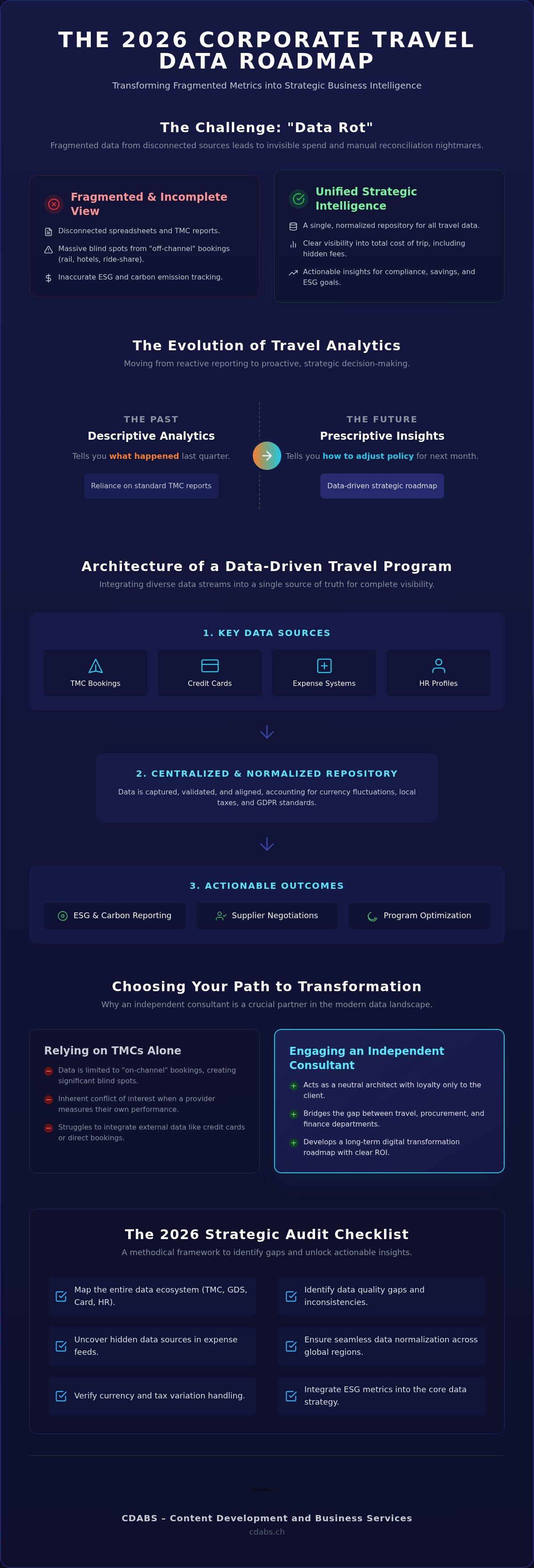
The 2026 Travel Data Audit Checklist
A successful audit begins with a clear understanding of your current baseline. Before engaging in travel data management consulting, it's vital to perform an internal assessment that goes beyond surface-level spend totals. This systematic approach ensures that when the deep-dive analysis begins, your data is accessible, clean, and relevant to your organizational goals. We follow a five-step process designed to uncover inefficiencies and prepare your program for a digital transformation.
Step 1: Data Inventory. You must list every source of travel and expense information. This includes GDS records, TMC feeds, corporate credit card statements, expense management software, and HR files.
Step 2: Quality Assessment. Examine your data for duplicates, missing fields, or currency inconsistencies. In a global environment, even minor rounding errors or mismatched exchange rates can lead to significant reporting discrepancies.
Step 3: Policy Alignment. Does your data show actual compliance with your business travel risk management policy? Reliable data doesn't just track costs; it validates that travelers are following safety protocols and using approved channels.
Step 4: Stakeholder Needs. Identify what different departments require. Finance needs tax accuracy; HR needs duty of care visibility; Travel needs supplier performance metrics.
Step 5: Gap Analysis. Identify your "Invisible Spend." These are the costs current systems aren't catching, such as local ride-shares or meals paid in cash that bypass corporate tools.
Technical Readiness Checklist
Your technical infrastructure determines how effectively a consultant can extract value from your information. You should confirm if you have a centralized data warehouse or a data lake to store disparate feeds. It's equally important to check if your payment systems are fully integrated with your expense management tool. Finally, assess your data refresh rate; daily or weekly updates are now the standard for 2026, as monthly reporting is often too slow to allow for proactive policy adjustments.
Strategic Readiness Checklist
Technical tools are only effective if the organization is ready to act on the findings. Strategic readiness requires confirmed executive buy-in for a data-driven transformation. You must also be prepared to change travel policies based on what the data reveals, even if those changes disrupt long-standing habits. Having a clear, measurable definition of "Success" for your data project ensures that your travel data management consulting partner can deliver the specific outcomes you need. Ready to begin your transformation? Connect with our team for professional business travel management consulting.
Transforming Data into Action with CDABS
CDABS brings over 30 years of industry experience to the table, providing a steady hand for organizations facing complex data transitions. Raw data alone is insufficient; it requires expert interpretation to become a strategic asset. Our approach to travel data management consulting focuses on translating these complex datasets into clear, actionable strategies that resonate with stakeholders across the business. We don't just deliver a report; we facilitate a complete implementation that aligns with your broader organizational health and operational excellence.
A critical part of this process is the integration of data insights into change management for corporate travel. Many programs fail because they ignore the human element of the data lifecycle. We bridge this gap by creating bespoke communications packages designed to ensure that data findings lead to actual employee behavior change. Whether it's shifting travelers toward more sustainable options or improving compliance with new payment tools, our messaging is tailored to your specific corporate culture to ensure a seamless digital transition.
The CDABS Consulting Methodology
Our methodology is methodical and thorough, moving systematically from initial process optimization to final delivery. We provide independent oversight, acting as a neutral architect to ensure your technology vendors actually deliver on their promises. This personal approach distinguishes CDABS from faceless corporate entities. You gain access to senior-level expertise and a passionate mentor who is personally invested in the success of your partners. It's a balanced rhythm between technical service descriptions and a deep, personal professional philosophy.
Next Steps: Booking Your Data Audit
Preparing for an initial consultation with Dominic Short is a straightforward process. We recommend gathering your current TMC contracts and any existing spend reports to provide a baseline for our discussion. In the first 30 days of a travel data management consulting project, you can expect a comprehensive audit of your current data flows and the identification of immediate savings opportunities. This structured start provides the stability needed to manage intricate details without losing sight of long-term objectives. Contact CDABS today for a tailored project proposal that addresses your unique organizational challenges.
Mastering Your Travel Data Strategy for 2026 and Beyond
The transition from fragmented metrics to a unified, data-driven roadmap is a fundamental requirement for the modern corporate travel program. We've explored how a systematic audit identifies invisible spend and ensures your infrastructure is ready for the technical and regulatory shifts of 2026. By choosing an independent path, you ensure that your travel technology serves your business objectives rather than the interests of a specific vendor.
Success in this space requires more than just a software implementation; it demands the integration of technical insights with effective change management. CDABS provides the seasoned authority needed to navigate these complex transitions. With 30 years of global experience, we offer independent, project-based travel data management consulting specifically tailored for Swiss enterprises. Our expertise in both travel technology and employee communications ensures that your data findings translate into lasting organizational health.
If you're ready to turn your corporate travel information into a strategic asset, Book a Strategic Consultation with CDABS today. We look forward to helping you build a more efficient and transparent travel future.
Frequently Asked Questions
What exactly does a travel data management consultant do?
A consultant acts as a strategic architect who bridges the gap between travel procurement and finance. They analyze fragmented metrics from TMCs, credit cards, and HR feeds to build a unified view of spend. This role involves process optimization, digital transformation, and ensuring technology vendors deliver on their promises. It's about turning raw data into actionable business intelligence rather than just delivering static reports.
How is travel data management different from standard TMC reporting?
Standard TMC reporting is often limited to "on-channel" bookings, which misses significant leakage like direct hotel or rail bookings. These reports are usually descriptive, showing only what happened in the past. Travel data management consulting provides a holistic view by integrating payment and expense systems. It offers an independent perspective, removing the conflict of interest that occurs when a provider audits their own performance.
How much can a travel data audit save our company?
Savings vary based on the complexity of your travel program and the extent of existing data fragmentation. Audits often uncover hidden leakage, duplicate fees, and missed rebates that typical agency reporting overlooks. While exact figures depend on your specific volume and policy compliance, professional audits generally pay for themselves within months by identifying unmanaged spend and providing leverage for more effective supplier negotiations.
Does my company need a consultant if we only travel within Switzerland?
Yes, because travel within Switzerland still involves complex data streams from rail providers, hotel groups, and expense systems. Even localized programs face challenges with data normalization and ESG reporting requirements for 2026. A consultant helps Swiss enterprises optimize their internal processes and ensure that local spend is captured accurately, providing the same level of strategic oversight required for global operations.
What kind of data do I need to provide for a consulting engagement?
You'll typically need to provide access to your TMC booking records, corporate credit card statements, and expense management data. It's also helpful to include HR traveler profiles and any existing supplier contracts. Providing this comprehensive set of information allows for a thorough gap analysis, helping to identify "invisible spend" that doesn't appear in standard booking tools or agency reports.
How long does a typical travel data transformation project take?
A standard project lifecycle often begins with an initial 30-day audit to identify immediate savings and data quality gaps. The full transformation, including the implementation of new technology or process optimizations, typically takes three to six months. This timeline depends on the number of entities being merged and the complexity of your existing technical infrastructure, such as your corporate ERP and data lake maturity.
Can a consultant help us with ESG and carbon emission reporting?
Absolutely, as accurate ESG reporting is built on a foundation of clean travel data. Consultants help you integrate carbon metrics into your core data strategy, ensuring you meet Swiss corporate reporting requirements for 2026. This involves capturing emissions data from all sources, not just flights, to create a transparent audit trail that satisfies both internal sustainability goals and external regulatory standards.
How does travel data management impact employee satisfaction?
It reduces friction by identifying pain points in the booking and reimbursement process. When data is managed effectively, you can use those insights to refine policies that balance cost control with traveler well-being. Using bespoke change management communications packages ensures that travelers understand the "why" behind policy changes, leading to higher adoption rates and a more positive experience for your mobile workforce.



Comments