How to Plan a Carbon-Neutral Corporate Event 2026
What if the most talked-about feature of your next conference wasn't the keynote speaker, but the fact that the entire occasion left no footprint behind? Many organisers worry that sustainability is just a polite word for "expensive and boring," or they find themselves tangled in a thicket of technical jargon about carbon credits. You likely feel the pressure to deliver something spectacular while your ESG reporting requirements grow more demanding by the day. We understand that planning a carbon-neutral corporate event can feel like trying to solve a Rubik's Cube while wearing oven mitts, but it doesn't have to be a logistical headache. It's actually a brilliant opportunity to innovate and show your stakeholders that you're a steady hand in a changing world.
This guide promises to show you how to orchestrate high-impact events that delight your guests without compromising the planet. We'll share a clear, step-by-step framework that turns complex data into a success story for your next board meeting. From untangling the mysteries of delegate travel to selecting partners who actually walk the talk, you're about to discover how to make "green" the most exciting colour in your branding palette. Let's dive into the practical magic of modern, sustainable event management.
Table of Contents
The Business Case for Carbon-Neutral Events in 2026
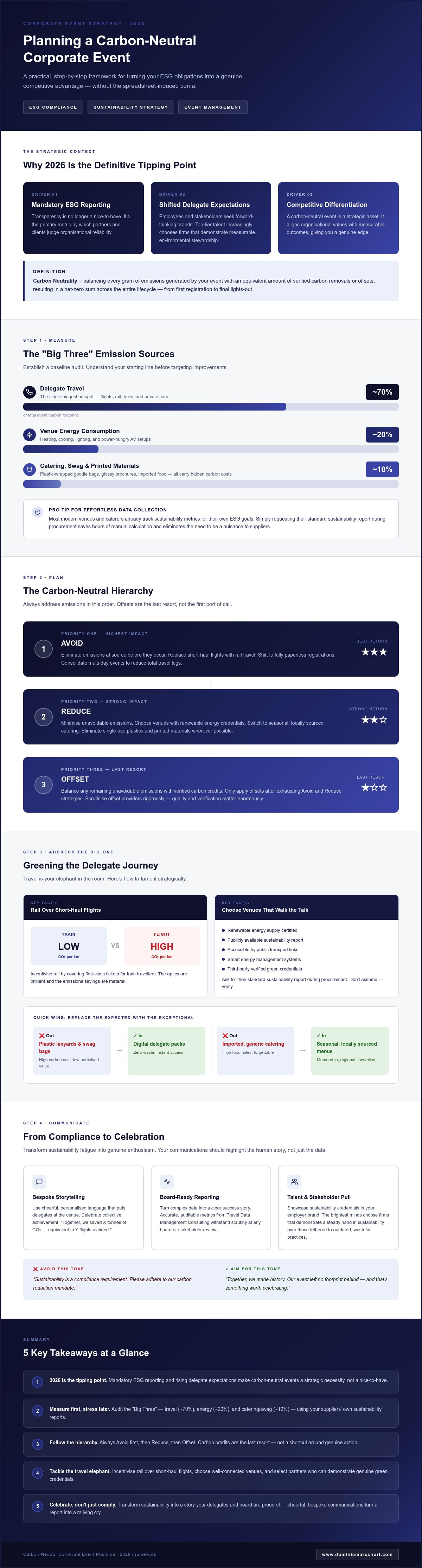
Carbon neutrality is often discussed in hushed, reverent tones, but the concept is actually quite straightforward. It involves balancing every gram of carbon emissions generated by your activity with an equivalent amount of carbon removals or verified offsets, ultimately reaching a net-zero sum. In the context of planning a carbon-neutral corporate event, this means looking at the entire lifecycle of your gathering, from the first delegate registration to the final light being switched off at the venue.
Why has 2026 become the definitive tipping point for this approach? The answer lies in a combination of tightening ESG (Environmental, Social, and Governance) reporting requirements and a fundamental shift in attendee expectations. Transparency is no longer a "nice-to-have" feature hidden in the back of an annual report; it's a primary metric by which partners and clients judge your reliability. A carbon-neutral event is a strategic asset that fuels modern growth by aligning organisational values with measurable environmental stewardship.
Beyond Compliance: The Joy of Sustainable Hosting
There's a quiet thrill in hosting an event that doesn't cost the earth. When you remove the guilt of a high-carbon footprint, you often find that attendee engagement and pride skyrocket. Employees and stakeholders want to be associated with forward-thinking brands that respect their future. This is particularly true when it comes to attracting top-tier talent. The brightest minds in the industry are increasingly selective, and they'll choose a firm that demonstrates a steady hand in sustainability over one that remains tethered to outdated, wasteful practices.
We often see planners worry that sustainability acts as a constraint. In reality, these "restrictions" serve as creative boundaries that lead to far more memorable themes. Instead of generic, imported catering, you might explore a seasonal, locally sourced menu that offers a genuine taste of the region. It's about replacing the expected with the exceptional.
Why "Sustainable" is the New Standard for Excellence
The days of plastic-heavy conferences, defined by overflowing bins and single-use lanyards, are firmly behind us. Excellence in 2026 is defined by how seamlessly a brand can integrate digital transformation into the event experience. By moving toward paperless registrations and smart energy management, you aren't just being "green"; you're being efficient. A well-planned, sustainable event reduces friction for both planners and attendees, ensuring that the focus remains on high-value connections rather than logistical clutter. It's a pragmatic, results-oriented way to show that your organisation is ready for the challenges of the modern business world.
Step 1: Measuring the Footprint without the Frowns
Measuring the footprint doesn't have to result in a headache or a spreadsheet-induced coma. When planning a carbon-neutral corporate event, your first and most sensible move is establishing a baseline audit. This isn't about achieving perfection from day one; it's about understanding your starting line so you can measure genuine progress. You'll want to focus your attention on what we call the "Big Three" of event emissions: travel, catering, and energy consumption.
Gathering this data requires a bit of detective work, but it needn't make you a nuisance to your suppliers. Most modern venues and caterers are already tracking these metrics for their own ESG goals. Simply asking for their standard sustainability report during the procurement phase can save hours of manual calculation. For a truly professional finish, engaging in Travel Data Management Consulting ensures that your reporting is accurate enough to withstand scrutiny from any board of directors.
Identifying Your Emission Hotspots
Delegate travel is almost always the elephant in the room, often accounting for up to 70% of an event's total footprint. It's the heavy hitter that requires the most strategic attention. Beyond the journey, you must consider energy consumption at the venue, including the heating, cooling, and the power-hungry AV setups that make your keynote speakers look so sharp. Don't overlook the hidden impact of "swag" and printed materials. Those plastic-wrapped goodie bags and glossy brochures carry a carbon cost that often outweighs their promotional value.
Choosing Simple Yet Effective Measurement Tools
You don't need to be a data scientist to get this right. While basic online carbon calculators offer a quick estimate, they often lack the nuance needed for verifiable corporate reporting. Professional audit services provide a deeper level of insight, using your existing travel data to forecast future impacts with precision. This transparency is vital when you're assembling your final post-event report. If you're looking for a steady hand to help navigate these complexities, exploring a bespoke consulting framework can turn data dread into a competitive advantage. It's about making the numbers work for you, rather than the other way around.
Step 2: Strategic Reduction – Where Less is Truly More
When you've finished measuring your footprint, the real fun begins. You don't just want to pay for offsets; you want to design out the waste from the start. The gold standard hierarchy for planning a carbon-neutral corporate event follows three simple steps: avoid, reduce, and then offset. It's a bit like a diet; it's much easier to avoid the extra biscuit than to run it off later. By prioritising reduction, you ensure your event is lean, efficient, and genuinely impactful.
Venue Selection and Circular Catering
Selecting a venue is more than just finding a room with enough chairs and decent coffee. You need a partner that actually walks the talk. Ask the venue managers specific questions about their renewable energy sources and waste management protocols. Does the building run on solar or wind power? Do they have a robust recycling system that actually works? These details matter because they form the backbone of your sustainability report, and they show you're a steady hand when it comes to the finer details.
Catering is another area where you can make a massive splash without a massive footprint. We advocate for the "Km Zero" food philosophy, which focuses on sourcing ingredients locally. This approach delivers better flavour and significantly lower transport miles. It's a win-win for your guests' palates and the planet. To handle the inevitable food surplus, set up partnerships with local charities before the event starts. It turns potential waste into a community benefit, which is a much nicer story to tell your stakeholders than simply filling up a bin.
Digital Transformation: Hybrid and Paperless Strategies
We've all seen those sad piles of abandoned printed programmes at the end of a conference. It's time to leave them in the past. High-quality event apps can replace printed materials and badges entirely, providing real-time updates and better networking opportunities for your attendees. This is where Mastering Business Travel Technology Implementation becomes your secret weapon. By streamlining your logistics through smart tech, you eliminate paper waste while improving the user experience for everyone involved.
Hybrid formats also play a crucial role in your reduction strategy. You don't always need every single attendee to fly halfway across the world for a two-hour session. By offering a high-quality digital experience for remote participants, you drastically cut down on long-haul travel emissions. This doesn't mean the event is less personal; it means it's more accessible and thoughtful. It demonstrates that you understand that sometimes, less really is truly more when it comes to long-term organisational health.
Greening the Delegate Journey: The Travel Factor
Travel is undeniably the "elephant in the room" when it comes to planning a carbon-neutral corporate event. While you can control the venue's thermostat and the caterer's compost bin, you can't physically pedal the delegates to the front door. However, you can certainly make the sustainable choice the most attractive one. For national events, incentivising rail travel over short-haul flights is a powerful lever. It's often more productive for the traveller, offering a chance to catch up on emails with reliable Wi-Fi, and it's significantly kinder to your carbon balance sheet.
For those unavoidable long-haul journeys, Sustainable Aviation Fuel (SAF) certificates are an excellent tool. They allow your organisation to support the transition to cleaner fuels even when direct options are limited. This isn't just about ticking boxes; it's about embedding these values into your Corporate Travel Policy. When sustainability is a policy requirement rather than a suggestion, the planning process becomes much smoother and more predictable for everyone involved.
Optimising the Commute
Reducing individual car journeys is a quick win that adds a touch of community spirit to your event. Consider providing group transport solutions, such as shuttle buses from major rail hubs, which also serve as excellent informal networking spaces before the first keynote even begins. During the registration phase, communicate the "greenest route" clearly to your delegates. Most people are happy to choose the eco-friendly path if you've already done the legwork for them. Partnering with transport providers for discounted group rail fares is another brilliant way to nudge behaviour while keeping the finance department smiling.
Sustainable Accommodations
Your delegates need somewhere comfortable to rest their heads, and your choice of hotel can significantly impact your net-zero goals. Focus on selecting properties with verified eco-labels and transparent energy-saving policies. Something as simple as encouraging delegates to opt-out of daily room cleaning for short stays can save thousands of litres of water across a large group. Managing these choices becomes far simpler when using centralised Global Travel Management Solutions. These systems allow you to filter for sustainable options automatically, ensuring your bookings align with your environmental objectives without the manual slog.
Communicating the Change: From Compliance to Celebration
You've measured the data and reduced the waste, but if your attendees feel like they're being punished, the event won't be a success. The "human element" is the secret sauce that transforms a technical exercise into a shared victory. When planning a carbon-neutral corporate event, your internal communications are just as important as your logistics. Instead of dry mandates, use positivity and a light touch to overcome "sustainability fatigue" among your staff. This is where bespoke Change Management Communications Packages become essential. They help you frame the transition as an exciting evolution rather than a restrictive chore, ensuring everyone arrives with a smile.
Engaging Stakeholders with a Touch of Humour
It's much easier to sell a plant-forward menu when you explain it with a cheerful wink rather than a stern lecture. You might highlight the vibrant, seasonal flavours or the happy fact that no one will suffer from a "post-lunch food coma" during the afternoon sessions. Gamifying the carbon reduction process is another brilliant way to build momentum. Consider introducing a "Greenest Delegate" award for those who took the train or used the event app most effectively. By keeping the tone upbeat and inclusive, you avoid the "preachy" vibe that often derails environmental initiatives. It turns a corporate requirement into a collective badge of honour.
Partnering with CDABS for End-to-End Success
Navigating the complex landscape of sustainable suppliers and ESG reporting requires a steady, experienced hand. Dominic Short brings over 30 years of industry experience and a track record of more than 500 delivered events to your strategy. As an independent consultant, CDABS offers a calm, controlled perspective that helps you manage the intricate details of carbon-neutral logistics without losing sight of your broader business objectives. We function as both a strategic architect and a hands-on facilitator, ensuring your global transformation is as seamless as it is impactful.
A carbon-neutral event is a splendid gift to your future business health. It proves that high-impact connections and environmental stewardship can live happily together in a modern corporate ecosystem. Celebrate the win by sharing the final carbon-neutral results with your team; there's nothing quite like the collective pride of knowing you've delivered excellence without leaving a footprint behind. It's time to make your next event a benchmark for the industry.
Stepping Boldly into the Future of Corporate Events
The journey to net-zero doesn't have to be paved with logistical nightmares or dull spreadsheets. By focusing on the "Big Three" emissions and prioritising a reduction-first mindset, you can transform your gatherings into benchmarks of modern excellence. We've explored how planning a carbon-neutral corporate event is less about restriction and more about the creative opportunity to innovate. Whether it's through circular catering or clever travel incentives, these choices build a legacy of responsibility that resonates with every attendee.
Dominic Short brings 30 years of business travel expertise to ensure your strategy is as robust as it is inspiring. From bespoke change management packages to independent, expert consulting for SMEs and NGOs, we provide the steady hand needed to navigate this transition. It's time to lead the way with confidence and a touch of good humour.
Your future business health depends on the sustainable choices you make today. Let's make your next event truly unforgettable for all the right reasons.
Frequently Asked Questions
What exactly constitutes a carbon-neutral corporate event?
A carbon-neutral event is one where the net greenhouse gas emissions are zero. This is achieved by first measuring the total footprint, then aggressively reducing emissions through smarter logistics, and finally balancing any unavoidable remainder with removals or offsets. When planning a carbon-neutral corporate event, the focus should always be on the "avoid, reduce, then offset" hierarchy. It's about ensuring your gathering leaves a splendid impression on attendees but no lasting mark on the planet.
How much more does it cost to plan a carbon-neutral event compared to a traditional one?
It's a common misconception that "green" always equals "expensive." While carbon offsets represent an additional line item, many reduction strategies actually save money. Switching from printed programmes to digital apps or opting for locally sourced, seasonal catering can significantly reduce costs. By optimising your supply chain and streamlining travel, you often find that the efficiencies gained balance out the investment required for high-quality carbon credits. It's a pragmatic shift toward smarter, more modern spending.
Can an event really be carbon-neutral if people have to fly to get there?
Yes, an event can achieve carbon neutrality even with air travel involved, provided those emissions are accurately measured and balanced. We recommend prioritising rail for national journeys, but for international delegates, air travel is often unavoidable. In these cases, you can use Sustainable Aviation Fuel (SAF) certificates or contribute to verified carbon removal projects. The goal is to account for every mile flown and ensure the environmental cost is fully addressed through your mitigation strategy.
What are Scope 3 emissions and why do they matter for my event?
Scope 3 emissions are indirect emissions that occur in your value chain, including delegate travel and third-party catering. For most organisations, these represent the largest portion of an event's footprint. They matter because 2026 reporting standards increasingly require transparency across the entire lifecycle of corporate activities. Addressing Scope 3 proves you have comprehensive oversight of your environmental impact, which is essential for satisfying stakeholders and meeting mandatory ESG requirements with a steady, confident hand.
How do I choose a credible carbon offsetting project for the remaining emissions?
Credibility in offsetting comes down to rigorous, third-party verification. You should look for projects certified by recognised international standards, such as the Gold Standard or the Verified Carbon Standard (VCS). These ensure that the carbon savings are additional, permanent, and accurately measured. It's also wise to choose projects that align with your firm's values, such as reforestation or renewable energy initiatives, turning a technical requirement into a meaningful part of your brand story.
What is the best way to measure food waste at a corporate conference?
The most effective method is to partner with your caterer for weight-based reporting of food surplus and waste. Modern caterers often use digital tracking tools to record what was prepared versus what was consumed. By implementing a "Km Zero" philosophy, you reduce the initial impact, while partnerships with local food-redistribution charities can turn surplus into a community benefit. This data-driven approach allows you to refine your ordering for future events, saving both carbon and budget.
How can I convince my board that carbon neutrality is worth the investment?
Focus on the link between sustainability and long-term organisational health. In 2026, carbon neutrality is a powerful tool for brand differentiation and attracting top-tier talent who value environmental stewardship. It also mitigates the risk of non-compliance with evolving ESG regulations. Remind them that a sustainable event isn't just a "nice-to-have" feature; it's a strategic asset that demonstrates your organisation's ability to navigate complex global transitions with reliability and quiet confidence.
What role does digital transformation play in reducing an event’s footprint?
Digital transformation is the engine that drives modern sustainability. By implementing event apps, you eliminate the need for thousands of printed pages and plastic badges, while hybrid technology reduces the necessity for long-haul travel. When planning a carbon-neutral corporate event, these digital tools provide the verifiable data needed for accurate carbon reporting. It streamlines the entire process, making it easier to manage intricate details while ensuring the attendee experience remains cheerful, efficient, and thoroughly professional.



Comments