How to Moderate a Lively Panel Discussion: A Practical Guide
By Dominic Marc Short · 15 October 2026 · 14 min read
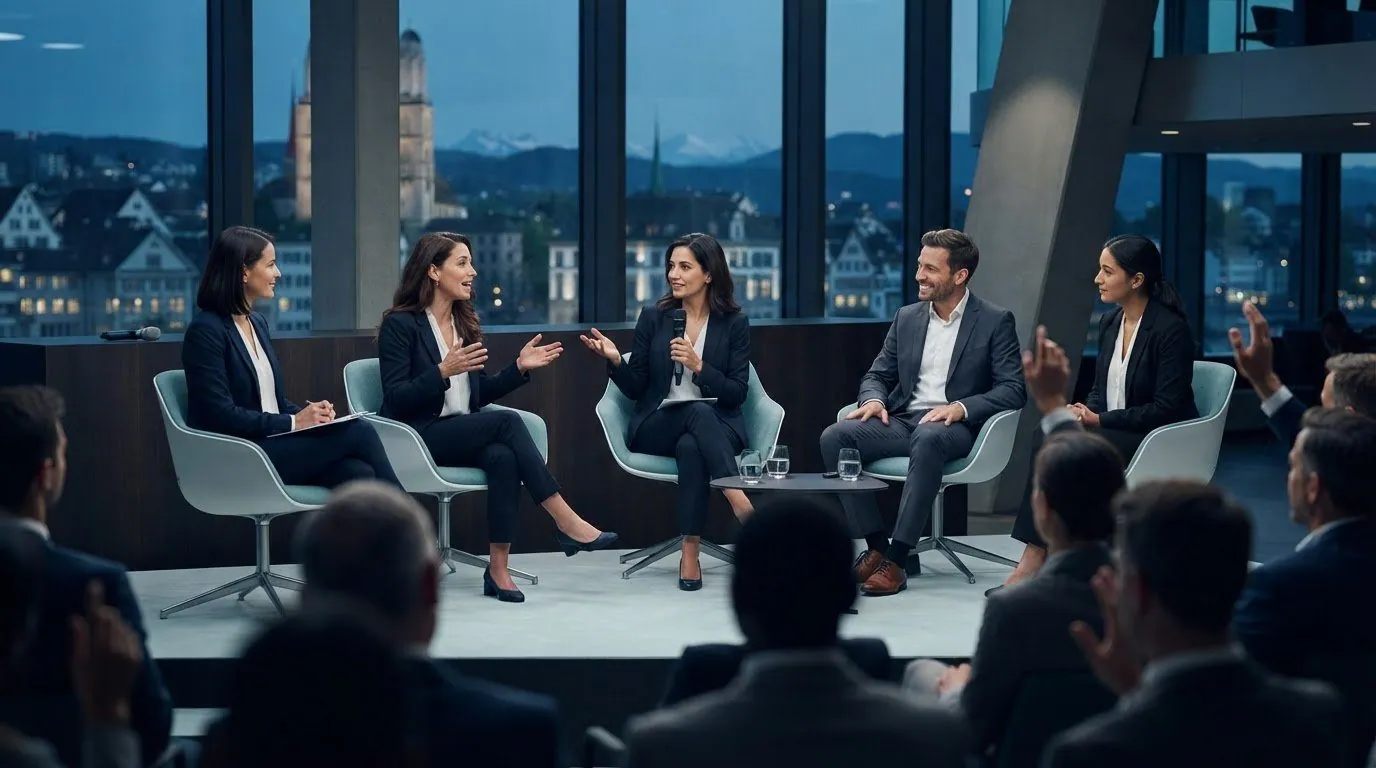
What if the secret to a lively panel is not more spontaneity, but a little more structure? If you’re learning how to moderate a lively panel discussion, the challenge may feel familiar: one panellist takes the scenic route, disagreement turns personal, and audience questions start competing with the clock. Energy is welcome; a discussion that needs its own traffic warden is less so.
The aim isn’t to flatten strong opinions or script every exchange. It’s to keep the conversation purposeful, give each voice room and involve the audience. This guide covers how to prepare clear themes, balance airtime, steer disagreement towards useful insight, manage questions and finish with practical takeaways. A little structure helps lively mean engaging, not chaotic.
Table of Contents
- How to Moderate a Lively Panel Discussion Without Losing Its Purpose
- Prepare to Moderate a Lively Panel Discussion Before the Event
- Keep a Lively Panel Discussion Balanced When Opinions Clash
- Use a Practical Live-Session Method to Manage Time and Audience Questions
- Bring Experienced Moderation to Your Next Lively Panel Discussion
How to Moderate a Lively Panel Discussion Without Losing Its Purpose
A lively panel discussion is engaged and varied, not uncontrolled or uniformly agreeable. It may include contrasting interpretations and moments when a panellist challenges an assumption. The aim isn’t to make every speaker sound alike. It’s to create a conversation in which different perspectives help the audience understand the subject more clearly.
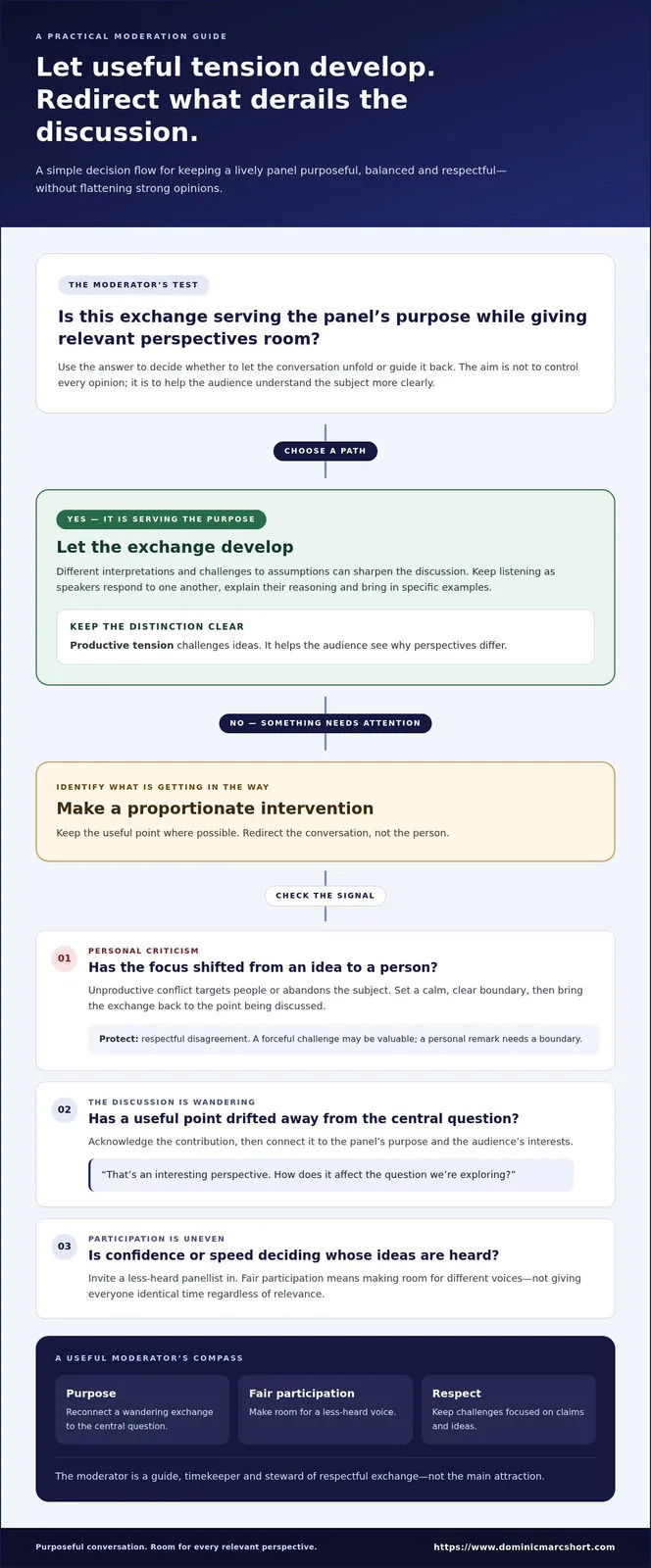
Use one simple test to decide whether to let an exchange develop or guide it back: is it serving the panel’s purpose while giving relevant perspectives room? Understanding the format of panel discussions is a useful starting point, but effective moderation also depends on the audience, event and question at hand.
To learn how to moderate a lively panel discussion, think of the moderator as a guide, timekeeper and steward of respectful exchange. You aren’t there to control every opinion or become the main attraction. Your role is to help speakers make their points, connect ideas and give the audience a clearer understanding of the topic. Keep this distinction in mind: productive tension challenges ideas; unproductive conflict targets people or abandons the subject.
What makes a panel discussion lively and useful?
Energy comes from attention and substance, not simply volume. Panellists listen to one another, respond to the points actually made and use specific examples to bring abstract ideas to life. Genuine differences of view can sharpen the conversation, especially when speakers explain why they see an issue differently.
Agreement isn’t the measure of success, and competition for airtime isn’t proof of enthusiasm. Connect each contribution to the panel’s central question and the audience’s interests. If a speaker introduces a useful but distant point, you might say, “That’s an interesting perspective. How does it affect the question we’re exploring?” The exchange stays open, with a clear route back to the purpose.
What should the moderator protect?
Protect the conditions for a useful discussion rather than trying to eliminate every surprise. Keep the event’s purpose in view, make room for different voices and maintain a tone in which panellists can disagree without being diminished. A forceful challenge may be valuable; a personal remark needs a calm, clear boundary.
- Purpose: Bring a wandering exchange back to the central question without dismissing a relevant contribution.
- Fair participation: Invite a less-heard panellist in, so confidence or speed doesn’t determine whose ideas are heard.
- Respect: Let speakers challenge claims, then intervene if the focus shifts to personal criticism.
These responsibilities work together. A respectful panel can still be robust, and balance doesn’t mean giving every speaker identical time regardless of relevance. The moderator’s judgement keeps the conversation open, purposeful and useful to the people in the room.
Prepare to Moderate a Lively Panel Discussion Before the Event
Good preparation doesn’t mean writing a script and hoping the panellists stick to it. It means understanding what the session needs to achieve, where speakers may align or differ, and how you’ll guide the conversation if it takes an unexpected turn. This is how to moderate a lively panel discussion with confidence while leaving space for the moments that make it worth attending.
Build a practical foundation with this sequence:
- Clarify the purpose. Define what the audience should understand, consider or be better equipped to do afterwards. A broad theme such as “the future of work” needs a sharper central question to keep the discussion focused.
- Learn the perspectives. Review each panellist’s relevant expertise and ask what they believe is often misunderstood about the topic. Find out where they expect agreement, where they differ and whether any subject needs careful framing. Don’t ask them to pre-write answers or settle disagreements in advance.
- Design the flow. Plan an opening, a logical sequence of themes, space for audience questions and a closing synthesis. Leave enough flexibility to follow a useful point without losing sight of the session’s purpose.
- Agree practical expectations. Share the format, timing, audience context and expected contribution. Discuss how you’ll handle interruptions, questions and strong differences of opinion, so your interventions don’t come as a surprise.
Panel preparation is part of the wider event design. A strategic corporate event management approach connects the session’s format and content to the experience the event is meant to create. For broader context on roles, formats and planning, the guide to panel moderation can help clarify the mechanics of a panel.
How do you brief panellists before a lively discussion?
Give each speaker the same concise briefing: the session purpose, audience context, format and what you hope they’ll contribute. Invite them to identify the expertise they’ll bring and the perspective they can add that others may not. Discuss how to keep disagreement specific, respectful and focused on ideas. This creates shared expectations without asking anyone to soften a genuinely held view.
How do you build questions that invite real conversation?
Begin with an accessible question that lets each panellist establish a point of view. Then prepare open prompts that ask for reasoning or examples, or invite a response to another perspective. For instance: “What leads you to that conclusion?” Keep follow-ups ready, such as “Can you give us an example?”, but don’t script every transition. A conversation needs a route, not railway tracks.
Keep your notes brief enough to scan at a glance: the central question, key themes, possible follow-ups and the agreed structure. If a panellist raises an unexpected but valuable issue, adjust the order while preserving the session’s purpose. For experienced support with shaping and moderating event conversations, explore Dominic Marc Short - Independent Consultant's moderation experience.
Keep a Lively Panel Discussion Balanced When Opinions Clash
Intervening doesn’t have to close down debate. A neutral, proportionate prompt can make space for more voices and help panellists explain the substance of their disagreement. Respond to what’s happening, rather than favouring the person whose view you happen to share. Neutrality means applying a fair process, not pretending that all viewpoints are identical.
Before stepping in, consider whether the exchange is still adding something useful. Disagreement is productive when speakers explain different reasoning, test assumptions or offer evidence. It may be time to redirect if they’re repeating the same points, criticising one another personally or drifting away from the question the audience came to explore. Strong delivery alone isn’t a problem; a discussion can be animated without becoming unmanageable.
A practical way to moderate a lively panel discussion is to intervene in stages. Start lightly, then become more direct only if needed:
- Clarify: “Could you explain which part of that argument you disagree with?”
- Focus: “We’ve heard both positions. What’s the main difference in the reasoning?”
- Redirect: “Let’s bring this back to the question of what the evidence tells us.”
- Set a boundary: “Please challenge the idea, not the person. Let’s keep the exchange focused on the issue.”
Use the least forceful prompt that will work. This keeps the intervention from becoming a performance of its own and gives speakers a chance to reset without losing face.
What can you do when one panellist dominates?
Acknowledge the point briefly, then pass the conversation to someone specific: “Thank you, that’s a clear view. Priya, you’ve approached this from a different angle. What would you add?” A direct question gives the quieter panellist an easy way in. Rather than telling the dominant speaker off in front of the room, redirect attention to the shared question and move the discussion on.
How can you handle sharp disagreement without shutting it down?
Keep your tone steady and summarise the difference without adding judgement: “You’re weighing speed against long-term reliability.” Ask each speaker to explain the reasoning behind their position, or where they believe the evidence points in different directions. If comments turn personal, state the boundary clearly, then invite a response focused on ideas. The goal isn’t to remove the tension; it’s to make it useful to the audience.
Once the exchange reaches a useful point, summarise what the audience has learned and pose a forward-moving question. If the views remain different, say so plainly. A tidy resolution isn’t required. Fair airtime, clear reasoning and a respectful close are a perfectly respectable result, even if nobody leaves with a matching opinion.
Use a Practical Live-Session Method to Manage Time and Audience Questions
A lively session can make time feel slippery. One contribution opens up a new line of thought, another panellist responds, and suddenly the audience questions are waiting while the closing summary is still a distant dream. A simple live-session method helps protect both the discussion and its agreed finish without treating every minute as a reason to hurry speakers along.
Keep the sequence visible in your notes or on the event agenda. A glance down should be enough to show where you are and what comes next.
- Open clearly. Restate the central question, explain the session’s flow and tell the audience how they can take part.
- Frame each topic. Introduce the next theme with a short question or summary, so panellists and listeners can follow the shift.
- Monitor airtime. Notice who has contributed and whether the current exchange is adding new insight. Use a concise transition when it’s time to move on.
- Invite audience questions. Explain how to submit or ask a question, then select those that best serve the session’s purpose.
- Close with synthesis. Draw together the main insights and unresolved differences, then end on time.
This sequence helps you keep one eye on the clock and the other on the quality of the exchange. The clock is a guide, not a heckler. If an important point needs more space, adjust the remaining discussion deliberately rather than letting every topic run long and sacrificing the close.
How do you keep the session moving without sounding abrupt?
Use transitions that acknowledge what’s been said before moving the conversation forward: “We’ve heard why this matters. Let’s turn to what it means in practice.” For a time check, be transparent: “We have time for one final thought on this theme.” If an exchange runs long, briefly summarise the point reached, explain that you’ll move to the next topic to preserve the closing, and continue calmly.
How do you make audience questions work in a lively panel?
Set expectations before opening the floor: explain how to contribute, invite one question at a time and clarify whether questions will be taken verbally or through a channel. Select questions fairly by relevance, not by how loudly or repeatedly they’re raised. If several ask the same thing, combine them and put the shared question to the panellists.
For a long or multi-part intervention, help the contributor land the point: “If I’ve understood you, the key question is how this affects implementation. Is that right?” Then direct the concise version to the panel. A well-designed event makes audience participation feel connected to the wider experience, as illustrated by strategic corporate event management.
Bring Experienced Moderation to Your Next Lively Panel Discussion
Some panels benefit from an especially steady hand. A complex subject, panellists with sharply different perspectives or a high-stakes audience can make it harder to balance depth, participation and the event’s wider purpose. An experienced moderator brings preparation and judgement to that challenge, helping the discussion serve the people in the room rather than becoming a performance by the person holding the microphone.
The value begins before the session. A moderator can work with the organiser to clarify the intended outcome, understand the panellists’ expertise and shape a flow that supports the event’s objectives. During the discussion, they manage transitions, draw out contributions and keep the conversation focused and approachable. Preparation doesn’t remove spontaneity; it helps the moderator recognise when to follow an unexpected insight and when to guide the panel back on course.
What does a professional panel moderator contribute?
A professional moderator connects three things that can otherwise pull in different directions: the organiser’s objectives, the panellists’ knowledge and the audience’s needs. They pay attention to how the discussion is landing, not only to the next question on the page. That makes it easier to adjust a transition, invite a fresh perspective or clarify a point without taking the spotlight from the speakers.
Experience also brings perspective under pressure. Dominic Short has delivered more than 500 events in varied formats and contexts worldwide, with over 30 years of experience across meetings and events, business travel management and marketing. That background supports moderation grounded in the practical realities of live events, where no two conversations follow precisely the same route.
How can an organiser prepare for a moderator-led panel?
Start with the outcome. What should the audience understand or take away? Define who they are and the central question the panel needs to address. Then share useful context on the panellists, including their roles and relevant perspectives, along with the format, schedule and audience-question plan. These details help the moderator make informed choices rather than rely on guesswork once the session is under way.
Keep the panel connected to the wider event design. The strategic corporate event management guide explores how individual sessions can support the event’s overall purpose and participant experience. Clear alignment gives the conversation a useful frame without over-prescribing what panellists should say.
Before the session, agree how you’ll communicate changes and who is responsible for practical decisions. A brief conversation about the desired tone, priorities and constraints can prevent avoidable surprises while leaving room for the discussion to develop naturally. The organiser provides the context; the moderator uses it to guide the conversation in real time.
For experienced, purpose-led moderation at your next event, explore moderation support with Dominic Short.
Make Your Next Panel a Conversation Worth Remembering
Your next panel can do more than fill a slot in the programme. It can give an audience a clearer view of a complex issue, surface perspectives that might otherwise go unheard and leave people with a question worth carrying into the rest of the event. Start by deciding what you want participants to take away, then shape the conversation around that outcome.
Knowing how to moderate a lively panel discussion is part of the preparation. On the day, the difference often lies in judgement: when to let a challenging exchange develop, when to invite another voice and how to bring the session to a considered close. A moderator’s role is not to steal the show, but to help the people on stage and in the audience make the most of their time together.
For event organisers, experienced moderation brings an additional perspective to the session’s purpose, structure and flow. Dominic Short has delivered more than 500 events worldwide and brings over 30 years of experience across meetings, events, marketing and business travel management.
With a clear purpose and thoughtful facilitation, strong opinions can become the start of a better conversation. Your next panel has every chance to leave the room energised, informed and glad they joined in.
Frequently Asked Questions
How many panellists should a lively panel discussion have?
There’s no single panel size that suits every lively discussion. Choose based on the topic’s breadth, session length and format, then consider whether each panellist can contribute meaningfully rather than merely introduce themselves. A tightly focused subject may benefit from a smaller group that can explore it in depth; a broader theme may call for more varied expertise. If the roster grows, plan how to draw out distinct contributions.
How long should a panel discussion last?
Set the duration to suit the event agenda, audience and depth the topic requires; no fixed length guarantees a strong discussion. Allow time for the opening, core questions, audience participation and a proper close. If audience questions are essential, reserve time for them rather than hoping the conversation finishes early. Share the available time with panellists in advance, so they can shape concise contributions.
Should a panel moderator share their own opinion?
A moderator should generally keep personal opinions out of the discussion. The role is to help panellists’ ideas reach the audience, not to add another competing viewpoint. If a brief comment is needed to clarify context, make it factual and distinguish it from the speakers’ views. For instance, clarify a term, then return the floor to a panellist. This keeps the moderator useful without making their opinion the session’s unofficial verdict.
What should a moderator do if the panel goes quiet?
Give panellists a moment to think before jumping in. If the pause continues, narrow the question or invite one person to begin: “What’s one example you’ve seen in practice?” A concrete prompt can be easier to answer than a broad question about a complex issue. You can also restate the question in plain language. Keep your expression and tone relaxed; silence needn’t mean the discussion has stalled.
Can audience members ask questions during a lively panel discussion?
Yes, audience questions can be part of the session if they support its purpose. Explain the process before taking them, including how people can contribute and how you’ll choose questions. If several attendees raise a similar point, combine them into one clear prompt. For example, bring together questions about implementation, then invite the panellists to address the shared concern. This helps the audience hear a considered response rather than several repeats.
Does a panel moderator need a script?
No, a moderator needs a reliable structure more than a word-for-word script. Prepare key wording for moments where clarity matters, such as introducing the purpose, explaining audience participation or closing the session. Leave responses and follow-up exchanges open so you can react to what speakers actually say. If you’re learning how to moderate a lively panel discussion, practise the transitions aloud, but don’t memorise every line.
How can you make a virtual panel discussion lively?
Make participation simple and visible for remote attendees. At the outset, explain where to submit questions and how you’ll bring them into the conversation. Address panellists by name when inviting responses, and make space for online contributions alongside any in-room discussion. For instance, pause after a theme to review submitted questions before moving on. Clear instructions and deliberate inclusion help remote participants feel present, not like an audience in the next room.
Related articles
20 October 2026 · 14 min read
Integrating Sustainability into Travel Policy: A Practical 2026 Guide
What if a more sustainable business trip could also be the more practical one? Integrating sustainability into travel policy isn’t about saying “no” to…
19 October 2026 · 14 min read
Corporate Travel Expense Audit Best Practices: A Practical 2026 Guide
Explore corporate travel expense audit best practices to ditch receipt dramas, keep finance smiling, and streamline business travel compliance with ease.
8 October 2026 · 15 min read
Automating Corporate Travel Approvals: A Practical Guide
Say goodbye to approval chaos! Discover how automating corporate travel approvals keeps everyone smiling, policies clear, and decisions delightfully swift.