Global Travel Management Solutions in Switzerland: A 2026 Implementation Guide
In 2026, global travel management is no longer a simple procurement task; it's a sophisticated digital transformation project that requires the steady hand of a strategic architect. Many organizations seeking global travel management solutions Switzerland still struggle with opaque pricing structures from traditional agencies and fragmented data that makes global oversight nearly impossible. You've likely noticed that when policies feel outdated, traveller compliance drops, leaving your team to manage a patchwork of inefficient processes that don't serve your broader business goals.
This guide provides a methodical roadmap to architecting and implementing a program that actually scales. You'll learn how to modernize your operations by integrating high-tech payment systems and ERP workflows, moving beyond simple ticket savings toward measurable organizational health. We will examine the specific steps to transition from legacy models to transparent, data-driven frameworks that respect both your bottom line and the 2026 regulatory environment, including new biometric entry requirements. By the end of this article, you'll have a clear strategy for delivering a travel program that balances fiscal discipline with high traveller satisfaction.
Table of Contents
The Landscape of Global Travel Management Solutions in Switzerland
Switzerland serves as a primary headquarters for multinational corporations, making it a unique environment for travel oversight. In 2026, the definition of Corporate travel management has shifted. It's no longer just about securing a flight; it's about managing a complex ecosystem of data, risk, and financial reconciliation. For firms seeking global travel management solutions Switzerland, the focus has moved toward integrated business service management where travel data flows seamlessly into broader corporate systems.
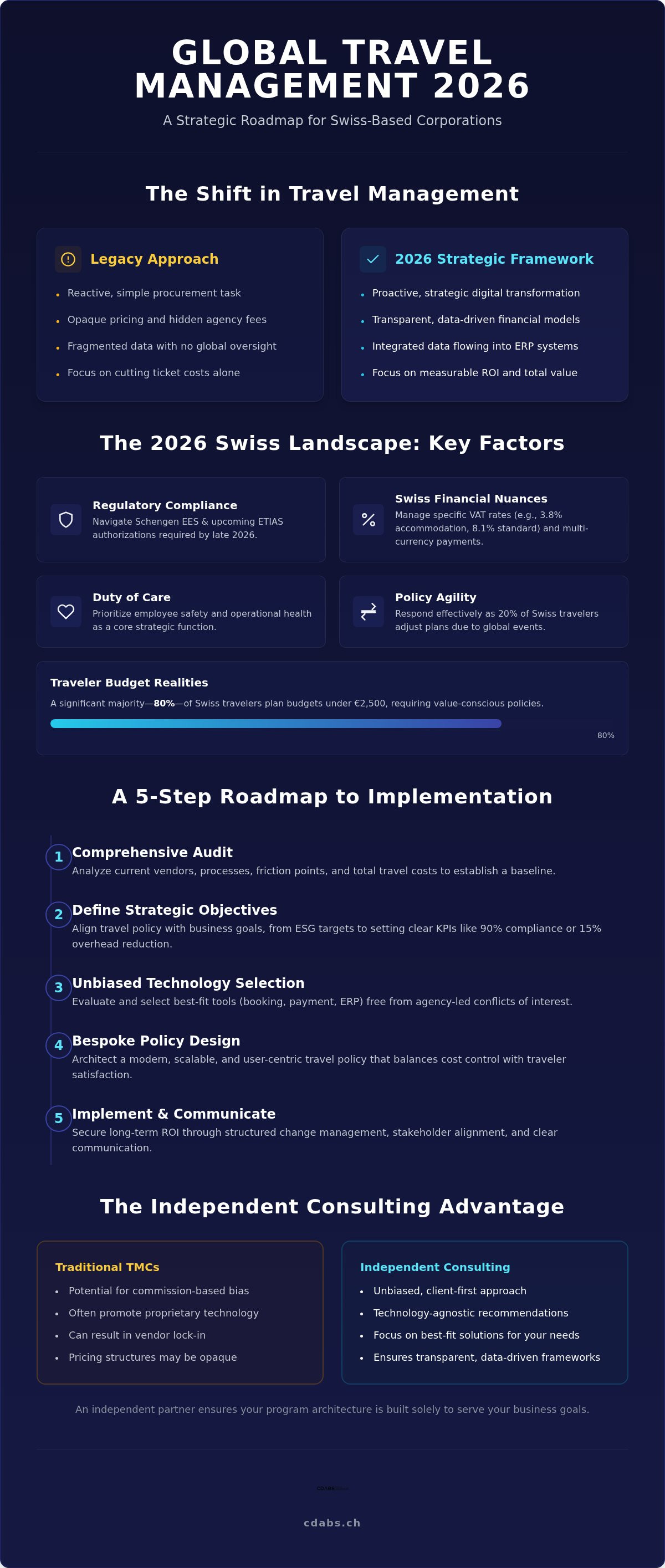
The current environment presents specific hurdles. Regulatory compliance is more rigorous than ever, particularly with the full implementation of the Schengen Entry/Exit System (EES) and the upcoming ETIAS travel authorization required for non-Schengen visitors by late 2026. Organizations must also manage the intricacies of multi-currency payments and high-level duty of care. These aren't just administrative tasks; they're strategic priorities that impact a company's operational health and employee safety. With 20% of Swiss travelers adjusting plans due to global events, agility in policy management has become a non-negotiable asset for the modern corporate headquarters.
Why Switzerland Requires a Specialized Approach
Operating from a Swiss base requires a delicate balance between local quality standards and global scalability. Swiss firms expect precision and reliability, yet they must also navigate a crowded market of travel agencies that often prioritize their own commissions over client interests. Maintaining a neutral, independent perspective is vital here. You need a system that respects local Swiss nuances, such as specific VAT treatments like the 3.8% accommodation rate or the stable 8.1% standard rate, while remaining robust enough to handle international corporate requirements across multiple regions. This specialized approach ensures that the high expectations of Swiss stakeholders are met without sacrificing the flexibility needed for a global workforce.
The Evolution of Corporate Travel in 2026
The role of technology has fundamentally changed the travel lifecycle. AI and digital transformation now automate the most tedious parts of the process, from expense reconciliation to real-time border alerts. We've moved beyond simple cost-savings toward "value-based" travel management. This approach prioritizes the return on investment for every trip, ensuring that travel supports strategic growth rather than just being a line item to be cut. Recent data shows that Swiss travelers are increasingly value-conscious, with 80% planning budgets under €2,500 for their trips. Engaging with business travel management consulting helps leaders move past legacy booking models and adopt these modernized, high-tech frameworks that respect these budgetary realities.
Designing a Robust Global Travel Framework
Designing a resilient architecture for your travel programme starts long before a single ticket is issued. While many providers focus on the user interface of a booking tool, a truly robust framework relies on a deep end-to-end analysis of your existing business travel processes. This involves identifying friction points that frustrate travellers and complicate financial workflows, such as delayed approvals or cumbersome reimbursement cycles. By setting clear strategic objectives, you define what success looks like for your organization; whether that is achieving 90% policy compliance, a 15% reduction in administrative overhead, or full integration with your existing ERP system.
Implementing global travel management solutions Switzerland requires a methodical approach to these foundational elements. You must look beyond simple ticket costs to understand the total cost of ownership for each trip. This includes the time spent on manual expense reports and the hidden costs of fragmented data across different regions. A well-designed framework acts as a steady, experienced hand, guiding your organization through complex transitions while maintaining operational stability and financial clarity.
Process Optimisation and Strategic Alignment
Mapping the project lifecycle begins with a comprehensive audit that aligns your travel policy with 2026 sustainability and ESG goals. It is not just about tracking carbon footprints; it's about building a digital roadmap that supports long-term global growth while respecting corporate responsibility. Evaluating these workflows is a cornerstone of professional travel management consulting, ensuring your infrastructure is built on a solid foundation. This alignment ensures that every travel decision supports the broader health of the organization. It allows for a calm, controlled perspective on how travel contributes to the company's strategic vision, rather than viewing it as a fragmented expense.
Modernising Payment and Expense Solutions
Modern programmes thrive on the seamless integration of payment solutions. Virtual cards and automated reconciliation tools significantly reduce the administrative burden on your finance department. Digital transformation in travel is the integration of siloed data into a unified management system. By replacing manual entry with strategic technology implementation—often supported by Swiss ICT specialists like Flux Group SARL—you ensure that every transaction is tracked and categorized in real time. This level of oversight provides the clarity needed to manage complex global budgets with confidence and precision. It creates a sense of reliability that reassures partners that their travel spend is being handled with sophisticated, modern tools that prioritize efficiency and accuracy.
Choosing between a Travel Management Company (TMC) and an independent consultant is a decision that defines the transparency and efficiency of your entire programme. While TMCs typically act as transactional facilitators, their revenue models often rely on booking volume and supplier commissions. This creates an inherent potential for conflict of interest when selecting global travel management solutions Switzerland. An independent consultant, however, functions as a strategic architect. They focus on the long-term health of your organizational processes rather than the number of tickets issued or the specific technology stack of a single provider.
Independent oversight is essential for auditing global travel programmes and identifying hidden costs buried within complex agency contracts. CDABS provides this steady, experienced hand, offering a calm and controlled perspective on complex transitions. By remaining independent from travel agencies, a consultant ensures that every recommendation is based solely on your specific business requirements. This results-oriented approach moves beyond the simple act of booking, transforming travel management into a streamlined component of your broader digital transformation strategy. For organizations that require this same level of strategic rigor for their investment initiatives, you can learn more about Swiss Alpha Matrix to see how their specialized due diligence supports complex financial programmes.
A consultant identifies hidden costs in agency contracts that often escape the notice of general procurement teams. They manage the RFP (Request for Proposal) process with a methodical, thorough approach, ensuring that vendor selections align with your strategic goals. This unbiased perspective is where organizations find the ROI of business travel consulting. It's about more than just ticket savings; it's about optimizing the entire lifecycle of a trip, from the initial approval to final financial reconciliation. This level of oversight provides the stability needed to manage intricate details without losing sight of broader corporate objectives.
When to Engage a Travel Transformation Advisor
There are specific signs that your current global travel solution is underperforming. If you see low traveller compliance with outdated policies or fragmented data across multiple global regions, it's time for a professional analysis. Preparing for a merger or rapid international expansion also requires a hands-on facilitator who can bridge the gap between procurement needs and the actual traveller experience. A transformation advisor creates a balanced system that satisfies the C-suite's demand for data while respecting the frequent flyer's need for efficiency. This personal investment in your success ensures that your travel programme supports, rather than hinders, your international growth.
How to Implement Global Travel Solutions: A 5-Step Roadmap
Implementing a new travel infrastructure is a methodical process that moves from initial analysis to final delivery. For leaders deploying global travel management solutions Switzerland, a structured roadmap ensures that every operational detail aligns with broader corporate objectives. This isn't a simple software installation; it's a strategic transition that requires steady, experienced oversight to navigate complex business environments.
The first step is a comprehensive audit. You can't improve what you don't measure. This phase involves assessing global data and current vendor contracts to establish a baseline for performance. Next, we move to policy development. A bespoke, modern corporate travel policy is essential to balance fiscal discipline with traveller satisfaction. Technology selection follows, where you choose the right Online Booking Tool (OBT) and expense systems that integrate with your existing ERP. The fourth step is implementation and change management. This is the hands-on phase where the new solution is rolled out to the workforce with a focus on clear communication. Finally, ongoing optimisation uses data management to drive continuous improvement, ensuring your programme remains agile as market conditions shift.
Step-by-Step Implementation Guidance
Developing a robust corporate travel policy is the most effective way to ensure compliance. It shouldn't be a rigid document that travellers ignore; it should be a flexible framework that guides them toward the best choices. This is a key aspect of travel management for global corporates, where local nuances must be respected within a global standard. Managing the transition period is equally critical to avoid operational disruption. A staged rollout allows you to identify and resolve issues in a controlled environment before a full-scale launch, providing a sense of stability during the change.
Leveraging Data for Strategic Insights
Setting up travel data management systems for real-time reporting gives you the clarity needed to make informed decisions. This oversight helps identify "leakage," which occurs when travellers book outside of the global solution, often leading to opaque pricing and fragmented data. Data management is the cornerstone of 2026 travel ROI. By capturing every transaction, you gain the measurable insights required to justify your travel spend to the C-suite and drive operational excellence. If you need a partner to guide you through this process, we specialize in global travel management solutions implementation.
Driving Success through Change Management and Communication
The most sophisticated technological framework will fail if the workforce doesn't embrace it. Successful implementation of global travel management solutions Switzerland depends on a robust change management strategy that prioritizes the people behind the data. This isn't just about sending an announcement; it's about a methodical approach to shifting organizational behavior and ensuring every stakeholder feels supported. CDABS acts as a hands-on facilitator in this process, providing a steady, experienced hand to navigate the human complexities of large-scale transitions.
Engaging stakeholders requires a nuanced understanding of their unique priorities. The C-suite demands measurable ROI and organizational health, while frequent flyers simply want to get from point A to point B with minimal friction. By positioning your travel transformation as a benefit rather than a mandate, you overcome resistance and build a culture of compliance. This composed, results-oriented perspective ensures that the digital roadmap we've discussed translates into actual operational excellence across all global regions.
Bespoke Change Management Packages
Generic internal emails are rarely effective at driving travel policy compliance. They often lack the precision needed to address the specific pain points of different departments. Utilizing change management for corporate travel allows for the creation of tailored communication streams that speak directly to the user. Masterclasses and targeted training sessions further empower travel managers, giving them the tools to mentor their own teams. This methodical flow of information prevents the fragmentation of data and ensures that the implementation moves systematically through the entire business cycle.
The Human Element of Digital Transformation
Digital transformation should never come at the expense of the human experience. In fact, a well-communicated global solution reduces "travel friction" by automating tedious tasks and providing clear guidance on new regulations. For instance, with the late 2026 implementation of ETIAS and the already active EES biometric requirements, travellers need proactive information to navigate Swiss borders confidently. This is where your corporate culture shines through; by providing high-level support, you demonstrate a personal investment in your employees' success. If you're looking to bridge the gap between procurement needs and traveller experience, you can enquire about bespoke change management packages at CDABS to ensure your next rollout is seamless and effective.
Architecting Your Future Travel Strategy
Building a resilient global travel programme is a methodical journey that requires both a strategic architect and a hands-on facilitator. We have explored how a structured roadmap and robust process analysis transform your travel department from a cost centre into a driver of organizational health. By prioritizing independent oversight and bespoke change management, you ensure that your global travel management solutions Switzerland are not only technically sound but also fully embraced by your workforce.
With 30 years of strategic experience, CDABS provides the unbiased advice needed to navigate the complexities of digital transformation. We help you move beyond the limitations of traditional agency models, implementing a proven methodology that delivers measurable results. It's time to align your travel processes with your 2026 growth objectives and secure long-term stability.
Optimise your global travel programme with CDABS consulting and take the first step toward a more transparent, efficient, and traveller-centric future. You have the tools and the roadmap; now it's time to build a programme that truly serves your global ambitions.
Frequently Asked Questions
What are the main benefits of global travel management solutions in Switzerland?
Global travel management solutions Switzerland provide centralized oversight for multinational corporations, ensuring transparent pricing and high traveller compliance. By integrating fragmented data across global regions, these solutions allow firms to align travel spend with broader corporate objectives. This approach reduces manual administrative tasks and improves financial reconciliation. Organizations benefit from a scalable framework that respects Swiss quality standards while maintaining the agility needed for international operations in a complex 2026 regulatory environment.
How does an independent travel consultant differ from a Travel Management Company (TMC)?
An independent consultant operates on project-based fees and provides unbiased advice, whereas a TMC often relies on commissions from bookings. This fundamental difference means a consultant acts as a strategic architect, focusing on your organizational health rather than transaction volume. While a TMC facilitates bookings, a consultant like CDABS audits existing contracts and identifies hidden costs. This independent oversight ensures that technology selection and policy development serve your interests alone, free from agency-led conflicts.
Can CDABS help with the digital transformation of our existing travel processes?
CDABS specializes in the digital transformation of business travel processes through comprehensive end-to-end analysis. We help organizations move away from siloed data by integrating modern payment solutions and ERP workflows into a unified system. This process involves mapping your current lifecycle and identifying friction points that hinder efficiency. By leveraging over 30 years of industry experience, we implement high-tech solutions that automate manual tasks and provide real-time reporting for better strategic decision-making.
What role does change management play in a global travel rollout?
Change management is the bridge between a new technology and its successful adoption by your workforce. It involves crafting bespoke communications that address the unique needs of stakeholders, from the C-suite to frequent travellers. Without a structured change management plan, even the most advanced global travel management solutions Switzerland will face resistance and low compliance. We use masterclasses and training sessions to empower your team, ensuring the transition feels like a benefit rather than a mandate.
How do we ensure our global travel programme remains compliant with Swiss regulations?
Ensuring compliance requires a methodical approach to both financial and border regulations. Your programme must account for Swiss VAT rates, such as the 8.1% standard rate and the 3.8% accommodation rate, which are confirmed through 2026. Additionally, your policy should reflect new entry requirements like the EES biometric data collection and the €20 ETIAS authorization. We build these regulatory updates into your corporate travel policy to protect your organization from legal risks and operational delays.
Is travel management consulting suitable for SMEs as well as large corporates?
Travel management consulting is highly effective for both SMEs and global corporates. While large firms often face data fragmentation, SMEs frequently struggle with opaque pricing from traditional agencies. A consultant provides the same level of sophisticated oversight for smaller organizations, helping them implement scalable systems that grow with their business. We tailor our process optimisation and digital transformation services to fit your specific budget and operational needs, ensuring that every trip delivers measurable value.
How can we reduce corporate travel friction for our frequent flyers?
Reducing travel friction starts with identifying bottlenecks in the traveller journey, such as slow approval cycles or manual expense reporting. By implementing automated payment systems and integrated booking tools, you remove the administrative burden from your employees. Clear, proactive communication regarding border changes, like the 2026 ETIAS requirements, also helps travellers feel supported. A well-designed programme balances corporate fiscal discipline with a user experience that prioritizes efficiency and ease of use for your team.
What are the expected ROI metrics for a travel management optimisation project?
ROI in travel management extends far beyond simple ticket price reductions. Key metrics include a measurable decrease in administrative hours through automated reconciliation and a significant increase in policy compliance. You should also track the reduction in leakage, where employees book outside of the official solution. By consolidating fragmented data, you gain the clarity needed to negotiate better vendor contracts. These improvements contribute to overall organizational health and provide a clear, data-driven justification for your travel spend.



Comments